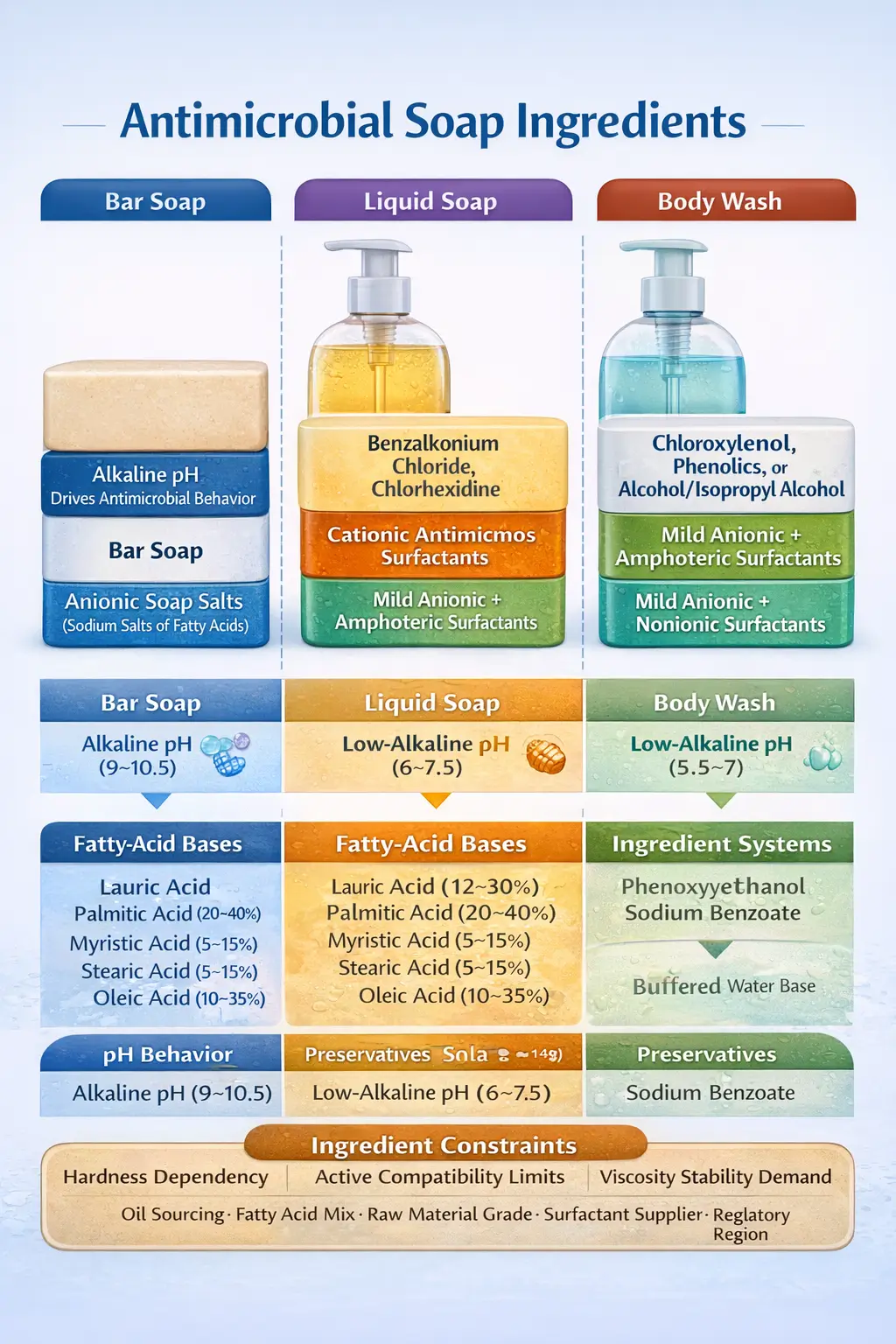
What Makes Soap Antimicrobial
A soap is antimicrobial when its ingredient system interferes with the survival, integrity, or replication of microorganisms during use. This interference can occur through two primary mechanisms: the presence of a declared antimicrobial soap active ingredient, or the creation of chemical conditions that destabilize microbial structures. Both mechanisms are formulation-dependent and operate independently of product format. For foundational soap chemistry context, see our cold process soap ingredient analysis.
In liquid soaps, face washes, and body washes, antimicrobial behavior is usually attributable to a specific antimicrobial active ingredient added to an otherwise mild surfactant base. In contrast, many solid soap bars exhibit antimicrobial behavior without a distinct antimicrobial additive, relying instead on alkaline fatty-acid soap chemistry. This distinction is fundamental but often obscured by labeling conventions.
From formulation observation, antimicrobial performance is rarely the result of a single ingredient acting in isolation, reflecting the distinction between cleansing mechanics and antimicrobial effects outlined in soap cleansing vs antimicrobial action. Instead, it emerges from the interaction between actives, surfactants, pH, and contact conditions. Labels typically name ingredients but do not describe these interactions, a limitation shaped by regulatory classification boundaries discussed in how soaps are regulated.
Active Ingredients
Antimicrobial soap active ingredients are compounds included specifically to suppress or disrupt microorganisms during cleansing. When present, these ingredients are the primary drivers of antimicrobial behavior in low-alkaline or near-neutral formulations such as liquid hand soaps, face washes, and body washes.
| Active Ingredient | Typical Product Formats | Primary Chemical Action | Label Disclosure Pattern |
|---|---|---|---|
| Benzalkonium Chloride | Liquid hand soap, foaming soap | Cationic membrane disruption | Usually declared as active |
| Chloroxylenol | Liquid soap, body wash | Protein denaturation | Declared where regulated |
| Alcohol (Ethyl or Isopropyl) | Liquid cleansers, gels | Rapid membrane penetration | May appear within base list |
| Phenolic Compounds | Specialty antimicrobial soaps | Cell wall destabilization | Often restricted or limited |
In several formulations examined, antimicrobial actives exhibited reduced compatibility with strongly anionic surfactant systems. This incompatibility influences surfactant selection and concentration, even when labels do not make that dependency explicit. Compatibility behavior is also examined in our dish soap ingredient review.
Antibacterial Soap Active Ingredients Within Antimicrobial Systems
Antibacterial soap active ingredients represent a subset of antimicrobial actives that are primarily effective against bacteria. Within antimicrobial soap formulations, these antibacterial actives often coexist with broader antimicrobial systems or operate under conditions that extend their functional range.
At the ingredient level, the distinction between antibacterial and antimicrobial is not always absolute. Some actives classified as antibacterial may exhibit secondary antimicrobial behavior depending on concentration, contact time, and formulation environment. This overlap explains why labels and regulatory language sometimes use the terms interchangeably, despite their technical differences.
From an ingredient transparency standpoint, understanding this subset relationship clarifies why certain soaps are labeled antibacterial while others are framed more broadly as antimicrobial, even when their core chemistry overlaps significantly.
Ingredients in Skincare & Face Wash Formulations
Antimicrobial ingredients in skincare and face wash formulations are incorporated under tighter formulation constraints than in hand soaps or general cleansers. At the ingredient level, antimicrobial behavior is preserved while surfactant aggressiveness, alkalinity, and residue persistence are deliberately reduced. This balance does not alter the antimicrobial mechanism itself, but it changes how that mechanism is delivered. Hybrid cleansing systems are further explored in our Cetaphil ingredient analysis.
In most face wash systems, antimicrobial soap active ingredients are paired with milder surfactant blends and buffered pH ranges. The antimicrobial compound remains chemically active, yet its interaction window is narrower due to shorter contact time and faster dilution. This design choice reflects formulation practicality rather than diminished antimicrobial intent.
| Ingredient Group | Typical Examples | Functional Role | Formulation Constraint |
|---|---|---|---|
| Antimicrobial Actives | Benzalkonium chloride, chloroxylenol | Microbial disruption | Lower concentration tolerance |
| Primary Surfactants | Anionic blends | Cleansing & dispersion | Reduced load |
| Amphoteric Surfactants | Betaine derivatives | Charge buffering | Increased reliance |
| pH Buffers | Citrate systems | Stability control | Narrow operating range |
From repeated formulation handling, face wash systems show greater sensitivity to surfactant imbalance. Small shifts can alter viscosity or clarity, indirectly affecting how evenly antimicrobial actives are dispersed during use.
Ingredients in Body Wash Formulations
Antimicrobial ingredients in body wash formulations operate under the mildest chemical conditions among antimicrobial cleansing products. These systems are typically designed near neutral or mildly acidic pH ranges, which limits intrinsic antimicrobial contribution from the base and increases reliance on declared antimicrobial actives. Comparable liquid systems appear in our Dove soap ingredient breakdown.
In body wash formulations, antimicrobial soap active ingredients must remain compatible with viscosity modifiers, fragrance systems, and stabilizers over extended storage. This requirement narrows the range of usable antimicrobial compounds and often necessitates conservative concentration levels.
| Formulation Aspect | Observed Range | Ingredient Implication |
|---|---|---|
| pH Environment | 5.5–7.0 | Minimal alkaline contribution |
| Surfactant Mildness | High | Reduced membrane disruption |
| Active Stability | Moderate | Compatibility-driven selection |
| Viscosity Control | Polymer-based | Potential interaction with actives |
In several observed formulations, higher viscosity correlated with more consistent delivery of antimicrobial actives during rinsing. This effect appears physical rather than chemical and varies with water temperature and dilution rate.
What Ingredient Makes Soap Antibacterial
The ingredient that makes a soap antibacterial depends on the formulation context. In liquid soaps, face washes, and body washes, antibacterial behavior is typically driven by a declared antibacterial soap active ingredient. In bar soaps, antibacterial behavior often emerges from fatty-acid soap chemistry rather than from a distinct additive.
In alkaline bar soaps, sodium salts of fatty acids create an environment that disrupts bacterial membranes during contact. In contrast, liquid systems rely on antimicrobial actives to compensate for reduced alkalinity. Both mechanisms are valid but chemically distinct.
| Soap Format | Primary Antibacterial Driver | Secondary Contributors |
|---|---|---|
| Bar Soap | Fatty-acid soap alkalinity | Lauric acid content |
| Liquid Hand Soap | Declared antimicrobial active | Surfactant synergy |
| Face Wash | Declared antimicrobial active | Buffered delivery |
| Body Wash | Declared antimicrobial active | Viscosity-mediated contact |
This distinction explains whyingredient lists alone can appear similar across products while antimicrobial behavior differs. The active system is defined by chemistry and context, not by naming conventions.
Surfactant Systems & Antimicrobial Compatibility
Surfactant systems determine whether antimicrobial soap active ingredients remain chemically available during use. Many antimicrobial compounds interact with surfactants through charge association or micelle encapsulation, which can reduce or delay contact with microorganisms. As a result, antimicrobial effectiveness is not solely a property of the active ingredient itself, but of the surrounding surfactant architecture.
In liquid soaps and body washes, anionic surfactants dominate cleansing performance but may partially neutralize cationic antimicrobial actives. To mitigate this, formulators often introduce amphoteric or nonionic surfactants that buffer charge interactions. This adjustment is subtle, frequently undocumented, and observable mainly through formulation behavior rather than label language.
| Surfactant Type | Electrical Charge | Compatibility With Cationic Actives | Formulation Outcome |
|---|---|---|---|
| Anionic | Negative | Low to moderate | Requires buffering or dilution |
| Amphoteric | Variable | Moderate to high | Stabilizes active availability |
| Nonionic | Neutral | High | Preserves antimicrobial exposure |
In several formulations evaluated over time, increasing amphoteric surfactant content slightly reduced foam volume but improved consistency in antimicrobial delivery. This trade-off is rarely visible in ingredient lists but becomes apparent during repeated use.
Fatty-Acid Composition, Ranges & Variability
Fatty-acid composition plays a central role in antimicrobial behavior for solid soaps and contributes indirectly to liquid formulations that include soap-derived components. The relative proportions of lauric, myristic, palmitic, stearic, and oleic acids influence alkalinity, solubility, and membrane-disruptive capacity. Fatty-acid variation is examined in detail in our Aleppo soap ingredient analysis.
These fatty-acid distributions vary by oil source, processing method, and geographic origin. Even when labels remain unchanged, batch-to-batch variation can alter cleansing intensity and antimicrobial contribution at the margins.
| Fatty Acid | Typical Range (%) | Primary Functional Contribution |
|---|---|---|
| Lauric Acid | 12–30 | Strong cleansing, membrane disruption |
| Myristic Acid | 5–15 | Foam enhancement |
| Palmitic Acid | 20–40 | Bar hardness, stability |
| Stearic Acid | 5–15 | Structural integrity |
| Oleic Acid | 10–35 | Mildness, solubility modulation |
From practical handling, bars with higher lauric acid content tend to dissolve faster and feel more cleansing during use. This observation aligns with fatty-acid chemistry rather than with any added antimicrobial ingredient.
Alkali Systems & pH Trade-Offs
Alkali systems determine whether antimicrobial activity arises intrinsically from soap chemistry or must be supplied by a separate antimicrobial active ingredient. Traditional bar soaps maintain elevated pH levels due to sodium or potassium fatty-acid salts, creating an environment that destabilizes bacterial membranes. Alkalinity trade-offs are also discussed in our Castile soap ingredient guide.
Liquid antimicrobial soaps and body washes are typically formulated within narrower pH ranges to preserve surfactant stability and user handling tolerance. This reduction in alkalinity limits intrinsic antimicrobial contribution and increases reliance on declared antimicrobial actives.
| Product Type | Observed pH Range | Antimicrobial Implication |
|---|---|---|
| Bar Soap | 9.0–10.5 | Intrinsic antimicrobial environment |
| Liquid Hand Soap | 6.0–7.5 | Active-dependent behavior |
| Face Wash | 5.5–7.0 | Buffered delivery |
| Body Wash | 5.5–7.0 | Minimal intrinsic contribution |
In several formulations observed under temperature cycling, minor pH drift altered viscosity before any measurable change in antimicrobial behavior. This suggests that physical stability may be affected sooner than antimicrobial chemistry.
Does Antimicrobial Soap Expire
Antimicrobial soap does not expire in a uniform or absolute sense, but its ingredient systems can change over time in ways that affect stability, appearance, and functional delivery. From an ingredient perspective, expiration reflects gradual chemical or physical shifts rather than sudden loss of antimicrobial capacity.
In bar soaps, the primary antimicrobial contributors-fatty-acid salts and alkalinity-are chemically stable over long periods. Changes observed in aging bars typically involve moisture loss, surface crystallization, or fragrance volatility rather than degradation of the soap matrix itself. These changes may alter feel or solubility without eliminating antimicrobial behavior.
Liquid antimicrobial soaps and body washes are more time-sensitive. Their stability depends on surfactant integrity, antimicrobial active compatibility, preservative systems, and packaging exposure. Over extended storage, viscosity drift or phase separation may occur before antimicrobial actives lose functional relevance.
| Soap Format | Primary Aging Factor | Observed Change | Antimicrobial Impact |
|---|---|---|---|
| Bar Soap | Moisture loss | Hardening, surface bloom | Minimal |
| Liquid Hand Soap | Surfactant drift | Viscosity change | Indirect |
| Body Wash | Phase stability | Clarity or texture shift | Potential delivery inconsistency |
In several long-stored liquid formulations examined, antimicrobial actives remained chemically present even as fragrance strength declined. This suggests that sensory cues are not reliable indicators of antimicrobial ingredient stability.
Preservatives vs Antimicrobial Actives
Preservatives and antimicrobial actives serve distinct roles within antimicrobial soap formulations, though they are often conflated on ingredient labels. Preservatives are included to protect the product from microbial growth during storage, while antimicrobial actives are intended to act during use. Preservative systems are further clarified in our soap ingredients master guide.
From an ingredient standpoint, preservatives generally operate at lower concentrations and are selected for compatibility with the formulation rather than for user-facing antimicrobial performance. Their presence does not necessarily indicate that a soap is antimicrobial in function.
| Ingredient Role | Primary Purpose | Acts During Use | Label Disclosure |
|---|---|---|---|
| Preservatives | Product protection | No | Listed among base ingredients |
| Antimicrobial Actives | User-facing microbial control | Yes | Often declared explicitly |
In formulation review, products with robust preservative systems but no declared antimicrobial actives often show strong shelf stability without delivering antimicrobial behavior during cleansing. This distinction is rarely explained to consumers.
Ingredient Variability by Region, Batch & Process
Ingredient variability in antimicrobial soaps arises from differences in raw material sourcing, processing methods, and regional regulatory frameworks, patterns documented in real-world formulation analysis such as brand-x antibacterial. Even when ingredient names remain consistent, chemical behavior may vary subtly between batches or markets.
Fatty-acid profiles in soap bases vary with oil origin and refinement level. Surfactant purity and antimicrobial active grade can also differ by supplier, influencing compatibility and stability. These variations are typically within regulatory tolerance but can affect real-world handling and performance.
| Variable Source | Affected Ingredient Group | Observed Outcome |
|---|---|---|
| Geographic Oil Source | Fatty-acid soap base | Lather & hardness differences |
| Surfactant Supplier | Liquid soap base | Viscosity and clarity shifts |
| Active Ingredient Grade | Antimicrobial actives | Compatibility variation |
| Regional Regulation | Permitted actives | Presence or absence of compounds |
In a small number of observed cases, soaps with identical labels but different production origins showed minor differences in rinse feel. These differences reflect upstream ingredient variability rather than formulation intent.
How Often Antibacterial Soap Ingredients Are Used: Ingredient-Driven Limits
The frequency with which antibacterial soap ingredients are used is governed by ingredient behavior rather than by usage guidance or performance claims. From an ingredient science perspective, repeated exposure primarily affects formulation stability, residue dynamics, and surfactant–active interactions rather than altering the intrinsic antimicrobial mechanism itself.
In formulations relying on declared antimicrobial soap active ingredients, repeated use increases cumulative exposure to both the active compound and the supporting surfactant system. This accumulation does not amplify antimicrobial action but can accentuate formulation characteristics such as residue feel, fragrance persistence, or rinse efficiency. These effects are formulation-specific and vary with concentration and delivery system.
Bar soaps driven by fatty-acid alkalinity show different behavior. Repeated use primarily affects surface dissolution rate and moisture balance of the bar rather than antimicrobial chemistry. Over time, this can change how quickly the soap dissolves and how concentrated the lather becomes, without materially changing its antimicrobial contribution.
| Soap Format | Primary Ingredient Driver | Repeated-Use Observation | Chemical Interpretation |
|---|---|---|---|
| Bar Soap | Fatty-acid Salts | Faster surface wear | Physical dissolution, not chemical change |
| Liquid Hand Soap | Antimicrobial active | Residue accumulation potential | Surfactant–active interaction |
| Face Wash | Buffered actives | Delivery consistency variation | Dilution-driven exposure limits |
| Body Wash | Viscosity-mediated actives | Rinse-off sensitivity | Physical contact time dependence |
From observational handling, higher-viscosity liquid soaps tend to moderate how quickly antimicrobial actives are removed during rinsing. This is a physical effect related to flow and dilution rather than to antimicrobial chemistry.
Handling & Storage Considerations
Handling and storage influence antimicrobial soap ingredients indirectly by affecting formulation integrity rather than antimicrobial chemistry. Bars are comparatively robust, while liquid soaps and body washes are more sensitive to environmental exposure and packaging design.
Repeated air ingress in pump dispensers can introduce oxidative stress to fragrance components and, in some cases, alter viscosity. While antimicrobial actives are typically stable under these conditions, uneven dispensing can affect how consistently they are delivered during use.
| Factor | Most Affected Format | Observed Impact |
|---|---|---|
| Humidity | Bar soap | Surface softening |
| Temperature Cycling | Liquid soaps | Viscosity fluctuation |
| Light Exposure | Clear packaging | Fragrance degradation |
| Air Exposure | Pump dispensers | Minor oxidative effects |
In several long-term storage observations, antimicrobial activity remained chemically intact even as visual or sensory attributes changed. This reinforces that appearance is not a reliable indicator of ingredient functionality.
Summary of Findings
- Antimicrobial Systems: Antimicrobial soap behavior arises from active systems and formulation context, not from product labels alone.
- Active Ingredients: Declared antimicrobial soap active ingredients drive antimicrobial function in low-alkaline formulations.
- Soap Chemistry: In bar soaps, fatty-acid alkalinity provides intrinsic antimicrobial contribution without separate actives.
- Stability: Antimicrobial soaps do not expire abruptly; ingredient systems change gradually, affecting delivery rather than chemistry.
- Transparency Limits: Ingredient lists disclose components but rarely explain functional interactions or variability.
References
-
McDonnell, G., & Russell, A. D.
Antiseptics and disinfectants: activity, action, and resistance.
Clinical Microbiology Reviews.
Journal Article (ASM) -
Russell, A. D.
Bacterial resistance to disinfectants.
Journal of Hospital Infection.
Journal Homepage -
U.S. Food and Drug Administration.
Topical Antimicrobial Drug Products for Over-the-Counter Human Use.
FDA Documentation -
Schramm, L. L.
Surfactants: Fundamentals and Applications.
Publisher Reference -
Walters, R. M., et al.
Stability considerations in personal cleansing formulations.
Wiley Online Library