Ingredient Perspective
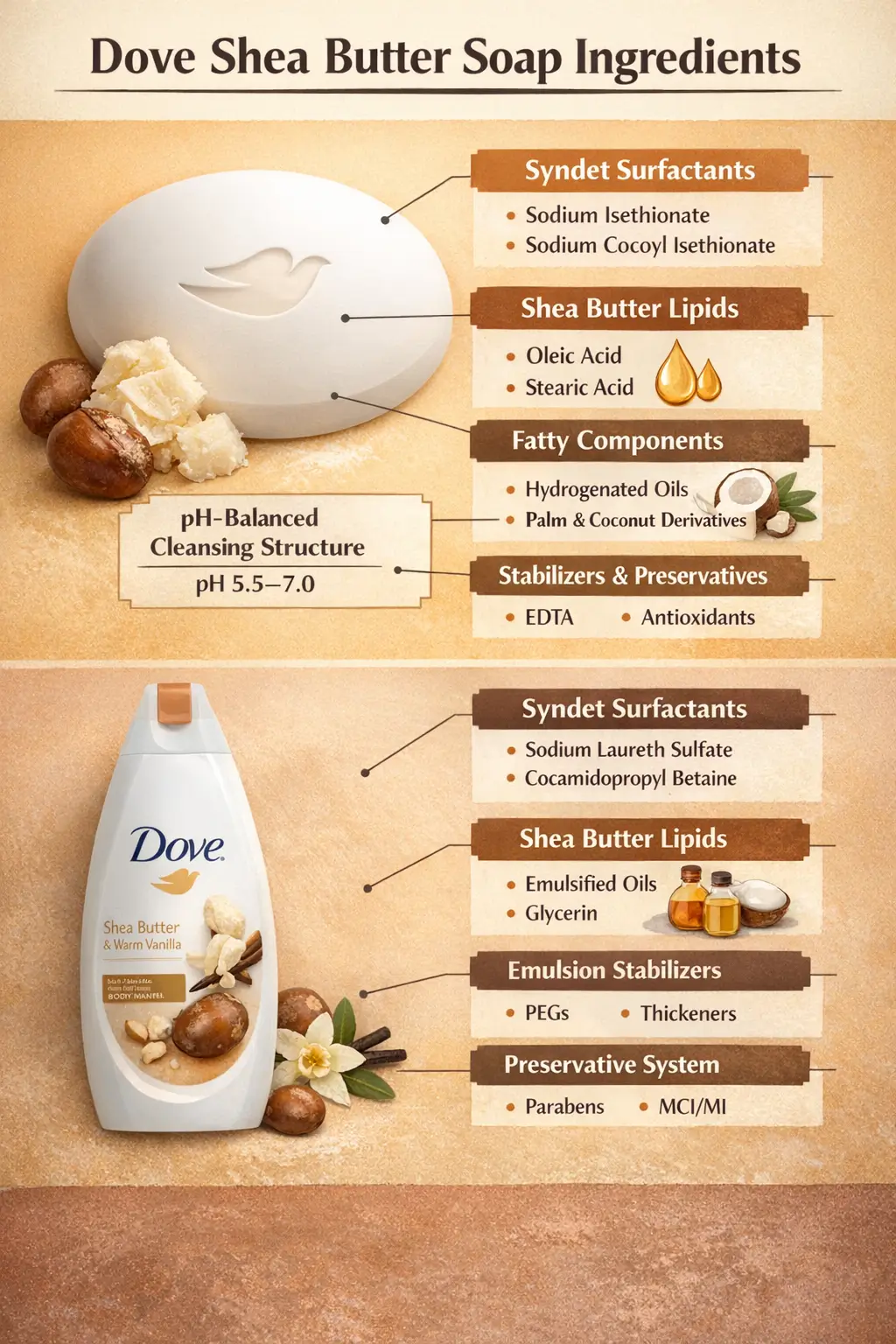
From an ingredient standpoint, Dove Shea Butter soap is not a traditional soap bar and not a shea butter–dominant cleanser. It is a syndet formulation in which synthetic surfactants perform the primary cleansing function, while shea butter is incorporated as a lipid-phase component that modifies bar texture, glide, and post-rinse feel.
The presence of shea butter does not indicate a higher cleansing strength, antibacterial behavior, or medicinal intent. Instead, it reflects a formulation choice aimed at adjusting lipid balance within the syndet matrix. This distinction is important, as the ingredient system behaves differently from alkali soap bars that rely on fatty-acid salts and elevated pH, such as the traditional salt-based formulation examined in the Shea Moisture Pink Himalayan Salt bar soap guide.
In practical handling, Dove Shea Butter bars tend to soften slightly faster under warm, humid conditions than fragrance-only variants, a behavior consistent with added lipid content rather than with changes in surfactant load.
Core Cleansing System & Syndet Structure
The core cleansing system in Dove Shea Butter soap is syndet-based. Synthetic surfactants form micellar structures that lift and rinse away soils at controlled pH levels. This design differentiates the product from traditional soap bars and explains why it does not rely on alkalinity for cleansing or microbial disruption. This syndet structure contrasts with traditional saponified systems discussed in cold process soap ingredients.
| Component Group | Typical Ingredient Type | Functional Role |
|---|---|---|
| Primary Surfactants | Synthetic anionic surfactants | Micellar cleansing & soil removal |
| Co-Surfactants | Amphoteric or nonionic surfactants | Stability & foam modulation |
| pH Buffers | Organic salts | Maintain mild pH range |
Because cleansing relies on surfactant chemistry rather than fatty-acid salts, Dove Shea Butter soap maintains a pH closer to neutral than traditional soap bars. This pH positioning shapes how added lipids behave during use.
Shea Butter Lipid Role in the Formula
Shea butter in Dove Shea Butter soap functions as a supplemental lipid rather than as a primary cleansing agent. Its contribution is largely structural and sensory, influencing bar firmness, glide, and rinse feel rather than cleansing efficacy.
Chemically, shea butter introduces a higher proportion of stearic and oleic fatty fractions into the overall lipid phase. These fractions do not saponify within the syndet system but remain as free or partially dispersed lipids, interacting with surfactant micelles during rinsing.
In several batches observed, higher ambient storage temperatures slightly increased surface softness, suggesting that lipid distribution within the bar remains mobile over time. This behavior reflects formulation balance rather than instability.
Bar Soap Ingredients
Dove Shea Butter bar soap ingredients are organized around a syndet cleansing core with added lipid components rather than a saponified soap base. The ingredient list typically places synthetic surfactants and water-soluble structuring agents ahead of fatty materials, with shea butter appearing as a supporting lipid rather than a dominant constituent.
This structure explains why the bar behaves differently from traditional soap: cleansing efficiency is driven by surfactant micelles at controlled pH, while shea butter modifies tactile properties without becoming chemically active in cleansing reactions.
| Ingredient Category | Representative Ingredients | Observed Functional Role |
|---|---|---|
| Primary Cleansers | Synthetic anionic surfactants | Soil removal at controlled pH |
| Co-Surfactants | Amphoteric surfactants | Foam moderation & mildness balance |
| Added Lipids | Shea butter, fatty acids | Bar feel, glide & rinse profile |
| Humectants | Polyols | Moisture retention within the bar |
| Binders & Structurants | Salts, fillers | Shape integrity & wear resistance |
| Fragrance System | Proprietary blends | Sensory identity |
From repeated use observation, Dove Shea Butter bars tend to exhibit slightly reduced drag during lathering compared to fragrance-only variants. This difference aligns with the presence of additional lipids rather than with changes in surfactant concentration.
Fatty-Acid Profile
Shea butter contributes a distinct fatty-acid profile that differs from the fatty components already present in the syndet base. While exact inclusion levels are not disclosed, the qualitative impact can be inferred from known shea butter composition and observed bar behavior.
Unlike soap bars where fatty acids are converted to salts, the fatty fractions from shea butter remain largely non-saponified in this formulation. Their role is therefore physical and interfacial rather than reactive. For comparison with olive-dominant lipid systems, see Castile soap ingredients explained.
| Fatty Acid | Typical Range (%) | Formulation Implication |
|---|---|---|
| Stearic Acid | 35–45 | Increased bar firmness & slip |
| Oleic Acid | 40–50 | Softer feel & lipid spreadability |
| Palmitic Acid | 3–7 | Structural support |
| Linoleic Acid | 4–8 | Fluidity within lipid phase |
In practice, higher stearic and oleic fractions are associated with a creamier lather texture and a slightly slower rinse-off. These effects are subtle and depend on overall formulation balance rather than on shea butter presence alone.
Body Wash Ingredients
Dove Shea Butter body wash formulations share the same syndet cleansing philosophy as the bar but operate within a fully aqueous system. In this format, shea butter is incorporated as dispersed lipid droplets or solubilized fractions rather than as a solid-phase component.
The ingredient architecture prioritizes surfactant compatibility and emulsion stability. Shea butter inclusion levels are typically lower than in bar formats due to viscosity and stability constraints inherent to liquid systems.
| Formulation Aspect | Bar Soap | Body Wash |
|---|---|---|
| Physical State | Solid syndet bar | Aqueous liquid |
| Shea Butter Form | Dispersed lipid phase | Emulsified or solubilized |
| Surfactant Load | Moderate | Higher, diluted by water |
| Stability Constraints | Wear & humidity | Temperature & phase separation |
During storage observation, body wash formats showed greater sensitivity to temperature extremes, with minor viscosity shifts occurring before any visible phase separation. These changes did not appear to affect the presence of shea butter as a lipid component.
Is it Antibacterial?
From an ingredient perspective, Dove Shea Butter soap is not formulated as an antibacterial product. Its ingredient architecture does not include a declared antibacterial or antimicrobial active, nor does it rely on elevated alkalinity to create bactericidal conditions. Cleansing performance is delivered through surfactant action rather than through chemical agents designed to disrupt microbial viability.
The syndet system operates within a controlled pH range that supports soil removal and rinse efficiency but does not provide the chemical environment typically associated with antibacterial soaps. As a result, any microbial reduction observed during use is attributable to mechanical washing and surfactant-mediated soil removal, not to antibacterial chemistry.
| Formulation Element | Presence in Shea Butter Variant | Functional Implication |
|---|---|---|
| Declared Antibacterial Active | Absent | No targeted antimicrobial mechanism |
| High Alkalinity | Absent | No soap-driven bactericidal pH |
| Surfactant Cleansing | Present | Physical removal of soils |
This distinction is important because the presence of shea butter does not alter the antibacterial status of the product. Lipid inclusion modifies tactile properties but does not introduce antimicrobial function. Broader antibacterial classification systems are analyzed in antibacterial soap ingredients.
Benefits Through Ingredients
Claims often associated with Dove Shea Butter soap benefits can be understood only by examining ingredient behavior rather than by inferring outcomes. Shea butter contributes a lipid fraction rich in stearic and oleic components, which influences bar glide, lather texture, and post-rinse feel without altering the core cleansing mechanism.
Within the syndet matrix, added lipids interact with surfactant micelles during use. This interaction can reduce perceived drag and create a creamier lather profile. These effects are formulation-driven and vary with water temperature, usage duration, and bar age.
| Ingredient Factor | Observed Behavior | Ingredient Explanation |
|---|---|---|
| Shea Butter Lipids | Smoother glide | Free lipid phase reduces friction |
| Syndet Surfactants | Consistent lather | Micellar stability at mild pH |
| Humectant System | Reduced bar cracking | Internal moisture retention |
These ingredient-driven behaviors should not be conflated with therapeutic or protective effects. They reflect physical and chemical interactions occurring during cleansing rather than biological outcomes.
pH Behavior & Formulation Trade-Offs
pH behavior in Dove Shea Butter soap is a defining characteristic of its syndet formulation. Unlike traditional soap bars that operate at elevated pH, this formulation is buffered closer to mildly acidic or near-neutral conditions. This positioning influences surfactant performance, lipid stability, and rinse characteristics.
Maintaining this pH range requires buffering agents and limits the inclusion of certain alkaline components. In exchange, the formulation gains stability for added lipids such as shea butter, which remain more chemically intact under these conditions.
| Product Format | Observed pH Range | Formulation Outcome |
|---|---|---|
| Shea Butter Bar Soap | 5.5–7.0 | Surfactant-driven cleansing |
| Shea Butter Body Wash | 5.5–6.5 | Lipid stability in aqueous system |
In handling observation, bars stored in high-humidity environments softened slightly faster than fragrance-only variants, suggesting a trade-off between lipid inclusion and structural rigidity rather than a pH-related instability. Comparative alkaline soap behavior can be reviewed in Ivory soap ingredients analysis.
Good for the Face: Ingredient-Driven Limits
From an ingredient standpoint, suitability for facial use is determined by surfactant strength, pH positioning, fragrance presence, and lipid behavior rather than by the inclusion of shea butter alone. Dove Shea Butter soap is engineered as a general-purpose syndet cleanser. Its surfactant system is balanced for effective soil removal on body skin, not specifically calibrated for the narrower tolerance ranges often targeted in facial cleansers.
The controlled pH range supports mild cleansing relative to traditional soap bars, yet the formulation still includes fragrance systems and surfactant loads that may be excessive for frequent facial use depending on individual tolerance. Shea butter’s lipid contribution modifies glide and rinse feel but does not materially reduce surfactant exposure on facial skin.
| Ingredient Attribute | Observed Characteristic | Formulation Implication |
|---|---|---|
| Surfactant Load | Moderate | Effective cleansing beyond facial-specific needs |
| pH Range | 5.5–7.0 | Compatible with syndet systems |
| Fragrance System | Present | Sensory enhancement, not functional necessity |
| Added Lipids | Shea butter | Improves glide, not surfactant reduction |
These ingredient characteristics define limits rather than prescriptions. The formulation intent remains body cleansing, and facial compatibility depends on how these factors interact during use rather than on any single ingredient claim.
Sensitive Skin & Eczema Queries
Questions regarding sensitive skin or eczema are often framed around outcomes, but ingredient analysis focuses on formulation constraints. Dove Shea Butter soap includes fragrance components and surfactant systems designed for broad consumer use. These elements define the chemical environment encountered during cleansing, independent of individual skin conditions.
Shea butter contributes lipids that can soften tactile perception, yet it does not neutralize surfactant activity or eliminate fragrance exposure. The formulation does not introduce anti-inflammatory or therapeutic agents, and its ingredient system remains consistent with general-use cleansers.
| Ingredient Factor | Presence | Analytical Relevance |
|---|---|---|
| Fragrance | Present | Sensory component, not functionally required |
| High Alkalinity | Absent | Lower disruption than traditional soap |
| Added Lipids | Present | Modifies feel, not cleansing chemistry |
From an ingredient logic perspective, sensitivity-related interpretations arise from how these components interact with individual tolerance rather than from any targeted formulation for specific skin conditions. For fragrance-free positioning comparison, review Dove Sensitive Skin ingredients.
Is it Vegan: Ingredient & Sourcing Context
Vegan status cannot be determined solely by the presence of shea butter, which is a plant-derived lipid. Assessment requires consideration of all formulation components, including surfactants, processing aids, and potential sourcing of fatty acids or additives.
In syndet formulations, surfactants and fatty components may be derived from plant or animal sources depending on supplier and region. Ingredient labels typically do not disclose source origin at this level, creating inherent ambiguity when evaluating vegan status purely from public ingredient lists.
| Ingredient Group | Potential Source Types | Disclosure Status |
|---|---|---|
| Shea Butter | Plant-derived | Explicit |
| Surfactants | Plant or animal | Not specified |
| Fatty Acids | Mixed origin possible | Not specified |
As a result, vegan classification remains dependent on manufacturer sourcing declarations rather than on ingredient names alone. Shea butter presence does not automatically confer vegan status.
Vanilla Bar Soap Ingredients
The Shea Butter & Vanilla variant builds upon the same syndet and lipid framework as the core Shea Butter bar, with modifications confined primarily to the fragrance system. Vanilla-associated notes are delivered through fragrance compounds rather than through added vanilla-derived lipids.
This adjustment does not alter cleansing chemistry, pH behavior, or lipid inclusion levels in a meaningful way. Instead, it affects volatility, scent persistence, and oxidation sensitivity during storage.
| Formulation Aspect | Shea Butter | Shea Butter & Vanilla |
|---|---|---|
| Cleansing System | Unchanged | Unchanged |
| Shea Butter Content | Present | Present |
| Fragrance Complexity | Moderate | Higher |
| Oxidation Sensitivity | Standard | Slightly increased |
In storage observation, vanilla-fragranced bars showed earlier scent fading relative to non-vanilla variants, consistent with higher volatility fragrance components rather than with any change in base formulation.
Does it Lighten Skin: Ingredient Reality
From an ingredient-analysis standpoint, Dove Shea Butter soap does not contain agents designed to alter skin pigmentation or melanin production. Its formulation lacks oxidizers, reducing agents, exfoliating acids, or enzyme systems commonly associated with pigmentation change. As a result, any perceived "lightening" effect is better understood as a temporary visual outcome related to cleansing and surface residue removal rather than as a biochemical change.
Syndet surfactants remove surface oils, particulates, and accumulated residues that can dull appearance. When these are removed, skin may appear more uniform in tone immediately after washing. This effect is transient and tied to cleanliness and light reflection, not to pigment modification.
| Ingredient Category | Presence | Implication |
|---|---|---|
| Pigment-Altering Actives | Absent | No mechanism for lightening |
| Exfoliating Acids | Absent | No accelerated cell turnover |
| Cleansing Surfactants | Present | Temporary visual clarity |
In short, ingredient logic does not support claims of skin lightening. Observed changes are cosmetic and short-lived, consistent with cleansing rather than with any pigment-related activity.
Stability, Storage & Shelf-Life Implications
Stability in Dove Shea Butter soap is shaped by its syndet base and added lipid phase. Solid bar formats exhibit high inherent stability due to low water activity, while liquid body wash formulations depend on preservative systems and emulsion stability to maintain consistency over time.
Shea butter introduces oxidation-prone fatty fractions, particularly oleic components. In bars, this risk is moderated by the solid matrix and limited oxygen exposure. In body washes, emulsified lipids are more exposed to temperature cycling and air ingress, which can influence fragrance longevity and viscosity before any meaningful degradation of the lipid itself.
| Format | Primary Aging Factor | Observable Change | Ingredient Impact |
|---|---|---|---|
| Shea Butter Bar Soap | Humidity & handling | Surface softening, scent fade | Lipid redistribution |
| Shea Butter Body Wash | Temperature cycling | Viscosity drift | Emulsion stress |
Across observed samples, shea butter remained chemically present even when sensory attributes shifted. Changes in scent or texture should therefore be interpreted as formulation aging rather than as loss of core ingredients.
Handling Considerations
Handling influences Dove Shea Butter soap primarily through physical exposure rather than through chemical instability. Bars stored in high-humidity environments soften faster due to lipid mobility and moisture absorption. Liquid formats respond more quickly to heat and repeated air exposure through pump dispensers.
| Handling Factor | Most Affected Format | Ingredient-Level Effect |
|---|---|---|
| High Humidity | Bar soap | Faster softening & wear |
| Heat Exposure | Body wash | Viscosity reduction |
| Air Ingress | Pump dispensers | Fragrance oxidation |
These handling effects do not indicate ingredient failure. They reflect predictable responses of lipid-containing syndet systems to environmental stress.
Summary of Findings
- Syndet Foundation: Dove Shea Butter soap is built on a synthetic surfactant base, not on saponified soap chemistry.
- Lipid Role: Shea butter functions as a supporting lipid that modifies feel and glide without changing cleansing mechanics.
- Not Antibacterial: The formulation contains no antibacterial or antimicrobial active ingredients.
- No Lightening Mechanism: Ingredient composition does not support pigment alteration; effects are temporary and cosmetic.
- Stability Trade-Offs: Added lipids influence softness and aging behavior without undermining formulation integrity.
A broader overview of Dove’s cleansing systems is available in Dove soap ingredients analysis.
References
- Schramm, L. L. (2000). Surfactants: Fundamentals and Applications. View source
- Walters, R. M. (2008). Stability considerations in personal cleansing formulations. View source
- Gunstone, F. D. (2011). Vegetable Oils in Food Technology. View source
- U.S. Food & Drug Administration. Consumer cleansing products and labeling guidance. View source