What Soap Regulation Is Designed To Do
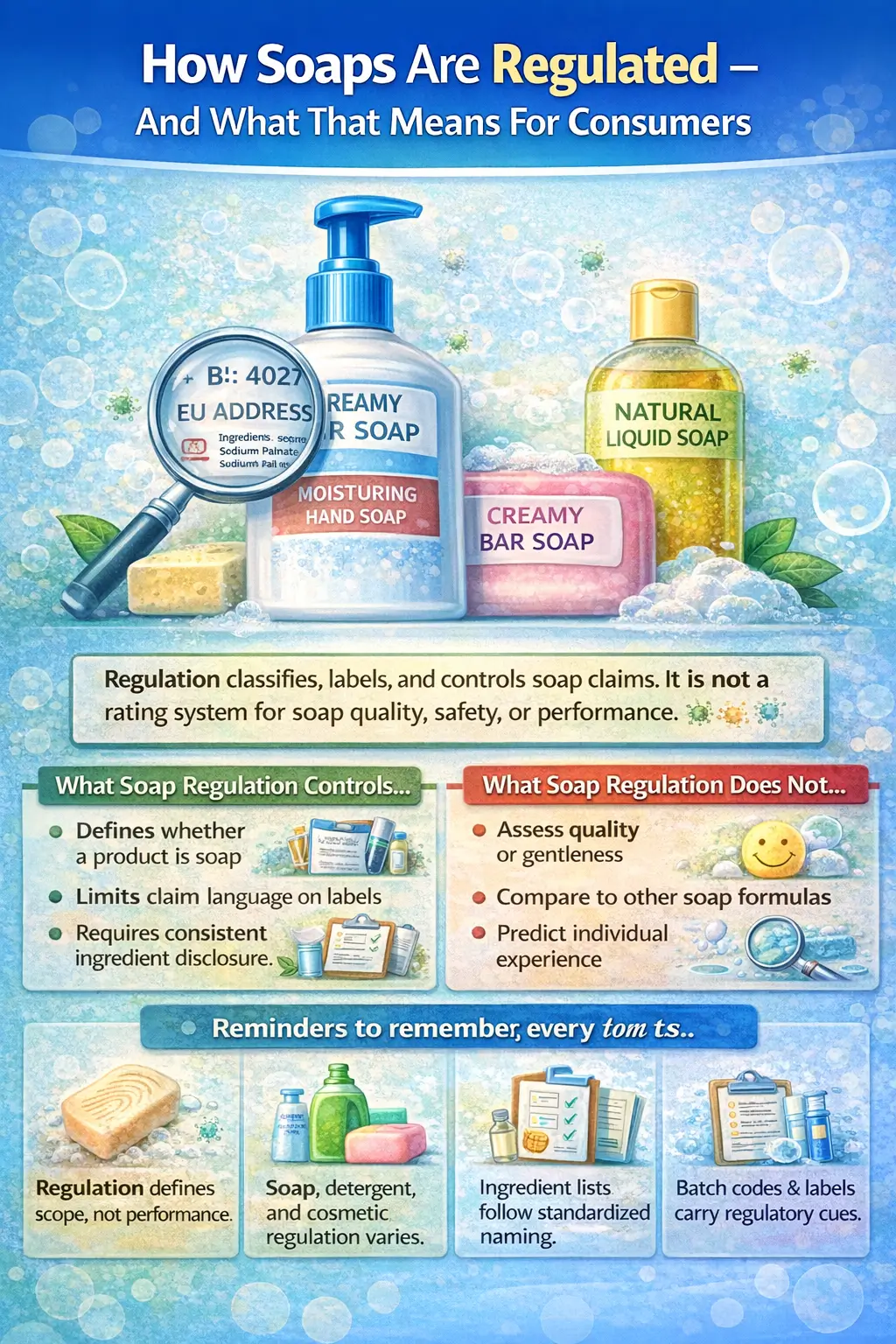
Regulation exists to define boundaries. In the context of soaps, it determines how a product is categorized, what information must be disclosed, and which claims are permitted. It does not evaluate whether a soap is better, gentler, or more effective than another.
This distinction is often missed. Regulation is frequently interpreted as a form of approval or endorsement, when in reality it is a framework for consistency and accountability across the market.
Once this purpose is understood, many assumptions about what regulation guarantees begin to soften. The system governs classification and communication, not experience.
Why Classification Matters More Than Ingredients
In regulatory terms, soaps are defined less by their full ingredient list and more by their primary intended function. Whether a product cleans skin, conditions it, or claims additional effects influences how it is regulated.
This means that two products with similar formulations can fall under different regulatory frameworks if their positioning or claims differ, reflecting how cosmetic and drug classifications are defined. Conversely, products with different ingredient systems may share the same classification.
For consumers, this can feel counterintuitive. Ingredient awareness is important, but regulation operates first at the level of purpose and claim, not formulation detail.
When Soap Stops Being Regulated As Soap
A product commonly referred to as soap may not always be regulated as soap. When additional cosmetic claims are introduced, the regulatory category can shift.
This shift does not necessarily reflect a change in formulation complexity. It reflects a change in what the product is presented as doing. The same base cleansing product can cross regulatory boundaries based on language and positioning alone.
These disclosure gaps become more apparent when reviewing brand-specific ingredient listings, such as those documented for Buff City Soap ingredients or mainstream personal-care examples like Caress soap ingredient disclosures.
Soap, Detergent, And Cosmetic - Why Categories Matter
In everyday language, soap is a broad term. In regulation, it is not. Products that clean the body, hands, or surfaces may fall under different regulatory frameworks depending on how they are described and what they claim to do.
A traditional soap positioned purely as a cleansing product may be regulated differently from a liquid wash described as moisturizing, antibacterial, or skin-conditioning. Detergents intended for household cleaning follow yet another regulatory path.
These distinctions exist to clarify oversight, not to signal superiority or safety. For consumers, understanding category boundaries explains why similar products can carry very different labeling structures.
What Soap Regulation Actually Controls
Regulation governs how soaps are described, what information must appear on the label, and which claims are allowed. It ensures consistency in disclosure, such as ingredient naming systems and required identifiers.
What regulation does not do is assess how pleasant a soap feels, how it performs for different users, or how it compares to alternatives. Those aspects fall outside the regulatory scope.
This distinction helps explain why regulatory compliance should be read as a baseline requirement rather than a comparative signal.
What Regulation Does Not Evaluate Or Guarantee
Regulatory systems do not evaluate individual experience. They do not predict how a soap will behave in different water conditions, climates, or usage patterns.
They also do not judge formulation philosophy, ingredient sourcing, or performance preferences. Two compliant soaps may feel entirely different in use while meeting the same regulatory requirements.
Recognizing this boundary helps prevent overconfidence in regulation as a proxy for personal suitability.
How Regulation Appears On European Retail Shelves
In European retail settings, regulatory information is often subtle. Batch codes, responsible party details, and standardized ingredient lists appear without explanation, yet they carry regulatory significance.
Consumers may interpret the presence or absence of certain disclosures as meaningful, even when those differences reflect category placement rather than formulation risk or quality.
Understanding these signals helps contextualize why regulation feels invisible while still shaping what can be sold.
Where Regulatory Interpretation Reaches Its Limits
Regulation provides structure, not certainty. It establishes boundaries within which products operate but cannot resolve questions of preference, comfort, or expectation.
This unresolved space is where consumer interpretation often stretches regulation beyond its intent. The system was not designed to answer every question a buyer may have.
Recognizing these limits allows regulation to be understood as context rather than assurance.
Summary of Findings
- Regulation defines categories: It determines how soaps are classified and labeled.
- Classification shapes disclosure: Claims and positioning influence regulatory treatment.
- Compliance is a baseline: It is not a measure of quality or performance.
- Retail signals are subtle: Regulatory presence is often indirect on packaging.
- Interpretation has limits: Regulation cannot predict individual experience.
References & Primary Sources
| Source Title | Authority | Specific Relevance | Official Link |
|---|---|---|---|
| Regulation (EC) No 1223/2009 | European Parliament | The primary law for cosmetic safety, labeling (Art. 19), and PIF (Art. 10). | EUR-Lex (Consolidated) |
| Manual on Borderline Products | European Commission | Guidance on distinguishing cosmetics from biocides or medicinal products. | EC Guidance |
| Regulation (EC) No 648/2004 | ECHA | Framework for products classified as detergents rather than cosmetics. | View Regulation |
| Regulation (EU) No 655/2013 | European Commission | Common criteria for the justification of cosmetic claims (Art. 20). | Claims Criteria |
Related Technical Standards
- ISO 22716:2007: International standard for Cosmetics Good Manufacturing Practices (GMP).
- Article 2(1)(a) Definition: For the legal definition of a "cosmetic product" as used in this research, see Consolidated Regulation 1223/2009, Article 2.