Definition
Tetrasodium EDTA is a synthetic chelating compound widely used in cosmetic and cleansing formulations as a metal ion binding agent. Chemically it is the sodium salt form of ethylenediaminetetraacetic acid, a molecule capable of forming stable complexes with dissolved metal ions such as calcium, magnesium and iron. The compound belongs to the broader class of aminopolycarboxylate chelators that are frequently used in aqueous chemical systems where control of trace metal ions is required.
Within soap systems and liquid cleansing formulations, tetrasodium EDTA does not perform a cleansing function itself. Instead it modifies the surrounding chemical environment by binding metal ions that would otherwise interact with surfactants, soap salts or other ingredients. Through this binding behavior the compound helps maintain predictable formulation performance in the presence of mineral ions commonly present in water supplies.
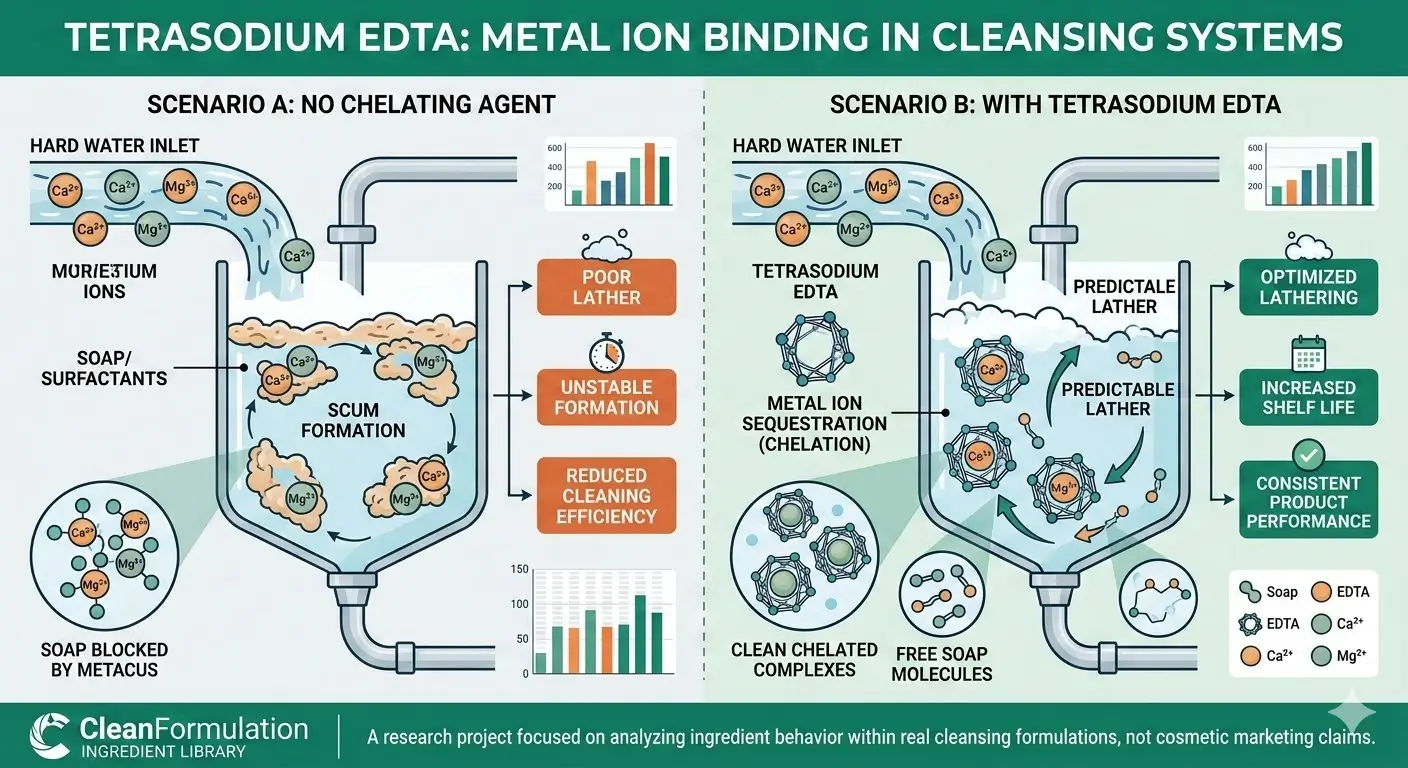
In practical formulation contexts the presence of metal ions can alter how surfactant systems behave. Calcium and magnesium ions may react with fatty acid soap salts, forming insoluble deposits that affect lather and product stability. By forming coordination complexes with these ions, tetrasodium EDTA reduces their ability to interfere with the cleansing system.
This page belongs to the CleanFormulation Ingredient Library, a research project focused on analyzing ingredient behavior within real cleansing formulations rather than evaluating cosmetic marketing claims.
Quick Facts
| Property | Description |
|---|---|
| Ingredient Type | Chelating agent and formulation stabilizer |
| Chemical Class | Aminopolycarboxylate chelating compound |
| Functional Role | Metal ion binding compound that reduces mineral interference in aqueous formulations |
| Ionic Class | Highly ionic sodium salt of EDTA |
| Typical Use Context | Liquid soaps, shampoos, surfactant cleansers and cosmetic formulations |
| Physical State | White crystalline powder readily soluble in water |
Why This Ingredient Appears on Cosmetic Labels
Consumers often encounter tetrasodium EDTA on cosmetic ingredient lists because the compound is commonly used to manage trace metal ions present in water based formulations. Cosmetic ingredient declarations follow the International Nomenclature of Cosmetic Ingredients system, which standardizes how formulation components are listed on product labels. Under this system the compound appears under the name tetrasodium EDTA rather than the longer chemical name derived from ethylenediaminetetraacetic acid.
In many cleansing products the water phase can contain dissolved minerals originating from manufacturing water supplies or raw materials. These metal ions may influence the behavior of surfactants, preservatives or fragrances. Tetrasodium EDTA is introduced into the formulation to bind these ions and prevent them from participating in unwanted reactions within the product system.
The presence of this ingredient on a label therefore reflects its role as a formulation stabilizing component rather than as an active cleansing substance. Surfactants or soap salts perform the primary cleansing function, while tetrasodium EDTA operates in the background by controlling metal ion interactions within the aqueous environment.
Chemical Identity and Classification
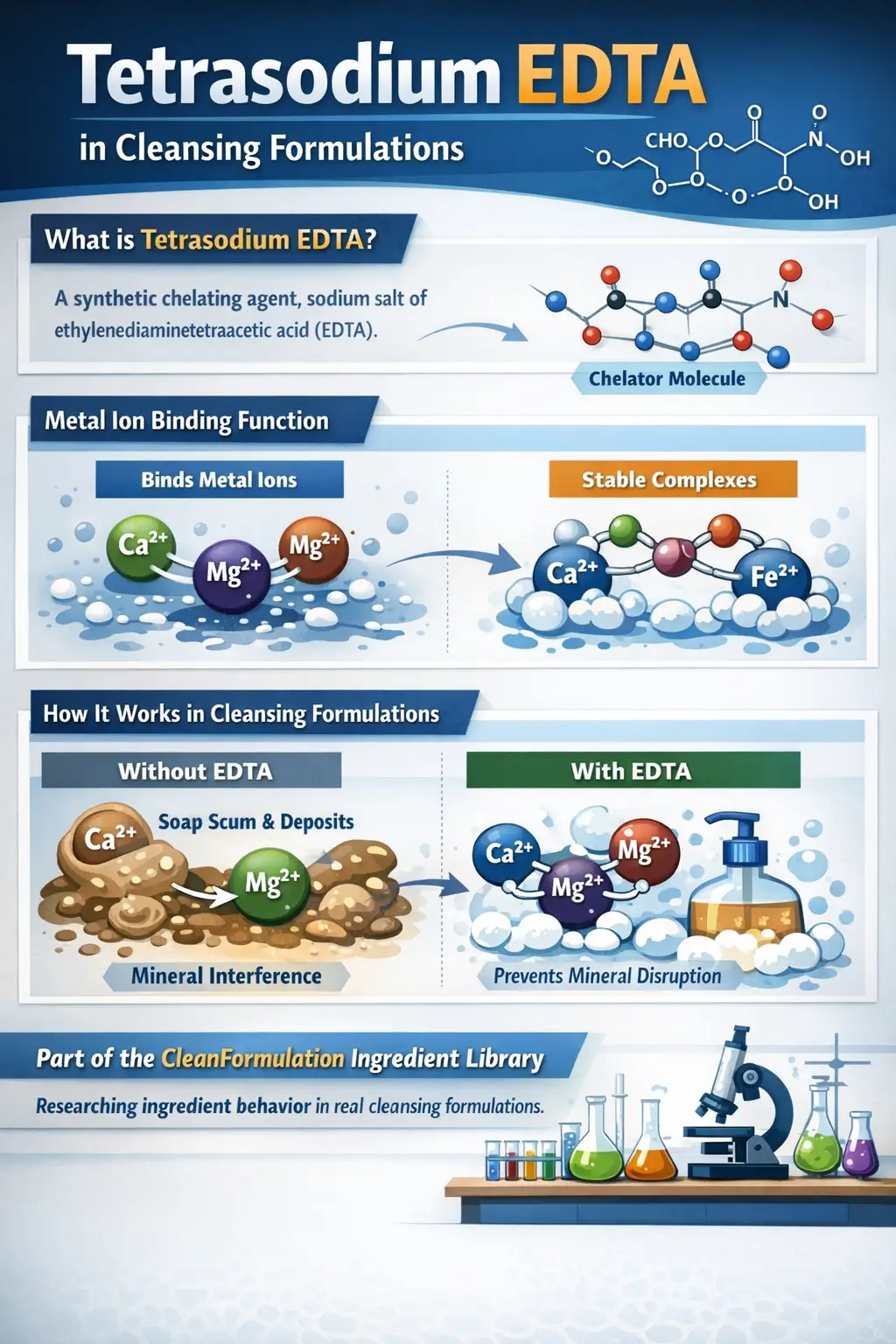
Tetrasodium EDTA is the fully neutralized sodium salt form of ethylenediaminetetraacetic acid. The parent molecule contains a central ethylenediamine backbone surrounded by four carboxylate groups capable of binding positively charged metal ions. When neutralized with sodium hydroxide these acidic groups form the sodium salt commonly used in industrial and cosmetic formulations.
The compound belongs to the family of aminopolycarboxylate chelating agents. These molecules are characterized by multiple coordination sites that can simultaneously interact with a metal ion, creating a stable ring like complex known as a chelate. This structural arrangement allows tetrasodium EDTA to capture metal ions and keep them dissolved within the water phase of the formulation.
In aqueous solution the compound dissociates into sodium ions and the EDTA anion. The negatively charged EDTA structure contains several electron donating groups capable of coordinating with metal ions such as calcium, magnesium, copper and iron. These interactions form stable complexes that limit the ability of these ions to interact with other formulation ingredients.
Because of this coordination chemistry tetrasodium EDTA is classified in formulation science as a chelating or sequestrant agent. Its functional behavior differs from surfactants, humectants or preservatives because it operates primarily by controlling the chemical environment surrounding other ingredients rather than directly modifying product texture or cleansing activity.
Functional Role in Soap Systems
Within soap based cleansing systems the presence of dissolved minerals can significantly influence formulation performance. Hard water ions such as calcium and magnesium may react with fatty acid soap salts, producing insoluble deposits sometimes described as soap scum. These deposits reduce lather efficiency and may leave residues on surfaces or fabrics.
Tetrasodium EDTA influences this process by binding the mineral ions before they can interact with soap salts. When the chelating molecule forms a complex with calcium or magnesium ions, the resulting structure remains dissolved within the water phase rather than forming insoluble salts. This interaction allows soap molecules to remain available for micelle formation and cleansing activity.
In surfactant based cleansers the compound performs a similar stabilizing role. Trace metal ions can accelerate oxidation reactions, destabilize fragrances or reduce the effectiveness of certain preservatives. By binding these ions, tetrasodium EDTA helps maintain a more predictable chemical environment within the formulation.
The compound therefore functions as a supporting component rather than a central active ingredient. Its presence is often not directly perceptible to the user, yet it contributes to maintaining consistent product behavior across different water qualities and storage conditions.
Ingredient Interaction Logic
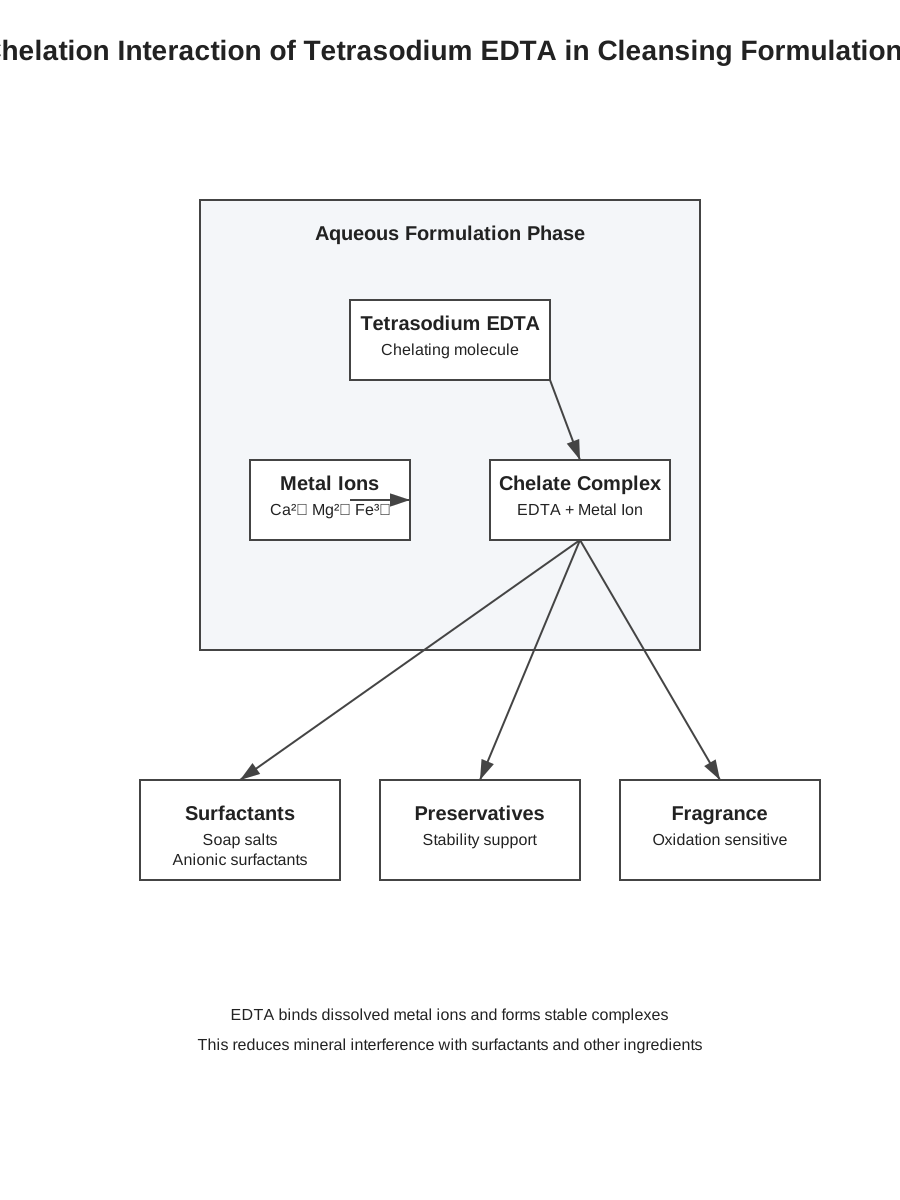
The behavior of tetrasodium EDTA within cleansing formulations arises primarily from its interaction with dissolved metal ions present in the aqueous phase. When introduced into water the EDTA anion exposes multiple coordination sites capable of binding positively charged ions through electrostatic attraction and coordination bonding.
These binding interactions form chelate complexes that reduce the reactivity of the captured metal ions. As a result the ions become less available to participate in reactions with surfactants, soap salts or other formulation ingredients. This mechanism allows the formulation to remain chemically stable even when trace minerals are present in the water supply.
In surfactant systems the removal of interfering metal ions can influence micelle behavior and overall formulation clarity. Certain metal ions may interact with anionic surfactants, altering micelle packing or contributing to precipitation reactions. Chelation reduces the concentration of free metal ions in solution and therefore minimizes these interactions.
Other formulation ingredients operate within the same aqueous environment. Humectants such as glycerin modify water structure, while preservatives rely on stable chemical conditions to maintain antimicrobial activity within the product. By limiting metal ion catalyzed reactions, tetrasodium EDTA indirectly supports the stability of these other components.
Phase Behavior in Cleansing Formulations
Tetrasodium EDTA is typically supplied as a crystalline powder that dissolves readily in water to produce an alkaline solution. Once dissolved, the compound exists primarily as the EDTA anion accompanied by sodium counter ions. This highly soluble behavior allows the chelating molecule to disperse throughout the aqueous phase of cosmetic formulations where it can interact with dissolved metal ions.
The stability of the EDTA complex is influenced by several environmental variables within the formulation system. Solution pH plays a particularly important role because the carboxylate groups responsible for metal binding must remain deprotonated to coordinate effectively with metal ions. Under typical cleansing formulation conditions the molecule remains sufficiently ionized to maintain strong chelation capacity.
Temperature and ionic strength can also influence complex formation. Higher ionic environments or the presence of competing ions may shift equilibrium conditions for metal binding. In practical formulation systems however, tetrasodium EDTA generally remains soluble and functionally active across a wide range of aqueous cosmetic environments.
Because the compound operates within the water phase rather than within oil phases or solid structures, its behavior is largely governed by the chemistry of the surrounding solution. As long as the chelating groups remain available for coordination, the molecule continues to capture dissolved metal ions and stabilize the formulation environment.
Regulatory Context
In cosmetic ingredient labeling systems the compound is declared using the standardized International Nomenclature of Cosmetic Ingredients name tetrasodium EDTA. Ingredient lists must follow recognized nomenclature rules to ensure that formulation contents remain identifiable across different regulatory jurisdictions and product markets.
Within the European Union cosmetic ingredient declarations are governed by Regulation (EC) No 1223 2009 on cosmetic products. This regulatory framework requires ingredients to be listed in descending order of concentration above defined thresholds and identified using their approved INCI names.
Ingredient databases such as the European Commission CosIng database classify tetrasodium EDTA primarily as a chelating agent. This classification reflects the compound’s functional role in controlling metal ions within cosmetic formulations rather than performing a cleansing or surfactant activity.
Common Misunderstanding
A common misunderstanding arises from the assumption that tetrasodium EDTA functions directly as a cleansing ingredient in soaps or liquid cleansers. Because the compound appears alongside surfactants in ingredient lists, it is sometimes interpreted as part of the cleaning system itself.
In reality the compound does not remove oils or soil from surfaces. Cleansing activity is produced by surfactant molecules or soap salts that form micelles capable of interacting with oils. Tetrasodium EDTA instead operates as a background stabilizing agent that prevents mineral ions from interfering with those surfactant processes.
The distinction highlights the difference between ingredients that perform the primary function of a product and those that support the stability and consistency of the formulation environment.
Structural Limitations
Although tetrasodium EDTA is highly effective at binding many common metal ions, its chelating capacity is not unlimited. Each molecule contains a defined number of coordination sites, which means that once these sites are occupied additional metal ions may remain free in the formulation environment.
Formulation conditions such as pH and competing ions can also influence chelation efficiency. If the solution environment changes in a way that protonates the binding groups or introduces stronger competing ligands, the stability of certain metal complexes may decrease.
For this reason the ingredient is generally treated as a supportive formulation component rather than a complete solution to all mineral interactions. Effective use depends on balancing the compound with the overall ionic environment of the formulation system.
Formulation References Using This Ingredient
Summary of Findings
Tetrasodium EDTA is a synthetic chelating compound derived from ethylenediaminetetraacetic acid and commonly used in aqueous cosmetic formulations to control dissolved metal ions. The molecule forms stable complexes with calcium, magnesium and other metal ions that might otherwise interfere with surfactant behavior or destabilize formulation components.
- Chemical Classification: Tetrasodium EDTA is an aminopolycarboxylate chelating compound and the fully neutralized sodium salt of EDTA.
- Functional Role: The ingredient operates as a metal ion binding agent that reduces mineral interference in aqueous cosmetic formulations.
- Interaction Logic: Chelation occurs when the EDTA structure coordinates with metal ions and forms stable complexes within the water phase.
- Formulation Context: By controlling metal ions the compound indirectly supports surfactant stability, preservative performance and formulation clarity.
- System Boundaries: Chelation efficiency depends on solution chemistry, pH conditions and the availability of coordination sites within the molecule.