Opening Definition
Sodium benzoate is a water-soluble preservative salt belonging to the benzoate family, used in cleansing and cosmetic formulations to limit microbial growth during storage as explained in preservatives in cosmetic formulation and maintain product stability.
It does not contribute to cleansing, foaming, or surface activity. Instead, its function operates within the formulation itself, protecting the system from microbial degradation over time.
Chemically, it is the sodium salt of benzoic acid, and its effectiveness is closely linked to formulation pH and water phase conditions.
In practical systems, its presence is often invisible during use, yet it plays a structural role in ensuring that the formulation remains stable, consistent, and usable throughout its lifecycle.
Quick Facts
| Property | Description |
|---|---|
| Ingredient Type | Preservative |
| Chemical Class | Benzoate salt |
| Functional Role | Prevents microbial growth within formulation |
| Ionic Class | Anionic salt |
| Typical Use Context | Liquid soaps, shampoos, detergents, cosmetic emulsions |
Why This Ingredient Appears on Labels
Sodium benzoate appears on ingredient labels because it is part of the formulation system that maintains product integrity during storage and use. Without preservation systems, water-containing formulations can undergo microbial contamination, leading to instability, separation, or degradation.
Its inclusion reflects formulation design requirements rather than performance during washing or application. In other words, it supports the product itself rather than directly interacting with the skin or cleaning process.
Chemical Identity and Classification
Sodium benzoate is the sodium salt of benzoic acid, typically represented as C7H5NaO2. It belongs to a class of aromatic carboxylate salts derived from benzoic acid structures.
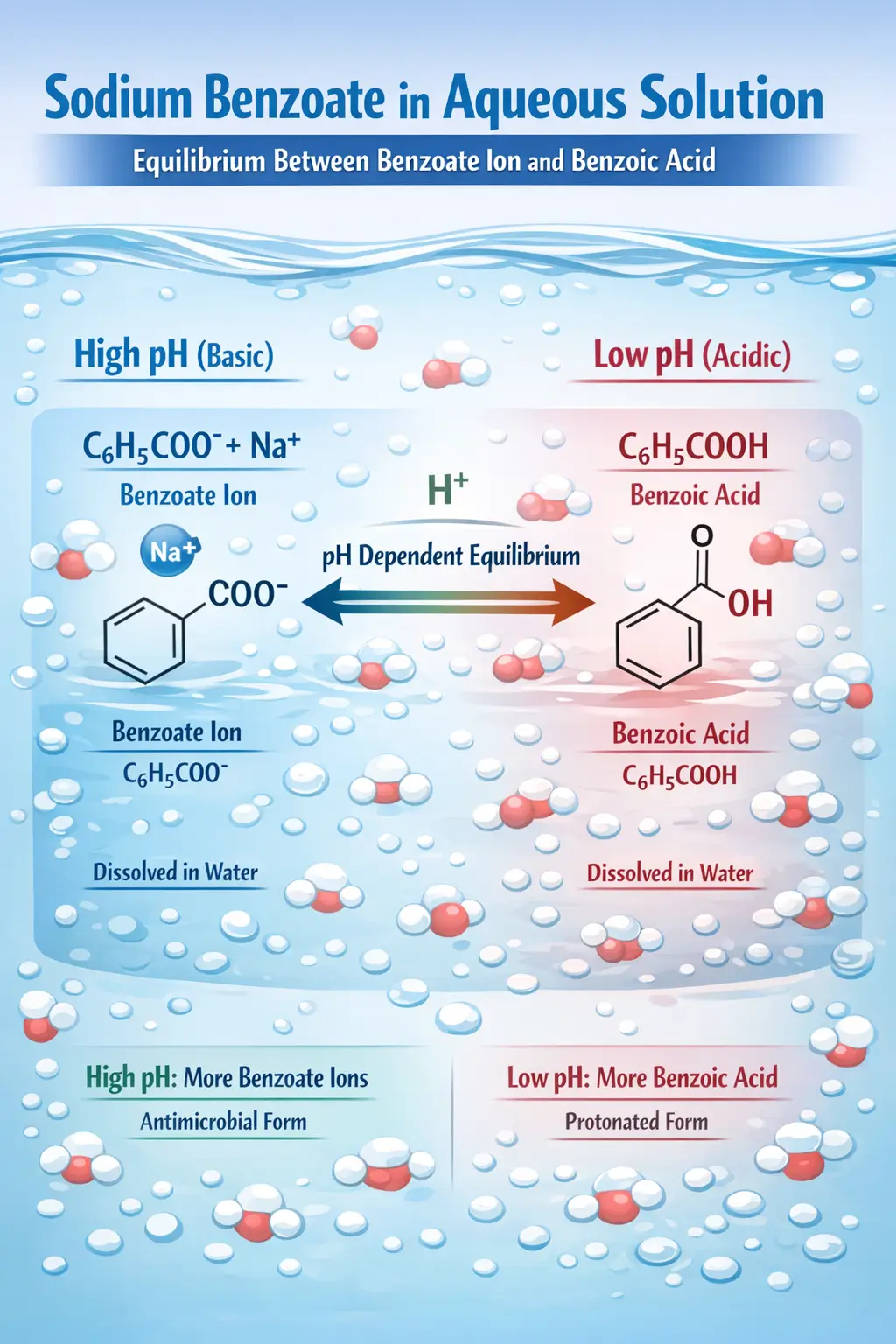
In aqueous systems, it dissociates into sodium ions and benzoate ions. The antimicrobial effectiveness of this system is associated with the equilibrium between benzoate and its protonated form, benzoic acid, which is influenced by formulation pH conditions.
This classification places it within preservative systems that depend on chemical equilibrium rather than surface activity or membrane disruption typical of surfactants.
Functional Role in Cleansing Systems
Sodium benzoate functions as a preservation component within water-containing cleansing systems. Its role is not related to soil removal, foam generation, or surface tension reduction. Instead, it operates within the internal environment of the formulation, limiting microbial proliferation that could otherwise destabilize the system.
In liquid soaps and shampoos, where water is the dominant phase, microbial exposure is unavoidable during manufacturing, storage, and repeated consumer use in real-world liquid soap systems.. Sodium benzoate contributes to maintaining the formulation’s integrity by controlling microbial growth within this aqueous environment.
Its presence does not alter lather quality, cleansing strength, or tactile feel in a direct way. However, indirectly, it supports consistent product performance by preventing microbial-driven degradation that could affect viscosity, clarity, or odor over time.
From an observable standpoint, systems containing effective preservation tend to maintain stable texture, uniform appearance, and consistent flow behavior throughout their shelf life.
Ingredient Interaction Logic
The behavior of sodium benzoate is closely linked to the aqueous phase of a formulation. It dissolves readily in water and distributes uniformly, allowing it to interact with the entire system rather than localized regions.
Its effectiveness is influenced by formulation pH. In systems where pH is adjusted toward mildly acidic conditions, a greater proportion of the benzoate equilibrium shifts toward benzoic acid, which plays a central role in preservation behavior.
Interaction with surfactants is generally indirect. Unlike amphiphilic molecules that form micelles, sodium benzoate does not participate in aggregation structures. Instead, it remains in the continuous phase, operating independently of surfactant assemblies.
In systems containing humectants such as glycerin, or solvents such as alcohol, its distribution remains stable due to its high solubility in polar environments. Chelating agents may complement its function by reducing metal-ion-driven instability, but they do not directly modify its chemical role.
Fragrance components, which are typically hydrophobic, are not directly influenced by sodium benzoate. However, overall formulation stability, including preservation, ensures that fragrance integrity is maintained over time.
Phase Behavior and Solubility Characteristics
Sodium benzoate is highly soluble in water and remains in the dissolved state across typical formulation concentrations. It does not form separate phases, crystalline structures within finished products, or visible aggregates under normal conditions.
Its behavior is governed by ionic dissociation and equilibrium chemistry rather than physical structuring. This distinguishes it from ingredients such as fatty acids or surfactants that may form micelles, gels, or crystalline domains.
Temperature variations within normal storage ranges have limited impact on its solubility. However, its functional equilibrium with benzoic acid is sensitive to pH, making formulation pH control a central parameter in its performance.
Comparison With Related Preservative Systems
| Feature | Sodium Benzoate | Potassium Sorbate |
|---|---|---|
| Chemical Type | Benzoate salt | Sorbate salt |
| Primary Mechanism Basis | pH-dependent equilibrium system | pH-dependent unsaturated fatty acid derivative |
| Solubility | Highly water soluble | Highly water soluble |
| Typical Use Systems | Liquid soaps, shampoos, detergents | Cosmetic emulsions, food-contact systems |
| pH Sensitivity | Strong dependence on acidic conditions | Strong dependence on acidic conditions |
Both ingredients operate within similar formulation logic, relying on pH-dependent equilibrium rather than structural interaction with surfactant systems. Their selection is often influenced by formulation compatibility and system design constraints rather than direct performance differences in cleansing behavior.
Regulatory Context
Sodium benzoate is a widely recognized preservative listed under cosmetic regulatory frameworks, including the European Union Cosmetic Regulation. It appears in Annex V of Regulation (EC) No 1223/2009, where permitted preservatives are defined for use in cosmetic products.
Its inclusion in formulations requires declaration by its INCI name, ensuring transparency within ingredient labeling systems. The regulatory framework governs its allowable use conditions, including concentration limits and formulation compatibility considerations.
Within cleansing products such as liquid soaps, shampoos, and detergents intended for cosmetic use, its presence reflects compliance with preservation requirements necessary for maintaining product integrity during storage and use.
Common Misunderstanding
A frequent misunderstanding is that sodium benzoate functions as an antibacterial agent during washing or skin contact. In reality, its role is confined to preserving the formulation itself rather than acting as a cleansing-active or surface antimicrobial component.
This distinction is important in formulation logic. Ingredients that operate during product use typically interact with the skin or surface being cleaned, whereas sodium benzoate operates within the product matrix, maintaining stability before and during use rather than contributing to the washing process.
Structural Limitations
The effectiveness of sodium benzoate is closely tied to formulation pH. In systems that are neutral to strongly alkaline formulation environments, its functional equilibrium shifts away from the form associated with preservation activity, reducing its effectiveness within those environments.
This makes it less suitable for formulations that operate at higher pH levels, such as traditional soap systems based on saponified fatty acid salts. In such cases, alternative preservation strategies are often required.
Additionally, its role is limited to aqueous environments. In low-water or anhydrous systems, its function becomes less relevant, as microbial growth conditions differ significantly from water-based formulations.
These constraints mean that sodium benzoate is most effectively used in mildly acidic, water-rich systems where its equilibrium behavior supports stable preservation.
Product Formulation References Using This Ingredient
- Dial Himalayan Salt Hand Soap
- Method Clementine Dish Soap
- Method Hand Soap – Ingredient & Surfactant Systems
- Method Laundry Detergent
- Dial Antimicrobial Soap Ingredients Analysis
- Dermakleen Antiseptic & Antibacterial Soap
- Williams Sonoma Hand Soap
- Method Foaming Hand Soap Refills – Formulation & Performance Analysis
Summary of Findings
- Classification: Sodium benzoate is a benzoate salt preservative operating within the aqueous phase of formulations.
- Functional Role: It limits microbial growth inside the product rather than contributing to cleansing or surface activity.
- Interaction Logic: Its behavior depends on pH-driven equilibrium and uniform distribution in the water phase.
- System Behavior: It does not form structures such as micelles or crystals within finished formulations.
- Limitations: Its effectiveness decreases in alkaline systems and is most relevant in mildly acidic formulations.