Definition and System Role
Citric acid is a water-soluble organic acid classified as a chelating agent and pH-adjusting component, commonly used in cleansing systems to regulate acidity and interact with dissolved minerals.
It belongs to the group of low molecular weight carboxylic acids, with three acid functional groups that allow it to bind metal ions and participate in acid-base balance within aqueous formulations.
In soap and detergent systems, its role is not structural. Instead, it modifies the surrounding environment by influencing mineral availability, pH balance, and formulation stability.
This page is part of the CleanFormulation Ingredient Library, a research project focused on analyzing how ingredients behave inside real formulation systems rather than in isolation.
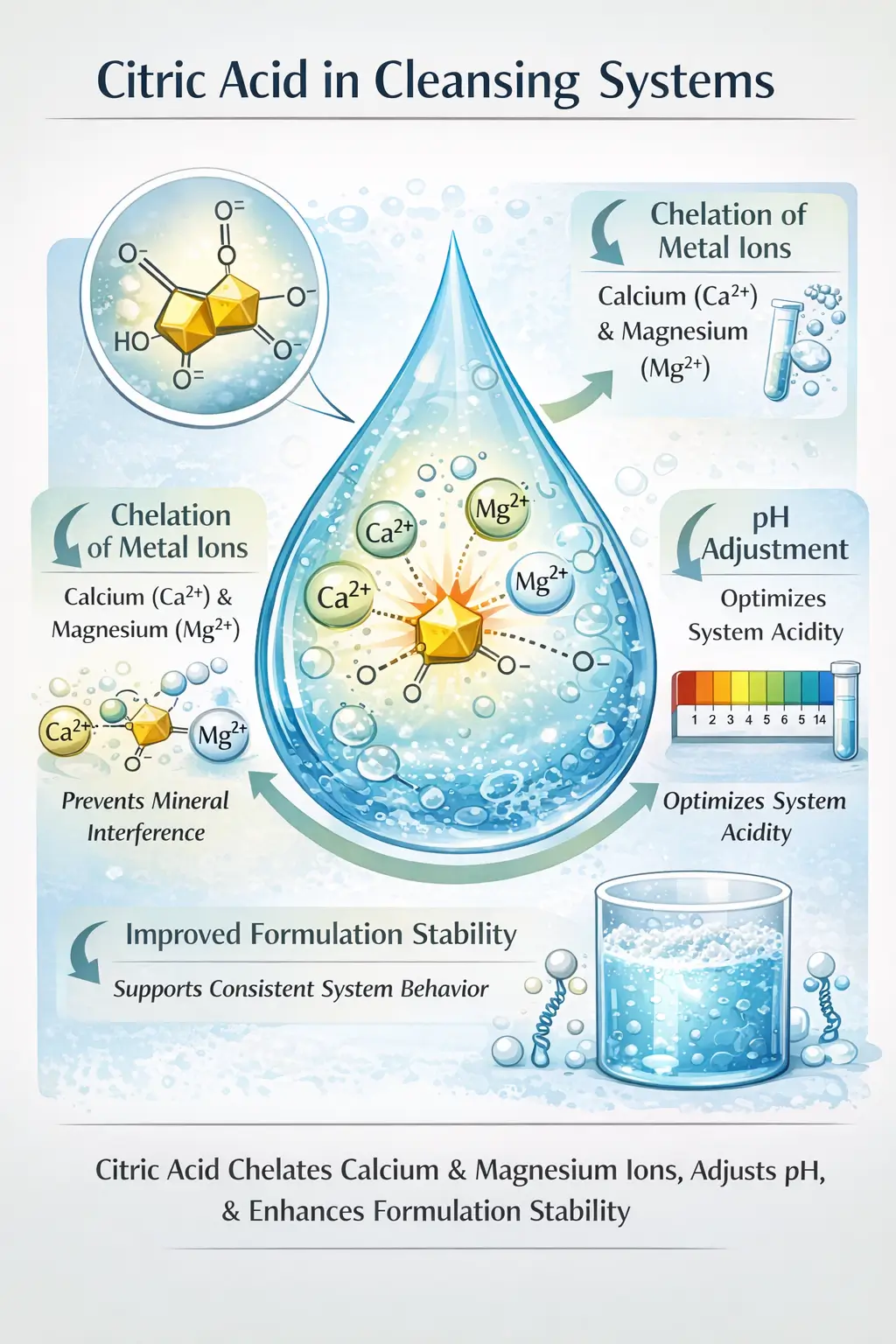
Quick Facts
| Property | Description |
|---|---|
| Ingredient Type | Functional additive |
| Chemical Class | Tricarboxylic organic acid |
| INCI Name | Citric Acid |
| CAS Number | 77-92-9 |
| Primary Function | Chelating agent and pH regulator |
| Secondary Function | Buffering agent, preservative booster, mild exfoliating agent |
| Ionic Behavior | Weak acid, forms citrate ions in aqueous systems |
| pKa Values | ~3.1, 4.7, 6.4 (triprotic acid behavior) |
| Typical Use Context | Soap, detergent powder, liquid cleansers, shampoo and cream formulations |
| Solubility | Highly soluble in water |
| pH Range (1% Solution) | ~2.0 – 2.5 |
| Chelation Mechanism | Binds metal ions (Ca²⁺, Mg²⁺, Fe³⁺), improving stability and preventing oxidation |
| Compatibility | Compatible with most surfactants and preservatives; may interact with strong bases |
| Stability | Stable under normal storage; sensitive to high heat over prolonged periods |
| Biodegradability | Readily biodegradable |
| Source | Typically derived via fermentation of sugars (e.g., glucose, molasses) |
| Appearance | White crystalline powder or granules |
| Odor | Odorless |
| Usage Level | 0.1% – 2.0% (depending on formulation and function) |
| Regulatory Status | Widely approved for cosmetic, food, and pharmaceutical use |
| Formulation Role in Cleansers | Adjusts pH, enhances preservative efficacy, and reduces water hardness impact |
| Interaction with Hard Water | Sequesters calcium and magnesium ions, improving foam and cleaning efficiency |
Why This Ingredient Appears on Labels
Citric acid appears on ingredient lists because it performs a supporting function that helps maintain consistency across batches and improves system performance in variable water conditions.
In cleansing formulations, dissolved minerals such as calcium and magnesium can interfere with surfactant efficiency. Citric acid interacts with these ions, reducing their availability and allowing the cleaning system to function more predictably.
It is also used to adjust acidity during formulation or after production. This adjustment helps align the system with its intended performance range, especially in liquid cleansers and multi-component formulations.
For consumers reading labels, its presence reflects a formulation decision related to stability and interaction control, rather than a primary cleansing role.
Chemical Identity and Classification
Citric acid is identified in ingredient lists under its INCI name “Citric Acid”. It belongs to the family of tricarboxylic acids, meaning it contains three carboxyl groups that can donate protons in aqueous systems.
In water, it does not remain as a single neutral molecule. Instead, it partially dissociates to form citrate ions, with the extent of dissociation depending on the surrounding pH. This behavior allows it to participate in both acid-base balance and ion interaction.
From a formulation perspective, its classification is functional rather than structural. It does not contribute to the formation of soap or surfactant systems, but instead operates within the water phase, where most ionic interactions occur.
Although often associated with citrus sources, the material used in formulations is typically produced through controlled fermentation processes. Its functional behavior is determined by its molecular structure rather than its origin.
Functional Role in Cleansing Systems
Within soap, detergent powder, and liquid cleansing systems, citric acid performs two closely linked roles: mineral interaction control and pH adjustment. These roles influence how effectively the overall formulation performs during use.
In water containing dissolved minerals, surfactants and soap salts can lose efficiency due to interaction with calcium and magnesium ions. Citric acid binds these ions, reducing their ability to interfere with the cleansing process.
It also acts as a pH-modifying component. During formulation or post-processing, small adjustments using citric acid can shift the system toward a more controlled acidity range, which influences solubility, clarity, and stability.
In bar soap systems, its presence is usually indirect or minimal, since the structure is defined by fatty acid salts. In contrast, in liquid cleansers and detergents, its influence becomes more visible through improved solution clarity and reduced residue formation.
At the user level, this translates into more consistent rinsing behavior and fewer mineral-related deposits, particularly in hard water conditions.
Ingredient Interaction Logic
Citric acid operates primarily within the aqueous phase, where it interacts with both dissolved ions and other formulation components. Its behavior is shaped by its ability to transition between protonated and deprotonated forms depending on system conditions.
When combined with alkaline agents, it can partially neutralize excess alkalinity, forming citrate salts. This interaction is often used to fine-tune system balance after primary reactions such as saponification.
In surfactant-based systems, its role is indirect but significant. By reducing interference from metal ions, it allows surfactants to maintain their intended structure and performance, particularly in dilute or rinse-heavy applications.
It also interacts with other chelating components when present, contributing to a broader ion-control system rather than acting alone. In such cases, its contribution depends on concentration, pH, and competing binding interactions.
Its compatibility with humectants, solvents, and fragrance systems is generally high, as it remains dissolved and does not form visible phases under normal formulation conditions.
Phase Behavior and Solubility
Citric acid is highly soluble in water, where it rapidly dissolves to form a clear solution. This makes it suitable for use in liquid systems where uniform distribution is required.
In solid formulations such as detergent powder, it exists in crystalline form. Upon contact with water, it transitions into the dissolved state and begins interacting with the surrounding system.
Its behavior is strongly influenced by pH. As the system becomes more alkaline, citric acid shifts toward its ionized citrate form. This transition is central to its function as both a chelating agent and a buffering component.
Thermally, it remains stable under typical formulation conditions, although excessive heat or prolonged exposure to reactive systems can lead to gradual degradation.
From a formulation perspective, its phase behavior is predictable and consistent, which allows it to be used reliably across a wide range of cleansing systems without introducing phase separation or instability.
Comparison With Related Chelating Components
Citric acid is often used alongside or in place of other chelating agents. While its function overlaps with stronger chelators, its behavior is milder and more dependent on system conditions.
| Feature | Citric Acid | Etidronic Acid |
|---|---|---|
| Chemical Class | Organic tricarboxylic acid | Phosphonate compound |
| Chelation Strength | Moderate | Stronger mineral binding capacity |
| pH Influence | Acts as pH adjuster | Minimal direct pH adjustment role |
| Use Context | Widely used across soap, shampoo, cream, and detergent powder | Often used in detergent systems requiring higher stability |
| System Behavior | Balances mineral interaction and acidity | Primarily stabilizes metal-sensitive systems |
Regulatory Context
Citric acid is listed under its INCI name “Citric Acid” in cosmetic ingredient declarations. It is not classified as a restricted substance under typical cosmetic regulations when used within standard formulation practices.
In the European Union framework, it is included in ingredient inventories and may be used without specific concentration limits in most rinse-off and leave-on applications, provided the final product complies with general safety and labeling requirements.
Its role is considered functional rather than active. As such, it is not associated with claim-based classification but is treated as a supporting component within formulation systems.
In detergent systems, it is similarly regarded as a formulation aid, particularly in relation to water hardness management and pH adjustment, without separate classification as a primary cleaning agent.
Common Misunderstanding
A frequent assumption is that citric acid functions mainly as a “natural ingredient” because it is associated with citrus fruits. In formulation practice, this distinction is not relevant to how the ingredient behaves.
Its performance is defined by its molecular structure and ionization behavior, not by its source. Whether obtained through fermentation or extraction, the resulting compound operates identically within the system.
Another misconception is that it plays a direct cleansing role. In reality, it does not remove soil or oils on its own. Instead, it supports the cleaning system by improving the conditions under which surfactants and soap components function.
Structural Limitations
Citric acid has a moderate chelating capacity compared to stronger agents. In systems with high mineral load, its ability to fully control metal ion interference may be limited, requiring combination with other chelating components.
Its function is also dependent on pH. In highly alkaline environments, its acid form is reduced, and it exists primarily as citrate ions, which may alter its interaction profile.
In solid formulations, uneven distribution or moisture exposure can lead to localized activation, which may affect stability during storage if not properly controlled.
Additionally, because it participates in acid-base balance, excessive use can shift formulation pH beyond the intended range, requiring careful adjustment during formulation design.
Formulation References Using This Ingredient
Summary of Findings
- Classification: Citric acid is a tricarboxylic organic acid functioning primarily as a chelating agent and pH regulator.
- Functional Role: It supports cleansing systems by interacting with dissolved minerals and adjusting acidity rather than contributing directly to cleaning action.
- Interaction Logic: Operates within the water phase, influencing surfactant performance and system stability through ion control and buffering behavior.
- System Boundaries: Its effectiveness depends on concentration, pH conditions, and presence of competing ions or stronger chelating agents.