Cocamidopropyl Betaine Definition
Cocamidopropyl Betaine is an amphoteric surfactants derived from fatty acids and betaine structures, used in cleansing systems to support foam stability, reduce irritation potential of primary surfactants, and improve formulation balance.
Its structure contains both positive and negative charge sites, allowing it to behave differently depending on the pH and surrounding formulation environment.
Within cleansing formulations, it does not typically act as the primary cleansing agent but modifies how other surfactants perform, especially in mixed systems.
In observable terms, its presence often results in foam that feels smoother and more stable, while also contributing to improved texture and reduced harshness of the overall system.
Quick Facts
| Property | Description |
|---|---|
| Ingredient Type | Secondary Surfactant |
| Chemical Class | Amphoteric Betaine |
| Functional Role | Foam stabilization, viscosity support, surfactant balancing |
| Ionic Class | Amphoteric (zwitterionic behavior depending on pH) |
| INCI Name | Cocamidopropyl Betaine |
| CAS Number | 61789-40-0 |
| Solubility | Highly water-soluble |
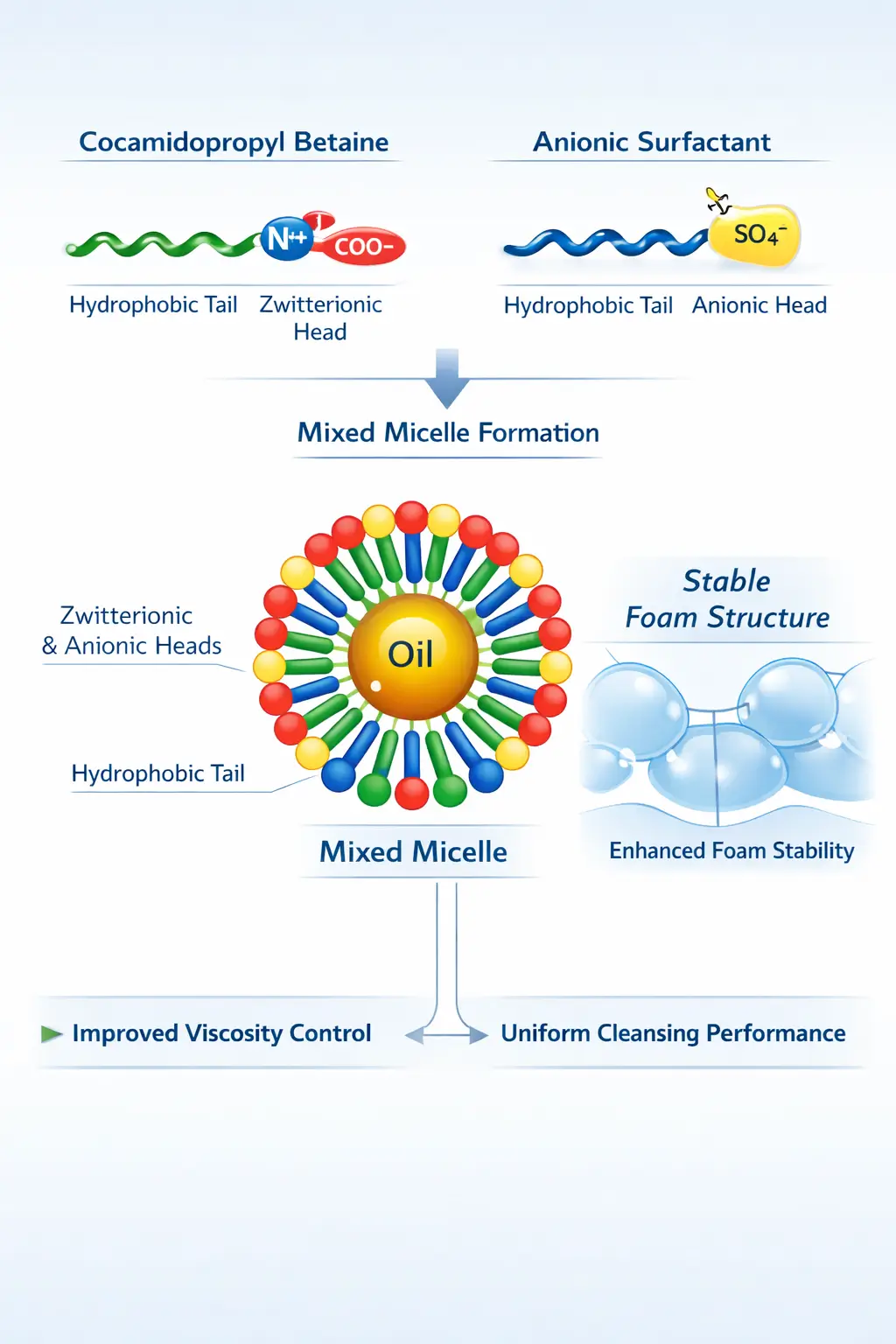
| Micelle Behavior | Integrates into anionic surfactant micelles forming mixed micellar structures |
| Surface Interaction | Reduces irritation potential by modifying surfactant-surface interaction |
| Foam Profile | Enhances foam stability and improves foam texture |
| Viscosity Contribution | Supports viscosity development in combination with anionic surfactants and electrolytes |
| Electrolyte Response | Stabilizes viscosity response in salt-thickened systems |
| Compatibility | Compatible with anionic and nonionic surfactants; limited compatibility with strong cationic systems |
| pH Behavior | Exhibits cationic or anionic character depending on formulation pH |
| Typical Use Context | Liquid cleansing systems such as shampoo, face wash, body wash and mild cleansers |
| Formulation Role | Co-surfactant used to balance cleansing strength, foam stability and system mildness |
Why This Ingredient Appears on Labels
Cocamidopropyl Betaine appears on ingredient lists because it plays a supporting role in surfactant systems, particularly where multiple surfactants are combined to control foam behavior and system stability.
It is commonly used in shampoo and liquid cleansing formulations, where it interacts with primary anionic surfactants to improve foam stability, reduce harshness, and support more uniform formulation behavior.
Its inclusion extends across products such as face cleansers, body wash systems, and even formulations aligned with toothpaste or dishwash liquids, where controlled foam and compatibility with other ingredients are required.
From a formulation perspective, its presence indicates a blended surfactant system rather than a single-surfactant design, which directly influences foam texture, viscosity, and interaction with conditioning or functional additives.
Chemical Identity and Classification
Cocamidopropyl Betaine is defined under the INCI system as an amphoteric surfactant derived from fatty acids, typically sourced from coconut oil, combined with a betaine functional group.
It belongs to the broader class of amphoteric surfactants, specifically betaine-type surfactants, which contain both a quaternary ammonium group and a carboxylate group within the same molecule.
This dual charge structure allows the molecule to shift its ionic behavior depending on the pH of the formulation environment, interacting as either a cationic or anionic-compatible species.
In formulation systems, this adaptability enables it to associate with a wide range of surfactants, particularly anionic types, modifying their interaction patterns rather than acting independently.
Functional Role in Soap Systems
Within cleansing systems, Cocamidopropyl Betaine primarily functions as a secondary surfactant that modifies the performance of primary cleansing agents.
In systems described as soap or synthetic cleansing bases, it contributes to foam stabilization rather than primary cleansing. It reduces the sharpness of foam collapse and supports a more uniform lather structure.
When incorporated into systems such as facewash or liquid cleansers, it enhances the sensory profile by producing foam that feels denser and less brittle during application.
In formulations like body wash or multi-surfactant blends, it also contributes to viscosity building through interaction with electrolytes and surfactant micelles.
In observable terms, its presence shifts the system from a highly reactive foam profile toward a more controlled, stable, and uniform cleansing experience.
Ingredient Interaction Logic
The performance of Cocamidopropyl Betaine is strongly dependent on how it interacts with other surfactants and formulation components.
When combined with anionic surfactants, it forms mixed micellar structures that alter surface activity and reduce interfacial tension variability. This interaction is central to its role in surfactant systems.
Its amphoteric nature allows it to align with negatively charged surfactants without causing destabilization, unlike purely cationic ingredients which may precipitate in such systems.
In the presence of electrolytes such as sodium chloride, it contributes to viscosity modulation by supporting micelle elongation and structural organization.
Interactions with humectants influence hydration behavior of the system, while fragrance components are stabilized through incorporation into mixed micelles.
In broader contexts such as cleansing products and detergent systems, this interaction logic determines foam texture, thickness, and overall formulation stability rather than standalone cleansing strength.
From a practical standpoint, these interactions define whether a product feels thin or structured, produces soft or sharp foam, and maintains consistency across use conditions.
Phase Behavior and System Structure
Cocamidopropyl Betaine is highly soluble in water and participates in micellar systems formed by primary surfactants.
On its own, it forms relatively weak micellar structures, but when combined with anionic surfactants, it integrates into mixed micelles that exhibit enhanced stability and altered geometry.
As concentration increases, the system may transition into more structured phases, particularly in the presence of salts, where micelle elongation contributes to viscosity development.
Its amphoteric charge behavior also affects how micelles respond to pH changes, allowing the system to remain stable across a broader pH range compared to single-surfactant systems.
In practical formulation terms, this phase behavior explains why systems containing this surfactant often show smoother viscosity transitions and more consistent foam performance.
Comparison With Related Surfactants
Cocamidopropyl Betaine is typically used alongside other surfactants rather than as a standalone cleansing agent, making comparison useful for understanding its role within mixed systems.
| Feature | Cocamidopropyl Betaine | Sodium Lauryl Sulfate | Nonionic Surfactants |
|---|---|---|---|
| Ionic Nature | Amphoteric | Anionic | Nonionic |
| Primary Role | Secondary, system modifier | Primary cleanser | Mild cleansing or emulsification |
| Foam Behavior | Stabilizes and smooths foam | Creates strong foam | Lower foam generation |
| System Interaction | Enhances compatibility in blends | Drives cleansing performance | Supports emulsification |
| Typical Use Context | Blended surfactant systems | Liquid cleansers and shampoos | Creams, cleansers, mild systems |
Compared to primary surfactants, its role is not defined by cleansing strength but by how it modifies system behavior, particularly in foam structure and compatibility across ingredients.
Regulatory Context
Cocamidopropyl Betaine is recognized under the INCI naming system and is permitted for use in cosmetic and cleansing formulations under regulatory frameworks such as the European Union Cosmetics Regulation (EC) No 1223/2009.
It is not listed as a restricted substance when used in accordance with formulation standards. Instead, it falls under general product safety and labeling requirements applicable to all cosmetic ingredients.
From a labeling standpoint, it must be declared using its INCI name, ensuring consistent identification across product categories including cosmetics, cleansing systems, and detergent-type formulations.
Manufacturing quality considerations, including residual impurities from synthesis, are governed by broader regulatory expectations related to ingredient purity rather than specific prohibitions.
Common Misunderstanding
A common misunderstanding is that Cocamidopropyl Betaine functions as a primary cleanser similar to anionic surfactants.
In reality, its contribution is primarily structural and interactive. It modifies how other surfactants behave rather than independently driving cleansing performance.
Another misconception is that it behaves as a fixed ionic type. Its amphoteric nature means its interaction profile changes depending on formulation conditions such as pH and surrounding ingredients.
From a formulation perspective, its importance lies in system balance rather than individual performance metrics.
Structural Limitations
While Cocamidopropyl Betaine enhances formulation flexibility, it has limitations that must be considered during system design.
Its standalone cleansing ability is limited, requiring combination with primary surfactants to achieve effective removal of oils and residues.
Its performance is influenced by formulation pH, which alters its ionic behavior and interaction with other surfactants.
In systems with excessive electrolyte concentration, its contribution to viscosity may become less predictable due to changes in micelle structure.
These limitations appear in practical terms as reduced cleansing efficiency when used alone or variability in viscosity depending on formulation conditions.
Summary of Findings
- Classification: Amphoteric betaine surfactant with dual charge behavior.
- Functional Role: Supports foam stabilization, improves system balance, and enhances surfactant compatibility.
- Interaction Logic: Forms mixed micelles with anionic surfactants and adapts to formulation pH.
- System Behavior: Produces smoother foam, controlled viscosity, and improved formulation stability.
- Limitations: Limited standalone cleansing and sensitivity to formulation conditions such as pH and electrolyte balance.