Ivory is a long-standing consumer bar brand with a formulation historically marketed as "pure" and mild. Typical ingredient declarations list sodium tallowate and related fatty acid salts, discussed in detail in our soap ingredients guide, sodium palmitate, sodium cocoate or other plant-derived sodium salts, water, glycerin, Sodium Chloride, and fragrance or citric acid in some versions. Modern product lines include variations with nonsoap cleansing agents similar to systems examined in our antibacterial soap ingredient framework in specialty bars. This article provides a technical breakdown of the full ingredient set, INCI-style interpretations, composition data, pH behavior, likely exposure and allergy considerations, environmental aspects, and practical guidance for formulators and informed consumers.
Typical Ingredients
| Ingredient / Component | Primary Functional Role | Status After Processing |
|---|---|---|
| Sodium Tallowate | Primary soap base (animal fat-derived fatty acid salt) | Remains as solid cleansing matrix forming bulk of bar structure |
| Sodium Palmitate | Primary soap base (plant-derived fatty acid salt) | Provides hardness and structural stability in finished bar |
| Sodium Cocoate | Foaming fatty-acid salt (coconut-derived) | Enhances lather formation and increases solubility |
| Sodium Palm Kernelate | High-cleansing fatty acid salt | Improves detergency and foam speed |
| Sodium Stearate | Structuring fatty acid salt | Increases bar firmness and reduces dissolution rate |
| Sodium Hydroxide | Saponification agent (alkali) | Consumed during reaction; residual presence minimal after curing |
| Glycerin | Humectant and byproduct of saponification | Retained in controlled amounts contributing to glide and moisture interaction |
| Water (Aqua) | Processing solvent | Partially evaporated during drying; residual moisture remains in bar |
| Sodium Chloride | Bar hardening and processing control | Adjusts crystallization and mechanical strength of soap matrix |
| Fragrance (Parfum) | Sensory fragrance system | Volatile blend; gradually dissipates during storage and use |
| Fragrance Allergens (Limonene, Linalool, etc.) | Fragrance constituents | Present in trace amounts; may oxidize over time |
| Citric Acid | pH adjustment and chelation support | Neutralizes excess alkalinity and binds metal ions |
| Tetrasodium EDTA | Chelating agent | Improves performance in hard water by binding calcium and magnesium ions |
| Etidronic Acid | Stabilizer and chelating support | Prevents oxidation and improves shelf stability |
| Titanium Dioxide | Opacifier and whitening agent | Remains inert; provides visual brightness and uniform appearance |
| CI Colorants (if present) | Coloring agents | Stable pigments dispersed within soap matrix |
| Trisodium Phosphate (variant dependent) | Builder / cleaning enhancer | Supports soil removal; more common in laundry-oriented variants |
| Synthetic Surfactants (variant dependent) | Supplementary cleansing system | Present in specialty bars or liquid variants; form micellar cleansing systems |
| Preservatives (e.g., Phenoxyethanol, DMDM Hydantoin) | Microbial control (mainly liquid variants) | Remain active throughout product shelf life |
| Viscosity Modifiers (PEGs, Carbomers) | Texture and rheology control | Maintain consistency in liquid formulations |
| pH Adjusters (Sodium Carbonate) | Alkalinity control | Maintains target pH range in final product |
| Fatty Acid Residues (Palmitic, Stearic, Oleic fractions) | Composition remnants of feedstock oils | Remain integrated within soap matrix influencing performance |
| Processing Residues (trace) | Manufacturing remnants | Present at negligible levels without active functional role |
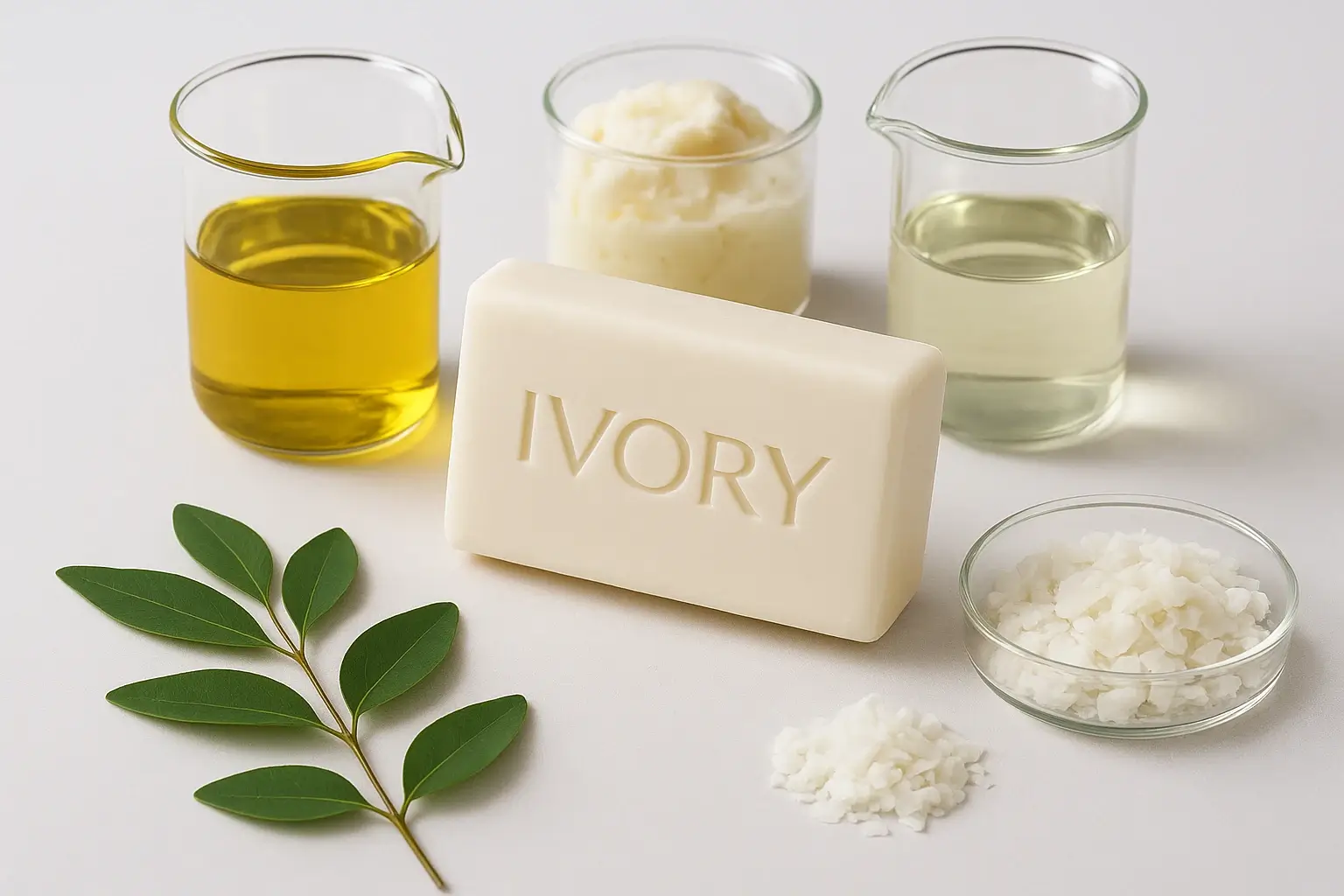
Clear Definition In Simple Terms
Ivory is primarily a solid soap bar produced by saponifying fats and oils with alkali, consistent with processes described in our cold process soap ingredient analysis, resulting in sodium salts of fatty acids that function as surfactants. The finished bar also contains processing aids and low-level additives such as glycerin, salt, and fragrance. In some modern iterations, the brand uses combinations of traditional soap with mild synthetic surfactants in specialty products. The classic intention of the product is a general-purpose cleansing bar with emphasis on mildness and rinsability.
Origin And Brief History
Ivory was introduced in the late 19th century by a major consumer goods company and quickly positioned around simplicity and purity. Early advertising emphasized the absence of heavy perfumes and the product's ability to float in water. Over decades the ingredient list evolved with changes in raw material sourcing, manufacturing efficiency, and regulatory transparency. The brand has remained associated with basic bar soap formulations, while newer product variants have incorporated modern cleansing technology and alternative feedstocks.
How Ivory Bar Is Made
The core manufacturing route for a traditional Ivory-style bar is saponification. Triglyceride feedstocks, such as tallow or vegetable oils, react with sodium hydroxide to yield glycerin and sodium carboxylate salts, commonly referred to as soap. The process stages are:
- Fat Blending - selection and blending of triglyceride fats to achieve target fatty acid profile.
- Saponification - controlled addition of sodium hydroxide at specific temperature to convert triglycerides to sodium salts.
- Glyceryl Retention or Removal - some processes retain glycerin as a humectant; others recover and reuse glycerin.
- Washing and Neutralization - removal of soluble impurities and adjustment of free alkali to safe levels.
- Additive Incorporation - addition of salts to control hardness, whitening agents for appearance, and low-level fragrance.
- Drying, Milling, and Molding - to produce a uniform bar with desired hardness and finish.
Chemically, the saponification reaction is a base-catalyzed ester hydrolysis. The sodium salts formed are amphiphilic molecules with a hydrophilic carboxylate head and a hydrophobic alkyl chain, enabling micelle formation and emulsification of oils in aqueous wash.
Forms And Types
Ivory-style products exist in several forms:
- Classic Bar Soap - hard bar formulated via saponification of fats and oils.
- Beauty Bars - variants marketed for skin use that may include additional emollients or glycerin retention.
- Specialty Bars - formulations with added synthetic mild surfactants or conditioners for targeted claims.
- Liquid Cleansers - surfactant systems derived from similar fatty acid feedstocks but processed into liquid syndet formats.
The specific ingredient set and proportions vary between product lines and markets. Understanding which form is under consideration is essential when interpreting an ingredients list.
Ingredient Transparency And Full INCI Interpretation
Publicly available ingredient declarations for Ivory products typically include a combination of soap salts and processing aids. Below is a detailed INCI-style interpretation of common entries and the functional meaning behind them.
Common INCI Entries And Interpretations
- Sodium Tallowate - Sodium salt of fatty acids derived from animal tallow. Predominantly palmitic and stearic acids. Provides bar hardness and mild cleansing.
- Sodium Palmitate - Sodium salt derived from palm oil. Balances hardness and lather properties.
- Sodium Cocoate - Sodium salts of coconut-derived fatty acids. Rich in lauric and myristic acids that boost foaming and detergency.
- Sodium Stearate - Sodium salt of stearic acid. Contributes to bar firmness and longevity.
- Glycerin - A byproduct of saponification retained as a humectant and to improve skin feel and bar plasticity.
- Sodium Chloride - Salt added to control soap hardness and to modify solubility.
- Water - Solvent and processing medium.
- Fragrance - Proprietary blend of odorants. Composition is often trade secret; some variants specify "unscented" or "fragrance-free".
- Citric Acid - pH stabilizer or chelating agent in some formulations.
- Trisodium Phosphate Or Mild Builders - Occasionally used in laundry-aimed bars; not typical in personal care beauty bars.
- Sodium Palmitate - Specific sodium salt representing palmitic acid-rich fractions, often present when palm-based feedstocks are used.
Ingredient transparency varies by market. Labels generally follow regulated naming conventions, but full composition details such as fatty acid distribution and fragrance constituents remain proprietary.
Key Characteristics And pH Notes
Key functional characteristics of a traditional Ivory-style bar:
- Mild Cleansing - Balanced fatty acid profile aimed at lower irritation compared with harsh detergents.
- Good Rinsability - Formulation optimized to rinse clean from skin and fabrics.
- Moderate Lather - Combination of coconut and palm/tallow-derived sodium salts yields usable foam across water hardness ranges.
- Stable Bar Hardness - Use of saturated fatty acid salts such as palmitate and stearate for durability.
pH Considerations - Most sodium salt bar soaps are alkaline in aqueous solution. Typical pH of a soap solution for bar products ranges from 9 to 11 depending on dilution and residual free alkali content. pH values are a physical property of soap solutions and influence cleaning performance and interaction with skin or fabrics. This is an informational note and not medical guidance.
Fatty-Acid And Chemical Composition Tables
The functional profile of a soap bar is a direct result of the fatty-acid distribution present in the starting triglycerides. The table below gives representative ranges for common feedstocks used in Ivory-style formulations.
| Fatty Acid | Palm / Palmitic-Rich Feedstock % | Coconut % | Tallow % | Functional Effect |
|---|---|---|---|---|
| Lauric (C12) | 0-1 | ~45-50 | <1 | High foaming, strong detergency |
| Myristic (C14) | 1-3 | ~15-20 | 1-3 | Foam stability, cleansing speed |
| Palmitic (C16) | ~40-45 | ~8-10 | ~20-30 | Bar hardness, creamy lather |
| Stearic (C18) | ~3-6 | ~2-3 | ~10-25 | Hardness, slow solubility |
| Oleic (C18:1) | ~35-45 | ~6-10 | ~30-45 | Conditioning, mildness |
Notes - Actual percentages in finished soap are influenced by fat blend, saponification completeness, and any post-process additions. Fatty-acid ranges above are typical for feedstocks and are useful to estimate expected bar performance for lather, hardness, and conditioning.
Ingredient Function Table
| Ingredient | Function | Performance Notes |
|---|---|---|
| Sodium Palmitate / Sodium Tallowate | Primary surfactant (soap) and structure | Provides bulk of cleaning and contributes to hardness |
| Sodium Cocoate | High-foaming surfactant fraction | Improves initial lather; increases solubility |
| Glycerin | Humectant and plasticizer | Improves feel on skin and reduces rapid bar drying |
| Sodium Chloride | Hardness and rheology modifier | Used to adjust bar firmness and milled soap texture |
| Fragrance | Olfactory attribute | Trade secret blends; may include allergens for sensitive individuals |
| Citric Acid | pH chelation and stability | May reduce free metal ions that affect appearance or rancidity |
Ingredient Ranges, Ratios, And Percentages
Commercial bar soaps typically present the following approximate composition ranges, recognizing that precise formulations are proprietary:
- Soap (Sodium Salt Fraction) - 70 to 95% by weight. This group comprises mixed sodium salts from various fats and oils.
- Glycerin - 0.5 to 6% retained, depending on whether glycerin is reclaimed or intentionally retained for skin feel.
- Water - 3 to 10% in a fully milled and dried bar; higher in softer or beauty bars.
- Sodium Chloride - trace to 3% to modulate hardness.
- Fragrance - trace to 1% depending on scent intensity.
- Other Additives - optical brighteners, Colorants, or mild syndet agents <1% each when present.
Ratio Example - A generic composition for a classic bar might be 85% combined sodium salts (palmate, stearate, cocoate), 4% glycerin, 7% water, 2% sodium chloride, and 1% minor additives. This is illustrative and not a claim about any specific SKU.
Comparison Table
The following table contrasts a traditional Ivory-style soap bar and a modern syndet beauty bar to highlight technical differences.
| Feature | Traditional Soap Bar | Syndet Beauty Bar |
|---|---|---|
| Main Surfactant | Sodium salts of fatty acids (soap) | Ethoxylated or sulfonated synthetic surfactants |
| pH Of Wash Solution | ~9 to 11 | ~5 to 7 (formulated to skin pH) |
| Rinsability | Good; can form soap scum with hard water | Excellent; formulated to resist scum and rinse easily |
| Skin Compatibility | Depends on fatty-acid profile; generally acceptable for many users | Targeted for mildness and preserved skin barrier |
| Typical Use | General cleansing and laundry-style bars | Facial and body cleansing with mildness claims |
Manufacturing Transparency
Transparency on ingredient lists for mass-market bars adheres to regulatory labeling rules in most jurisdictions. However, exact fatty-acid distributions, manufacturing aids, and fragrance compositions are often proprietary. For industrial or safety concerns, safety data sheets and manufacturer declarations provide more detailed hazard and composition information, including any trace contaminants or allergenic constituents. When precise compositional data is required for regulatory, toxicological, or supply chain reasons, direct manufacturer engagement is the recommended route.
Dish Soap Ingredients (Ivory dishwashing liquid)
Its formula is detergent-based, not traditional soap. Ingredients include: water, sodium lauryl sulfate, C10-16 alkyldimethylamine oxide, sodium chloride, Deceth-8, preservative (methylisothiazolinone), phenoxyethanol, PPG-26, and fragrance.
The dish soap is formulated to cut grease effectively (typical for detergents), while the bar soap is more about gentle skin cleansing. The bar soap is made by saponification (traditional soap chemistry), while the dish soap is a commercial detergent (synthetic surfactants)
Practical Understanding Guidance
Interpreting an ingredients list and using Ivory-style bars practically:
- Reading Labels - Ingredients are listed in descending order by weight for most jurisdictions. Pay attention to exact INCI names and any "plus" lines indicating proprietary blends.
- Allergen Awareness - Fragrances can contain allergenic molecules. Individuals with known fragrance sensitivities should seek fragrance-free variants or consult ingredient disclosures.
- Hard Water Interaction - Traditional soap can form insoluble salts ("soap scum") in hard water. Rinsability and user experience vary by water hardness and bar composition.
- Substitution Considerations - For skin-focused use choose bars labeled as "beauty" or "for skin" which typically retain more glycerin and may have modified fatty-acid profiles or syndet blends.
Environmental Notes
Environmental considerations for soap bars include raw material sourcing, biodegradability, and auxiliary additives. Sodium salts of fatty acids from natural feedstocks biodegrade under aerobic conditions. Concerns arise with feedstock sustainability for palm oil or animal fats, and with persistent synthetic additives such as nonbiodegradable brighteners or certain fragrance components. Wastewater treatment typically handles saponified fatty acids effectively, but product lifecycle assessments should consider upstream agricultural impacts and downstream additive persistence. Another example of a classic bar soap formulation can be explored in the Pears soap ingredient analysis , where the soap base is combined with humectants and additives.
Myths Versus Reality
Common assertions and technical context:
- Myth - Ivory Bars Are Completely Natural. Reality - Core soap salts are derived from natural fats, but finished products can include synthetic fragrances, brighteners, and processing aids.
- Myth - Soap Bars Are Always Harsh. Reality - Mildness depends on fatty-acid composition and glycerin retention; many bars are formulated for gentle use.
- Myth - Floating Means Purity. Reality - Floating is an incidental physical property related to bar density and air incorporation from manufacturing; it is not a proxy for chemical purity.
Q And A
- What Are The Main Ingredients In Ivory Soap?
- Main ingredients include sodium salts of fatty acids (from tallow, palm, or coconut), water, glycerin, sodium chloride, and optional fragrance or citric acid, depending on variant.
- Is Ivory Soap Safe For Sensitive Skin?
- Many users find classic bars acceptable. However, individuals with known sensitivities to fragrances or certain additives should choose fragrance-free or dermatologist-tested variants. This is informational and not medical advice.
- Does Ivory Contain Animal Fats?
- Some formulations historically used tallow or other animal fats; modern variants may use plant oils or a blend. Ingredient declaration on the packaging will indicate source if present.
- How Alkaline Is Ivory Soap?
- Typical soap solutions are alkaline, with pH commonly in the range of 9 to 11 when dissolved at use concentrations.
Summary
Ivory-style bars are primarily composed of sodium carboxylate salts, comparable to structures analyzed in our Dove soap ingredient breakdown, produced by saponification of triglyceride feedstocks. The overall performance, mildness, and environmental profile depend on the fatty-acid distribution of the starting fats, the degree of glycerin retention, and the presence of minor additives such as fragrance, chelants, or brighteners. Labels provide a high-level ingredient overview but not proprietary ratios. Informed selection requires reading exact ingredient declarations, assessing fragrance inclusion for sensitivity, and considering water hardness when evaluating rinsability.
References
- Gunstone, F. D. Fatty Acid and Lipid Chemistry. Publisher reference
- Schramm, L. L. Surfactants: Fundamentals and Applications. Wiley Online Library
- Rosen, M. J. Surfactants and Interfacial Phenomena. Publisher reference
- U.S. FDA Cosmetic Labeling Guide. FDA documentation
- Journal of Surfactants and Detergents – Soap and syndet chemistry studies. Journal archive