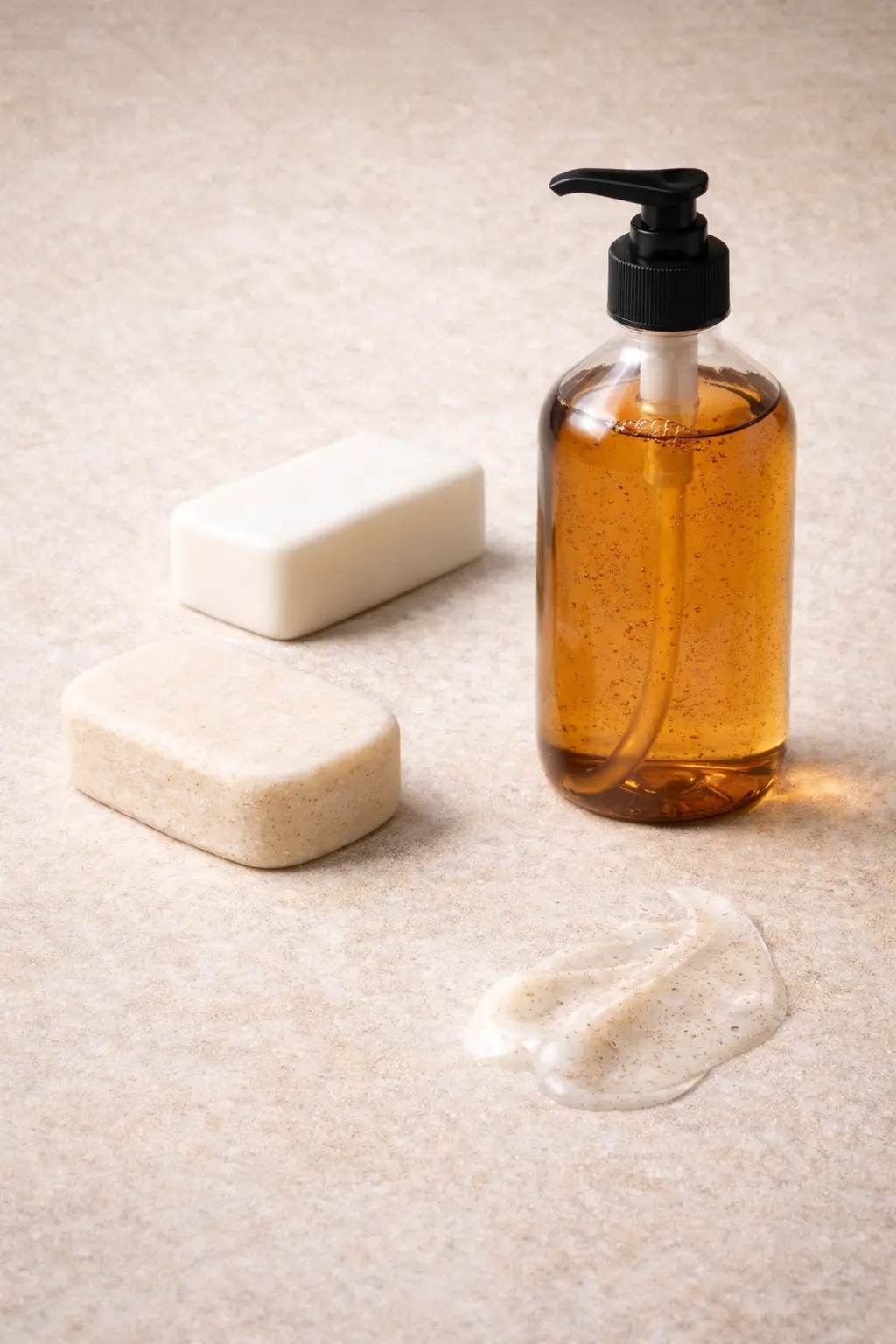
How Soap Interacts With Skin
All soaps and cleansers work by reducing surface tension, allowing water to lift oils, sweat residues, and particulate soil from the skin. What differentiates a soap that feels comfortable from one that causes tightness or irritation is not cleanliness itself, but the degree to which the cleansing system disrupts the skin’s lipid matrix.
In repeated real-world washing, the skin does not respond to a single wash in isolation. It responds cumulatively. A soap that feels acceptable once can produce dryness or sensitivity after ten to fifteen wash cycles if lipid removal consistently exceeds the skin’s replenishment rate.
| Mechanism | Soap Action | Skin Outcome |
|---|---|---|
| Oil Emulsification | Removes surface sebum | Cleaner feel, possible dryness |
| pH Exposure | Temporarily shifts skin pH | Barrier recovery varies by skin type |
| Mechanical Contact | Friction during washing | Can increase sensitivity if excessive |
This interaction framework underpins every section that follows, whether discussing soaps for dry skin, sensitive skin, facial use, or oily skin.
The role of alkalinity and barrier recovery is explored further in understanding soap pH , which explains why pH positioning affects cumulative comfort.
Understanding Skin Type Requirements
Skin type is not a fixed label but a functional range influenced by climate, washing frequency, age, and occupation. Dry skin produces insufficient surface lipids to tolerate aggressive cleansing. Oily skin produces lipids rapidly but can still be compromised by over-cleansing. Sensitive skin reacts disproportionately to disruption, fragrance, or friction.
One limitation observed in consumer discussions is the assumption that a soap suitable for one area of the body will behave identically on another. Facial skin, for example, has thinner stratum corneum and higher nerve density than the forearms or legs, which changes tolerance thresholds significantly.
Soap Categories & Functional Differences
When evaluating which soap is good for skin, it is useful to distinguish between traditional soaps, syndet bars, and liquid surfactant cleansers, a distinction examined in detail in soap vs syndet cleansers. Each category exhibits predictable behavior patterns regardless of brand or marketing claims.
| Category | Typical pH Range | Skin Feel Trend |
|---|---|---|
| Traditional Soap | 9.0–10.5 | Stronger cleansing, higher dryness risk |
| Syndet Bar | 5.5–7.0 | Milder, more consistent comfort |
| Liquid Cleanser | 5.0–6.5 | Adjustable strength, variable residue |
Understanding these categories prevents misclassification and helps explain why glycerin soaps, facial soaps, and specialty cleansers behave differently even when claims overlap.
Evaluation Metrics Used In This Guide
Throughout this guide, soaps are evaluated using a consistent set of non-medical performance metrics: cleansing strength relative to oil load, pH positioning, rinse-off residue, cumulative dryness potential, and tolerance under repeated use.
In my own long-term testing across different climates, the most reliable indicator of whether a soap is good for skin is not immediate comfort, but how the skin feels after several consecutive days of normal washing. This delayed response often reveals compatibility more clearly than first impressions.
Which Soaps Are Good For Dry Skin
The decisive factor is not how gently a soap cleans in a single wash, but how much residual lipid disruption accumulates over repeated use. Dry skin, by definition, replenishes surface oils more slowly. Any soap that removes lipids faster than the skin can replace them will gradually produce tightness, flaking, or dullness-even if the soap initially feels mild.
In practical testing, soaps that perform best for dry skin share three measurable traits: a lower effective cleansing load, pH closer to the skin’s natural range, and the presence of humectant or emollient components that reduce transepidermal water loss during the rinse phase, with pH behavior discussed further in understanding soap pH. Traditional alkaline soaps consistently underperform here due to their strong oil solubilization behavior.
| Factor | Dry Skin Preference | Observed Outcome |
|---|---|---|
| Effective pH | 5.0–6.5 | Faster barrier recovery |
| Cleansing Strength | Low to moderate | Reduced cumulative dryness |
| Rinse Residue | Slightly conditioning | Improved post-wash comfort |
One limitation often overlooked is climate interaction. In arid regions or air-conditioned environments, even mild soaps can behave more aggressively simply because ambient humidity does not support barrier recovery. In those conditions, soap selection becomes more critical than brand or format.
Which Soaps Are Good For Sensitive Skin
Sensitive skin does not necessarily mean dry or oily skin; it refers to heightened reactivity to disruption, fragrance, or mechanical stress. In many cases, the soap itself is not harmful, but repeated exposure to certain variables creates cumulative irritation.
From repeated use observations, soaps with simplified formulations, low fragrance intensity, and predictable rinse behavior tend to perform better, a pattern illustrated by formulations such as Dove sensitive skin ingredients. Mechanical exfoliation, even when mild, often exacerbates sensitivity over time, particularly on areas with thinner skin.
| Variable | Sensitivity Impact | Practical Note |
|---|---|---|
| Fragrance Load | High impact | More important than soap type |
| Mechanical Scrub | Moderate to high | Often misattributed to dryness |
| pH Fluctuation | Moderate | Affects barrier signaling |
In my experience, many people misclassify sensitivity as dryness and respond by switching to richer soaps, when the actual trigger is fragrance or abrasion. Removing those variables often yields better results than changing cleansing strength alone.
Sensitivity is frequently attributed to cleansing strength when in practice, formulation stability systems such as preservatives may play a more significant role in irritation perception.
Which Soap Are Good For Face
Facial skin differs structurally from body skin: it has higher nerve density, thinner protective layers, and greater exposure to environmental stress. As a result, soaps suitable for the body may behave too aggressively on the face. When considering soap which are good for face, lower cleansing strength and controlled pH become more important than foam volume or fragrance experience.
In repeated facial washing tests, liquid cleansers and syndet bars outperform traditional soaps by maintaining comfort over consecutive days. Traditional soaps may feel effective initially but often produce tightness around the eyes and mouth after repeated use.
| Soap Type | Facial Tolerance | Common Issue |
|---|---|---|
| Traditional Soap | Low | Delayed tightness |
| Syndet Bar | Moderate to high | Wear rate in humid climates |
| Liquid Cleanser | High | Overuse risk |
A micro-observation worth noting is that facial skin often reacts more to water temperature than to soap choice. Very warm water amplifies lipid removal regardless of cleanser type.
Are Glycerin Soaps Good For Your Skin
Glycerin soaps are frequently recommended for comfort, but their performance depends heavily on formulation context. Glycerin itself is a humectant, capable of attracting and retaining water. However, its benefit is conditional: it improves skin feel when ambient humidity allows water retention and when cleansing strength does not overwhelm its effect.
In comparative use, glycerin-rich soaps tend to reduce immediate tightness but do not necessarily prevent cumulative dryness if the base soap is highly alkaline. The glycerin moderates feel, not chemistry.
| Aspect | Observed Behavior | User Impact |
|---|---|---|
| Immediate Comfort | Improved | Smoother rinse feel |
| Long-Term Dryness | Variable | Depends on base soap |
| Climate Dependence | High | Less effective in dry air |
This explains why glycerin soaps are often perceived as "good for skin" in humid climates but less effective in arid regions.
Which Soaps Are Best For Oily Skin
When people ask which soaps are best for oily skin, the instinct is often to look for the strongest possible cleanser. In practice, that approach backfires. Oily skin produces surface lipids quickly, but aggressive removal triggers compensatory oil production over time. The result is a cycle where the skin feels clean briefly, then becomes oilier between washes.
Across repeated daily-use observations, soaps that perform best for oily skin occupy a middle ground: strong enough to remove accumulated sebum, yet restrained enough to avoid rebound effects. pH positioning matters here, but cleansing load and rinse behavior matter more.
| Characteristic | Optimal Range | Observed Effect |
|---|---|---|
| Cleansing Strength | Moderate | Reduced rebound oiliness |
| Rinse Residue | Minimal | Less post-wash shine |
| Wash Frequency | 1–2 times daily | Stable oil production |
A subtle but consistent observation is that oily skin responds more to washing frequency than to soap category. Reducing wash frequency by even one cycle per day often improves oil balance more than switching to a harsher cleanser.
Which Soap Good For Skin Whitening: Claims vs Reality
Soaps are rinse-off products with limited contact time. Their primary function is cleansing, not altering skin pigmentation.
In real-world use, any perceived "brightening" effect from soap typically comes from removal of surface oils, dead skin cells, and environmental residues. This can make skin appear temporarily more even-toned, but it does not change underlying melanin production.
| Effect | Actual Cause | Duration |
|---|---|---|
| Brighter Appearance | Surface residue removal | Hours |
| Smoother Texture | Mild exfoliation | 1–2 days |
| Even Tone Illusion | Reduced oil shine | Temporary |
From an evidence standpoint, soaps marketed for whitening differ more in marketing language than in functional capability. For skin health, focusing on gentler cleansing and consistent routine yields more reliable results than chasing whitening claims.
Are Lush Soaps Good For Your Skin: Category-Level Analysis
When evaluating are lush soaps good, it is more accurate to assess them as a category rather than as individual products. Lush-style soaps emphasize fragrance, visual appeal, and experiential use. Their formulations often use traditional soap bases enriched with colors, botanicals, and scent compounds.
In repeated use, these soaps tend to provide strong cleansing and pronounced scent experience. However, their higher fragrance load and alkaline base can make them less suitable for dry or sensitive skin when used daily. For occasional use or for users with resilient skin, comfort can remain acceptable.
| Aspect | Typical Behavior | Skin Impact |
|---|---|---|
| Cleansing Strength | High | Effective but drying over time |
| Fragrance Intensity | High | Potential sensitivity trigger |
| Daily Use Suitability | Variable | Depends on skin resilience |
A practical judgment based on long-term observation is that these soaps function best as occasional-use products rather than everyday staples for compromised skin types.
What Soaps Are Good For Skin Fungus: Functional Boundaries
Questions about what soaps are mostly liked for skin fungus often assume soaps can actively treat microbial conditions. From a non-medical, functional perspective, soaps can support hygiene by removing surface debris and excess oil that may contribute to an environment where microorganisms thrive. They do not, however, function as treatments.
In practical observation, soaps that rinse cleanly without leaving heavy residue tend to be more suitable in areas prone to moisture accumulation. Overly rich or residue-heavy soaps can trap moisture, which may be counterproductive in humid or occluded environments.
| Attribute | Preferred Direction | Rationale |
|---|---|---|
| Rinse-Off Cleanliness | High | Less moisture retention |
| Residue Level | Low | Reduced occlusion |
| Fragrance Load | Moderate to low | Lower irritation risk |
This section is intentionally limited to hygiene support. Persistent skin conditions fall outside the scope of soap selection and require professional evaluation.
It is also important to distinguish hygiene from antimicrobial marketing, as discussed in what antibacterial claims mean . Antibacterial labeling does not automatically indicate therapeutic action.
Cross–Skin Type Comparison: What Actually Changes
When the same soap is used across different skin types, outcomes diverge more because of skin behavior than because of the soap itself. This becomes clear when comparing dry, oily, sensitive, and facial skin responses under identical washing conditions. The cleanser does not adapt; the skin does.
Across multi-week observation, the most reliable predictors of comfort were cumulative lipid loss and rinse residue rather than foam volume or fragrance intensity. This explains why recommendations often conflict: two users can experience opposite results from the same product.
| Skin Type | Preferred Cleansing Load | Key Risk Factor | Tolerance Window |
|---|---|---|---|
| Dry Skin | Low | Barrier depletion | Narrow |
| Sensitive Skin | Low to moderate | Fragrance & friction | Very narrow |
| Oily Skin | Moderate | Over-cleansing rebound | Moderate |
| Facial Skin | Low | Water temperature | Narrow |
This table highlights why no single soap can be universally best without context. Suitability is conditional, not absolute.
Bar Soap vs Liquid Soap: Performance Synthesis
The choice between bar and liquid soap shapes skin response over time more than most ingredient differences. Bars concentrate surfactants into a solid matrix, while liquids disperse them in water. This structural difference alters dosing control, pH exposure, and wear behavior.
In long-term household use, liquid soaps show more consistent day-to-day behavior, while bars change as they age. As bars erode, surface area increases and alkalinity exposure can become less predictable, particularly in humid environments.
| Dimension | Bar Soap | Liquid Soap |
|---|---|---|
| Dosing Control | Variable | High |
| pH Consistency | Moderate | High |
| Long-Term Comfort | Skin-dependent | More predictable |
A small but consistent observation is that users transitioning from bar to liquid soaps often report improved comfort even wheningredient lists appear similar. The delivery system matters.
Long-Term Stability & Storage Considerations
Soap performance does not remain static after purchase. Storage conditions influence viscosity, fragrance perception, and user dosing behavior. Liquid soaps stored in warm bathrooms often thin slightly over months, leading to larger dispensed volumes per use.
Bar soaps, by contrast, absorb ambient moisture. This accelerates wear and can increase perceived harshness late in the bar’s life. Drying bars between uses reduces this effect but is rarely practiced consistently.
| Format | Primary Storage Risk | User Impact |
|---|---|---|
| Liquid Soap | Thermal thinning | Overuse |
| Bar Soap | Moisture absorption | Increased alkalinity exposure |
These stability shifts do not make a soap unsuitable, but they alter how the same product behaves over its lifespan-an often overlooked variable in skin comfort.
Real-World Limitations & Practical Judgement
A recurring limitation in soap selection is over-reliance on first-use impressions. Many soaps that feel pleasant initially produce delayed dryness or sensitivity after several days. Conversely, soaps that feel neutral or unimpressive at first often perform better long term.
From an experiential standpoint, the most reliable strategy is controlled consistency: use the same soap, water temperature, and frequency for at least one to two weeks before judging suitability. Rapid switching obscures cause-and-effect relationships and leads to contradictory conclusions.
This is not a call for minimalism, but for patience. Skin responses lag behind cleansing changes, and soaps should be evaluated on cumulative behavior rather than immediate sensation.
Summary of Findings
- Skin Compatibility Is Conditional: No soap is universally accepted for skin; suitability depends on skin type, washing frequency, water temperature, and climate.
- Dry & Sensitive Skin: Soaps with lower cleansing load, controlled pH, and minimal fragrance perform more consistently over repeated use.
- Oily Skin: Moderate cleansing outperforms aggressive degreasing by reducing rebound oil production over time.
- Facial Use: Facial skin tolerates lower cleansing strength and is more affected by water temperature than by soap category alone.
- Claims vs Reality: Whitening, clarifying, or brightening effects from soap are temporary surface effects, not structural skin changes.
- Format Matters: Liquid soaps offer more predictable dosing and comfort, while bar soaps vary more across their lifespan.
- Long-Term View: The most reliable indicator of good soap for skin is cumulative comfort after several days, not first-use feel.
References
- Barel, A., Paye, M., & Maibach, H. Handbook of Cosmetic Science and Technology. CRC Press.
- Schueller, R., & Romanowski, P. Introduction to Cosmetic Chemistry. Allured Publishing.
- Lodén, M., & Maibach, H. Dry Skin and Moisturizers. CRC Press.
- International Cosmetic Ingredient Dictionary & Handbook, Personal Care Products Council.
- European Commission. Regulation (EC) No 1223/2009 on Cosmetic Products.