Soap As A Cleansing System
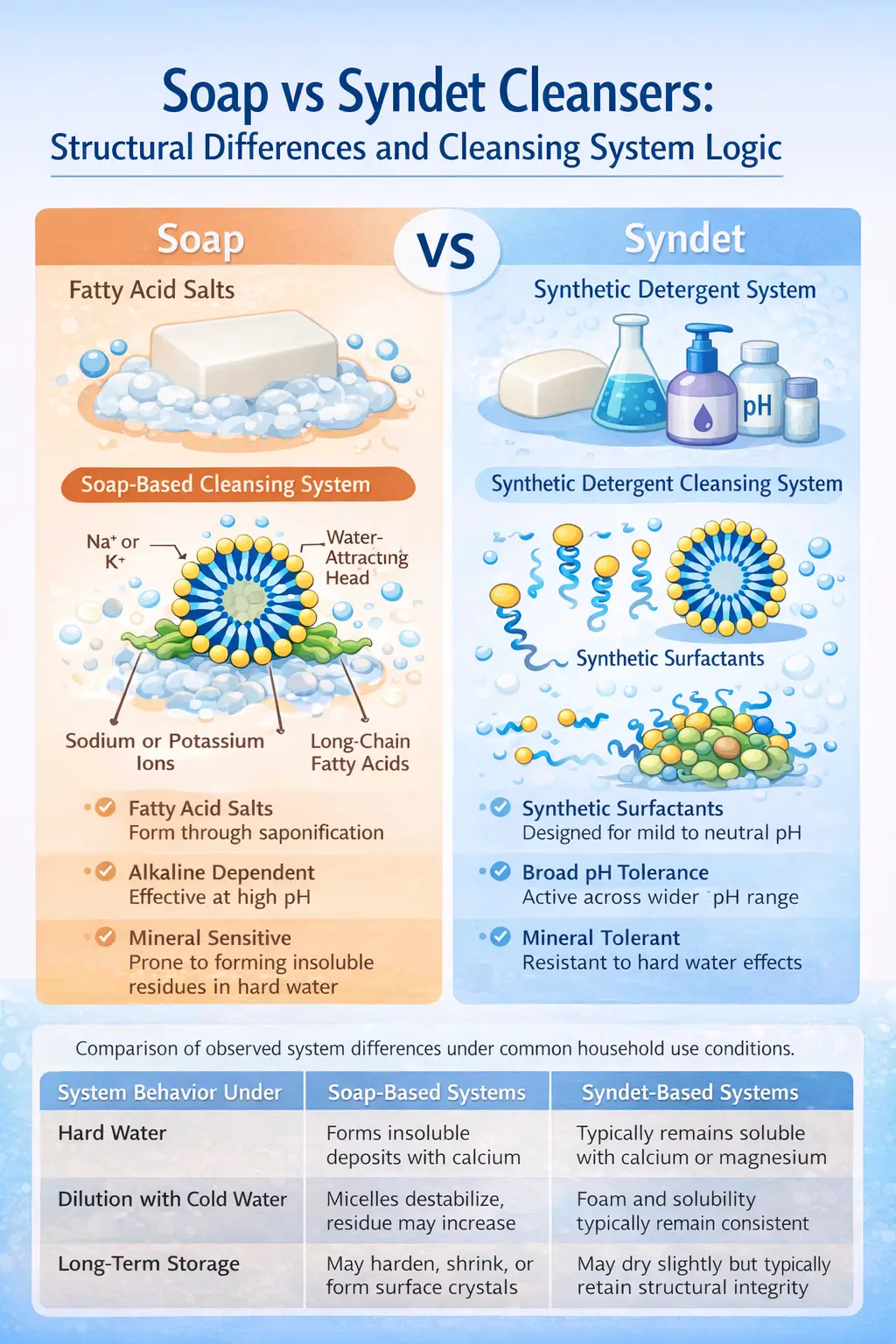
Soap is a cleansing system built from fatty acid surfactants (fatty acid salts) formed through saponification. In this structure, long-chain fatty acids are chemically bound to sodium or potassium ions, creating amphiphilic molecules that interact with both oils and water. This dual affinity allows soap to emulsify soils, but it also introduces specific constraints that shape how soap behaves once it leaves the formulation and enters use.
The defining feature of soap is its ionic dependency, a constraint shared with traditional soap systems and contrasted structurally in the soap vs detergent formulation differences guide. The cleansing action relies on the stability of fatty acid salts in solution, which remains sensitive to environmental factors such as water hardness and dilution rate. Historically, this system dominated household cleansing because it could be produced from natural fats using relatively simple chemistry, long before synthetic surfactants were developed.
Because soap molecules are both the cleansing agents and the structural backbone of the product, changes in fatty acid composition directly affect hardness, solubility, and wear rate. A bar rich in sodium stearate behaves very differently from one dominated by sodium oleate, even though both are technically soap.
How Soap Structure Shapes Real-World Behavior
Soap systems form crystalline or semi-crystalline matrices in solid form and micellar systems in solution. These structures are not fixed. They reorganize continuously as water content, temperature, and mineral composition change during use. This dynamic behavior explains why soap performance can feel inconsistent across households without any change in formulation.
A common misunderstanding is that soap performance is primarily determined by added ingredients. In practice, the dominant factor remains the fatty acid salt system itself. Additives may influence secondary characteristics such as slip or scent perception, but they do not override the core ionic behavior of soap.
| Condition | Structural Response | Observable Outcome |
|---|---|---|
| Hard Water Exposure | Fatty acid salts bind calcium or magnesium ions | Reduced solubility and visible residue formation |
| Rapid Dilution | Micelle destabilization | Uneven rinsing and film persistence |
| Low Temperature | Decreased fatty acid mobility | Lower lather volume and slower dispersion |
Syndet As A Cleansing System
Syndet cleansers are built on synthetic surfactants rather than fatty acid salts, a formulation approach illustrated in ingredient-level analyses such as Dove Sensitive Skin Ingredients. Common examples include sodium cocoyl isethionate, sodium lauryl sulfate, sodium laureth sulfate, and alkyl polyglucosides. These surfactants are engineered to provide surface activity without relying on the ionic pairing that defines soap.
This structural separation allows syndet systems to decouple cleansing performance from mineral sensitivity. The surfactant molecules remain soluble across a broader range of water compositions and pH environments, which is why syndets are frequently described as more formulation-flexible, even when delivered in solid formats.
Unlike soap, the solid form of a syndet cleanser is not created by crystallized surfactant salts alone. Structural integrity is achieved through binders, fillers, and processing techniques that hold surfactant particles in place without forming a true soap matrix.
Why Syndet Systems Behave Differently In Use
Syndet surfactants are designed to maintain micelle formation under conditions that destabilize soap. Their molecular structure reduces sensitivity to divalent ions and allows formulators to target specific performance traits such as foam persistence or rinse feel with greater precision.
This flexibility often leads to the assumption that syndets are categorically superior. In reality, the difference lies in system design rather than outcome quality. Syndet systems prioritize structural control and consistency, while soap systems operate through fatty acid salt chemistry..
A limitation of syndet systems is that their performance depends heavily on formulation balance. Changes in binder ratio, surfactant blend, or processing conditions can alter dissolution behavior significantly, even when the ingredient list appears similar.
Summary of Findings
- System Identity: Soap and syndet cleansers are fundamentally different chemical systems despite overlapping formats.
- Structural Dependence: Soap relies on fatty acid salts, while syndets rely on engineered surfactants and binders.
- Environmental Sensitivity: Soap systems respond strongly to water hardness and temperature, following the same mineral interaction limits outlined in soap and hard water behavior, whereas syndets are more stable across conditions.
- Design Trade-Offs: Each system reflects deliberate compromises between simplicity, control, and consistency.
Boundary Cases And Hybrid Formats
In everyday use, the distinction between soap and syndet is often blurred by formats that resemble one system while operating as the other. Solid bars labeled as cleansers may look and feel like soap yet rely primarily on synthetic surfactants such as sodium cocoyl isethionate or sodium lauroyl sarcosinate. The visual form suggests soap, but the underlying chemistry does not.
These boundary cases frequently lead to misinterpretation. Consumers may attribute differences in rinsing, residue, or lather to added ingredients when the decisive factor is the core surfactant system. The confusion is structural rather than informational. Format cues are stronger than ingredient literacy in most household contexts.
Hybrid designs also exist in liquid products where fatty acid soaps are blended with synthetic surfactants to stabilize foam or reduce mineral sensitivity. In such cases, neither system operates in isolation. Behavior reflects the balance between ionic soap components and non-soap surfactants rather than a single dominant mechanism.
Storage And Aging Effects Across Systems
Soap and syndet systems respond differently to time and storage conditions. Soap bars continue to reorganize internally after production as residual moisture migrates and crystalline regions mature. This slow structural change affects hardness, solubility, and wear rate over weeks or months.
Syndet bars, by contrast, do not rely on crystallized fatty acid salts for structure. Their physical stability depends on binder integrity and moisture equilibrium rather than ongoing chemical reorganization. As a result, changes over time tend to appear as surface drying or texture shifts rather than altered cleansing behavior.
| Factor | Soap Systems | Syndet Systems |
|---|---|---|
| Extended Dry Storage | Increased hardness and slower dissolution | Surface drying with minimal change in solubility |
| High Humidity | Surface sweating or softening | Binder weakening or shape distortion |
| Repeated Wet-Dry Cycles | Accelerated wear and residue formation | Gradual loss of surface cohesion |
Why Labels Often Obscure System Identity
Ingredient lists rarely communicate system logic clearly. A syndet cleanser may list surfactants alongside fatty acids, while a true soap may include chelators or humectants that resemble detergent formulations. Without context, consumers often infer system type from naming conventions rather than chemical function.
Terms such as "soap-free," "synthetic," or "based on natural oils" describe aspects of formulation without defining the cleansing mechanism. This gap encourages overgeneralization, particularly when marketing language emphasizes familiarity rather than structural accuracy.
The result is a persistent assumption that soap and syndet differ primarily in gentleness or quality, an interpretation addressed more carefully in Which Soaps Are Good for Skin. In practice, the distinction is architectural. Each system solves the same cleansing problem using different molecular strategies.
System Limits And Where Comparisons Break Down
Direct comparison between soap and syndet systems becomes unreliable at their extremes. In extremely soft water, many of the disadvantages attributed to soap disappear, while in very hard water, even carefully balanced soap formulations show rapid precipitation behavior regardless of additives.
Syndet systems also have limits. Certain surfactants lose efficiency outside narrow concentration or temperature ranges, and solid syndet formats can fracture or smear under conditions where soap remains structurally intact. These edge cases highlight that neither system is universally adaptable.
Understanding these boundaries helps explain why user experiences vary sharply between households without any change in product composition. Environmental context interacts with system design in ways that labeling alone cannot predict.
Additional Takeaways
- Boundary Formats: Visual form does not reliably indicate whether a cleanser is soap or syndet.
- Time Effects: Soap continues to evolve structurally after production, while syndets remain more static.
- Label Limits: Ingredient lists rarely communicate cleansing system logic without interpretation.
- Context Dependence: Environmental extremes reveal limitations in both systems.
References
- Rosen, M. J. Surfactants and Interfacial Phenomena. Publisher Page
- Schramm, L. L. Surfactants: Fundamentals and Applications. Cambridge Reference
- OECD Technical Dossiers – Fatty Acid Salts and Synthetic Surfactants. OECD Chemical Portal