Definition And System Role
Disodium EDTA is an aminopolycarboxylate chelating agent that binds metal ions and controls their interaction within formulation systems.
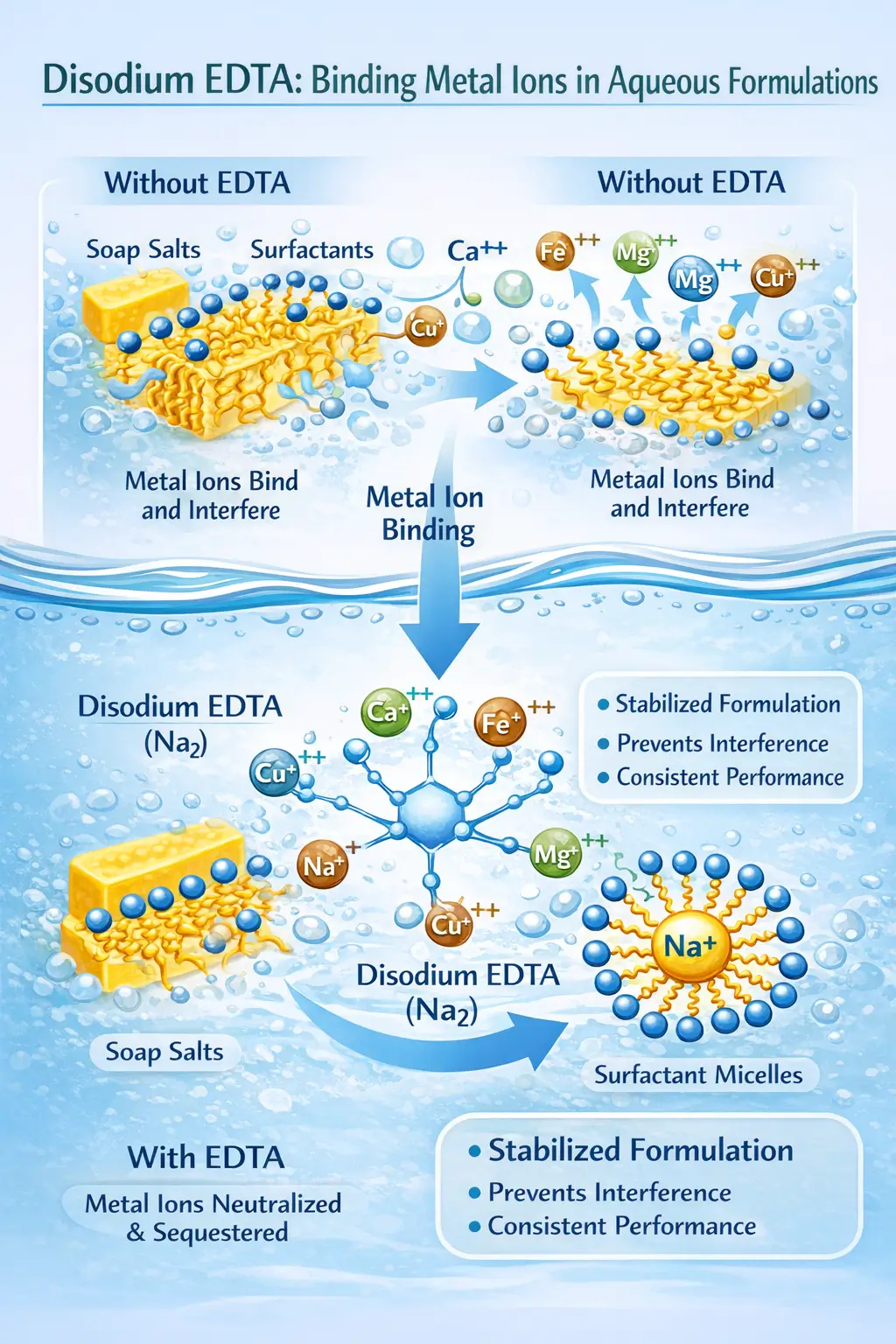
It does not act as a cleanser on its own. Instead, it supports system performance by preventing interference from minerals such as calcium and magnesium.
In cleansing products, it stabilizes the formulation environment, allowing surfactant systems to function more consistently.
This behavior is particularly relevant across liquid systems such as shampoo, face cleansers, and similar rinse-based formulations where water quality directly influences performance.
This page is part of the CleanFormulation Ingredient Library, a research-based system analyzing ingredient behavior in real formulation environments.
Quick Facts
| Property | Description |
|---|---|
| Molecular Formula | C10H14N2Na2O8 |
| Molecular Weight | 336.21 g/mol |
| Chelation Constant (Ca2+) | log K ≈ 10.7 indicating strong binding affinity |
| Chelation Constant (Fe3+) | log K ≈ 25.1 showing very high stability complex |
| Optimal pH Range | Effective chelation typically between pH 4–10 |
| pKa Values | ≈2.0, 2.7, 6.2, 10.3 corresponding to carboxyl and amine groups |
| Solubility in Water | ≈100 g/L at 25 °C forming clear aqueous solutions |
| Complex Formation Mechanism | Hexadentate ligand forming 1:1 metal–ligand complexes |
| Metal Binding Capacity | 1 mol EDTA binds 1 mol divalent or trivalent metal ion |
| Hard Water Performance | Prevents precipitation by sequestering Ca2+ and Mg2+ |
| Oxidation Control | Reduces metal-catalyzed oxidation in formulations |
| Preservative Boosting Effect | Enhances efficacy of preservatives by binding destabilizing metal ions |
| Foam Stability Impact | Improves foam performance by minimizing ion interference |
| Clarity Enhancement | Prevents haze formation in transparent liquid systems |
| Thermal Stability | Stable under typical formulation temperatures up to ~100 °C |
| Electrolyte Interaction | Remains functional in presence of moderate salt concentrations |
| Usage Level | Typically 0.05% – 0.2% depending on formulation needs |
| Biodegradation Profile | Slowly biodegradable under specific environmental conditions |
| Compatibility with Surfactants | Compatible with anionic, nonionic, and amphoteric systems |
| Hydration Behavior | Exists as hydrated salt in aqueous systems enhancing solubility |
| Buffer Interaction | Minimal buffering effect but influenced by surrounding pH system |
| Heavy Metal Control | Effective in binding trace metals such as Cu2+ and Zn2+ |
| Formulation Stability Mechanism | Prevents catalytic degradation pathways involving transition metals |
| Ionic Strength Influence | Binding efficiency slightly reduced at very high ionic strength |
| Phase Distribution | Remains in aqueous phase due to hydrophilic structure |
| Shelf Stability Contribution | Extends product shelf life by maintaining chemical integrity |
Why This Ingredient Appears On Labels
Disodium EDTA appears on ingredient labels because it helps maintain formulation stability by controlling metal ions naturally present in water and raw materials.
Without this control, minerals can interfere with surfactant performance, reduce clarity, and lead to instability over time.
Its presence is therefore functional rather than active in a cleansing sense. It supports the overall system rather than directly contributing to washing action.
It is commonly encountered across a wide range of formulations including liquid cleansers, baby wipes, and emulsion-based products such as moisturizer and sunscreen, where stability and consistency are critical.
In label interpretation, it signals that the formulation includes a mechanism to manage water-related variability and maintain predictable behavior during use.
Chemical Identity And Classification
Disodium EDTA is the disodium salt of ethylenediaminetetraacetic acid, belonging to the aminopolycarboxylate family of chelating compounds.
Its structure contains multiple carboxylate groups and nitrogen atoms that can coordinate with metal ions, forming stable complexes. This multi-point binding capability defines its role as a sequestration agent.
In aqueous environments, it exists in an ionized form, allowing it to interact with positively charged metal ions such as calcium, magnesium, iron, and trace metals.
Unlike surfactants that act at interfaces, Disodium EDTA operates within the bulk solution, modifying how other ingredients behave by controlling the chemical environment.
Functional Role In Cleansing And Cosmetic Systems
Disodium EDTA functions as a system stabilizer by binding metal ions that would otherwise interfere with formulation performance.
In traditional soap systems, calcium and magnesium ions can react with fatty acid salts to form insoluble residues. By sequestering these ions, Disodium EDTA reduces this interaction and helps maintain effective cleansing behavior.
In modern liquid formulations such as facewash and body cleansers, it supports clarity and consistency by preventing metal-induced cloudiness or phase instability.
Within cosmetic emulsions, it contributes to formulation stability by limiting oxidation pathways that can be accelerated by trace metal contamination.
In deodorant systems, its role is indirect, helping maintain stability of fragrance and base components rather than contributing to odor control itself.
From an observable standpoint, formulations containing Disodium EDTA tend to remain clearer, more stable, and more consistent across varying water conditions.
Ingredient Interaction Logic
Disodium EDTA interacts with multiple components within a formulation by controlling the availability of metal ions.
Key interaction relationships include:
- Water phase: binds hardness ions such as Ca²⁺ and Mg²⁺, reducing interference in cleansing systems
- Surfactants: improves efficiency by preventing formation of insoluble complexes
- Soap salts: reduces precipitation reactions that would otherwise lead to residue formation
- Preservative systems: enhances effectiveness by limiting metal-catalyzed degradation pathways
- Fragrance components: stabilizes volatile systems by reducing oxidation triggers
These interactions do not produce visible effects individually, but collectively they influence how stable and predictable the overall formulation remains during storage and use.
Phase Behavior And Solution Characteristics
Disodium EDTA is highly water-soluble and functions entirely within the aqueous phase of a formulation.
It does not form micelles, emulsions, or structural networks. Instead, it remains dissolved and active as a chelating agent throughout the system.
Its effectiveness depends on pH conditions, as ionization of its functional groups determines its ability to bind metal ions.
Key characteristics include:
- High solubility: remains evenly distributed in liquid systems
- pH-dependent activity: optimal chelation occurs in neutral to mildly alkaline environments
- No structural contribution: does not influence viscosity or texture directly
- Thermal stability: maintains function across typical formulation temperatures
This behavior explains why it is typically used at low concentrations yet still impacts overall system stability.
Comparison With Related Chelating Agents
| Feature | Disodium EDTA | Tetrasodium EDTA | Etidronic Acid |
|---|---|---|---|
| Chemical Form | Partially neutralized EDTA salt | Fully neutralized EDTA salt | Phosphonate-based compound |
| pH Behavior | Near neutral to mildly alkaline | Strongly alkaline | Acidic to neutral |
| Chelation Strength | High | Very high | Moderate |
| Water Compatibility | High | High | High |
| Typical System Use | Balanced liquid formulations | High pH cleansing systems | Scale control and stabilization |
| Effect On Formulation pH | Minimal shift | Raises pH | Can lower pH slightly |
| Formulation Role | Stability and metal ion control | Strong chelation and alkalinity support | Threshold stabilization and scale inhibition |
| Common Use Context | Liquid cleansers and emulsions | Detergents and alkaline systems | Industrial and detergent systems |
Structural Limitations And Formulation Constraints
The effectiveness of Disodium EDTA depends on pH conditions. Its ability to bind metal ions is influenced by the ionization state of its functional groups, which varies across formulation environments.
At lower pH levels, protonation reduces its binding efficiency, limiting its chelation capacity in acidic systems.
It also does not contribute to cleansing, emulsification, or viscosity. Its role is strictly supportive, meaning it must be used alongside active systems such as surfactants.
In highly complex formulations, interactions with other additives such as stabilizers and preservatives must be balanced to avoid over-dependence on a single control mechanism.
Additionally, its performance is concentration-dependent, with typical usage levels ranging from approximately 0.05% to 0.2% depending on formulation requirements.
Common Misunderstandings
- “It acts as a cleanser”
Disodium EDTA does not remove dirt or oils. Cleansing action is provided by surfactants, while EDTA supports system performance indirectly. - “It is only used in detergents”
While common in detergent systems, it is also widely used in personal care formulations including shampoo, face cleansers, and emulsions. - “It changes the texture of products”
It does not contribute to viscosity, thickness, or structural feel. Its function remains within the chemical environment rather than physical structure. - “It works independently”
Its effectiveness depends entirely on interaction with water chemistry and other ingredients within the formulation system.
Formulation References Using This Ingredient
Summary of Findings
- Classification: Disodium EDTA is an aminopolycarboxylate chelating agent used to control metal ion interactions.
- Primary Function: Binds calcium, magnesium, and trace metals to stabilize formulation systems.
- System Behavior: Operates in the aqueous phase without contributing to cleansing or structure.
- Interaction Logic: Enhances surfactant efficiency, preservative stability, and overall formulation consistency.
- Limitations: Performance is pH-dependent and does not replace active formulation components.
- Formulation Role: Supporting ingredient that maintains stability rather than driving primary function.