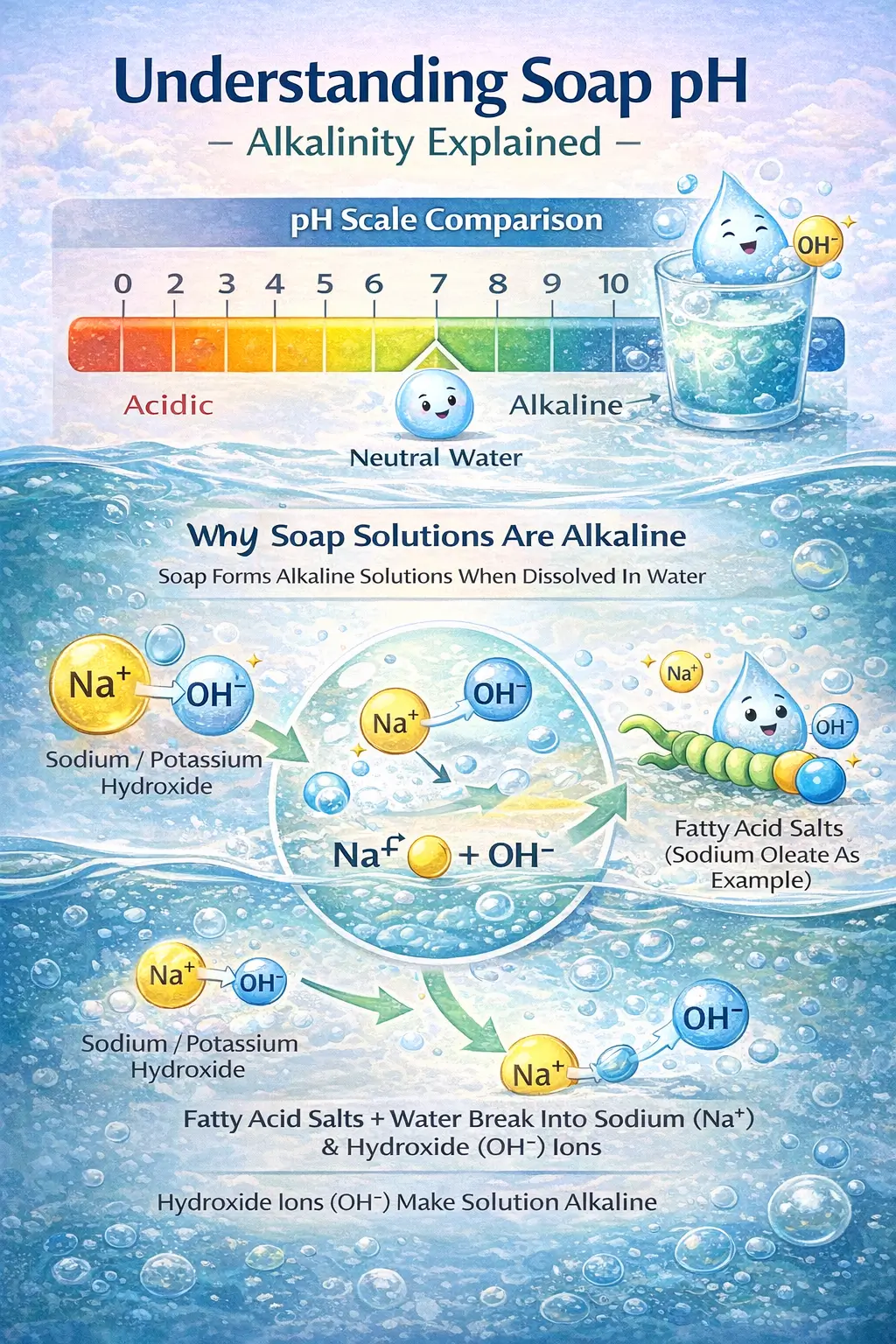
What pH Means In Soap Systems
pH is a logarithmic measure of hydrogen ion activity in water. In soap systems, pH does not describe an additive or adjustment but reflects the ionic environment created when soap salts dissolve in water.
When a bar or liquid soap contacts water, its fatty acid salts dissociate into charged species. The balance between hydroxide ions, fatty acid anions, and counterions such as sodium or potassium establishes the observed pH range.
This distinction matters because soap pH is often discussed as though it were comparable to finished cosmetic products buffered to specific values. Soap systems do not behave this way. Their pH emerges from equilibrium rather than being locked in by buffering agents.
| System Type | How pH Arises | Stability During Use |
|---|---|---|
| True Soap | Fatty acid salt dissociation | Shifts with dilution and rinsing |
| Syndet Cleanser | Buffered aqueous system | Relatively stable |
Confusion often arises when soap pH is evaluated using expectations borrowed from non-soap cleansing systems, a mismatch that underlies many labeling and interpretation issues discussed in Why pH Matters in Soap Label Interpretation. This mismatch explains many common claims about soap being "too alkaline" without context.
Why Soap Is Alkaline By Design
Soap is produced through saponification, a reaction between triglycerides and a strong alkali such as sodium hydroxide or potassium hydroxide, using ingredient systems characteristic of traditional methods described in the Cold Process Soap Ingredients Guide. The end product is not oil plus alkali, but a salt of fatty acids.
These fatty acid salts are weak acids paired with strong bases. When dissolved in water, they partially hydrolyze, increasing hydroxide ion concentration and producing an alkaline solution.
This behavior is structural, not optional. Altering soap pH downward beyond a narrow range destabilizes the soap itself, causing fatty acids to precipitate or lose cleansing function.
Historically, traditional bar soaps made from sodium salts exhibit slightly higher pH ranges than potassium-based liquid soaps, but both remain alkaline under typical use conditions.
Attempts to force soap systems into neutral pH ranges result in products that are no longer chemically soap, even if they resemble soap in form or labeling.
The chemistry behind fatty acid salts is further detailed in the Ingredient Framework.
How Soap pH Behaves During Real-World Use
Soap pH is rarely experienced in its concentrated state. In practical use, soap is continuously diluted, redistributed, and removed through water flow, hand movement, and rinsing. Each of these factors alters the effective pH at the surface where cleansing occurs.
When soap is first wetted, the local solution near the surface of the bar or liquid concentrate reflects the upper end of its pH range. As lather develops, incoming water rapidly increases dilution, lowering alkalinity intensity without changing the fundamental alkaline character of the system.
This dynamic explains why pH readings taken from undiluted soap solutions often misrepresent actual use conditions. The system does not operate at a single static pH but across a moving range shaped by contact time and water volume.
| Use Phase | Relative Dilution | Effective Alkalinity |
|---|---|---|
| Initial Wetting | Low | Higher |
| Active Lathering | Moderate | Reduced |
| Rinsing | High | Rapidly diminishing |
Many consumer concerns around soap pH arise from assuming that the most alkaline moment defines the entire cleansing experience. In reality, that moment is brief and continuously offset by dilution.
How Alkaline Soap Interacts With Skin Surfaces
Skin interaction with soap is governed less by absolute pH values and more by exposure duration, as explained in our guide to Skin Safety 101, mechanical action, and rinse completeness. Soap does not sit on the skin long enough under typical use to behave like a leave-on alkaline treatment.
During cleansing, soap removes surface oils and particulate soil through emulsification. The temporary shift in surface conditions reflects lipid removal rather than permanent chemical alteration.
Misinterpretation often occurs when soap is evaluated using frameworks designed for leave-on cosmetic products. Soap systems are transient by nature. Their interaction window is measured in seconds, not hours.
Variability does exist. Short rinses, cold water, or high soap concentration zones can extend contact time and intensify perceived effects. These outcomes are system-driven rather than formulation defects.
Why Soap pH Differs From Syndet Cleansers
Syndet cleansers rely on synthetic surfactants such as sodium laureth sulfate, cocamidopropyl betaine, or alkyl polyglucosides. These systems allow formulators to buffer pH independently from cleansing function.
Soap systems do not offer this separation. The same fatty acid salts responsible for cleansing also determine pH behavior. Lowering pH disrupts solubility and compromises system integrity.
This difference explains why comparisons between soap and syndet products frequently focus on pH without acknowledging structural constraints, a contrast examined more directly in the Soap vs Syndet Cleansers Guide. Each system optimizes different variables.
| Aspect | Soap System | Syndet System |
|---|---|---|
| pH Origin | Intrinsic to fatty acid salts | Externally adjustable |
| Buffering Flexibility | Very limited | High |
| Cleansing Stability | Dependent on alkalinity | Independent of pH |
System Limits And Boundary Conditions
Soap pH behavior changes noticeably at system boundaries. Extremely soft water reduces mineral interference and can slightly moderate perceived alkalinity. Hard water increases fatty acid precipitation but does not eliminate alkalinity.
Temperature also acts as a modifier. Warm water accelerates dissolution and rinsing, while cold water prolongs contact and increases residue likelihood. These effects are often attributed to pH but are driven by solubility dynamics.
No soap formulation can fully decouple cleansing function from alkaline chemistry. This boundary defines what soap can and cannot be, regardless of processing or ingredient selection.
Regulatory interpretation of cleansing systems is addressed in our Editorial Policy.
Summary of Findings
- Structural Origin: Soap pH arises from fatty acid salt chemistry, not formulation preference.
- Dynamic Behavior: Effective pH shifts continuously during dilution and rinsing.
- Use Context: Contact time and water conditions matter more than static pH values.
- System Limits: Soap cannot be neutral without ceasing to function as soap.
- Comparative Clarity: Syndet pH control reflects a different cleansing system, not superiority.
References
- Rosen, M. J. Surfactants and Interfacial Phenomena. Wiley-Interscience. Publisher Link
- Schramm, L. L. Surfactants: Fundamentals and Applications. Cambridge University Press. Publisher Link
- OECD SIDS Reports on Fatty Acid Salts. OECD Chemicals Programme
- European Commission Scientific Opinions on Cosmetic Ingredients. SCCS Opinions