Executive Snapshot
| Product Type | Transparent true soap bar |
|---|---|
| Structural Category | Sodium fatty acid soap matrix |
| Primary Functional Base | Sodium Palmitate, sodium palm kernelate |
| Typical pH Range | 9.0 - 10.5 |
| System Classification | High TFM glycerin transparency system |
Ingredient Hierarchy Overview
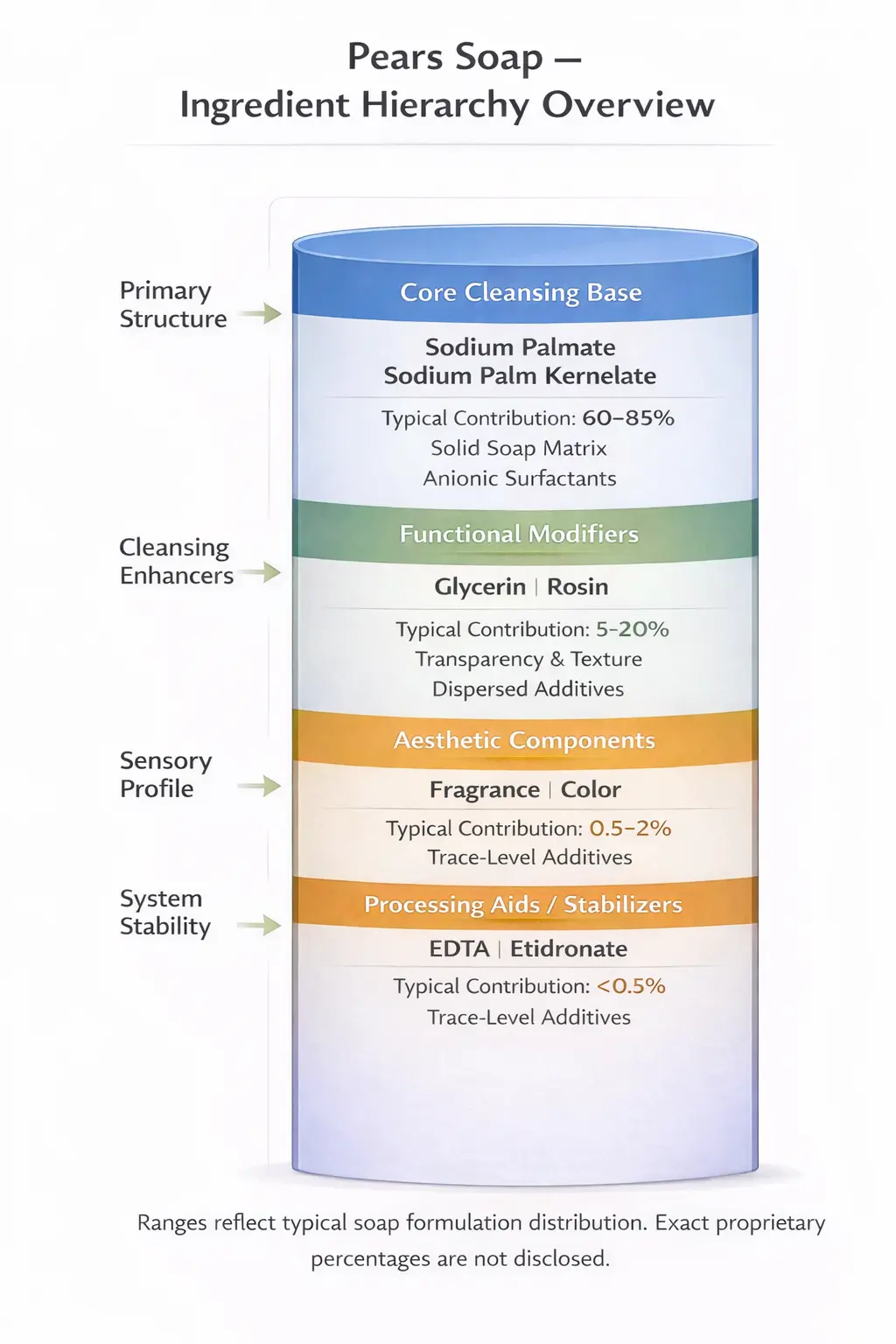
The dominant portion of Pears soap ingredients consists of sodium salts of fatty acids. These determine cleansing behavior, hardness, and TFM classification. Beneath this primary layer sits the solvent and humectant system, responsible for transparency and physical feel. Colorants, fragrance components, and stabilizers occupy tertiary positions with limited structural influence.
Functional Classification
| Ingredient | Functional Role | Phase | Typical Use Range | Regulatory Context |
|---|---|---|---|---|
| Sodium Palmitate | Primary cleansing surfactant | Solid soap matrix | 40-70% | Cosmetic soap base permitted globally |
| Sodium Palm Kernelate | Foam booster, hardness modifier | Solid matrix | 10-30% | Permitted soap base ingredient |
| Glycerin | Humectant, clarity modifier | Polyol phase | 5-15% | Widely accepted cosmetic humectant |
| Sorbitol | Solvent, transparency stabilizer | Polyol phase | 5-15% | Permitted cosmetic ingredient |
| Tetrasodium EDTA | Chelating agent | Water phase | <0.2% | Subject to regional concentration limits |
Formulation Architecture & Phase Flow
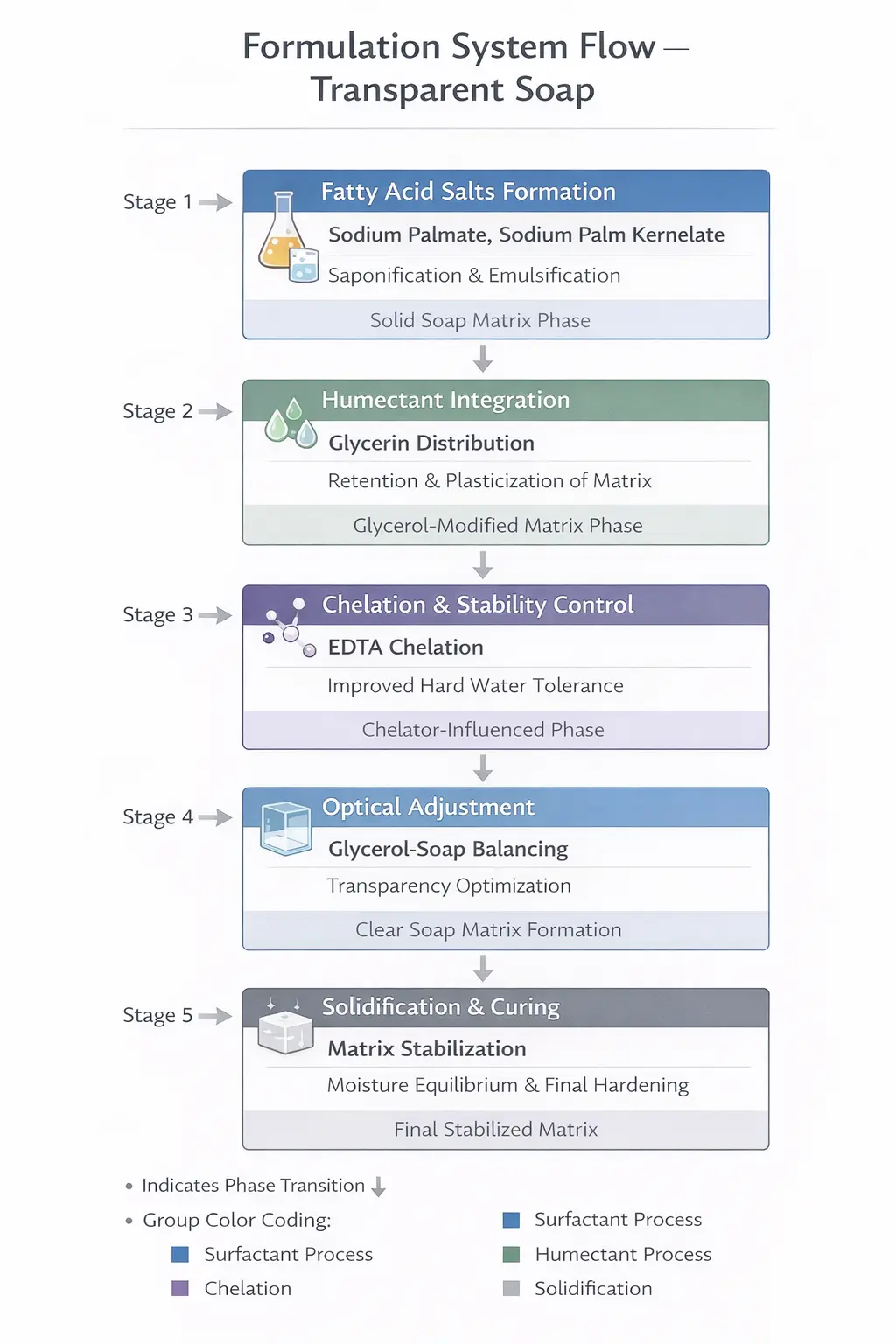
The architecture begins with saponification, producing sodium salts of fatty acids. Once formed, the soap mass is blended with glycerin and sorbitol. These solvents interfere with crystalline lattice formation that would otherwise scatter light. Controlled water content maintains workable viscosity before molding. Upon cooling, the matrix solidifies while retaining translucency.
Phase Behavior Analysis
In dry state, the bar exists as a semi crystalline alkaline solid. When exposed to water during face or skin washing, surface soap molecules dissolve and form micelles. These micelles solubilize sebum and particulate soil. The pH level during use remains alkaline due to the chemistry of sodium fatty acid salts. Unlike syndet systems, buffering is not built into the matrix.
Transparency sometimes leads to the assumption that the product is milder or closer to neutral pH. Structurally, clarity does not change the chemical identity of the soap base. Optical transparency is a solvent effect, not a shift in surfactant class.
Stability & Preservation System
Low free water reduces microbial growth risk. The alkaline environment further limits contamination during normal storage. Chelating agents bind metal ions that could otherwise catalyze oxidation or discoloration. Sodium chloride assists in structural firmness and helps regulate bar hardness.
No dedicated broad spectrum preservative system is typical in high TFM soap bars due to limited available water. Stability relies primarily on low water activity and high pH conditions rather than preservative chemistry.
Performance Profile
Cleansing efficiency is driven by total fatty matter content. Higher TFM typically correlates with denser lather and slower bar dissolution. Palm derived fatty acids contribute firmness, while palm kernel fractions increase foam volume.
On the skin surface, soap removes lipids effectively but may temporarily alter surface pH until natural acid mantle recovery occurs. This behavior is inherent to traditional soap chemistry and not specific to this brand.
Comparative Context
Compared to syndet bars, this system maintains an alkaline pH level and relies on fatty acid salts rather than synthetic surfactants. Compared to opaque soaps, the distinguishing feature is solvent adjusted transparency. Structurally, cleansing chemistry remains similar across true soap categories.
Regulatory Context
In the European Union, soap products are regulated under Regulation (EC) No 1223/2009 on cosmetic products. In India, oversight falls under the Drugs and Cosmetics Act and BIS standards for toilet soap classification including TFM grading. Ingredient declarations follow INCI nomenclature requirements.
Frequently Asked Questions
Is Pears soap a syndet bar?
No. It is a true soap composed primarily of sodium salts of fatty acids.
What does TFM indicate?
Total fatty matter reflects the percentage of fatty material in the soap and influences hardness and lather characteristics.
Is the pH level neutral?
Traditional soap chemistry results in an alkaline pH, typically between 9 and 10.5.
Neutral System Summary
Pears soap represents a glycerin modified transparent true soap system built on sodium fatty acid chemistry. Structural dominance lies in its high TFM soap matrix, while clarity results from polyol solvent integration. Its alkaline pH level and micellar cleansing behavior align with classical soap performance characteristics. The system does not function as a synthetic detergent and does not incorporate pH buffering mechanisms typical of syndet formulations.