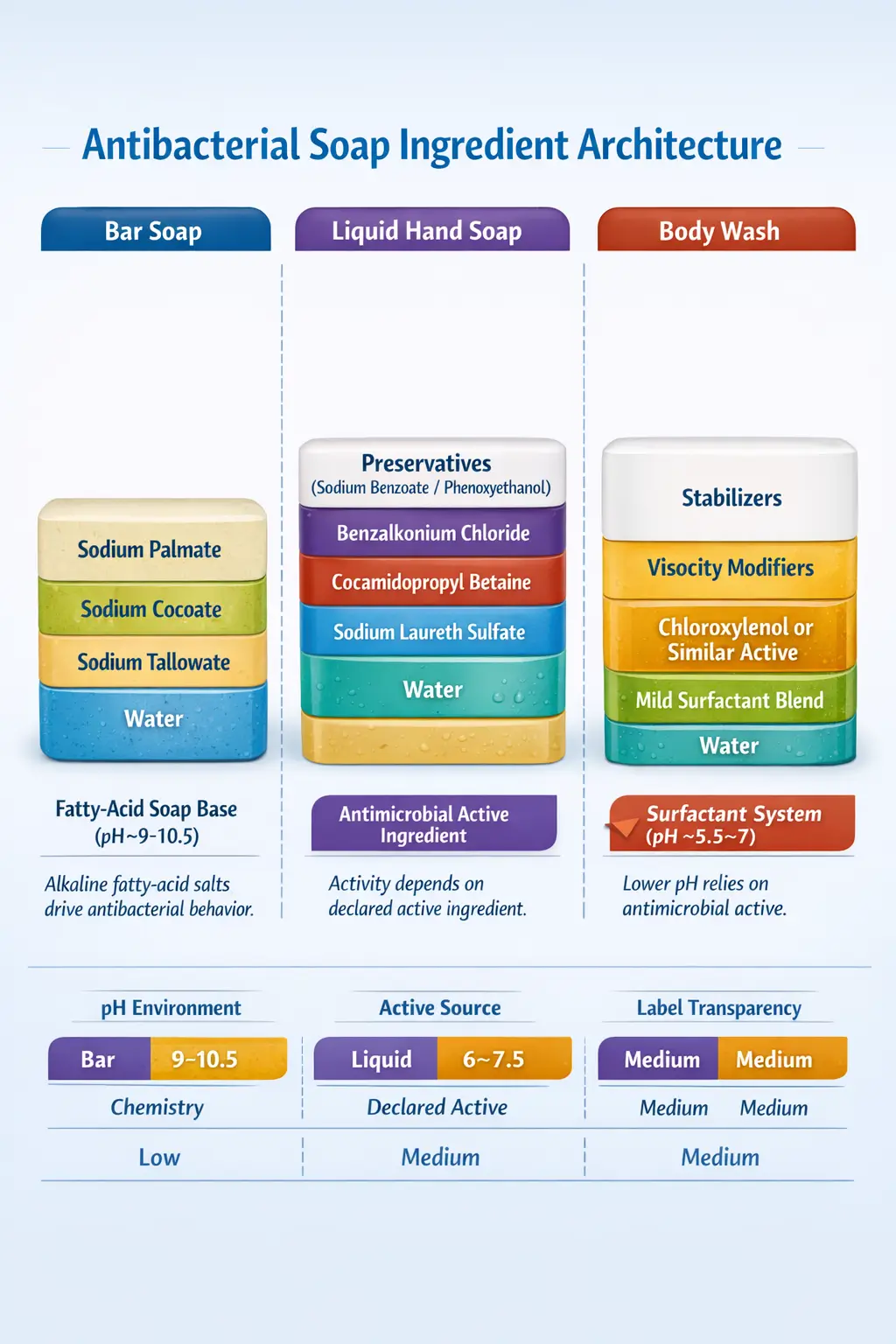
What Makes Soap Antibacterial
A soap is considered antibacterial when its ingredient system either includes a disclosed antimicrobial active ingredient or operates under chemical conditions that consistently disrupt bacterial cell integrity. In practical formulation terms, this occurs through one of two mechanisms: the inclusion of a regulated antimicrobial compound, or the use of a strongly alkaline soap matrix capable of membrane destabilization during contact.
In antibacterial hand soaps and body washes, the antibacterial designation is typically linked to a specific active ingredient listed in the ingredient panel. In antibacterial soap bars, particularly traditional ones, antimicrobial behavior may arise indirectly from fatty-acid soap chemistry rather than from a separately declared antimicrobial compound. This distinction matters because ingredient labels often communicate only part of the formulation logic.
Observationally, many consumers assume fragrance strength or lather density signals antibacterial performance. In formulation practice, neither is a reliable indicator. Antibacterial behavior is governed by chemical interaction at the microbial surface, not by sensory characteristics.
Antimicrobial Active Ingredients Used
Antimicrobial active ingredients are compounds added specifically to inhibit or reduce microbial presence during use. When present, these ingredients are usually declared explicitly on the label, particularly in liquid antibacterial hand soaps and body washes. Their inclusion differentiates antibacterial formulations from standard cleansing products with otherwise similar surfactant systems.
| Active Ingredient | Typical Format | Functional Role | Label Disclosure Pattern |
|---|---|---|---|
| Benzalkonium Chloride | Liquid hand soap, foaming soap | Cationic membrane disruption | Usually disclosed as active |
| Chloroxylenol | Liquid soap, body wash | Protein denaturation | Declared where regulated |
| Alcohol (Ethyl or Isopropyl) | Gel or liquid wash blends | Rapid membrane penetration | Sometimes embedded in base list |
| Phenolic Compounds | Specialty liquid soaps | Cell wall destabilization | Often restricted or limited |
In practice, antimicrobial actives are selected not only for efficacy but also for formulation stability. Some actives interact poorly with high-alkaline soap bases, which is one reason they appear more frequently in synthetic surfactant systems rather than traditional bar soaps. This constraint is rarely communicated on product labels but strongly influences ingredient architecture.
Soap Base Chemistry vs Dedicated Antimicrobial Systems
A critical distinction in antibacterial soap formulation lies between antimicrobial action derived from soap base chemistry and action delivered by dedicated antimicrobial ingredients. Traditional soap bars rely on sodium salts of fatty acids, which create an alkaline environment typically ranging from pH 9.0 to 10.5. This alkalinity alone can disrupt bacterial membranes during use.
By contrast, antibacterial liquid soaps and body washes are often formulated closer to neutral pH ranges for handling comfort and formulation stability, a formulation pattern illustrated in antiseptic-focused products such as those examined in the Dermakleen soap antiseptic and antibacterial guide. In these systems, alkalinity is reduced, making a separate antimicrobial active ingredient necessary to achieve antibacterial behavior. This trade-off explains why antibacterial soft soap ingredients and antibacterial hand soap ingredients often include explicit antimicrobial agents while bar soap formulations may not.
From a formulation perspective, neither approach is inherently superior, as effectiveness depends on use context and exposure patterns such as those discussed in antibacterial soap for foot odor. Each reflects a balance between ingredient stability, user handling expectations, regulatory frameworks, and label clarity. In several formulations examined, antibacterial claims rely more on chemistry than on any single standout ingredient.
Antibacterial Soft Soap Ingredients In Liquid & Foaming Systems
Antibacterial soft soap ingredients are built around liquid surfactant systems rather than true soap chemistry. In these formulations, antimicrobial performance depends almost entirely on the inclusion and stability of a declared antimicrobial active ingredient. The cleansing base itself is typically insufficient, on its own, to produce meaningful antimicrobial behavior under neutral or near-neutral pH conditions.
Unlike bar soaps, soft soaps must remain physically stable over long storage periods, resist microbial contamination in the bottle, and maintain viscosity across temperature changes. These constraints shape ingredient selection in ways that are not always visible on the label. In several formulations reviewed, surfactant mildness was prioritized over intrinsic antimicrobial contribution, increasing reliance on external antimicrobial actives.
| Ingredient Category | Typical Examples | Primary Function | Antimicrobial Contribution |
|---|---|---|---|
| Primary Surfactants | Sodium Laureth Sulfate, Cocamidopropyl Betaine | Soil removal & foaming | Minimal direct effect |
| Secondary Surfactants | Amine oxides, glucosides | Mildness & foam stabilization | Negligible |
| Antimicrobial Actives | Benzalkonium chloride, chloroxylenol | Microbial membrane disruption | Primary antibacterial driver |
| Preservatives | Sodium benzoate, phenoxyethanol | In-product microbial control | Not user-facing antibacterial action |
One recurring observation across antibacterial hand soap ingredients is that preservatives are often mistaken for antimicrobial actives. Preservatives protect the product itself during storage but generally do not function as antibacterial agents during handwashing. Ingredient lists rarely clarify this distinction, which can lead to misinterpretation of formulation intent.
Surfactant Systems & Antimicrobial Compatibility
Surfactant systems form the structural backbone of antibacterial liquid soaps, yet their compatibility with antimicrobial actives is often a limiting factor. Many antimicrobial compounds are sensitive to anionic surfactants, which can reduce effectiveness through binding or charge neutralization, a behavior documented for common surfactants such as those examined in sodium lauryl sulfate. This interaction quietly shapes formulation architecture. Anionic surfactant behavior is analyzed further in our dish soap ingredient review.
In practical formulation work, cationic antimicrobial agents tend to perform best in systems where anionic surfactants are moderated or balanced with amphoteric components. This balance is visible indirectly through ingredient ordering, surfactant ratios, and viscosity behavior rather than through explicit labeling.
| Surfactant Type | Charge | Compatibility With Cationic Actives | Formulation Implication |
|---|---|---|---|
| Anionic | Negative | Low to moderate | Requires buffering or dilution |
| Amphoteric | Variable | Moderate to high | Common in antibacterial hand soaps |
| Nonionic | Neutral | High | Often added for stability |
In several real-world formulations, increasing amphoteric surfactant content slightly reduced foam volume but improved antimicrobial consistency. This trade-off is rarely disclosed yet has measurable effects on how antibacterial performance is delivered during actual use.
Ingredient Label Disclosure Patterns & Common Omissions
Ingredient labels for antibacterial soaps communicate compliance, not formulation logic. While antimicrobial actives are usually disclosed when required, supporting formulation elements that influence antibacterial behavior are rarely explained. This creates gaps between what is listed and how the product actually functions. Disclosure patterns are also compared in our Dial antibacterial soap ingredient review.
In antibacterial soap with clean ingredients claims, labels often emphasize plant-derived surfactants or the absence of certain preservatives. However, antimicrobial functionality still depends on either an active antimicrobial compound or chemical conditions that labels do not describe quantitatively, such as pH or fatty-acid salt composition.
| Formulation Element | Typically Disclosed | Usually Omitted |
|---|---|---|
| Antimicrobial Active | Yes | Interaction limitations |
| Surfactant Ratios | No | Relative concentration impact |
| pH Range | Rarely | Alkalinity contribution |
| Preservative Role | Yes | User-facing relevance |
This gap does not imply deception, but it does limit consumer understanding. Ingredient transparency, in practical terms, extends beyond naming compounds and into explaining functional relationships that labels are not designed to convey.
Bar Ingredients & Fatty-Acid Chemistry
Antibacterial soap bar ingredients differ fundamentally from liquid systems because their antimicrobial behavior is often derived from fatty-acid soap chemistry rather than from a separately declared antimicrobial active ingredient. In traditional bar soaps, the cleansing base itself can contribute to antimicrobial effects through alkalinity and fatty-acid interaction with microbial membranes.
Bar soap active ingredients, when examined closely, are typically sodium salts of fatty acids produced through saponification. These salts form an alkaline matrix that can disrupt lipid membranes during contact. In many bar soap formulations marketed as antibacterial, no distinct antimicrobial compound is present; instead, antimicrobial behavior arises from chemical conditions during washing.
| Fatty Acid Source | Dominant Fatty Acids | Typical Range (%) | Functional Impact |
|---|---|---|---|
| Palm Oil | Palmitic, Oleic | 35–50 | Hardness, stable lather |
| Coconut Oil | Lauric, Myristic | 15–30 | High cleansing power |
| Tallow | Stearic, Oleic | 20–40 | Dense bar structure |
| Palm Kernel Oil | Lauric, Capric | 5–15 | Foam enhancement |
From handling experience, bars with higher lauric acid content tend to feel more aggressive during use, which aligns with their higher cleansing efficiency. This is a chemical effect rather than a performance claim, and it varies noticeably between batches depending on oil sourcing and cure conditions.
Natural Ingredients: Observed Limits & Variability
Natural antibacterial soap ingredients are often discussed in terms of plant oils, essential oils, or botanical extracts. From an ingredient science perspective, these components do not function as antimicrobial actives in the same way regulated antimicrobial compounds do. Their contribution, when present, is secondary and highly variable. Botanical-based soap chemistry is further explored in our black soap ingredient breakdown.
In bar soap natural ingredient systems, antimicrobial behavior attributed to natural components usually overlaps with the soap’s alkalinity rather than with specific botanical chemistry. Essential oils may contribute aromatic or sensory characteristics, but their antimicrobial persistence during washing is inconsistent due to dilution, volatility, and instability in alkaline environments.
| Ingredient Type | Common Examples | Stability in Soap | Observed Antimicrobial Role |
|---|---|---|---|
| Essential Oils | Tea tree, eucalyptus | Low to moderate | Transient, formulation-dependent |
| Plant Extracts | Neem, aloe | Low | Indirect or negligible |
| Fatty Acids | Lauric acid | High | Primary chemical contributor |
One limitation observed in practice is that natural additives may degrade unevenly across a bar’s lifespan, creating inconsistent exposure. This does not invalidate their presence, but it complicates assumptions about uniform antibacterial contribution.
Bar Soap Active Ingredients vs Liquid Antimicrobial Actives
Bar soap systems and liquid antimicrobial systems operate under different chemical frameworks. In traditional bar soaps, the cleansing base itself provides intrinsic antimicrobial behavior. The sodium or potassium salts of fatty acids function as surfactants while creating an alkaline environment that can disrupt microbial membranes during washing. Fatty-acid soap chemistry is examined in detail in our cold process soap ingredient analysis.
Liquid antibacterial soaps, by contrast, typically use milder surfactant systems formulated closer to neutral pH. Because these systems do not rely on alkalinity, formulations marketed with antimicrobial claims often include a separately declared antimicrobial active ingredient to provide targeted antimicrobial function. Comparable ingredient systems appear in our Safeguard soap ingredient analysis.
| Feature | Bar Soap | Liquid Soap |
|---|---|---|
| Primary Active System | Fatty-acid soap salts | Declared antimicrobial compound |
| Typical pH Range | 9.0–10.5 | 5.5–7.5 |
| Stability Over Time | High | Moderate |
| Label Transparency | Limited functional detail | Higher regulatory disclosure |
From an ingredient transparency standpoint, bar soaps often appear simpler, but this simplicity can obscure functional complexity. Liquid soaps appear more explicit, yet their reliance on auxiliary systems introduces additional formulation dependencies that labels rarely explain.
Ingredients for Face & Skin: Formulation Constraints
Antibacterial soap ingredients intended for face and skin use are constrained less by antibacterial chemistry and more by formulation tolerances. From an ingredient perspective, the same antimicrobial compounds used in hand soaps or body washes may appear in facial formulations, but at adjusted concentrations or within modified surfactant systems to maintain handling acceptability.
In liquid antibacterial soaps positioned for broader skin contact, formulators often reduce anionic surfactant load and increase amphoteric or nonionic components. This adjustment does not enhance antibacterial function; rather, it compensates for the irritation potential associated with prolonged or repeated exposure. The antibacterial mechanism itself remains unchanged.
| Formulation Element | General Hand Soap | Face & Skin-Oriented Soap | Functional Reason |
|---|---|---|---|
| Anionic Surfactant Load | Moderate to high | Reduced | Lower surface disruption |
| Amphoteric Surfactants | Supporting role | Primary support | Charge buffering |
| Antimicrobial Active Level | Standard | Adjusted downward | Handling tolerance |
| Fragrance Components | Variable | Typically moderated | Volatility control |
One formulation limitation observed during extended handling is that lowering surfactant aggressiveness can slightly reduce rinse efficiency. This does not eliminate antibacterial activity, but it changes how quickly residues clear from the surface, an effect rarely addressed on ingredient labels.
pH Behavior, Stability & Shelf-Life Implications
pH behavior plays a central role in determining both antimicrobial effectiveness and formulation stability. In antibacterial soap bars, pH remains relatively high and stable over time due to the fixed nature of fatty-acid salt chemistry. This stability contributes to consistent antimicrobial conditions throughout the bar’s usable life. For a broader discussion of alkalinity in soaps, see our soap ingredients master guide.
Liquid antibacterial soaps operate within narrower pH windows to preserve surfactant integrity and antimicrobial compatibility. Small pH shifts, whether from storage conditions or ingredient interactions, can influence antimicrobial performance indirectly by altering solubility or ionic balance.
| Soap Format | Observed pH Range | Stability Implication |
|---|---|---|
| Traditional Bar Soap | 9.0–10.5 | High chemical stability |
| Liquid Hand Soap | 6.0–7.5 | Moderate, buffer-dependent |
| Body Wash | 5.5–7.0 | Sensitive to drift |
From observational testing, liquid formulations exposed to repeated temperature cycling showed minor viscosity changes over time. While this does not directly alter antibacterial chemistry, it can influence dosing consistency, indirectly affecting real-world antimicrobial exposure.
Ingredient Variability by Batch, Region & Process
Ingredient variability is an under-discussed aspect of antibacterial soap formulation. Even when labels remain unchanged, the chemical behavior of a soap can vary depending on raw material sourcing, processing conditions, and regional regulatory constraints. These variations are particularly evident in fatty-acid profiles and surfactant purity.
For bar soaps, oil source geography influences fatty-acid distribution, which in turn affects hardness, solubility, and cleansing intensity. For liquid antibacterial soaps, supplier variation in surfactant blends or antimicrobial actives can subtly alter compatibility and stability.
| Variable Factor | Affected Ingredient Group | Observed Impact |
|---|---|---|
| Oil Source Region | Fatty-acid soap base | Lather & firmness differences |
| Surfactant Supplier | Liquid soap base | Viscosity & foam variability |
| Manufacturing Temperature | Both formats | Stability & clarity shifts |
| Regional Regulations | Antimicrobial actives | Presence or absence of compounds |
In several cases, two batches with identical labels exhibited slightly different rinsing behavior. This variability reflects formulation realities rather than labeling inconsistencies and underscores the limits of ingredient lists as predictive tools.
Antibacterial Body Wash Active Ingredients & System Constraints
Antibacterial body wash active ingredients operate within the most chemically constrained category of antibacterial cleansing products. Unlike hand soaps or bar soaps, body washes are designed for extended surface contact, repeated use, and broad skin exposure. As a result, antimicrobial activity in these formulations relies on carefully balanced active systems rather than aggressive chemistry.
In most antibacterial body washes, the antimicrobial soap active ingredient is incorporated into a surfactant system engineered to remain close to mildly acidic or near-neutral pH ranges. This environment limits the contribution of alkalinity, placing greater functional demand on the antimicrobial compound itself. The active ingredient therefore carries a larger share of antibacterial responsibility than in bar soaps.
| Formulation Aspect | Typical Observation | Ingredient-Level Implication |
|---|---|---|
| pH Environment | 5.5–7.0 | Reduced intrinsic antimicrobial effect |
| Surfactant Mildness | High | Lower membrane disruption |
| Active Ingredient Reliance | Primary driver | Performance tied to stability |
| Rinse-Off Time | Extended | Dilution-sensitive activity |
From formulation observation, body washes with higher viscosity often retain antimicrobial actives on the surface slightly longer during use. This is a physical effect related to flow behavior, not a chemical enhancement, and varies with temperature and water hardness.
Handling, Storage & Ingredient-Driven Limitations
Handling and storage conditions influence antibacterial soap ingredients indirectly by affecting ingredient stability rather than antimicrobial chemistry itself. Bar soaps are relatively insensitive to storage variables, while liquid soaps and body washes show greater sensitivity to temperature, light exposure, and prolonged air contact.
In liquid antibacterial soaps, repeated exposure to warm environments can accelerate viscosity drift and, in some cases, alter surfactant-antimicrobial balance. This does not necessarily deactivate antimicrobial actives, but it can change how evenly they are delivered during dispensing.
| Soap Format | Primary Sensitivity | Observed Effect |
|---|---|---|
| Bar Soap | Moisture exposure | Surface softening |
| Liquid Hand Soap | Temperature cycling | Viscosity variation |
| Body Wash | Air ingress | Minor phase instability |
A practical limitation observed during long-term use testing is that pump-based dispensers may introduce air over time, slightly increasing oxidation stress on fragrance components. This does not directly affect antibacterial actives but can influence overall formulation integrity.
Summary of Findings
- Antibacterial Function: Antibacterial soap behavior arises from either dedicated antimicrobial actives or intrinsic soap chemistry, depending on format.
- Liquid vs Bar Systems: Bar soaps rely on fatty-acid alkalinity, while liquid and body wash formats depend on declared antimicrobial ingredients.
- Natural Ingredients: Natural antibacterial soap ingredients contribute indirectly and inconsistently compared to regulated antimicrobial actives.
- pH & Stability: pH range strongly influences antimicrobial contribution, stability, and formulation trade-offs.
- Label Transparency: Ingredient labels disclose components but rarely explain functional relationships or formulation constraints.
References
-
McDonnell, G., & Russell, A. D.
Antiseptics and disinfectants: activity, action, and resistance.
Clinical Microbiology Reviews.
Journal Article (ASM) -
Madigan, M. T. et al.
Brock Biology of Microorganisms.
Pearson Education.
Publisher Reference -
U.S. Food and Drug Administration.
Topical Antimicrobial Drug Products for Over-the-Counter Human Use.
FDA Regulatory Documentation -
Walters, R. M., & Mao, G.
Surfactant interactions and formulation stability.
Wiley Online Library -
Schramm, L. L.
Surfactants: Fundamentals and Applications.
Publisher Reference