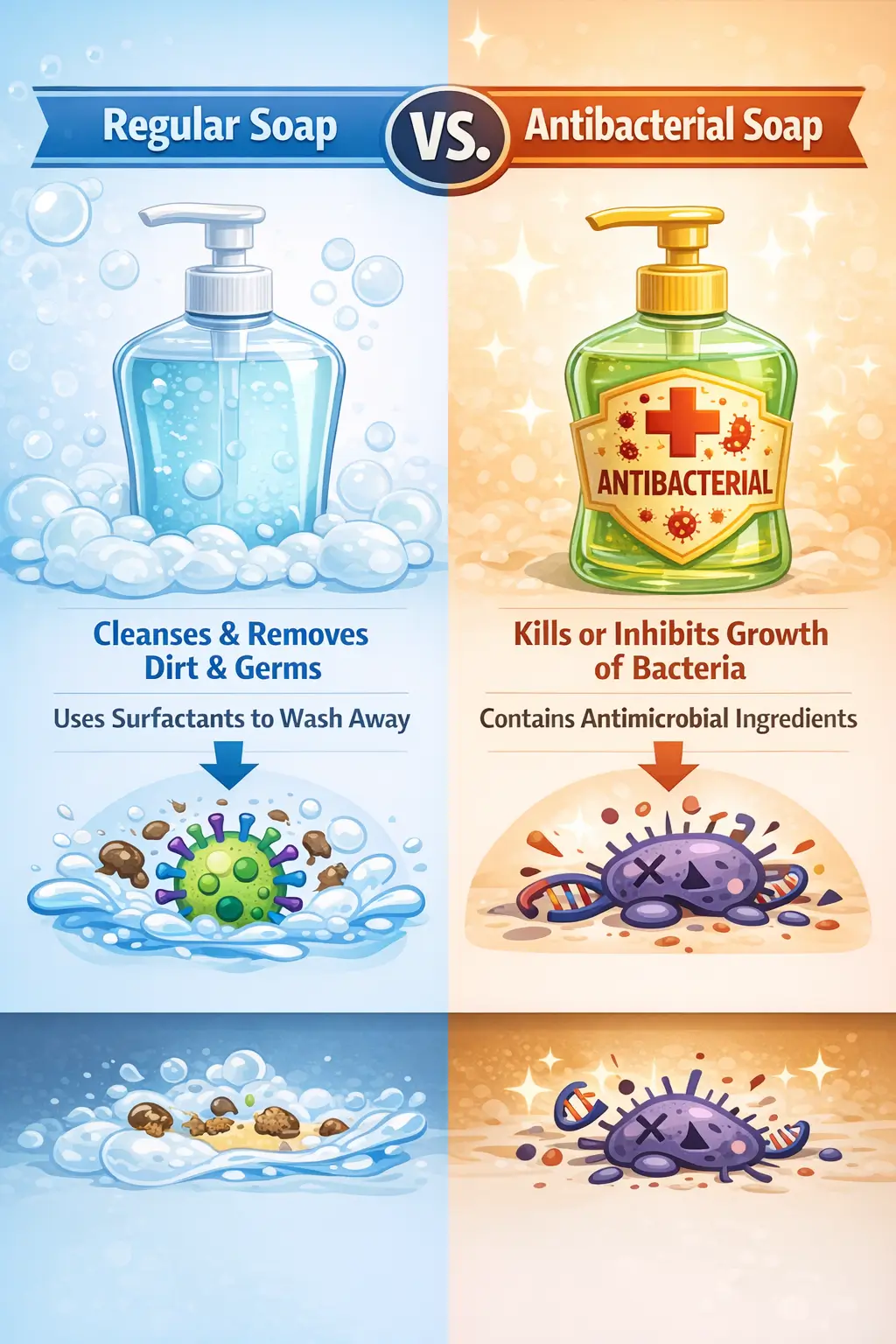
Regular Soap Cleans Through Removal, Not Targeted Killing
A recurring misunderstanding in supermarket aisles is the assumption that soap must kill microbes in order to work. Traditional soap, whether in bar form or liquid format, functions through surfactants, as explained in our detailed mechanism of how soap cleans guide. These molecules reduce surface tension, surround oils and debris, and allow them to be rinsed away with water.
These molecules reduce surface tension, surround oils and debris, and allow them to be rinsed away with water.This process includes the removal of microorganisms present on the skin surface. The emphasis is on displacement and rinsing. It does not require the presence of a specific antimicrobial active substance.
When consumers compare two hand washes on a shelf, both producing similar foam and both positioned for daily hygiene, it is easy to assume that one labeled antibacterial must cleanse more thoroughly. Mechanistically, cleansing efficiency depends on formulation balance and rinsing behavior, not on the antibacterial claim alone.
The Word "Antibacterial" Is A Claim, Not A Texture
The term antibacterial refers to an intended action against bacteria. It does not describe foam quality, viscosity, fragrance strength, or color. Yet packaging design often places the term near imagery of shields or laboratory motifs, which may imply broader protective qualities.
In the European Union, claims must align with regulatory frameworks. A product that explicitly claims to kill bacteria may be evaluated under the Biocidal Products Regulation if it is intended to control harmful organisms. A cosmetic hand soap that focuses on cleansing and hygiene without biocidal claims remains under the Cosmetics Regulation.
The wording matters. A phrase such as "cleanses and protects" is not identical to "kills bacteria." We examine how terminology influences classification in our analysis of what antibacterial claims actually mean. The regulatory interpretation depends on the specific language used. Consumers rarely read this distinction carefully, but it determines classification.
Ingredient Lists Reveal Structure, Not Marketing Category
When scanning ingredient lists in EU compliant INCI format, many consumers search for certain names, assuming that their presence defines antibacterial status. For a structured explanation of how ingredient lists should be interpreted, see our guide on how to read an ingredient list correctly. Ingredients such as benzalkonium chloride or chlorhexidine may appear in products positioned for antimicrobial claims. However, not every unfamiliar name indicates antimicrobial purpose.
Most regular soaps contain surfactants such as Sodium Lauryl Sulfate, sodium coco sulfate, or amphoteric co surfactants like Cocamidopropyl Betaine. These are cleansing agents, not biocidal actives. Preservatives such as phenoxyethanol serve to maintain product stability, not to act as hand disinfectants.
| Category | Typical Role In Regular Soap | Context In Antibacterial Products |
|---|---|---|
| Primary Surfactants | Removal of oils and debris | Still present for cleansing function |
| Preservatives | Protect product from microbial growth during storage | Same preservation role |
| Biocidal Actives | Typically absent | Present when antimicrobial claim is made |
The ingredient list does not by itself determine whether a product is classified as antibacterial. The declared intention and claim language are equally important.
EU Regulation Draws The Formal Boundary
Cosmetic products in the EU are governed by Regulation (EC) No 1223/2009. Products intended to exert a controlling effect on harmful organisms fall under Regulation (EU) No 528/2012, known as the Biocidal Products Regulation.
This distinction shapes testing requirements, labeling, and authorization procedures. It does not necessarily change how the product feels in the hand. The boundary is legal and functional rather than sensory.
On pharmacy shelves, antibacterial gels often sit near ordinary hand washes. The proximity can blur categories. The regulatory framework, however, treats them differently when claims cross into biocidal territory.
What This Article Does Not Decide
This discussion does not determine which product type is preferable in any specific situation. It does not assess clinical effectiveness, public health guidance, or individual suitability. Real world outcomes depend on variables such as contact time, formulation concentration, and usage context.
The aim here is interpretive clarity. Understanding the regulatory and mechanistic difference between cleansing and antibacterial claims helps avoid conceptual shortcuts. It does not resolve every question about performance or necessity.
In practice, uncertainty remains around how consumers interpret mixed messaging on packaging. Label wording is regulated, but visual cues can still shape perception in subtle ways.
Summary of Findings
- Different Mechanisms: Regular soap cleans primarily through surfactant driven removal, while antibacterial soap includes substances intended to act against bacteria.
- Claims Matter: The word antibacterial reflects regulatory intention, not foam strength or cleansing texture.
- Ingredient Context: INCI lists show composition but do not alone determine claim category.
- Regulatory Framing: EU cosmetics and biocidal regulations define how products may be labeled and marketed.
References
- Regulation (EC) No 1223/2009 on cosmetic products.
- Regulation (EU) No 528/2012 concerning the making available on the market and use of biocidal products.
- European Chemicals Agency guidance on biocidal product claims.