Product Summary
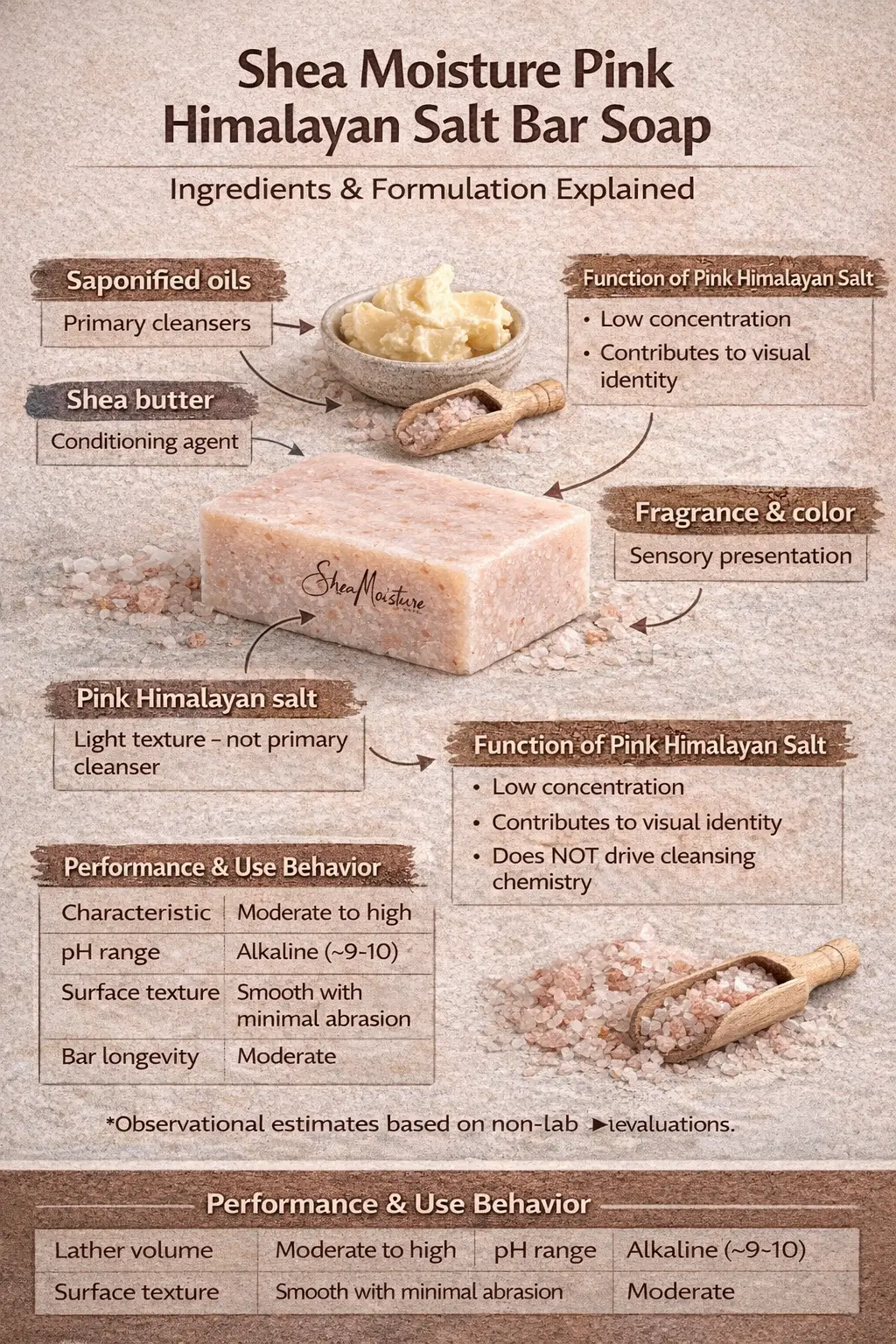
Shea Moisture Pink Himalayan Salt Bar Soap is positioned as a gentle, everyday cleansing bar rather than a traditional salt soap. This distinction is important. While the product name references Himalayan salt, its formulation strategy prioritizes consumer-friendly lather, smooth texture, and broad usability.
Unlike artisan Himalayan salt bars that can contain very high salt percentages, this bar uses salt in a controlled, low concentration. The result is a soap that behaves closer to a conditioning bar than an exfoliating salt block, making it suitable for regular use rather than occasional scrubbing.
Ingredient Breakdown
The formulation follows standard commercial soapmaking principles, with adjustments made to balance cleansing strength and sensory comfort.
| Ingredient Group | Functional Role |
|---|---|
| Saponified oils | Primary cleansing through fatty-acid soap chemistry |
| Shea butter | Contributes slip, softness, and reduced cleansing harshness |
| Pink Himalayan salt | Minor structural and visual component |
| Fragrance & color | Sensory identity and product differentiation |
The soap base provides the core cleansing action. Shea butter is added at a level that softens the overall feel of the bar without eliminating the naturally alkaline behavior of true soap. Ingredient evaluation follows criteria outlined in our Ingredient Framework.
Function of Pink Himalayan Salt
Pink Himalayan salt in this formulation is present at a much lower concentration than in traditional salt soaps. It does not dominate the bar structure or significantly interfere with lather formation.
At this level, salt serves primarily as a visual and branding element, with a subtle contribution to surface texture. It does not replace or enhance the fundamental cleansing mechanism, which remains entirely dependent on the soap base.
This approach allows the bar to maintain higher foam and smoother glide compared to high-salt artisan soaps, which often sacrifice lather for hardness and exfoliation.
Salt interaction with soap structure is discussed further in our Evidence & Sources documentation.
Performance & Use Behavior
| Characteristic | Observed Behavior |
|---|---|
| Lather volume | Moderate to high |
| pH range | Alkaline (approx. 9–10), consistent with behavior explained in our Skin Safety 101. |
| Surface texture | Smooth with minimal abrasion |
| Bar longevity | Moderate with proper drying |
In repeated use observations, the bar produces lather quickly and rinses without excessive residue. Compared to artisan salt bars, it feels noticeably less abrasive and more forgiving during daily use.
Context Compared to Artisan Himalayan Salt Bars
Despite similar naming, this product belongs to a different functional category than traditional Himalayan salt soaps.
- Salt concentration: Low, non-dominant
- Lather behavior: Preserved rather than suppressed
- Primary goal: Daily cleansing comfort
- Use pattern: Regular use rather than occasional exfoliation
Users expecting the dense, scrub-like feel of high-salt artisan bars may find this soap comparatively gentle. Those seeking a smoother, conditioning bar with subtle mineral character are more likely to align with its design. Methodology for comparative evaluation is explained in our Data & Methodology page.
Summary of Findings
- Commercial salt soap variant: Uses low salt levels within a standard soap base.
- Shea butter moderates feel: Softens cleansing without changing soap alkalinity.
- Not a traditional salt bar: Designed for comfort rather than exfoliation.
- Higher lather profile: Maintains foam compared to high-salt artisan soaps.
All analysis aligns with our Editorial Policy.
Scientific References
- International Journal of Cosmetic Science – Soap chemistry and fatty-acid behavior. Journal Archive
- Journal of Surfactants and Detergents – Soap structure and pH characteristics. Journal Archive
- USDA FoodData Central – Fatty-acid composition of shea butter and plant oils. USDA Database
- Clay Minerals Society – Mineral structure and salt behavior in solid matrices. Official Resource