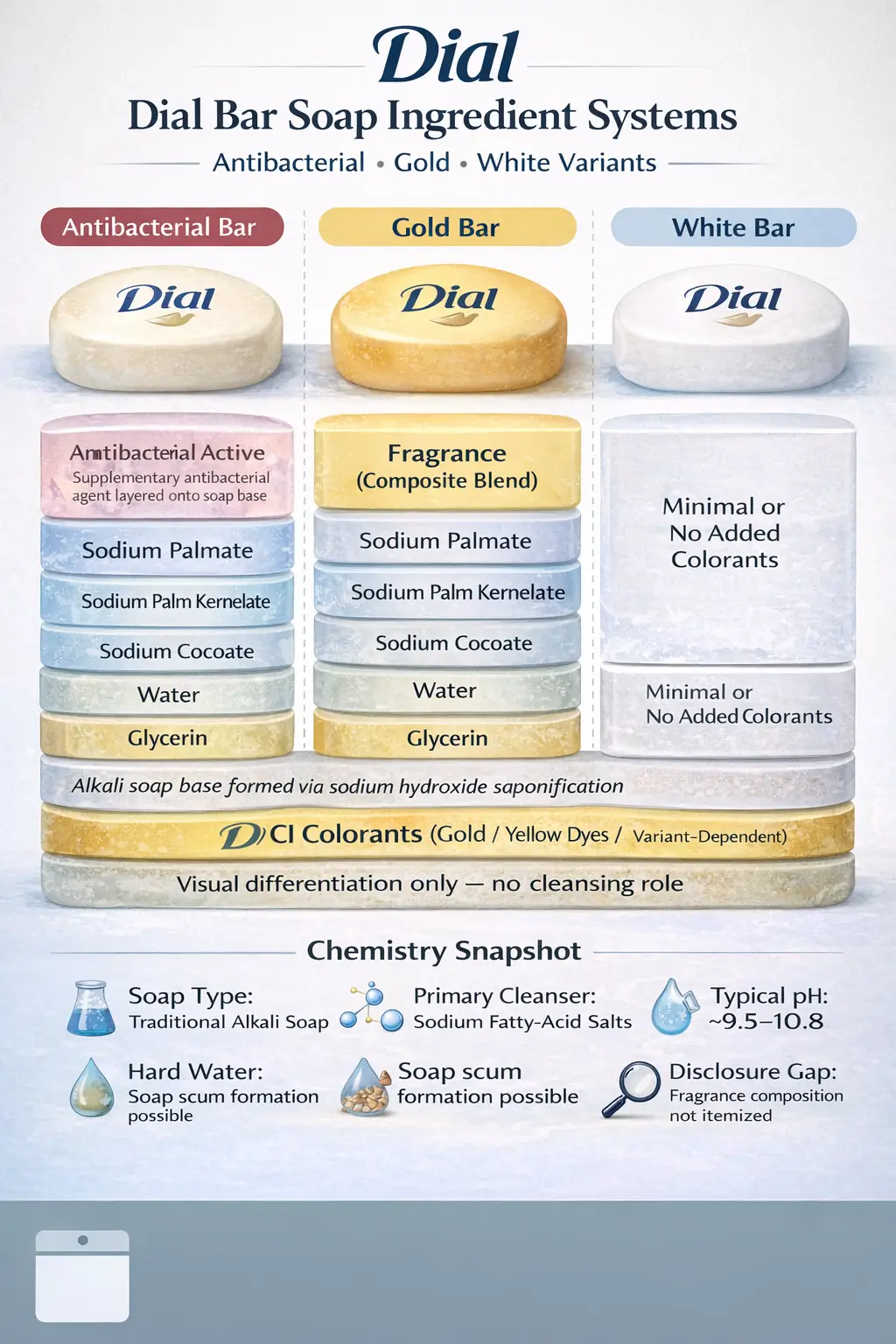
Ingredient Disclosure Scope
Dial bar soap ingredient lists generally follow regulated soap labeling practices, disclosing the primary fatty-acid salts, water content, fragrance systems, and colorants in descending order of predominance. Antibacterial variants additionally disclose active antibacterial agents when required by applicable regulations.
Unlike cosmetic syndet bars, Dial soaps are often regulated under soap-specific frameworks, which can result in differences in disclosure depth, a distinction explained more broadly in Dial soap ingredients explained. Fragrance systems are typically listed as a single composite term, limiting component-level analysis despite regulatory compliance.
| Disclosure Element | Label Practice | Analytical Implication |
|---|---|---|
| Soap Base | Fully named fatty-acid salts | Enables alkali system identification |
| Antibacterial Actives | Explicit when present | Supports functional interpretation |
| Fragrance | Grouped disclosure | Limits aromatic component analysis |
Formulation Classification
Dial bar soaps are classified as traditional alkali soaps rather than synthetic detergent bars. Their cleansing action arises from sodium salts of fatty acids produced through saponification, a process described in more detail in our cold process soap ingredients guide, a process fundamentally different from surfactant-based syndet systems.
Gold, white, and antibacterial variants share the same underlying soap chemistry. Differences between variants are introduced through antibacterial actives, fragrance profiles, and colorant systems rather than changes to the soap base itself.
| Variant | Base Chemistry | Primary Differentiator |
|---|---|---|
| Gold Bar | Sodium fatty-acid soap | Fragrance & colorants |
| White Bar | Sodium fatty-acid soap | Reduced dye load |
| Antibacterial Bar | Sodium fatty-acid soap | Added antibacterial active |
Alkali Soap Base Overview
The foundational cleansing system in Dial bar soaps consists of sodium salts of long-chain fatty acids. These salts are formed by reacting triglyceride oils with sodium hydroxide, yielding soap molecules capable of emulsifying oils through alkaline dissociation.
This alkali-driven mechanism results in a characteristically high pH environment during use. In practice, Dial bars demonstrate strong soil removal and rapid lather formation, particularly in warm water, reflecting the inherent efficiency of sodium soap chemistry.
One observable limitation of this system is interaction with hard water minerals, where calcium and magnesium ions can form insoluble residues. This behavior is intrinsic to alkali soaps and not specific to Dial formulations.
Active System Analysis
Dial antibacterial bar soaps achieve antibacterial labeling through the inclusion of explicitly declared antibacterial active ingredients layered onto a conventional sodium soap base. These actives do not replace the soap system; instead, they operate within the existing alkaline cleansing environment.
Historically and across different markets, Dial antibacterial bars have used different active agents depending on regulatory allowances. Where present, these actives are listed separately from the soap base and appear in small but functionally relevant concentrations. Broader antibacterial active frameworks are examined in antibacterial soap ingredients analysis.
| Ingredient Category | Disclosure Practice | Functional Context |
|---|---|---|
| Antibacterial Active | Explicitly named when present | Supplementary to soap cleansing |
| Soap Base | Fully disclosed fatty-acid salts | Primary cleansing mechanism |
| Supporting Additives | Listed by function | Stability & sensory control |
From an ingredient behavior standpoint, antibacterial actives are constrained by the alkaline environment of soap. Their contribution is therefore additive rather than transformative, reinforcing cleansing rather than redefining it. For comparison with antimicrobial terminology, review Dial antimicrobial soap ingredients.
Fatty-Acid Composition of Bar Soap Base
Dial bar soaps rely on a blended fatty-acid feedstock to balance cleansing strength, bar hardness, and manufacturing consistency. The fatty acids are present as sodium salts, each contributing distinct physical and functional properties to the finished bar.
Lauric and myristic acids support rapid lather formation, while palmitic and stearic acids provide structural rigidity and slower dissolution. Oleic acid, when present, softens the bar matrix slightly and moderates brittleness. For comparison with traditional olive-based soap systems, see Castile soap ingredients explained.
| Fatty Acid | Carbon Chain | Estimated Range (%) | Primary Contribution |
|---|---|---|---|
| Lauric Acid | C12:0 | 20–35 | Fast lather & cleansing |
| Myristic Acid | C14:0 | 8–15 | Foam density |
| Palmitic Acid | C16:0 | 15–25 | Bar hardness |
| Stearic Acid | C18:0 | 5–12 | Structural stability |
| Oleic Acid | C18:1 | 5–10 | Flexibility & conditioning feel |
These ranges are observational estimates rather than disclosed values. Minor batch-to-batch variation is expected due to upstream oil sourcing and refining differences.
Alkali System Behavior & pH Characteristics
The alkali system in Dial bar soaps is defined by sodium hydroxide–derived fatty-acid salts. While free sodium hydroxide is consumed during saponification, the resulting soap solution remains alkaline due to dissociation of the sodium carboxylates.
In practical observation, Dial bar soaps typically produce lather with a pH in the range of approximately 9.5 to 10.8. This alkalinity supports strong soil removal but also drives interactions with mineral ions in hard water.
| Soap Variant | Typical pH Range | Chemical Driver |
|---|---|---|
| Gold Bar | 9.5–10.8 | Sodium fatty-acid salts |
| White Bar | 9.5–10.8 | Sodium fatty-acid salts |
| Antibacterial Bar | 9.5–10.8 | Sodium fatty-acid salts + active |
One consistent limitation of this system is soap scum formation in mineral-rich water, a consequence of insoluble calcium and magnesium fatty-acid salts rather than formulation error.
Dial Gold Bar Soap Ingredients: What Defines The Formula
Dial Gold bar soap is built on the same sodium fatty-acid soap base used across Dial’s bar lineup. The defining characteristics of the Gold variant are its fragrance system and colorant package rather than changes to the alkali soap chemistry.
Ingredient lists for Dial Gold bars typically show a conventional sequence: sodium salts of mixed fatty acids, water, fragrance, colorants, and minor stabilizers. The gold coloration is achieved through dye selection rather than metallic additives, and no functional cleansing role is associated with the color system. A focused breakdown of this variant is available in Gold Dial soap ingredients.
| Ingredient Group | Presence | Functional Role |
|---|---|---|
| Sodium Fatty-Acid Salts | Present | Primary cleansing |
| Fragrance Blend | Present | Scent profile & brand identity |
| Colorants | Present | Visual differentiation only |
| Chelators & Stabilizers | Trace | Formulation consistency |
In handling observations, Gold bars tend to retain fragrance slightly longer during use compared to white bars, likely due to higher fragrance loading rather than changes in the soap matrix.
Dial White Bar Soap Ingredients: Reduced Additive Profile
Dial White bar soap shares the same alkali soap base as the Gold variant but typically employs a reduced colorant system. This results in a visually neutral bar without altering cleansing behavior or pH expression.
Ingredient differences between Gold and White bars are therefore additive rather than structural. The absence or reduction of dyes does not affect lather formation, fatty-acid dissociation, or soil removal efficiency. Comparative structure differences can also be reviewed in Dial soap ingredients explained.
| Ingredient Group | Gold Bar | White Bar |
|---|---|---|
| Soap Base | Identical | Identical |
| Colorants | Present | Minimal or absent |
| Fragrance Load | Moderate | Moderate |
From a formulation analysis perspective, the White bar’s simpler additive profile slightly reduces the number of non-cleansing components without changing the soap’s fundamental chemistry.
Colorant Systems In Bar Soaps
Colorants in Dial bar soaps are included solely for visual identification and brand differentiation. These dyes are typically disclosed using CI identifiers, which categorize the pigment but do not reveal concentration or solubility characteristics.
In alkali soap matrices, colorants must remain stable at elevated pH and during repeated wet-dry cycles. Observationally, Dial bar colorants demonstrate minimal bleeding or fading under normal storage and use conditions.
| Property | Observed Outcome | Chemical Explanation |
|---|---|---|
| pH Stability | High | Alkali-resistant dye selection |
| Migration | Low | Low water mobility in solid bar |
| Fading | Minimal | Oxidation-resistant pigments |
Colorants do not participate in cleansing or antibacterial performance and can be removed without altering soap function.
Fragrance Architecture In Bar Soap
Fragrance systems in Dial bar soaps are embedded within the sodium soap matrix. As the bar hydrates during use, fragrance compounds are released gradually, producing a sustained scent profile.
Because fragrance blends are disclosed as a single composite ingredient, the specific aromatic components cannot be independently assessed from the label. This limits detailed volatility and allergen analysis but aligns with common soap labeling practices. General fragrance behavior in soap matrices is discussed in soap ingredients guide.
In practical observation, fragrance intensity diminishes over time as volatile components evaporate, while the underlying soap chemistry remains unchanged.
Label Transparency Gaps & Interpretive Limits
While Dial bar soap labels disclose the primary soap base and antibacterial actives where applicable, several transparency gaps remain. Fragrance composition, exact fatty-acid sourcing, and additive concentration ranges are not fully specified.
These omissions are typical of mass-produced soaps and reflect regulatory allowances rather than formulation concealment. Analytical interpretation must therefore rely on known soap chemistry and observed behavior rather than complete compositional disclosure.
Hand Soap Ingredients: Liquid Formulation Systems
Dial hand soaps are chemically distinct from Dial bar soaps, a difference that becomes clearer when examining liquid-format formulations such as those discussed in the Dial Himalayan salt hand soap guide. Liquid hand soap formulations do not rely on alkali soap chemistry and instead use synthetic surfactant systems designed to remain stable in aqueous environments over extended storage periods.
Across observed ingredient disclosures, Dial hand soaps typically list water as the primary component, followed by anionic surfactants supported by amphoteric or nonionic co-surfactants. This system enables controlled foaming, reduced residue formation, and compatibility with Preservatives.
| Ingredient Group | Typical Role | Formulation Implication |
|---|---|---|
| Water | Solvent & carrier | Requires preservation |
| Anionic Surfactants | Primary cleansing | Micelle-based soil removal |
| Amphoteric Surfactants | Foam modulation | Improves rinse behavior |
| Preservatives | Microbial control | Essential for shelf stability |
In handling observations, liquid hand soaps rinse more predictably in hard water compared to bar soaps, reflecting the absence of fatty-acid precipitation reactions.
Bar vs Liquid Soap: Ingredient System Differences
The fundamental difference between Dial bar soaps and Dial liquid hand soaps lies in the cleansing mechanism. Bar soaps rely on alkali fatty-acid salts, while liquid hand soaps use synthetic surfactants buffered to lower pH ranges.
This distinction affects ingredient selection across all formulation stages, including thickening, preservation, and fragrance solubilization. As a result, ingredient lists between bar and liquid formats are not directly comparable on a one-to-one basis. Liquid-format contrasts are further detailed in Dial antibacterial soap ingredients.
| Aspect | Bar Soap | Liquid Hand Soap |
|---|---|---|
| Primary Cleanser | Sodium fatty-acid salts | Synthetic surfactants |
| pH Range | 9.5–10.8 | 5.5–7.5 |
| Preservatives | Not required | Required |
| Hard Water Interaction | Soap scum formation | Minimal residue |
Preservative Systems & Shelf-Life Logic
Preservatives are not typically required in Dial bar soaps due to low free water content and alkaline conditions. In contrast, Dial liquid hand soaps depend on preservative systems to maintain microbiological stability throughout storage and use.
Preservatives function synergistically with chelating agents and controlled pH environments. Exact preservative blends may vary by region due to regulatory frameworks, introducing minor formulation variability without altering cleansing performance.
| Format | Preservation Strategy | Dependency |
|---|---|---|
| Bar Soap | Intrinsic stability | Low water activity |
| Liquid Hand Soap | Added preservatives | pH & packaging |
In observational use, preservative effectiveness appears consistent when containers remain closed between uses and not diluted with external water.
Regional & Batch Ingredient Variability
Dial soap formulations demonstrate controlled variability across regions due to differences in regulatory requirements, ingredient sourcing, and manufacturing infrastructure. These variations typically affect secondary ingredients rather than the core cleansing system.
Side-by-side observations of Dial bars sourced from different markets revealed subtle differences in fragrance intensity and bar hardness, likely attributable to fatty-acid feedstock variation rather than intentional reformulation.
Such variability is expected in large-scale soap manufacturing and does not materially alter ingredient behavior described in this analysis.
Stability & Shelf-Life Implications
Dial bar soaps exhibit high intrinsic stability due to their low free-water content and alkaline soap matrix. Microbial growth is not a governing stability factor; instead, long-term integrity depends on moisture exposure, fragrance volatility, and fatty-acid crystallization behavior.
Under typical storage conditions, bars retain structural integrity for extended periods. Prolonged exposure to standing water accelerates surface dissolution and increases mineral residue formation, reflecting soap chemistry rather than chemical degradation.
| Stability Factor | Observed Effect | Chemical Basis |
|---|---|---|
| Moisture exposure | Surface erosion | Fatty-acid salt solubility |
| Hard water minerals | Soap residue formation | Insoluble calcium salts |
| Fragrance volatility | Gradual scent loss | Aromatic evaporation |
No evidence suggests spontaneous chemical instability within standard shelf-life periods when bars are stored dry between uses.
Handling & Storage Considerations
From an ingredient behavior standpoint, Dial bar soaps perform optimally when allowed to dry fully between uses. Soap dishes with drainage reduce prolonged water contact and slow surface dissolution.
Long-term storage should avoid sealed, moisture-trapping containers. While bars do not spoil in a conventional sense, trapped humidity accelerates softening and fragrance dissipation.
Ingredient-Driven Functional Limitations
The alkali soap architecture of Dial bars imposes predictable functional boundaries. High alkalinity enhances soil removal but increases interaction with hard water minerals, resulting in soap scum formation.
Antibacterial actives, where present, operate within the soap system rather than replacing it. Their effectiveness is therefore constrained by rinse-off conditions and alkaline chemistry.
Fragrance system opacity remains the most significant transparency limitation, as composite disclosure prevents detailed aromatic component analysis.
Summary of Findings
- Traditional Soap Chemistry: Dial bars are sodium fatty-acid soaps, not syndet cleansing bars.
- Antibacterial Structure: Antibacterial actives supplement rather than replace the soap base.
- Fatty-Acid Balance: Blended fatty acids optimize lather speed, hardness, and durability.
- pH Reality: Alkaline pH supports strong cleansing but drives mineral interaction.
- Disclosure Limits: Fragrance composition and sourcing details remain partially opaque.
References
- Rosen, M. J. (2012). Surfactants and Interfacial Phenomena, Wiley. View source
- Rieger, M. M. Harry’s Cosmeticology, Chemical Publishing.
- Schramm, L. L. (2000). Surfactants: Fundamentals and Applications. View source
- U.S. Food & Drug Administration. Soap labeling and antibacterial active ingredient regulations. View source