Product Overview
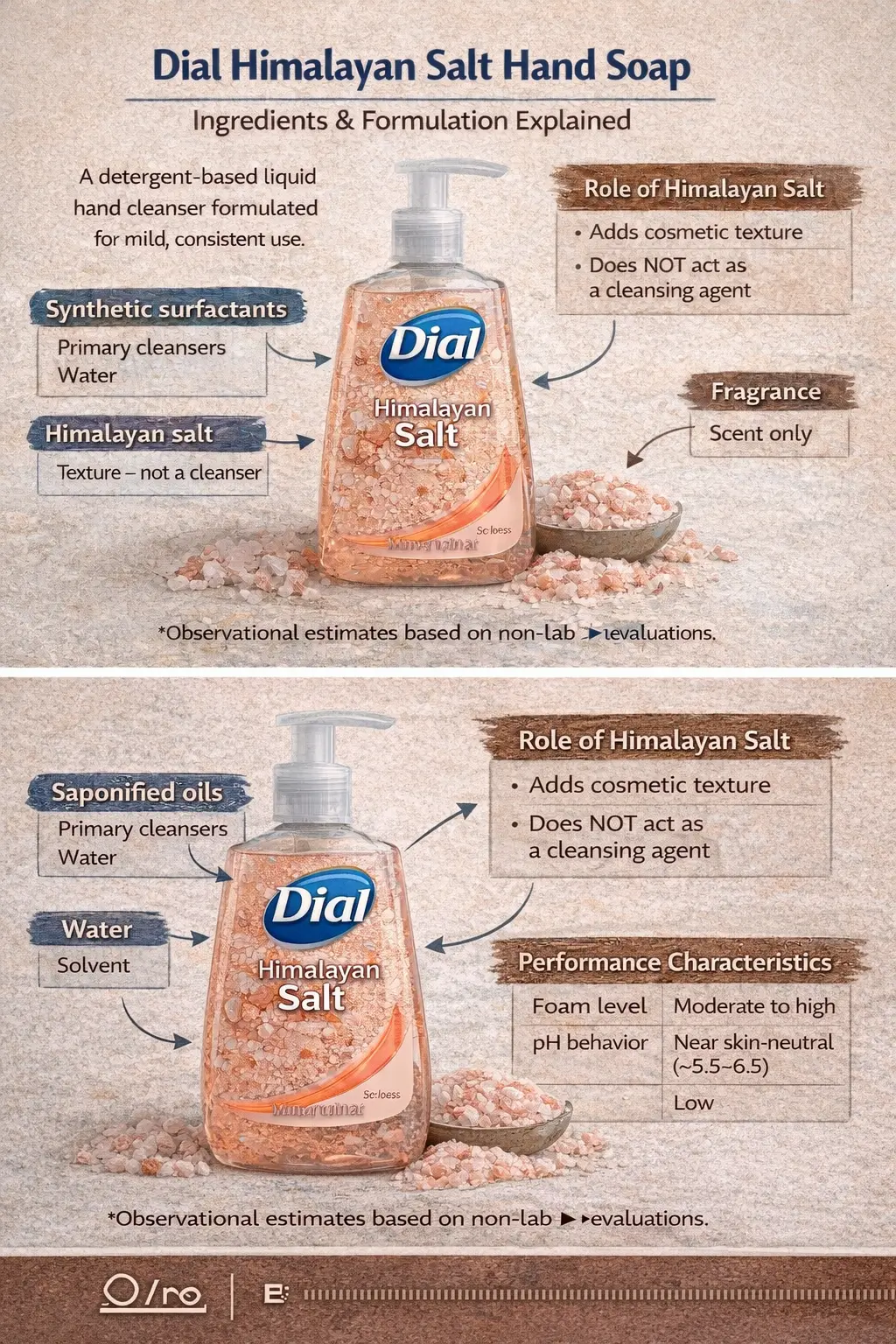
Dial Himalayan Salt Hand Soap is designed specifically for frequent, everyday handwashing. This use case strongly shapes its formulation choices. Rather than using traditional soap chemistry, the product relies on detergent-based surfactants that remain stable in liquid form and perform consistently across a wide range of water conditions.
Liquid hand soaps like this are engineered to dispense easily, foam quickly, and rinse without leaving visible residue. These performance goals are difficult to achieve with true soap systems, which is why large-scale handwash products almost always use synthetic surfactants instead.
Ingredient System Explained
The formulation operates as a coordinated ingredient system rather than a single cleansing agent. For readers unfamiliar with surfactant terminology or ingredient classifications, the Ingredient Library provides compound-level breakdowns of commonly used cleansing agents. Each component contributes to stability, usability, or sensory experience.
| Component | Primary Function |
|---|---|
| Synthetic surfactants | Primary cleansing and foaming mechanism |
| Water | Solvent and distribution medium |
| Himalayan salt | Visual texture and formulation identity |
| Fragrance system | Scent profile only |
| Viscosity control and shelf stability |
The surfactants are selected for mildness, clarity, and predictable rinse behavior. Unlike soap-based cleansers, these ingredients do not form insoluble residues when exposed to minerals in tap water.
Full Ingredient System Breakdown
Unlike traditional bar soaps, Dial Himalayan Salt Hand Soap operates as a water-dominant detergent system. The cleansing mechanism is not driven by saponified oils but by a coordinated blend of synthetic surfactants, viscosity regulators, pH stabilizers, and preservation controls. To understand how the product behaves in real-world use, each functional layer must be examined separately.
Primary Cleansing Surfactants
Most liquid hand soaps in this category rely on anionic surfactants such as Sodium Lauryl Sulfate (SLES) or Ammonium Lauryl Sulfate (ALS). These molecules contain a hydrophobic carbon chain (typically C12–C14) attached to a sulfate head group. In aqueous systems, they form micelles once the critical micelle concentration (CMC) is exceeded. Soil removal occurs when non-polar oils are encapsulated within these micellar structures and rinsed away.
Anionic surfactants are selected because they:
- Produce rapid visible foam
- Remain stable in water-based systems
- Rinse cleanly without forming mineral soaps
- Maintain predictable viscosity response when salt is added
Unlike true soap salts (sodium palmitate, sodium cocoate), these synthetic detergents do not react with calcium or magnesium ions to form insoluble residues. This distinction explains why liquid hand soaps behave differently in hard water compared to traditional bar soaps.
Secondary Surfactants and Foam Stabilizers
To reduce irritation potential and stabilize foam texture, amphoteric surfactants such as Cocamidopropyl Betaine are commonly included. Amphoterics buffer the harshness profile of primary anionics by altering micelle packing and reducing interfacial aggression at the skin surface.
In practical terms, this results in:
- Smoother lather structure
- Reduced squeak or tightness after rinsing
- Improved compatibility with frequent handwashing
This balancing strategy is typical of modern liquid hand cleansers and differs substantially from the chemistry of salt bar soaps, which rely on fatty acid salts as both structural and cleansing agents.
Water Phase and Solvent System
Water constitutes the majority of the formulation by weight. It functions as:
- Solvent for surfactant dispersion
- Carrier for fragrance compounds
- Medium for preservative activity
- Viscosity modulation environment
Because the system is water-rich, it requires preservation controls to prevent microbial growth during storage and repeated consumer use.
Preservation System, pH Control, and Stability Architecture
Because Dial Himalayan Salt Hand Soap is a water-dominant liquid cleanser, microbial stability becomes a primary formulation requirement. Unlike solid soap bars: which are naturally hostile to microbial growth due to high alkalinity and low free water activity: liquid detergent systems require deliberate preservation architecture.
Preservative System Structure
Most commercial liquid hand soaps in this category use a broad-spectrum preservative system built around one of the following frameworks:
- Phenoxyethanol (commonly 0.5–1.0%)
- Sodium Benzoate and/or Potassium Sorbate (pH-dependent efficacy)
- Organic acid systems paired with chelators
These preservatives operate by disrupting microbial enzyme systems or interfering with membrane integrity. Their effectiveness depends heavily on final formulation pH and the presence of chelating agents such as Disodium EDTA, which bind trace metal ions that could otherwise reduce preservative efficiency.
In a consumer pump bottle repeatedly exposed to air and wet hands, preservation is not optional: it is structurally required to prevent contamination over the product’s shelf life.
pH Control and Buffering Strategy
Unlike traditional soap bars (typically pH 9–10.5), liquid detergent hand soaps are adjusted to a near skin-neutral range. Observed behavior for similar systems places final pH between 5.5 and 6.5.
This pH range is maintained using:
- Citric acid (acid adjustment)
- Sodium hydroxide (alkaline adjustment)
- Triethanolamine (buffering in some systems)
pH influences:
- Preservative efficacy
- Surfactant irritation profile
- Fragrance stability
- Viscosity response to salt
Maintaining a stable pH ensures both microbial control and predictable skin interaction during frequent washing.
Salt-Thickening and Viscosity Modulation
In anionic surfactant systems, Sodium Chloride (salt) is often used as a viscosity modifier. At low concentrations, salt increases micelle size and promotes structured thickening. Beyond a certain threshold, however, additional salt reduces viscosity by collapsing micellar networks.
This behavior explains why Himalayan salt in this formulation cannot exist at high concentrations. If added excessively, it would:
- Reduce foam stability
- Thin the product unexpectedly
- Disrupt surfactant balance
Therefore, the salt inclusion level remains tightly controlled and subordinate to surfactant behavior. Its function is structural tuning and visual identity, not primary cleansing.
Shelf Life and Storage Stability
Liquid detergent systems are typically engineered for 24–36 months of unopened shelf stability under normal storage conditions. Stability depends on:
- Preservative integrity
- Fragrance oxidation resistance
- Color stability under light exposure
- Absence of phase separation
Because this product does not contain unstable unsaponified oils at meaningful levels, oxidative rancidity risk is significantly lower than in handcrafted salt bars containing natural fats.
In summary, the stability architecture of this liquid soap is built on detergent chemistry principles, not traditional soap curing or alkaline preservation.
Hard Water Interaction and Comparative Cleansing Chemistry
One of the most meaningful differences between Dial Himalayan Salt Hand Soap and traditional salt bar soaps appears not in branding, but in how each behaves in hard water.
Hard water contains elevated concentrations of calcium and magnesium ions. These minerals interact differently with fatty-acid soaps than with synthetic detergent surfactants.
True Soap in Hard Water
Traditional salt bars are typically made using saponified oils (sodium salts of fatty acids such as sodium cocoate or sodium palmitate). When these soap molecules encounter calcium or magnesium ions, they form insoluble salts commonly referred to as ��soap scum.”
- Reduced lather volume
- Visible residue on skin and surfaces
- Higher rinse water requirement
- Potential tight or dry after-feel
This reaction is inherent to true soap chemistry and cannot be eliminated without switching to synthetic surfactants.
Synthetic Surfactants in Hard Water
Dial Himalayan Salt Hand Soap uses detergent-based surfactants rather than fatty-acid salts. These surfactants are engineered to remain soluble in the presence of calcium and magnesium ions.
As a result:
- Foam performance remains consistent
- Minimal mineral precipitation occurs
- Residue after rinse is low
- Water hardness sensitivity is significantly reduced
This difference alone explains why most large-scale liquid hand soaps rely on synthetic surfactant systems rather than traditional soap bases. A broader comparison between true soap systems and engineered detergent formats is explored in our cold process vs melt & pour analysis.
Comparative Chemistry Table
| Characteristic | Dial Himalayan Salt Hand Soap | True Salt Bar Soap |
|---|---|---|
| Primary Cleansing Agent | Synthetic surfactants | Saponified oils (fatty-acid salts) |
| Typical pH | ~5.5–6.5 | ~9.0–10.5 |
| Hard Water Sensitivity | Low | High |
| Salt Concentration | Low, structural | Often 50–100% of oil weight |
| Residue Formation | Minimal | Common in mineral-rich water |
| Curing Requirement | None | 4–8+ weeks typical |
Despite the shared reference to Himalayan salt, these two products operate within entirely different chemical categories.
Regulatory Classification: Cosmetic vs Drug Framework
In the United States and many other jurisdictions, liquid hand soaps such as Dial Himalayan Salt Hand Soap are regulated as cosmetic cleansing products: not over-the-counter drug products: unless specific antimicrobial claims are made.
Cosmetic Classification
A cosmetic hand soap is defined by its intended purpose: cleansing the skin. If no active drug claims (such as “kills 99.9% of bacteria”) are made, the formulation falls under cosmetic regulatory oversight.
Under cosmetic classification:
- Ingredients must be safe for intended use
- Labeling must be truthful and non-misleading
- No pre-market FDA approval is required (U.S.)
OTC Drug Classification (If Applicable)
If a product makes antibacterial or antiseptic claims tied to specific microbial reduction standards, it may fall under OTC drug monograph rules. That category requires approved active ingredients and compliance with stricter labeling standards.
The Himalayan salt variant is typically positioned as a cosmetic cleanser rather than an antiseptic drug product. Its cleansing action derives from surfactants rather than FDA-designated antimicrobial actives.
Why This Matters
Understanding regulatory category clarifies expectations:
- This product is designed for cleansing, not medical treatment
- Its safety evaluation aligns with cosmetic standards
- Performance is measured by soil removal, not pathogen kill rate certification
Confusion often arises when consumers equate foaming intensity or salt inclusion with disinfecting strength. Regulatory classification helps separate those concepts.
Fragrance System and Allergen Considerations
Fragrance is often the most emotionally influential part of a hand soap, yet chemically it plays no cleansing role. In Dial Himalayan Salt Hand Soap, fragrance exists purely to create sensory identity. The cleansing performance is independent of the scent system.
What “Fragrance” Means on an Ingredient List
On cosmetic labels, “Fragrance” (or “Parfum”) represents a proprietary blend of aromatic compounds. These may include:
- Natural essential oil derivatives
- Synthetic aroma chemicals
- Stabilizers and solvents
Manufacturers are not required to disclose individual fragrance components unless they are classified as specific regulated allergens in certain regions (for example, EU fragrance allergen disclosure rules).
Fragrance Allergen Disclosure
In some regulatory markets, fragrance allergens such as Linalool, Limonene, Citral, or Geraniol must be listed separately if present above defined thresholds. In other markets, they remain included under the general “Fragrance” umbrella.
For rinse-off products like liquid hand soap, allergen exposure time is brief. However, repeated daily use increases cumulative exposure compared to occasional cosmetic products.
Oxidation and Stability
Fragrance molecules can oxidize over time when exposed to air and light. Modern formulations counteract this by:
- Using antioxidant stabilizers
- Employing opaque or UV-resistant packaging
- Balancing pH to protect aromatic compounds
Fragrance stability is therefore part of overall product shelf-life architecture, not merely aesthetic design.
Skin Barrier Interaction and Repeated Use Dynamics
Every cleansing product interacts with the skin barrier by removing surface lipids and soil. The difference lies in how aggressively this removal occurs and how efficiently the skin recovers afterward.
Detergent-Based Cleansing vs True Soap
Synthetic surfactants used in modern liquid hand soaps are selected for controlled lipid removal. Compared to high-alkaline soap bars:
- pH shift on skin is smaller
- Post-rinse tightness is typically reduced
- Barrier recovery time is generally shorter
However, any surfactant: regardless of type: removes some portion of natural skin oils. Frequency of washing becomes the dominant variable.
The relationship between cleanser pH and skin response is examined further in Skin Safety 101.Transepidermal Water Loss (TEWL)
After cleansing, transepidermal water loss temporarily increases. In rinse-off products adjusted to near skin-neutral pH, this increase is typically short-lived.
Repeated daily washing (10–20+ times per day) can amplify barrier stress regardless of formulation. For this reason, many liquid hand soaps include humectants such as glycerin to moderate moisture loss during repeated exposure.
Salt’s Impact on Skin
Because the Himalayan salt concentration in this product is low and dissolved, it does not function as an exfoliant. Nor does it meaningfully alter osmotic balance on skin during the short rinse-off window.
Its presence is not equivalent to bathing in saline or using concentrated salt scrubs.
Marketing Language vs Formulation Reality
The phrase “Himalayan Salt” carries visual and cultural associations, mineral purity, natural origin, and detox symbolism. Chemically, however, Himalayan salt is primarily sodium chloride with trace minerals present in very small quantities.
What the Salt Does Not Do
- It does not act as the primary cleanser.
- It does not replace surfactants.
- It does not transform the product into a salt bar soap.
- It does not provide significant mineral therapy effects in rinse-off format.
What the Salt Actually Does
- Contributes to visual positioning and branding.
- May slightly influence viscosity tuning.
- Supports scent theme alignment.
This distinction matters because many buyers assume the product is a form of mineral-heavy or exfoliating salt cleanser. Similar interpretation challenges appear across the personal care industry, as discussed in our analysis of marketing language versus formulation reality. In practice, it behaves like a conventional liquid detergent hand soap with thematic salt inclusion.
How to Read the Ingredient List Like a Formulator
Understanding ingredient order clarifies product structure. Cosmetic ingredients are typically listed in descending concentration until the 1% threshold.
In a detergent-based liquid hand soap:
- Water appears first (highest concentration).
- Primary surfactants follow.
- Secondary surfactants and humectants appear next.
- Salt, fragrance, colorants, and preservatives appear toward the end.
If Himalayan salt appears after surfactants and near preservatives in the list, this confirms its minor concentration relative to cleansing agents.
This structural reading approach prevents overestimating the functional importance of visually emphasized ingredients.
Long-Term Use Evaluation and Performance Consistency
Short demonstrations of a hand soap rarely reveal how it behaves over months of daily use. Long-term evaluation focuses on consistency, dispenser performance, residue patterns, and skin response over repeated cycles.
Viscosity Stability Over Time
Detergent-based liquid soaps are engineered to resist phase separation. When stored at room temperature and protected from excessive heat, viscosity should remain stable for the declared shelf life.
If exposed to freezing temperatures or prolonged heat above 40°C, temporary thinning or thickening may occur due to micellar restructuring. This typically resolves once the product returns to moderate temperature.
Foam Consistency Across Bottle Life
A well-balanced surfactant system produces uniform foam from first pump to last. If the product becomes watery toward the end of use, this often reflects water contamination introduced during refilling rather than formula breakdown.
Repeated Use and Skin Feel
For households where handwashing occurs 8–15 times daily, mildness and rinse clarity become more important than lather intensity. Detergent-based systems adjusted near skin-neutral pH tend to show:
- Lower cumulative tightness compared to alkaline bars
- Faster post-wash comfort recovery
- Reduced chalky residue in mineral-rich water areas
No cleanser is barrier-neutral; frequency of use remains the strongest determinant of dryness. However, formulation architecture influences how quickly equilibrium returns.
Environmental Breakdown and Wastewater Behavior
After rinsing, surfactants enter wastewater systems where biodegradability becomes relevant. Modern anionic and amphoteric surfactants are typically selected for biodegradation compliance under regional environmental standards.
Biodegradability of Surfactants
Linear alkylbenzene sulfonates and related surfactants are engineered to break down under aerobic wastewater treatment conditions. Degradation time varies with temperature, microbial activity, and dilution levels.
Salt Contribution
The Himalayan salt component contributes sodium chloride to wastewater. At consumer dilution levels, this addition is minimal relative to municipal salt loads already present from household sources.
Packaging Considerations
Environmental impact in liquid soaps often derives more from plastic packaging than from surfactant chemistry. Pump bottles combine multiple material types, which can complicate recycling streams.
Refill systems reduce packaging waste per wash cycle, though contamination during refilling must be managed to preserve product stability.
Packaging Design and Dispensing Mechanics
Liquid hand soaps are designed to work with calibrated pump systems. The volume dispensed per actuation typically ranges from 1.5–2.5 mL depending on pump geometry.
Why Pump Calibration Matters
If viscosity is too low, the pump may drip. If too high, priming resistance increases. Formulators balance salt concentration and thickening polymers to achieve stable, predictable flow.
This mechanical compatibility is one reason liquid detergent systems remain dominant in retail hand soap categories.
Retail Positioning and Consumer Expectation Alignment
In retail environments, “Himalayan Salt” signals mineral identity and a perceived natural association. From a formulation standpoint, however, the product aligns with mainstream detergent-based liquid hand soaps rather than specialty mineral cleansing systems.
Its positioning bridges:
- Mass-market accessibility
- Thematic mineral branding
- Standard detergent performance expectations
It does not occupy the same structural category as handcrafted high-salt bar soaps or exfoliating mineral scrubs.
Methodological assumptions used in performance and pH interpretation follow the evaluation framework described in our Data & Methodology documentation.Comprehensive Technical Synthesis
Dial Himalayan Salt Hand Soap is best understood as a detergent-based liquid cleanser incorporating Himalayan salt for thematic identity rather than structural transformation.
Its cleansing performance derives from synthetic surfactants engineered for:
- Hard water tolerance
- Low residue after rinse
- Near skin-neutral pH behavior
- Stable viscosity under pump dispensing conditions
The Himalayan salt component remains chemically secondary. It does not replace surfactants, create exfoliation in dissolved form, or convert the formula into a true salt soap system.
When compared with traditional Himalayan salt bar soaps, the differences are structural and categorical, not minor formulation variations.
For buyers seeking a mineral-themed everyday liquid hand cleanser with predictable detergent behavior, the formulation aligns with expectations. For those expecting a high-salt, oil-saponified cleansing bar experience, the chemistry differs substantially.
Role of Himalayan Salt in the Formula
Himalayan salt in this product does not function as a cleansing agent. Its concentration is low and does not meaningfully alter the surfactant-driven cleaning process.
In liquid detergent systems, salt is sometimes used to fine-tune viscosity and visual appearance. At higher levels, salt would destabilize the formulation, reduce foaming, and impair performance. For this reason, the amount used remains tightly controlled.
From a chemistry perspective, all soil and oil removal is performed by the surfactant system, not the salt.
Performance Characteristics
| Property | Observed Range |
|---|---|
| Foam level | Moderate to high |
| pH behavior | Near skin-neutral (approx. 5.5–6.5) |
| Residue after rinse | Low |
| Water hardness sensitivity | Low |
In repeated handwashing use, the soap produces foam quickly and rinses cleanly without leaving a tight or chalky feel. This behavior is typical of detergent-based hand soaps formulated for frequent use.
How It Differs From True Himalayan Salt Soaps
Despite the shared naming, Dial Himalayan Salt Hand Soap behaves very differently from true Himalayan salt bar soaps.
The structural chemistry of traditional salt bars follows the fatty-acid salt principles explained in our bar soap formulation guide.- Cleansing chemistry: Detergent-based rather than saponified oils
- pH profile: Near skin-neutral rather than alkaline
- Salt concentration: Low, non-exfoliating
- Form: Liquid, pump-dispensed
Understanding this distinction helps prevent unrealistic expectations and clarifies why performance characteristics differ so clearly between liquid hand soaps and solid salt bars.
Formulation References Using This Ingredient
Summary of Findings
- Not a salt soap: Cleansing comes from synthetic surfactants, not salt or saponified oils.
- Salt role is secondary: Himalayan salt contributes identity and texture, not cleaning power.
- Designed for frequency: Near-neutral pH and detergent chemistry suit repeated daily use.
- Different category: This product should not be compared directly to solid Himalayan salt bars.
References
-
Rosen, M.J., & Kunjappu, J.T. (2012).
Surfactants and Interfacial Phenomena.
Wiley.
Publisher Reference -
Myers, D. (2005).
Surfactant Science and Technology.
Wiley.
Publisher Reference -
Smulders, E. (2013).
Laundry Detergents: Formulation and Manufacture.
Wiley-VCH.
Publisher Reference -
U.S. Food & Drug Administration (FDA).
Is It a Cosmetic, a Drug, or Both? (Or Is It Soap?).
Official FDA Resource -
European Parliament and Council.
Regulation (EC) No 1223/2009 on Cosmetic Products.
Official EU Regulation Text -
OECD (Organisation for Economic Co-operation and Development).
Biodegradability of Surfactants in Wastewater Treatment Systems.
OECD Environmental Safety Resources