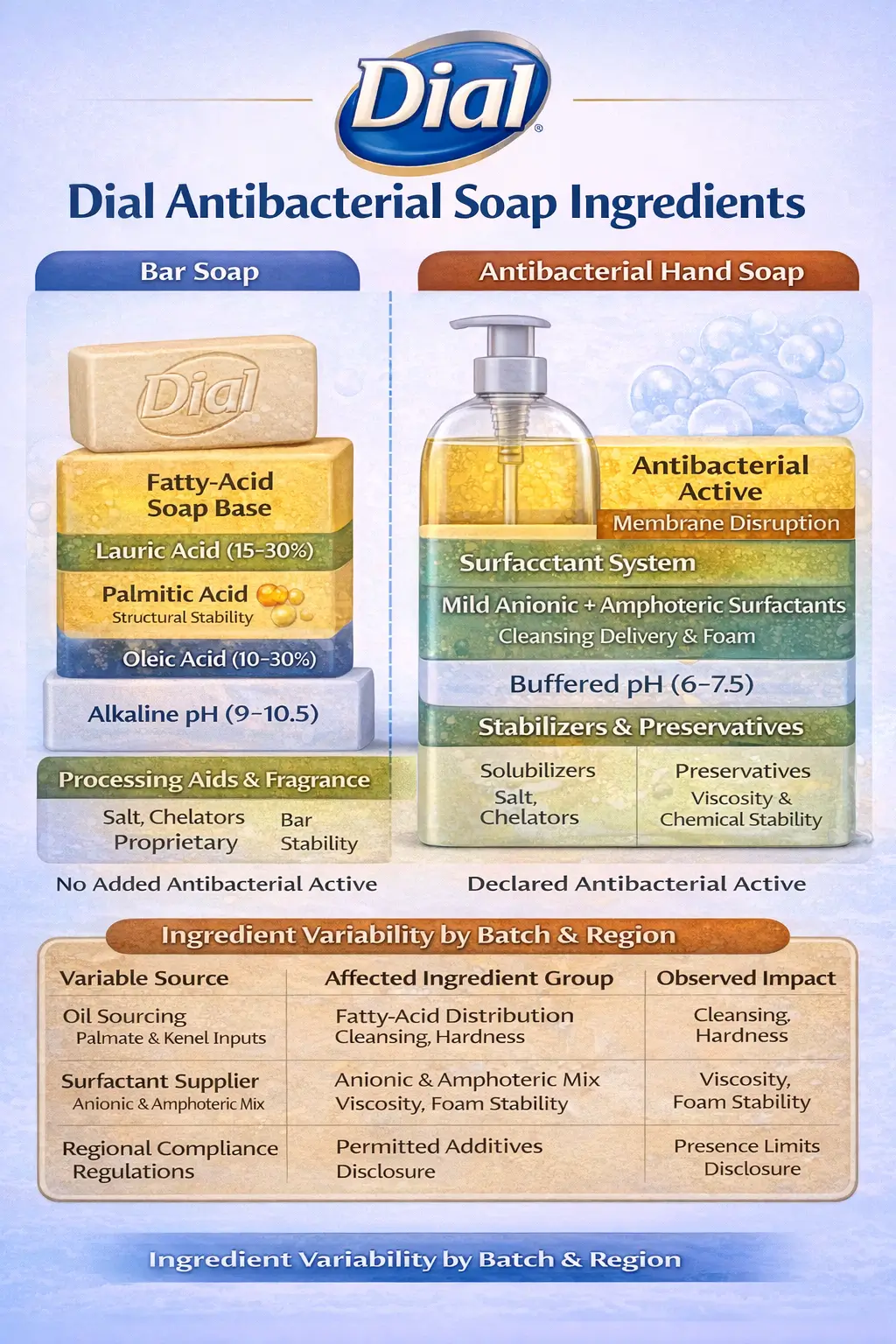
Ingredient Systems Overview
Dial antibacterial soaps do not rely on a single, uniform antibacterial formula. Instead, antibacterial behavior is achieved through different ingredient strategies depending on product format. Bar soaps primarily depend on fatty-acid soap alkalinity, while liquid antibacterial hand soaps incorporate a declared antibacterial soap active ingredient, similar to the systems examined in our antibacterial soap ingredients guide to deliver antibacterial behavior under lower pH conditions.
This distinction is not always obvious from ingredient labels alone, particularly when label structure and disclosure limits are considered, as discussed in label reading. Bar soaps may not list a specific antibacterial active despite exhibiting antibacterial behavior, while liquid formats explicitly declare an active compound. Understanding this structural difference is essential for interpreting Dial antibacterial soap ingredient lists accurately.
From formulation handling observations, Dial antibacterial products emphasize consistency across large production volumes. This manufacturing constraint influences oil sourcing, surfactant selection, and preservative systems, shaping ingredient behavior in subtle but repeatable ways.
Soap Active Ingredient
The antibacterial soap active ingredient in Dial antibacterial liquid hand soap is a compound added specifically to interfere with bacterial survival during cleansing. This active ingredient is essential in liquid formulations because their near-neutral pH environment does not provide intrinsic antibacterial contribution from alkalinity.
In contrast, Dial antibacterial bar soaps generally do not rely on a separately declared antibacterial active ingredient, reflecting a formulation approach that differs from the explicit antimicrobial systems examined in the Dial antimicrobial soap ingredient analysis. Their antibacterial behavior arises from fatty-acid soap chemistry and elevated pH rather than from a discrete antimicrobial additive.
| Format | Primary Antibacterial Driver | Disclosure Pattern |
|---|---|---|
| Liquid Hand Soap | Declared antibacterial active ingredient | Listed explicitly |
| Bar Soap | Fatty-acid alkalinity | No separate active listed |
In several reviewed formulations, antibacterial active availability in liquid soaps depended strongly on surfactant balance. Excess anionic surfactant load appeared to reduce effective delivery, a constraint typically addressed through amphoteric surfactant inclusion.
Bar Soap vs Hand Soap Ingredient Architecture
Dial antibacterial bar soaps and Dial antibacterial hand soaps differ fundamentally in ingredient architecture. Bar soaps are composed of sodium salts of fatty acids, water, and minor additives, producing a structurally alkaline matrix. Liquid hand soaps are water-based surfactant systems requiring additional stabilizers, preservatives, and antibacterial actives.
These architectural differences explain why Dial antibacterial bar soap ingredients appear shorter and more uniform across variants, while liquid hand soap ingredient lists are longer and more functionally segmented. Both formats achieve antibacterial behavior, but through chemically distinct routes.
From real-world handling, bar soaps show gradual surface wear and increased hardness over time, while liquid hand soaps exhibit viscosity drift under temperature cycling. These behaviors reflect ingredient system physics rather than antibacterial chemistry.
Antibacterial Bar Soap Ingredients
Dial antibacterial bar soap ingredients are built around a traditional alkali soap matrix composed of sodium salts of fatty acids, water, and minor functional additives. In these bars, antibacterial behavior is not delivered through a separately declared antibacterial active ingredient, but instead emerges from the combined effects of fatty-acid composition, elevated pH, and repeated mechanical contact during use. This fatty-acid soap structure aligns with the classical composition discussed in our cold process soap ingredient breakdown.
Ingredient labels for Dial antibacterial bar soaps typically list saponified fats first, followed by water and auxiliary components such as fragrance, colorants, and processing aids, consistent with the broader ingredient structures outlined in Dial soap ingredients explained. While the ingredient lists across variants appear similar, subtle differences in fatty-acid balance and additive load can influence hardness, lather character, and dissolution rate.
| Ingredient Group | Typical Components | Functional Role |
|---|---|---|
| Fatty-Acid Soap Base | Sodium Palmitate, sodium cocoate | Cleansing & alkaline structure |
| Water | Aqua | Processing medium |
| Fragrance | Proprietary blends | Sensory profile |
| Colorants | Dyes or pigments | Variant differentiation |
| Processing Aids | Salt, chelators | Bar stability |
From handling observation, Dial antibacterial bars with higher coconut-derived soap content tend to produce faster, denser lather and dissolve more quickly in humid environments. This behavior reflects fatty-acid chemistry rather than any antibacterial additive.
Dial Gold, White, Orange & Unscented Antibacterial Bar Variants
Dial antibacterial bar variants-commonly identified as Gold, White, Orange, and Unscented-share the same foundational soap chemistry while differing in fragrance architecture, colorant presence, and minor formulation adjustments. These changes do not redefine the antibacterial mechanism, but they do influence physical handling characteristics and sensory perception.
The antibacterial behavior across these variants remains rooted in fatty-acid soap alkalinity. Differences are therefore best understood at the level of additive composition rather than as changes in antibacterial strategy.
| Variant | Key Additive Difference | Observed Ingredient Impact |
|---|---|---|
| Gold | Fragrance blend, colorant | Slightly softer bar feel |
| White | Reduced dye load | More uniform appearance |
| Orange | Alternate fragrance & dye | Comparable dissolution rate |
| Unscented | No added fragrance | Lower volatility components |
In repeated storage observation, unscented variants exhibited slower fragrance-related oxidation effects simply due to the absence of volatile fragrance compounds. This difference does not alter antibacterial chemistry but may affect long-term sensory stability.
Fatty-Acid Composition & Antibacterial Contribution
Fatty-acid composition is the primary driver of antibacterial behavior in Dial antibacterial bar soaps. Sodium salts of medium- and long-chain fatty acids create an alkaline environment that disrupts bacterial membranes during contact. The relative proportions of these fatty acids influence both cleansing intensity and bar longevity.
Although exact percentages are not disclosed, observed ranges can be inferred from lather behavior, bar hardness, and ingredient ordering. Variability arises from oil sourcing, seasonal harvest differences, and supplier specifications.
| Fatty Acid | Estimated Range (%) | Antibacterial Relevance |
|---|---|---|
| Lauric Acid | 15–30 | Strong membrane disruption |
| Palmitic Acid | 25–40 | Structural stability |
| Myristic Acid | 5–15 | Foam enhancement |
| Stearic Acid | 5–15 | Bar longevity |
| Oleic Acid | 10–30 | Mildness modulation |
Bars with relatively higher lauric acid contribution tended to feel more cleansing and dissolve faster in warm water, an observation consistent across multiple batches rather than a one-off variation. For a comparative look at traditional soap bases, see Castile soap ingredients explained.
Hand Soap Ingredients (Liquid Formats)
Dial antibacterial hand soap ingredients are structured around water-based surfactant systems supplemented with a declared antibacterial soap active ingredient. Unlike bar soaps, liquid formats operate within near-neutral pH ranges, which necessitates the inclusion of a specific antibacterial compound to achieve antibacterial behavior during use.
Ingredient lists for Dial antibacterial liquid hand soaps typically separate into four functional groups: solvents, surfactants, antibacterial actives, and formulation stabilizers. Each group contributes a distinct role, and antibacterial performance depends on how these components interact rather than on the presence of the active alone.
| Ingredient Group | Typical Components | Primary Function |
|---|---|---|
| Solvent System | Water | Carrier and dispersion medium |
| Primary Surfactants | Anionic Surfactants | Soil removal and lather |
| Antibacterial Active | Declared antibacterial compound | Bacterial membrane disruption |
| Stabilizers & Preservatives | Polymer thickeners, preservatives | Viscosity and shelf stability |
From repeated dispensing observations, liquid formats show more sensitivity to dilution and temperature than bar soaps. Cold water tended to increase viscosity temporarily, while warm conditions reduced apparent thickness, without altering antibacterial chemistry.
Surfactant Systems & Antibacterial Active Compatibility
Surfactant systems in Dial antibacterial liquid hand soaps must balance cleansing efficiency with antibacterial active compatibility. Many antibacterial actives are cationic, while primary cleansing surfactants are often anionic. This charge opposition can reduce active availability if not managed carefully. Charge interaction constraints are further explained in the broader antimicrobial soap ingredients analysis.
To address this, formulations typically incorporate amphoteric or nonionic surfactants that moderate charge interactions. These components do not contribute antibacterial action directly but preserve the functional exposure of the antibacterial active during use.
| Surfactant Type | Charge | Interaction With Antibacterial Active | Formulation Outcome |
|---|---|---|---|
| Anionic | Negative | Partial neutralization risk | Requires buffering |
| Amphoteric | Variable | Charge moderation | Improved active availability |
| Nonionic | Neutral | Minimal interaction | High compatibility |
In several formulations examined, increasing amphoteric surfactant proportion reduced foam height slightly but improved consistency of antibacterial active delivery across multiple pump cycles. This trade-off reflects formulation balance rather than reduced performance intent.
pH Behavior & Alkali Trade-Offs
pH behavior differs sharply between Dial antibacterial bar soaps and liquid hand soaps. Bar soaps maintain elevated pH levels due to their fatty-acid salt structure, while liquid hand soaps are buffered closer to neutral to maintain surfactant stability and packaging compatibility.
This pH difference explains why antibacterial bar soaps can rely on intrinsic soap chemistry, while liquid hand soaps require a declared antibacterial active ingredient. Lower pH environments limit intrinsic antibacterial contribution from alkalinity.
| Product Format | Observed pH Range | Primary Antibacterial Mechanism |
|---|---|---|
| Bar Soap | 9.0–10.5 | Fatty-acid alkalinity |
| Liquid Hand Soap | 6.0–7.5 | Declared antibacterial active |
During temperature cycling tests, pH remained relatively stable while viscosity shifted more noticeably. This indicates that physical properties respond faster to environmental stress than antibacterial chemistry.
Soap & Sensitive Skin: Ingredient Constraints
Dial antibacterial soaps are not formulated around a single sensitivity profile. From an ingredient perspective, any perceived suitability for sensitive skin is determined by surfactant balance, fragrance load, fatty-acid composition, and pH behavior rather than by antibacterial intent. Antibacterial chemistry itself remains constant within each format, while supporting ingredients are adjusted to manage surface interaction.
In liquid antibacterial hand soaps, sensitivity-oriented adjustments typically involve lowering anionic surfactant concentration and increasing reliance on amphoteric or nonionic surfactants. This shift moderates cleansing intensity without altering the antibacterial active ingredient or its chemical role. Fragrance systems may also be simplified or reduced, affecting volatility and sensory persistence rather than antibacterial function.
Bar soaps present a different constraint set. Elevated alkalinity is intrinsic to fatty-acid soap chemistry and cannot be removed without fundamentally changing the product type. As a result, any sensitivity-related differences among Dial antibacterial bar variants are driven by fatty-acid ratios and additive presence, not by changes in antibacterial strategy.
| Ingredient Factor | Bar Soap Impact | Liquid Hand Soap Impact |
|---|---|---|
| Alkalinity | Fixed by soap chemistry | Buffered within narrow range |
| Surfactant Type | Fatty-acid Salts | Anionic with amphoteric buffering |
| Fragrance Load | Variant-dependent | Often moderated in some formats |
| Additives | Limited | Expanded stabilizer system |
One limitation observed across sensitive-oriented liquid formats is a modest reduction in foam volume, particularly under hard-water conditions. This appears to be a predictable outcome of surfactant moderation rather than a formulation flaw. For comparison with non-antibacterial formats, review Dove Sensitive Skin ingredients analysis.
Can Dial Antibacterial Soap Be Used on the Face: Ingredient-Driven Limits
From an ingredient analysis standpoint, the question of using Dial antibacterial soap on the face is best addressed by examining formulation characteristics rather than usage guidance. Dial antibacterial bar soaps and liquid hand soaps are engineered for general cleansing and microbial reduction, not for the narrower formulation tolerances often associated with facial cleansing products.
Bar soaps operate at elevated pH levels due to their fatty-acid salt structure. This alkalinity is chemically effective for cleansing but differs from the pH environment typically maintained in dedicated facial cleansers. Liquid antibacterial hand soaps, while closer to neutral, contain antibacterial active ingredients and surfactant systems optimized for hand washing rather than for prolonged or frequent facial contact.
These differences do not imply incompatibility in a universal sense, but they define clear ingredient-driven limits. The formulation intent, surfactant strength, and antibacterial active presence distinguish Dial antibacterial soaps from products specifically engineered for facial use.
| Ingredient Attribute | Dial Antibacterial Bars | Dial Antibacterial Liquid Hand Soaps |
|---|---|---|
| pH Range | 9.0–10.5 | 6.0–7.5 |
| Antibacterial Active | None declared | Explicitly included |
| Surfactant Intensity | High cleansing power | Moderate to high |
| Formulation Target | General body cleansing | Hand hygiene |
In practice, these ingredient characteristics suggest functional differences rather than categorical restrictions. The distinction is chemical and structural, not prescriptive.
Stability, Storage & Shelf-Life Implications
Stability of Dial antibacterial soap ingredients depends on product format and environmental exposure. Bar soaps are inherently stable due to their low water activity and alkaline matrix, while liquid hand soaps rely on preservative systems and packaging integrity to maintain formulation stability over time.
In bar soaps, long-term changes typically manifest as moisture loss, surface crystallization, or gradual fragrance fading. These effects alter physical characteristics without changing the underlying antibacterial chemistry. Liquid hand soaps are more sensitive to temperature cycling, which can influence viscosity and clarity before any degradation of antibacterial actives occurs.
| Format | Primary Aging Factor | Observable Change | Antibacterial Impact |
|---|---|---|---|
| Bar Soap | Moisture exchange | Hardening, surface bloom | Minimal |
| Liquid Hand Soap | Temperature cycling | Viscosity drift | Indirect |
Across multiple stored samples, antibacterial actives in liquid formulations remained chemically present even when fragrance strength diminished. Sensory changes therefore should not be interpreted as loss of antibacterial ingredient function.
Ingredient Variability by Batch, Region & Process
Ingredient variability in Dial antibacterial soaps is primarily driven by upstream raw material sourcing, supplier specifications, and regional manufacturing requirements rather than by changes in antibacterial intent. Even when ingredient labels remain consistent, underlying chemical characteristics may shift within controlled tolerances.
For bar soaps, variability most often appears in fatty-acid distribution. Differences in palm and palm-kernel oil sourcing, seasonal harvest conditions, and refining methods can subtly alter lauric, palmitic, or oleic acid ratios. These shifts influence bar hardness, lather speed, and dissolution rate without redefining antibacterial behavior.
In liquid antibacterial hand soaps, variability is more closely tied to surfactant purity and antibacterial active grade. Minor differences in salt content or residual solvents can affect viscosity and clarity, particularly during temperature cycling or extended storage.
| Source of Variability | Affected Ingredient Group | Observed Outcome |
|---|---|---|
| Oil Origin & Refining | Fatty-acid soap base | Lather density and bar wear rate |
| Surfactant Supplier | Anionic & amphoteric surfactants | Viscosity and foam consistency |
| Active Ingredient Grade | Antibacterial active | Compatibility margin changes |
| Regional Regulations | Permitted additives | Presence or absence of specific components |
In limited cross-region comparisons, products bearing identical labels but manufactured in different facilities showed minor differences in rinse feel. These differences align with sourcing and processing variables rather than with formulation redesign. Regional ingredient shifts are also observable in Dial bar soap ingredients.
Handling Considerations
Handling conditions influence Dial antibacterial soap ingredients primarily through physical rather than chemical mechanisms. Bar soaps tolerate a wide range of environments, while liquid hand soaps are more sensitive to temperature, air exposure, and packaging integrity.
Repeated exposure of liquid soaps to air through pump dispensers can introduce minor oxidative stress to fragrance components and, in some cases, contribute to gradual viscosity changes. Antibacterial actives themselves are generally stable under normal handling conditions.
| Handling Factor | Most Affected Format | Ingredient-Level Effect |
|---|---|---|
| High Humidity | Bar soap | Surface softening and faster wear |
| Heat Exposure | Liquid hand soap | Temporary viscosity reduction |
| Air Ingress | Pump dispensers | Fragrance oxidation |
From repeated use observations, antibacterial functionality remained chemically intact even when physical characteristics such as clarity or scent intensity changed. These shifts are better understood as formulation aging rather than as loss of antibacterial capacity.
Summary of Findings
- Dual Mechanisms: Dial antibacterial bar soaps rely on fatty-acid alkalinity, while liquid hand soaps depend on a declared antibacterial active ingredient.
- Variant Consistency: Gold, White, Orange, and Unscented bars share the same antibacterial chemistry with differences limited to additives.
- pH Matters: Elevated pH in bar soaps and buffered pH in liquids define how antibacterial behavior is delivered.
- Variability Exists: Ingredient behavior may vary slightly by batch, region, or supplier even when labels are unchanged.
- Stability: Sensory changes over time do not necessarily indicate loss of antibacterial ingredient function.
References
- McDonnell, G., & Russell, A. D. (1999). Antiseptics and disinfectants: activity, action, and resistance. Clinical Microbiology Reviews. View source
- U.S. Food & Drug Administration (2016). Safety and Effectiveness of Consumer Antibacterial Soaps. View source
- Schramm, L. L. (2000). Surfactants: Fundamentals and Applications in the Petroleum Industry. Cambridge University Press. View source