Definition and Functional Identity
Myristic Acid is a saturated fatty acid classified within the medium-chain fatty acid group, commonly used in soap and cleansing systems as a structural and lather-modifying component.
It is typically present as part of fatty acid blends or oils rather than used in isolation, contributing to the formation of soap salts when reacted with alkali in saponification-based systems.
Within formulation design, it plays a role in adjusting bar firmness, influencing foam density, and modifying the balance between solubility and structural integrity.
In practical terms, its presence often translates into soaps that feel firmer in hand and produce a denser, more compact lather compared to formulations dominated by longer-chain fatty acids.
This page is part of the CleanFormulation Ingredient Library, a research-based project focused on analyzing how ingredients behave within real-world cleansing formulations.
Quick Facts
| Property | Description |
|---|---|
| Ingredient Type | Fatty Acid |
| Chemical Class | Saturated medium-chain fatty acid |
| Functional Role | Structure modifier, lather density contributor |
| Ionic Class | Non-ionic (acid form), becomes anionic after saponification |
| Typical Use Context | Bar soaps, cleansing bases, blended fatty acid systems |
| Chemical Formula | C14H28O2 |
| Molecular Weight | 228.37 g/mol |
| CAS Number | 544-63-8 |
Why This Ingredient Appears on Cosmetic Labels
Myristic Acid appears on ingredient labels because it serves as a foundational building block in many cleansing formulations, either directly or as part of naturally derived oil compositions.
In soap systems, it is not always listed as a standalone component. Instead, it may be present implicitly through oils such as coconut or palm kernel oil, which contain measurable proportions of this fatty acid.
When listed explicitly, it usually reflects formulation control, where specific fatty acid profiles are adjusted to achieve targeted performance characteristics such as lather compactness or bar hardness.
From a formulation perspective, its presence signals an intentional adjustment of the fatty acid distribution rather than a standalone functional additive.
Chemical Identity and Classification
Myristic Acid is identified in ingredient labeling under its INCI name as Myristic Acid and belongs to the broader family of saturated fatty acids characterized by a 14-carbon chain structure.
It is part of the medium-chain fatty acid group, positioned between shorter-chain components like lauric acid and longer-chain components such as palmitic acid. This intermediate chain length influences both its solubility behavior and structural contribution within cleansing systems.
In its free acid form, it is non-ionic. However, when reacted with an alkali such as sodium hydroxide or potassium hydroxide, it converts into a soap salt, becoming part of an anionic surfactant system responsible for cleansing action.
It is commonly derived from natural oil sources including coconut oil and palm kernel oil, where it exists as part of triglyceride structures rather than as a free fatty acid. Industrial processing separates and concentrates it for targeted formulation use.
From a formulation perspective, it represents a mid-point structural contributor, balancing between solubility-driven fatty acids and rigidity-driven long-chain components.
Functional Role in Soap Systems
Within soap formulations, Myristic Acid contributes to multiple performance characteristics, particularly those related to structure, foam behavior, and dissolution rate.
When converted into its sodium or potassium salt, it participates directly in the surfactant matrix, contributing to cleansing performance through micelle formation within surfactant systems. However, its role is not dominant in cleansing strength but rather in modifying how the system behaves during use.
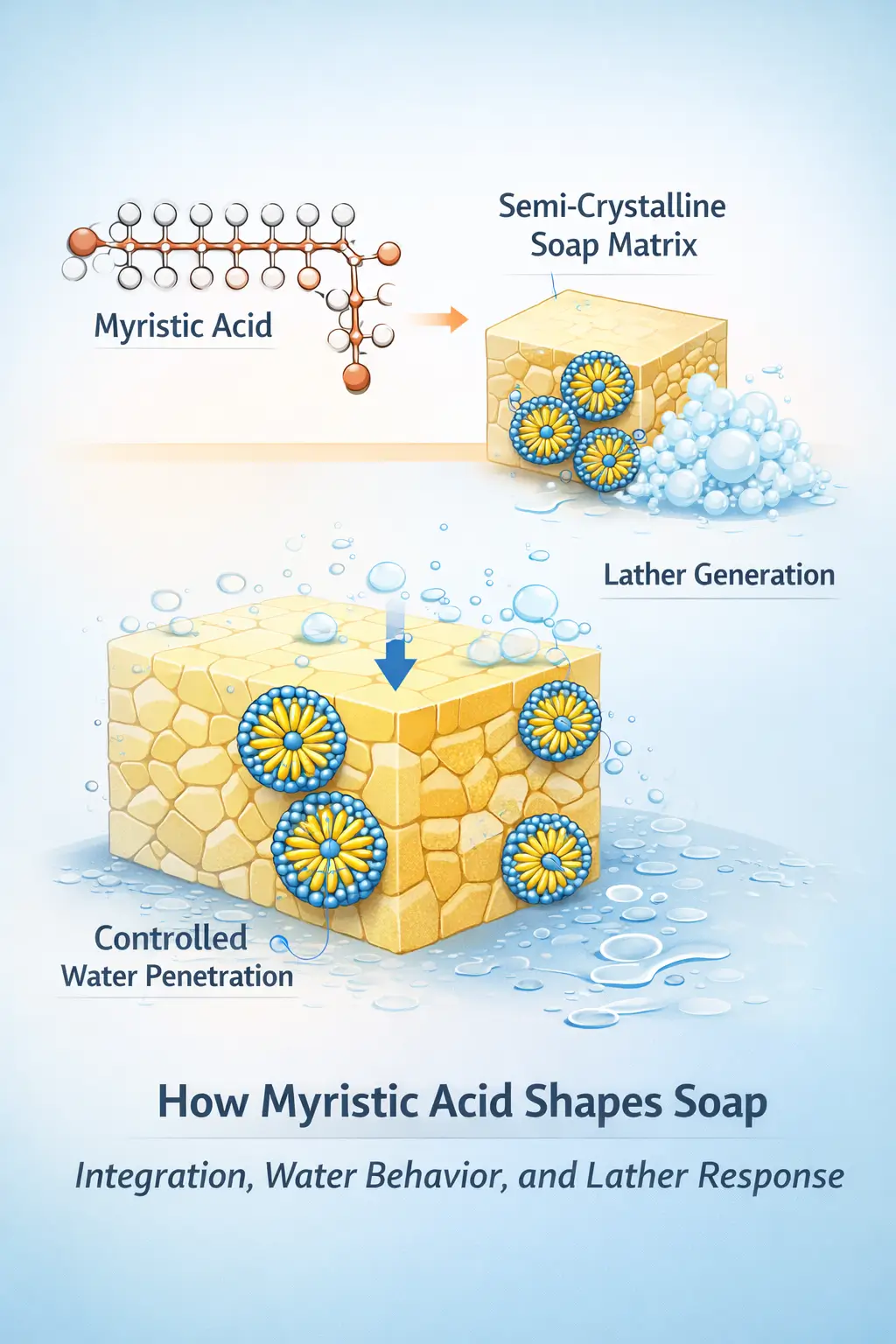
Its presence increases bar firmness compared to formulations dominated by highly soluble fatty acids. This results in a slower dissolution rate during washing, helping the bar maintain its physical integrity over repeated use cycles.
In lather formation, it supports the development of dense, creamy foam rather than large, airy bubbles. This shifts the sensory profile toward a more compact and stable foam structure.
It also influences rinse behavior by balancing solubility and persistence. Systems containing it tend to rinse cleanly while still maintaining a controlled interaction with water during use.
In practical terms, increasing its proportion often results in a bar that feels more solid, produces tighter foam, and dissolves more gradually when exposed to water.
Ingredient Interaction Logic
Myristic Acid does not operate in isolation within formulations. Its behavior emerges through interaction with other fatty acids, water, and supporting formulation components.
In combination with shorter-chain fatty acids such as lauric acid, it moderates excessive solubility and foam expansion. This creates a more balanced lather system where foam density is increased without significantly reducing cleansing activity.
When blended with longer-chain fatty acids such as palmitic or stearic acid, it introduces a degree of solubility that prevents excessive rigidity. This helps maintain usability by allowing controlled dissolution during washing.
Its interaction with water is particularly important. As part of the soap matrix, it influences how quickly water penetrates and disrupts the structure. A balanced proportion contributes to gradual hydration rather than rapid breakdown.
In the presence of humectants such as glycerin, it helps stabilize the structure by maintaining coherence within the soap matrix while allowing moisture retention within the system.
It also interacts with fragrance components by influencing retention and release. Denser soap structures tend to slow fragrance diffusion, leading to a more gradual scent release during use.
Overall, it functions as a balancing component within multi-fatty acid systems, shaping how the formulation responds to water, mechanical action, and repeated use.
Phase Behavior and Physical Characteristics
Myristic Acid exhibits behavior typical of saturated fatty acids with a defined melting range and crystalline structure that contributes to solid-phase stability in soap systems.
At room temperature, it exists as a solid with a relatively ordered crystalline arrangement. When incorporated into soap formulations, this contributes to the formation of a structured matrix that supports bar integrity.
During saponification, it transitions from a triglyceride-bound state into a salt form that integrates into the aqueous phase. This transformation allows it to participate in surfactant activity while still contributing to structural cohesion.
Its solubility is moderate compared to shorter-chain fatty acids, which allows it to dissolve gradually rather than rapidly. This property plays a role in controlling how quickly the soap matrix erodes during use.
Thermally, it remains stable under typical processing conditions used in soap manufacturing. However, its crystallization behavior can influence texture, especially in formulations where cooling rate affects structural uniformity.
From a user-observable standpoint, this translates into a soap that maintains shape during storage and use, with a consistent texture that does not soften excessively under normal environmental conditions.
Comparison With Related Fatty Acids
Myristic Acid sits between shorter-chain and longer-chain fatty acids in terms of structural and functional contribution. Comparing it with nearby chain-length fatty acids helps clarify its role within formulation systems.
| Feature | Myristic Acid (C14) | Lauric Acid (C12) | Palmitic Acid (C16) |
|---|---|---|---|
| Chain Length | Medium | Shorter-medium | Longer |
| Solubility | Moderate | Higher | Lower |
| Lather Type | Dense and creamy | Quick, airy foam | Low foam contribution |
| Bar Hardness | Moderate to firm | Softer structure | High rigidity |
| Dissolution Rate | Controlled | Faster | Slower |
| Functional Role | Balance between lather and structure | Cleansing and foam generation | Structural reinforcement |
This positioning explains why it is often used as a balancing component rather than a dominant fatty acid in formulation design.
Regulatory Context
Myristic Acid is listed under its INCI name without restriction in most cosmetic regulatory frameworks, including those defined under EU Cosmetic Regulation (EC) No 1223/2009.
It is not classified as a restricted substance when used in standard cosmetic and cleansing formulations. Its inclusion iningredient lists follows standard INCI labeling requirements based on concentration and presence in the final product.
In formulations derived from natural oils, it may not always be listed individually if present as part of a triglyceride composition. However, when isolated and used as a defined ingredient, it must be declared explicitly.
Its regulatory classification does not assign it a functional category such as preservative or colorant. Instead, it is treated as a general-purpose formulation component within the fatty acid category.
Common Misunderstanding
A common misconception is that Myristic Acid functions primarily as a cleansing agent. In practice, its role is more nuanced and structural.
While it becomes part of the surfactant system after saponification, it does not drive cleansing efficiency in the same way as shorter-chain fatty acids or synthetic surfactants.
Its primary contribution lies in modifying how the soap behaves, particularly in terms of lather texture and physical stability, rather than determining how strongly the system removes soil.
This distinction is important when interpreting ingredient labels, as its presence reflects formulation balance rather than cleansing intensity.
Structural Limitations in Formulation
Despite its functional benefits, Myristic Acid presents certain formulation constraints that require balancing with other components.
Its moderate solubility means that excessive concentrations can lead to reduced lather initiation, especially in systems lacking sufficient shorter-chain fatty acids.
In hard water conditions, soap salts derived from it can contribute to the formation of insoluble residues, affecting rinse clarity and surface feel.
It also does not provide strong structural reinforcement compared to longer-chain fatty acids, which limits its ability to maintain rigidity in high-temperature or high-moisture environments when used alone.
From a formulation standpoint, it performs best as part of a blended fatty acid system rather than as a dominant structural component.
Formulation References Using This Ingredient
Summary of Findings
Myristic Acid is a saturated medium-chain fatty acid that functions as a structural and lather-modifying component within soap and cleansing formulations.
- Classification: Saturated fatty acid positioned between shorter and longer chain components.
- Functional Role: Contributes to bar firmness and dense foam formation while moderating solubility.
- Interaction Logic: Works in combination with other fatty acids to balance cleansing performance and structural stability.
- System Behavior: Influences how water interacts with the soap matrix, affecting dissolution rate and lather texture.
- Limitations: Requires formulation balance to avoid reduced foam initiation or structural instability.