Formulation Scope and Formats
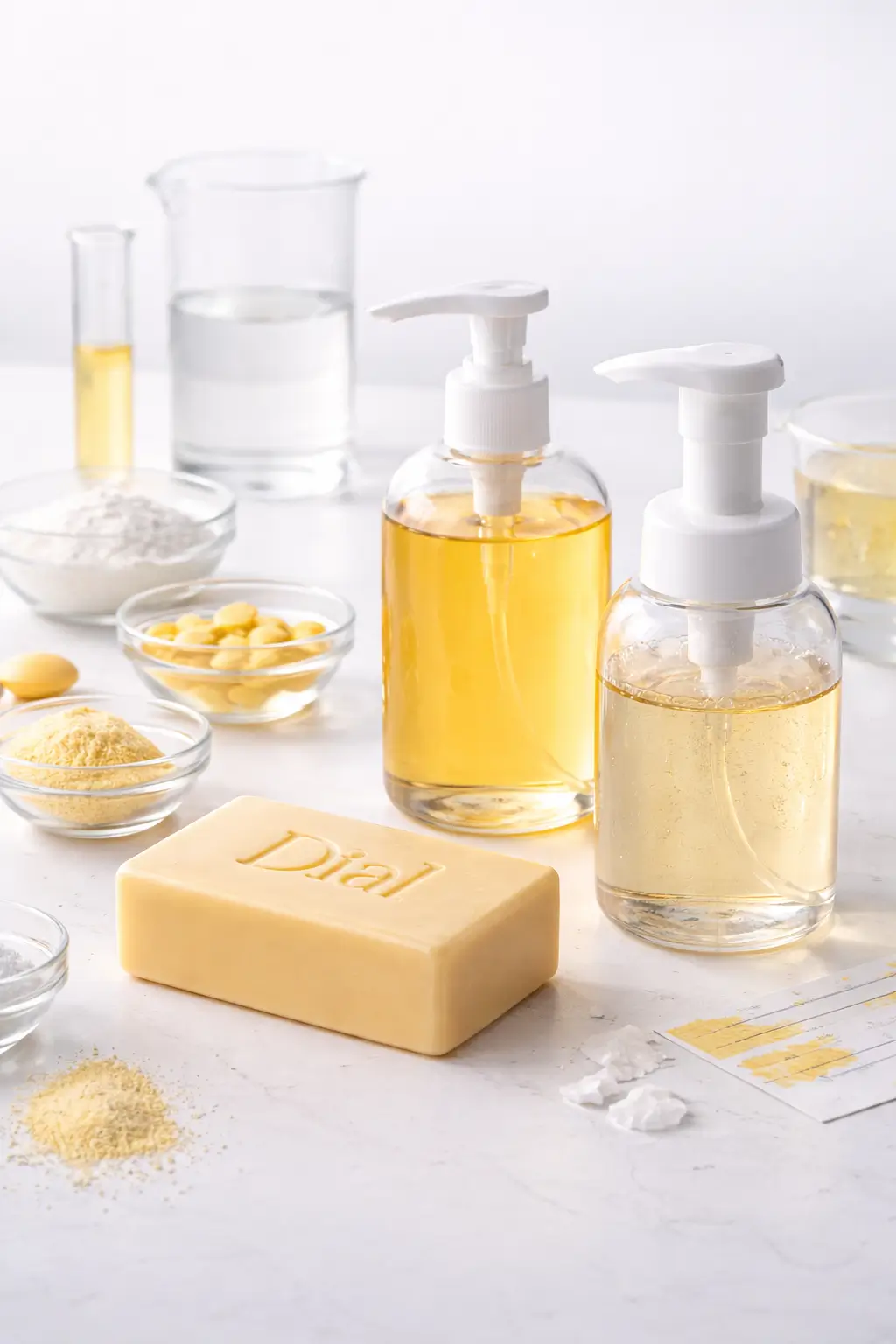
The term "Gold Dial" does not refer to a single formulation but to a family of products that share branding while differing substantially at the ingredient-system level. Gold Dial bar soaps, liquid hand soaps, and body wash formats each employ distinct cleansing architectures tailored to physical form and regulatory context.
Gold Dial bar soap ingredients typically combine traditional fatty-acid soap components with synthetic surfactants to stabilize lather and hardness. In contrast, Dial Gold liquid soap ingredients rely almost entirely on synthetic detergent systems, using water as a solvent matrix and preservatives to maintain shelf stability. Dial Gold body wash ingredients fall closer to liquid hand soaps but often incorporate viscosity modifiers to alter flow and dispensing behavior.
This variation explains why ingredient lists across Gold Dial antibacterial bar soap ingredients and Dial Gold liquid hand soap ingredients should not be interpreted interchangeably, even when product names appear similar.
Core Ingredient Architecture
Gold Dial soap formulations are built on a layered ingredient architecture consisting of a primary cleansing system, optional antibacterial actives, structural stabilizers, preservation agents, and fragrance components.
The cleansing layer dominates functional performance. In bar formats, this layer includes sodium salts of fatty acids supported by synthetic surfactants to improve foam reliability. In liquid and hand soap formats, cleansing depends on anionic and amphoteric surfactants that remain soluble across a controlled pH range.
| Ingredient Layer | Primary Function | Observed Formats |
|---|---|---|
| Cleansing System | Soil removal, foam generation | All formats |
| Antibacterial Active | Microbial reduction | Select bar & liquid variants |
| Structural Stabilizers | Hardness, viscosity control | Bar & liquid soaps |
| Preservation System | Shelf-life protection | Liquid & body wash |
| Fragrance System | Sensory identity | Most variants |
One practical limitation observed in storage is that fragrance components tend to volatilize faster than the underlying surfactant system degrades, particularly in warmer environments. This does not typically alter cleansing performance but can change perceived product strength over time.
Antibacterial Active Systems
Gold Dial antibacterial soap ingredients may include quaternary ammonium compounds or rely solely on surfactant-driven soil removal, depending on formulation year, region, and regulatory framework.
Historically, antibacterial bar and liquid soaps used specific chemical actives to inhibit microbial growth. In more recent formulations, regulatory changes have narrowed allowable actives, leading some Gold Dial antibacterial liquid soap ingredients to depend on mechanical removal rather than persistent antimicrobial agents.
This distinction is not always explicit on ingredient labels, making it necessary to interpret antibacterial claims cautiously and in context with disclosed active ingredients.
Label Disclosure Boundaries & Interpretation
Gold Dial ingredient labels meet regulatory disclosure requirements but compress complex formulation systems into grouped terms that limit precise interpretation.
Surfactant blends are often listed individually but without proportional context. Fragrance systems appear under a single descriptor despite representing numerous aromatic compounds. These practices are standard in mass-market formulations and reflect proprietary constraints rather than formulation deficiency.
As a result, ingredient lists for gold dial antibacterial liquid soap ingredients and gold dial bar soap ingredients should be read as presence indicators rather than complete functional blueprints.
Bar Soap Ingredients: Functional Breakdown
Gold Dial bar soap ingredients consist of a blended soap–syndet system, similar to patterns discussed in our Dial bar soap ingredient breakdown in which fatty-acid salts provide structural cleansing while synthetic surfactants and stabilizers improve foam reliability, bar hardness, and storage stability.
Unlike small-batch soaps, Gold Dial bar formulations are optimized for consistency across millions of units. This requires fatty-acid sourcing that favors saturated chains for durability, supported by non-soap cleansing agents that reduce sensitivity to water hardness and temperature.
| Ingredient Category | Primary Function | Formulation Role |
|---|---|---|
| Fatty-Acid Soap Base | Primary cleansing & bar structure | Hardness, longevity |
| Synthetic Surfactants | Foam enhancement | Lather stability |
| Antibacterial Actives | Microbial reduction | Variant-specific |
| Chelators | Metal ion binding | Prevents residue formation |
| Fragrance & Colorants | Sensory differentiation | Non-functional identity |
In handling observations, Gold Dial bars tend to retain shape longer than higher-oleic soaps, consistent with elevated palmitic and stearic acid content. This durability is a formulation choice rather than an indicator of cleansing intensity.
Fatty-Acid Composition in Bar Soap Ingredients
The fatty-acid profile of Gold Dial bar soaps is dominated by saturated C16–C18 chains, with secondary contributions from shorter-chain acids that support rapid lather formation.
Fatty-acid sourcing varies by manufacturing region and supply chain conditions. Palm-derived, palm-kernel-derived, or tallow-derived inputs may be used, resulting in small but measurable shifts in lather speed and bar wear rate.
| Fatty Acid | Carbon Length | Estimated Range | Functional Impact |
|---|---|---|---|
| Lauric Acid | C12:0 | 8–18% | Fast foam generation |
| Myristic Acid | C14:0 | 4–10% | Lather reinforcement |
| Palmitic Acid | C16:0 | 22–32% | Bar hardness |
| Stearic Acid | C18:0 | 12–22% | Structural stability |
| Oleic Acid | C18:1 | 5–12% | Mildness modulation |
Because saturated fatty acids dominate, Gold Dial bars resist softening in humid conditions. A trade-off is slower initial lather compared with high-oleic formulations, though foam persistence remains consistent.
Liquid & Hand Soap Ingredients
Dial Gold liquid soap ingredients rely on synthetic surfactant systems, as outlined in our broader Dial soap formulation overview rather than fatty-acid soap chemistry, allowing controlled viscosity, predictable rinsing, and pH adjustment.
Dial Gold liquid hand soap ingredients typically include an anionic surfactant as the primary cleanser, supported by amphoteric surfactants that soften foam texture and improve compatibility with antibacterial actives where present.
| Surfactant Class | Functional Role | Observed Effect |
|---|---|---|
| Anionic | Primary cleansing | Soil removal |
| Amphoteric | Foam moderation | Smoother lather |
| Nonionic | Stability support | Cold-temperature flow |
In dispensing tests, Gold Dial liquid soaps maintain foam consistency across moderate dilution ranges, suggesting air–liquid balance is engineered independently of surfactant concentration alone.
pH Behavior Across Soap Formats
Gold Dial bar soaps remain alkaline due to fatty-acid salt chemistry, while Dial Gold liquid and hand soaps are adjusted closer to neutral using buffering agents.
| Product Format | Estimated pH Range | Chemical Driver |
|---|---|---|
| Antibacterial Bar Soap | 9.5–10.5 | Fatty-acid sodium salts |
| Liquid Hand Soap | 6.0–7.5 | Synthetic surfactants & buffers |
| Body Wash | 5.5–7.0 | Diluted surfactant systems |
A practical limitation observed in liquid formats is mild pH drift over extended storage, particularly under repeated temperature cycling. Cleansing performance remains stable despite this shift.
Additives & Stabilizers in Soap Ingredients
Additives in Gold Dial soap formulations are included to stabilize cleansing systems, control viscosity, manage mineral interactions, and maintain physical consistency rather than to alter cleansing strength.
In bar soaps, stabilizers primarily limit soap scum formation and surface residue by binding metal ions present in hard water. In liquid and hand soap formats, additives play a larger role by controlling thickness, clarity, and pump performance across temperature variations.
| Additive Category | Functional Role | Primary Formats |
|---|---|---|
| Chelating Agents | Bind calcium & magnesium ions | Bar, liquid, body wash |
| Viscosity Modifiers | Control flow & thickness | Liquid, hand soap |
| Opacifiers | Visual consistency | Select liquid variants |
| Solubilizers | Fragrance dispersion | Liquid & body wash |
In practical storage observations, viscosity-modified liquids can thicken slightly in cooler environments, an expected polymer response rather than a sign of formulation instability.
Preservative Systems in Liquid & Hand Soaps
Preservatives are essential in Dial Gold liquid soap ingredients due to high water content, while bar soaps rely largely on alkalinity and low water activity for microbial control.
Dial Gold liquid hand soap ingredients typically use broad-spectrum preservative systems effective across moderately acidic to near-neutral pH ranges. These systems are often paired with chelating agents to enhance preservative efficiency by limiting metal-catalyzed degradation.
| Format | Primary Preservation Strategy | Stability Implication |
|---|---|---|
| Bar Soap | High pH, low water activity | Minimal preservative need |
| Liquid Hand Soap | Chemical preservatives | Extended shelf life |
| Body Wash | Preservatives + chelation | Clarity & odor stability |
A formulation limitation is that preservative systems must balance effectiveness with compatibility, which can constrain fragrance selection and long-term scent retention.
Antibacterial Mechanisms in Soap Ingredients
Gold Dial antibacterial soap ingredients may achieve microbial reduction, consistent with frameworks explained in our antimicrobial soap ingredient guide either through dedicated antibacterial actives or through surfactant-driven mechanical removal, depending on formulation and regulatory allowances.
In some Dial Gold antibacterial liquid soap ingredients, quaternary ammonium compounds are used at low concentrations to disrupt microbial cell membranes. In other variants, antibacterial labeling reflects the physical removal of microbes via surfactant action rather than persistent chemical activity.
| Mechanism Type | Chemical Basis | Observed Usage |
|---|---|---|
| Quaternary Compounds | Cell membrane disruption | Select liquid soaps |
| Surfactant Removal | Physical soil detachment | Most formats |
Ingredient labels do not always clarify which mechanism predominates, requiring interpretation based on active ingredient disclosure rather than marketing descriptors.
Fragrance Systems & Colorants in Soaps
Fragrance systems and colorants in Gold Dial soaps serve sensory and visual identification roles and do not materially contribute to cleansing performance.
Fragrance components are typically introduced at low concentrations but must remain compatible with surfactants and preservatives. In Gold Dial bars and liquids, fragrance volatility often exceeds that of the cleansing system, leading to gradual scent softening during storage.
Colorants are added to achieve the characteristic gold appearance and are selected for stability in alkaline bar soaps and near-neutral liquid systems. Minor fading over time is more closely associated with light exposure than with formulation degradation.
Ingredient Variability by Batch, Region & Process
Gold Dial soap ingredient composition can vary modestly between production batches and manufacturing regions due to differences in raw material sourcing, regulatory requirements, and process optimization, even when product naming remains unchanged.
For bar soaps, variability most often arises from fatty-acid feedstocks. Palm-derived, palm-kernel-derived, or tallow-derived sources can shift relative lauric, palmitic, and stearic acid proportions within functional ranges. These shifts rarely alter cleansing performance but may subtly affect bar hardness, wear rate, or initial lather speed.
In liquid and hand soap formats, variability is more commonly observed in preservative systems and surfactant blends. Regional regulations may influence preservative selection or concentration thresholds, while supply availability can affect secondary surfactant choice without changing the primary cleansing mechanism.
From a user perspective, these differences are usually perceived as minor changes in scent strength, color tone, or viscosity rather than functional performance.
Stability & Shelf-Life Behavior of Soap Ingredients
Gold Dial soap formulations are designed for extended shelf stability, with bars relying on low water activity and alkalinity, and liquid formats depending on preservative systems, chelation, and controlled packaging.
Gold Dial antibacterial bar soap ingredients maintain stability primarily through their alkaline environment, which inhibits microbial growth. Over time, bars may exhibit surface dulling or light powdery residue, commonly sodium carbonate formed through air exposure rather than ingredient breakdown.
Dial Gold liquid soap ingredients exhibit a different stability profile. Oxidative changes are limited by antioxidants and chelators, while preservatives manage microbial risk. Fragrance volatility remains the most noticeable long-term change, particularly under temperature cycling or prolonged light exposure.
| Format | Primary Stability Driver | Common Long-Term Change |
|---|---|---|
| Antibacterial Bar Soap | High pH, low moisture | Surface dulling, scent loss |
| Liquid Hand Soap | Preservatives, chelation | Minor viscosity drift |
| Body Wash | Dilution control, preservatives | Foam density variation |
In several storage observations, cleansing performance remained stable even when fragrance intensity declined, indicating that sensory degradation precedes functional degradation.
Formulation Balance & Ingredient Trade-Offs
Gold Dial soap formulations prioritize consistency, manufacturability, and regulatory compliance, which introduces predictable ingredient-level trade-offs rather than formulation defects.
In bar soaps, elevated saturated fatty-acid content improves durability and shelf stability but limits flexibility in tailoring mildness through higher oleic fractions. In liquid soaps, reliance on synthetic surfactants allows precise pH control but necessitates preservatives and viscosity modifiers that respond to temperature.
Antibacterial systems introduce additional constraints. Where dedicated actives are used, compatibility with surfactants and preservatives narrows formulation latitude. Where antibacterial action relies on surfactant removal alone, labeling clarity may be reduced despite unchanged cleansing mechanics.
| Design Priority | Ingredient Choice | Resulting Limitation |
|---|---|---|
| Long Shelf Life | Robust preservative systems | Reduced fragrance longevity |
| Bar Durability | High saturated fatty acids | Slower initial lather |
| Label Simplicity | Grouped ingredient terms | Limited ratio transparency |
Ingredient Label Transparency Across Formats
Ingredient disclosure is most granular in Gold dial bar soap ingredients, moderately detailed in liquid hand soaps, and least specific in body wash and foaming formats due to increasing formulation complexity.
| Format | Disclosure Detail Level | Common Omitted Context |
|---|---|---|
| Antibacterial Bar Soap | High | Ingredient ratios |
| Liquid Hand Soap | Moderate | Surfactant proportions |
| Body Wash | Lower | Fragrance composition detail |
This gradient reflects formulation layering rather than product hierarchy, with more complex systems requiring greater compression at the label level.
Safety & Practical Use Considerations (Ingredient-Based)
Gold Dial soap formulations are designed for routine cleansing use, with ingredient-driven limitations primarily related to alkalinity in bar soaps, preservative dependence in liquid formats, and fragrance volatility rather than inherent ingredient hazards.
Gold Dial antibacterial bar soap ingredients remain alkaline due to fatty-acid salt chemistry. This alkalinity supports cleansing efficiency and shelf stability but can leave transient residue on hard surfaces such as sinks or tiles. This effect reflects soap chemistry rather than formulation imbalance.
Dial Gold liquid hand soap ingredients and body wash formulations depend on preservative systems because of high water content. Diluting these products beyond intended levels, transferring them into non-sealed containers, or prolonged exposure to heat may reduce preservative effectiveness and accelerate fragrance loss.
Across all formats, ingredient systems perform most predictably when products are used as supplied and stored under typical indoor conditions. No ingredient systems discussed here are intended for non-cleansing applications.
Summary of Findings
- Formulation Families: "Gold Dial" refers to multiple formulations across bar, liquid, and body wash formats, not a single ingredient system.
- Cleansing Chemistry: Bar soaps rely on fatty-acid salts supported by synthetic surfactants, while liquid and hand soaps depend almost entirely on synthetic detergent systems.
- Antibacterial Function: Microbial reduction may arise from dedicated actives or from surfactant-driven removal, depending on formulation and regulatory context.
- Fatty-Acid Profile: Saturated fatty acids dominate Gold Dial bar soaps, contributing durability and consistency rather than customization.
- Transparency Limits: Ingredient labels disclose presence but not proportions, particularly for fragrance systems and surfactant blends.
References
- U.S. Food & Drug Administration – Consumer Antibacterial Soap Rule. FDA documentation
- Rieger, M. Surfactant Systems in Cleansing Formulations. Journal of Cosmetic Science. Journal archive
- Gunstone, F. Fatty Acid and Lipid Chemistry. CRC Press. Publisher page
- Schramm, L. Surfactants: Fundamentals and Applications. Wiley reference
- USP–NF. Preservative Effectiveness Testing Guidelines. USP documentation