Definition And System Role
Sodium Palmitate is a sodium salt of palmitic acid, classified as a soap-based anionic surfactant formed through saponification reactions in alkaline systems.
It represents one of the primary structural components in traditional bar soap formulations, contributing directly to cleansing behavior and solid bar formation.
Within soap systems, it functions as both a cleaning agent and a structural material, influencing hardness, solubility, and lather characteristics.
Its presence is not incidental. It defines the identity of a soap matrix rather than acting as an additive or supporting ingredient.
This page is part of the CleanFormulation Ingredient Library, a research-based system analyzing how ingredients behave within real formulation environments.
Quick Facts
| Property | Description |
|---|---|
| Molecular Formula | C16H31NaO2 |
| Molecular Weight | 278.41 g/mol |
| Carbon Chain Length | C16 saturated fatty acid chain |
| Melting Point | ≈62–65 °C (pure palmitic acid reference) |
| Density | ≈0.9–1.0 g/cm³ in solid soap matrix |
| Critical Micelle Concentration (CMC) | ≈1–3 mM in water depending on ionic strength |
| Foam Profile | Produces dense, creamy foam with moderate volume |
| Cleansing Strength | Moderate, balanced between oil removal and skin feel |
| Hardness Contribution | High, increases bar firmness and reduces deformation |
| Water Solubility | Low at <25 °C, increases with temperature and agitation |
| Krafft Temperature | ≈40–50 °C, below which solubility drops sharply |
| Surface Tension Reduction | Reduces water surface tension from ~72 mN/m to ~25–35 mN/m |
| Emulsification Behavior | Stabilizes oil-in-water emulsions through interfacial film formation |
| Calcium/Magnesium Sensitivity | Forms insoluble salts (soap scum) in hard water |
| Hydrolysis Reaction | C15H31COONa + H2O ⇌ C15H31COOH + NaOH |
| pKa (Palmitic Acid) | ≈4.8 indicating weak acid precursor |
| Thermal Stability | Stable under typical soap processing temperatures (~60–80 °C) |
| Biodegradability | Readily biodegradable via microbial fatty acid metabolism |
| Lather Stability | Provides stable foam structure but less persistent than laurate soaps |
| Compatibility with Additives | Compatible with glycerin, fatty alcohols, and superfatting agents |
| Role in Superfat Systems | Residual unsaponified fraction enhances skin conditioning |
| Processing Behavior | Contributes to rapid trace formation in cold process soap making |
| Phase Behavior | Forms lamellar liquid crystalline structures in hydrated systems |
| Rheological Contribution | Increases viscosity and structural rigidity of soap matrix |
| Degreasing Mechanism | Solubilizes oils via micelle formation with hydrophobic core |
| Shelf Stability | Stable under dry conditions, minimal oxidation due to saturated chain |
Naming Clarification: “Sodium Palmate” vs Sodium Palmitate
Sodium Palmitate is the correct and standardized INCI name used in soap and cosmetic formulations.
“Sodium Palmate” is not a separate ingredient. It is commonly seen as a simplified or incorrect spelling used in informal contexts, but it does not represent a distinct chemical identity.
- Not an official INCI name: “Sodium Palmate” does not appear as a recognized standardized ingredient name.
- Not a distinct chemical category: It does not refer to a different compound separate from sodium palmitate.
- Typically a variation or misuse: It is usually:
- a spelling variation or simplification, OR
- a loose reference to palm-derived soap mixtures rather than a defined fatty acid salt
In formulation and labeling contexts, the correct and precise term is always Sodium Palmitate, which specifically refers to the sodium salt of palmitic acid.
Why This Ingredient Appears On Labels
Sodium palmitate appears on ingredient labels because it represents the transformed product of fats or oils after reaction with an alkaline agent such as sodium hydroxide.
Instead of listing the original oils, labeling conventions reflect the final chemical structure present in the finished product.
Its presence indicates that the product is a true soap system rather than a synthetic detergent system, which typically relies on different classes of surfactants.
For consumers, it signals a saponified fatty acid base. For formulation readers, it indicates a specific structural and chemical framework governing the product behavior.
Chemical Identity And Classification
Sodium palmitate is the sodium salt of palmitic acid, a saturated fatty acid containing a 16-carbon chain. Its structure consists of a hydrophobic hydrocarbon tail and a hydrophilic carboxylate head group.
This dual structure defines it as an anionic surfactant, where the negatively charged head interacts with water while the hydrocarbon tail associates with oils and non-polar materials.
It is typically derived from triglycerides present in fats and oils. During reaction with sodium hydroxide, the ester bonds break, forming sodium palmitate and glycerin.
Unlike synthetic surfactants, its structure is directly tied to fatty acid composition, which determines how the final soap behaves in terms of hardness, solubility, and cleansing efficiency.
Functional Role In Soap Systems
Sodium palmitate serves as a primary structural and cleansing component in traditional bar soap systems. It contributes to both the physical integrity of the bar and its performance during use.
Its long saturated carbon chain results in tighter molecular packing, which directly influences the hardness and durability of the soap.
Key functional contributions include:
- Bar hardness: high saturation increases crystalline packing, producing firm bars
- Cleansing action: forms micelles that emulsify oils and particulate matter
- Lather structure: produces dense, stable foam rather than large, airy bubbles
- Solubility control: dissolves more slowly than shorter-chain soap salts
From an observable standpoint, formulations rich in sodium palmitate tend to feel firm in hand, dissolve gradually, and produce a more controlled lather during washing.
Ingredient Interaction Logic
Sodium palmitate does not operate independently. Its behavior emerges through interaction with other components in the formulation system.
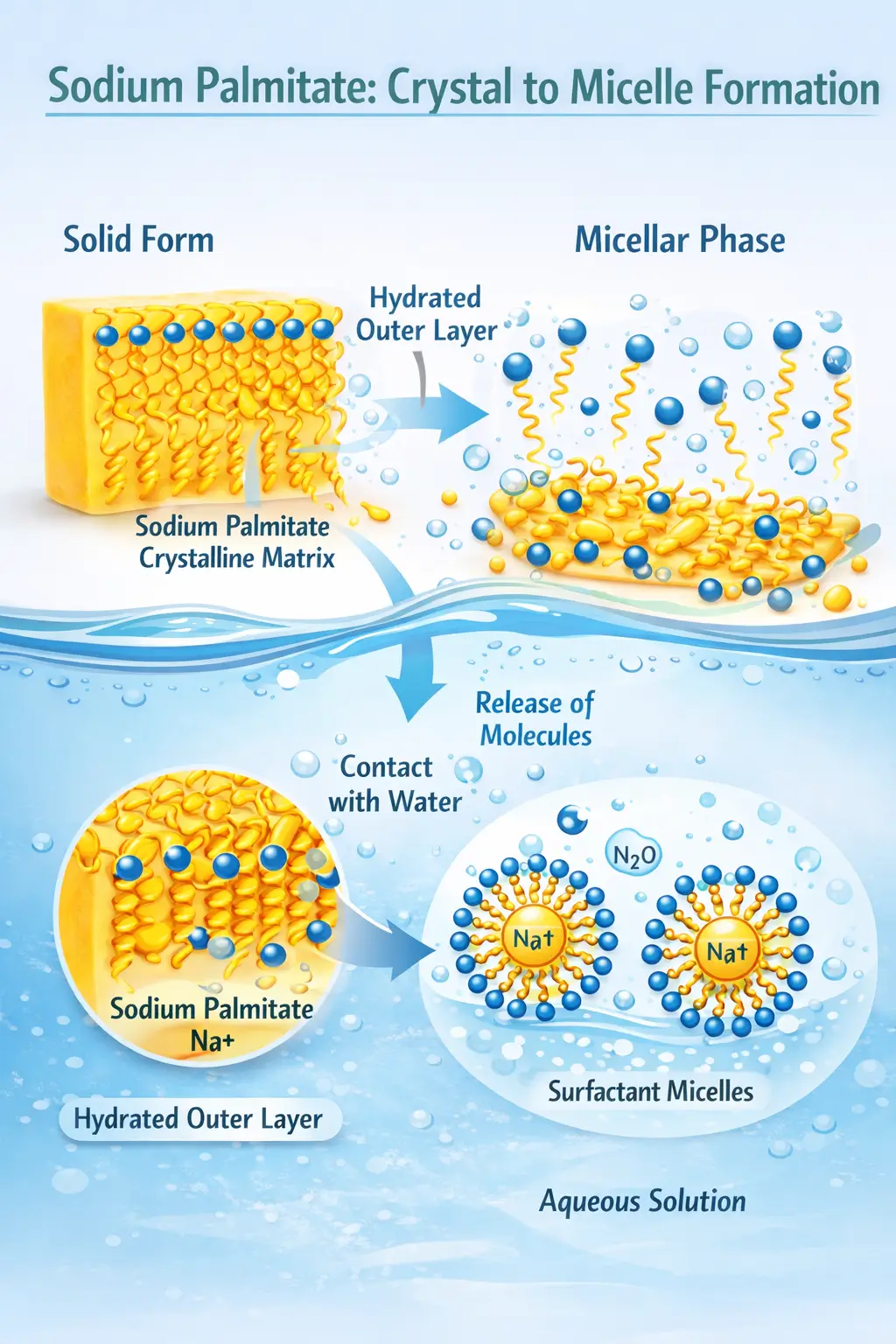
In aqueous conditions, it forms micellar structures where hydrophobic tails cluster inward and hydrophilic heads face outward, enabling removal of oils and residues.
Important interaction relationships include:
- Water: enables micelle formation and activates cleansing behavior
- Glycerin: produced during saponification, influences hydration and texture
- Chelating agents: reduce interference from metal ions in hard water
- Other soap salts: combine with sodium stearate or sodium oleate to adjust hardness and lather balance
In hard water conditions, calcium and magnesium ions react with sodium palmitate to form insoluble salts, reducing effective cleansing efficiency.
This interaction explains why soap performance can vary significantly depending on water composition.
Phase Behavior And Physical Characteristics
Sodium palmitate exhibits distinct phase behavior depending on temperature, water content, and formulation structure.
In solid soap bars, it exists as a crystalline matrix formed by tightly packed fatty acid salts. This structure provides mechanical strength and defines the shape of the product.
When exposed to water, the outer layer hydrates and transitions into a gel-like phase, allowing molecules to detach and participate in micelle formation.
Key physical characteristics include:
- Crystalline structure: responsible for bar rigidity and durability
- Hydration layer formation: occurs at the surface during use
- Micelle formation: enables cleansing action in aqueous phase
- Temperature sensitivity: higher temperatures increase dissolution rate
This phase transition from solid to hydrated surface layer explains why soap gradually wears down during repeated use rather than dissolving instantly.
Comparison With Related Soap Components
| Feature | Sodium Palmitate | Sodium Stearate | Sodium Oleate |
|---|---|---|---|
| Fatty Acid Chain | C16:0 (saturated) | C18:0 (saturated) | C18:1 (unsaturated) |
| Bar Hardness | High | Very high | Low |
| Solubility | Moderate | Lower | Higher |
| Lather Type | Dense and creamy | Dense and stable | Loose and quick-forming |
| Dissolution Rate | Controlled | Slow | Fast |
| Water Sensitivity | Affected by hard water | Affected by hard water | More tolerant |
| Formulation Role | Balance of hardness and usability | Structural reinforcement | Improves lather and solubility |
| Typical Use | Core soap base component | Hardness booster | Lather modifier |
Structural Limitations And Formulation Constraints
Sodium palmitate is highly sensitive to water composition. In the presence of calcium and magnesium ions, it forms insoluble salts that reduce effective cleansing performance.
This reaction can be represented as:
2 RCOO⁻ Na⁺ + Ca²⁺ → (RCOO)₂Ca ↓ + 2 Na⁺
The resulting precipitate contributes to residue formation and reduced lather efficiency in hard water environments.
Its alkaline nature also means that it produces a high pH environment in aqueous solution, which influences how it interacts with skin and other formulation components.
Additionally, its relatively low solubility compared to shorter-chain soap salts can limit rapid dispersion, especially in colder water conditions.
These constraints highlight the importance of balancing sodium palmitate with other components and using supporting systems such as stabilizers and chelating agents.
Common Misunderstandings
- “Sodium Palmate is a different ingredient”
The term “sodium palmate” is commonly seen in informal writing, product descriptions, or search queries, leading many to assume it is a separate ingredient. In reality, “sodium palmate” is not a distinct or standardized compound and is typically a spelling variation or simplified reference to sodium palmitate. In formulation and labeling contexts, the correct and precise term is always sodium palmitate, which specifically refers to the sodium salt of palmitic acid. - “It is just an oil”
Sodium palmitate is not an oil but the result of a chemical transformation through saponification, producing a distinct structure with different properties. - “It behaves like synthetic surfactants”
Soap-based surfactants differ significantly from synthetic surfactants in terms of solubility, pH behavior, and hard water interaction. - “It works the same in all water types”
Performance varies depending on mineral content, with reduced efficiency in hard water. - “It provides only cleansing”
It also defines the physical structure of the soap, including hardness and durability.
Summary of Findings
- Classification: Sodium palmitate is a fatty acid sodium salt forming the structural base of traditional soap.
- Primary Function: Provides both cleansing action and physical structure in bar soap systems.
- System Behavior: Forms micelles in water while existing as a crystalline matrix in solid form.
- Interaction Logic: Strongly influenced by water composition, glycerin presence, and supporting agents.
- Limitations: Hard water sensitivity and alkaline pH affect performance and user experience.
- Formulation Role: Core matrix ingredient rather than a supporting additive.