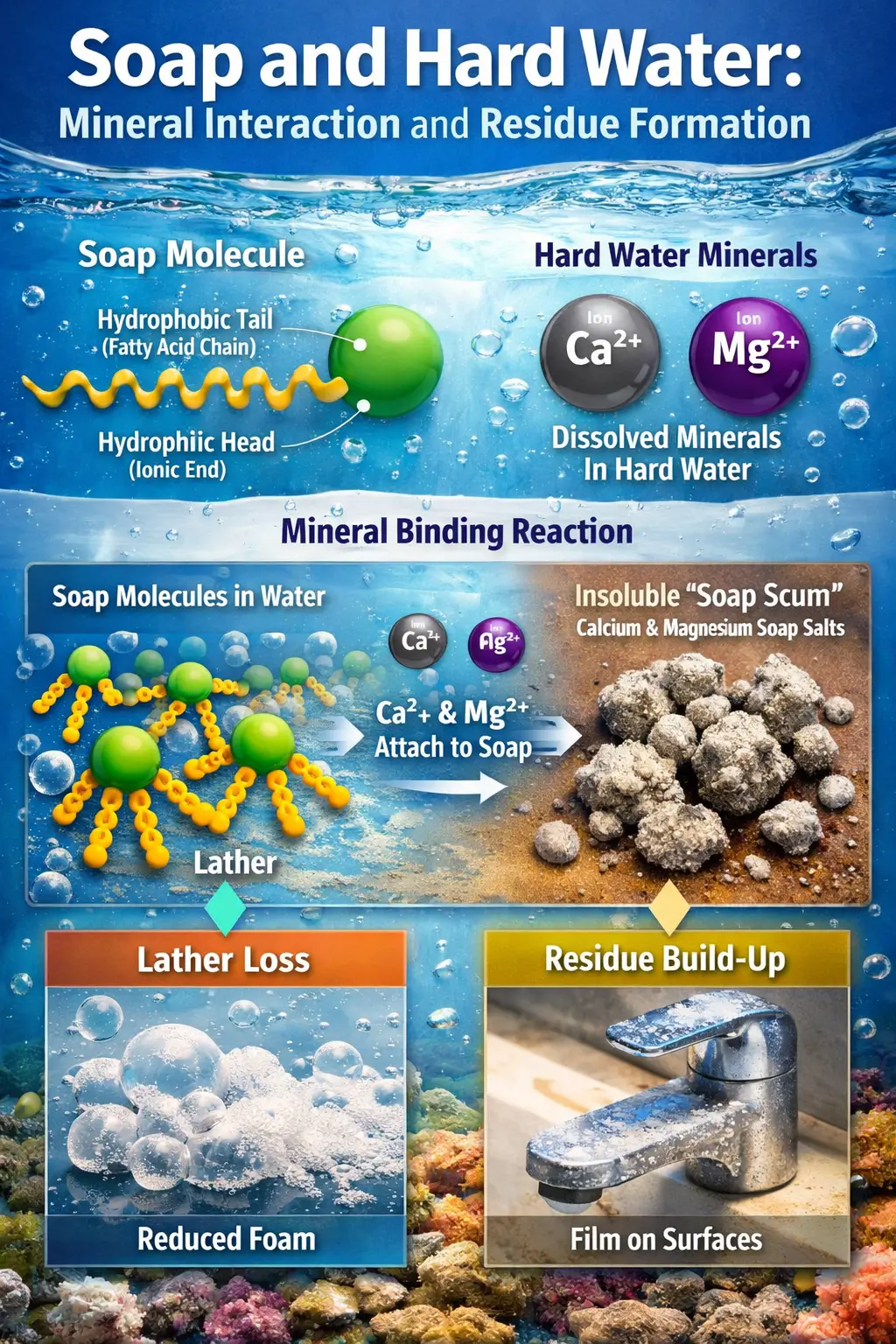
What Is Hard Water In A Soap System
Hard water is water containing elevated concentrations of divalent metal ions, primarily calcium (Ca²⁺) and magnesium (Mg²⁺). These ions originate from geological contact with limestone, dolomite, or chalk formations and remain dissolved as water moves through supply systems.
In a soap system, hardness is not an abstract measurement. It is an active participant. Calcium and magnesium ions interact directly with soap molecules, altering how those molecules disperse, aggregate, and deposit on surfaces.
Across Europe, hardness levels vary widely. Regions of the United Kingdom, Germany, northern France, Spain, and parts of Italy routinely exceed 200 mg/L calcium carbonate equivalent. In these contexts, soap behavior often diverges from expectations formed in soft water environments.
| Hardness Classification | CaCO3 Equivalent (mg/L) | Observed Soap System Behavior |
|---|---|---|
| Soft | < 60 | Rapid lather formation, minimal residue |
| Moderately Hard | 60 to 120 | Noticeable lather reduction, light film possible |
| Hard | 120 to 180 | Limited lather, visible residue formation |
| Very Hard | > 180 | Rapid soap precipitation, persistent surface deposits |
These effects are not formulation defects. They emerge from fundamental chemical compatibility limits between soap and mineral-rich water, culminating in the precipitation processes described in soap scum formation chemistry.
How Soap Molecules Are Designed To Function
Traditional soap is composed primarily of fatty acid surfactants (alkali metal salts of fatty acids). Common examples include sodium palmitate, sodium cocoate, potassium oleate, and related compounds derived from long-chain fatty acids.
Each soap molecule contains two functional regions: a hydrophobic hydrocarbon tail that associates with oils and soils, and a hydrophilic ionic head that interacts with water. In soft water, these molecules readily disperse and form micelles, allowing oils to be lifted and rinsed away.
Lather formation is a secondary visual outcome of this dispersion. It reflects air stabilization by soap films, not cleansing power itself. However, lather reduction is often the first visible signal that the soap system is being disrupted.
Soap systems evolved historically in soft to moderately hard water contexts. Their molecular architecture assumes limited competition at the ionic head group. When competing ions are introduced, behavior shifts.
Soap molecular structure is explained further in our Ingredient Framework.
Why Calcium And Magnesium Bind To Soap
Calcium and magnesium ions carry a double positive charge. Soap head groups carry a single negative charge. This difference creates a strong electrostatic attraction.
When a calcium or magnesium ion encounters soap molecules in solution, it can bind simultaneously to two soap head groups, initiating the same precipitation pathway explained in the chemistry of soap scum formation. The resulting compound is no longer water soluble. It precipitates out of solution as an insoluble metal soap.
These precipitates are commonly referred to as soap scum, a term describing the insoluble calcium and magnesium fatty acid salts formed through the binding reactions detailed in soap scum formation chemistry. Chemically, they are calcium or magnesium salts of fatty acids. Once formed, they no longer contribute to cleansing and instead deposit onto surfaces, fabrics, or skin.
This process occurs rapidly. It does not require heat, extended contact time, or mechanical agitation. In very hard water, a substantial fraction of soap can be rendered inactive almost immediately upon contact.
| System Stage | Soap State | Functional Result |
|---|---|---|
| Pre-binding | Dispersed, soluble | Micelle formation, oil suspension |
| During binding | Ion-paired aggregates | Reduced dispersion, collapsing lather |
| Post-binding | Insoluble precipitate | Residue formation, loss of cleansing capacity |
This binding mechanism explains why increasing soap quantity does not proportionally restore performance in hard water. Additional soap simply increases the amount of precipitate formed.
Why Lather Loss Is Often Misread As Cleansing Failure
Within soap systems, lather is frequently treated as a proxy for cleaning strength. This interpretation persists largely because lather is visible, immediate, and easy to compare across water conditions.
In hard water, reduced lather formation primarily reflects early disruption of soap dispersion rather than an immediate inability to solubilize oils. A portion of soap molecules may still form micelles briefly, particularly during initial contact, but the window of effective dispersion is shortened by mineral binding.
This distinction explains why some users report acceptable short-contact cleaning but persistent film or dullness after rinsing. The system partially functions, then collapses as insoluble metal soaps dominate the mixture.
Historically, this behavior was widely recognized in domestic contexts. In regions with consistently hard water, visual lather was never considered a reliable indicator of soap quantity or effectiveness, even before modern surfactant systems existed.
Foam formation behavior is examined in more detail within our Evidence & Sources documentation.
How And Where Soap Residue Forms
Soap residue in hard water is not a uniform substance but a composite of insoluble metal soaps, unbound oils, and captured particulates, reflecting the broader surface interactions examined in soap residue and hard water interaction. It is a mixture of insoluble calcium and magnesium fatty acid salts, unbound oils, and trace particulate matter captured during precipitation.
On hard surfaces, this residue appears as a dull, chalky film that resists simple rinsing. On skin or hair, it may feel draggy or waxy, particularly after repeated use without complete removal.
Residue formation is influenced by surface chemistry, reflecting the broader interaction patterns examined in soap residue and hard water interaction. Porous or slightly rough substrates retain precipitates more readily than smooth, non-reactive materials. This explains why residue accumulation is often uneven across different household surfaces.
| Surface Type | Observed Residue Behavior | Persistence Tendency |
|---|---|---|
| Ceramic or enamel | Visible film after drying | Moderate |
| Glass | Haze or streaking | Low to moderate |
| Skin or hair | Tactile drag, dull appearance | Variable |
| Textiles | Stiffness after drying | Moderate to high |
These outcomes are cumulative, as insoluble soap–mineral deposits layer progressively through repeated exposure, a behavior pattern detailed in hard water residue interaction analysis page. Individual wash cycles may produce subtle effects that become more noticeable over time as deposits layer rather than fully rinsing away.
How Temperature And Dilution Shift System Behavior
Water temperature influences soap behavior indirectly by affecting solubility and kinetic energy. Warmer water can temporarily improve soap dispersion, delaying precipitation rather than preventing it.
In hard water systems, this delay may be enough to alter user perception during short washing cycles. However, as cooling occurs or dilution changes during rinsing, mineral binding resumes and precipitates form.
Dilution introduces a separate constraint. As soap concentration drops during rinsing, the ratio of mineral ions to available soap increases. This accelerates binding even if total mineral content remains unchanged.
These effects explain why soap systems may appear to behave inconsistently across similar uses. The system is sensitive to small shifts in concentration, contact time, and temperature rather than operating as a fixed state.
Boundary Conditions Where Soap Behavior Changes
The soap and hard water system does not behave uniformly across all contexts. Several boundary conditions alter the dominant interactions.
At very low soap concentrations, mineral binding dominates almost immediately, producing minimal lather and rapid residue formation. At higher concentrations, dispersion may occur briefly but at the cost of increased precipitate mass.
Potassium-based soaps, often used in liquid formats, tend to remain soluble slightly longer than sodium-based soaps. This shifts the timing of precipitation but does not eliminate mineral interaction.
The presence of chelating agents, whether intentional or incidental, can also modify system behavior by temporarily binding calcium and magnesium ions, a strategy more commonly engineered into synthetic surfactant systems discussed within detergent formulation guides. This introduces additional variability without changing the underlying compatibility limits of soap chemistry.
These boundaries are important because they illustrate that soap performance differences are not binary, especially when contrasted with detergent systems designed to remain functional in mineral-rich water, as outlined across detergent formulation guides. They exist on a continuum shaped by interacting system variables.
Common Misinterpretations Of Soap Performance In Hard Water
One recurring misunderstanding is the belief that residue indicates incomplete rinsing alone. While rinsing plays a role, the formation of insoluble metal soaps means that some deposits are no longer water removable.
Another assumption is that reduced lather implies insufficient soap quantity. In hard water systems, adding more soap often increases residue formation without proportionally improving cleansing.
These interpretations persist because they align with soft water experience. When transferred unchanged into hard water contexts, they fail to account for mineral driven system changes.
Understanding these misalignments helps clarify why soap behavior can feel inconsistent across locations, households, or even seasonal water supply shifts.
Summary of Findings
- System interaction: Hard water minerals actively bind to soap molecules, altering dispersion and solubility.
- Lather limitation: Reduced lather reflects early system disruption, not necessarily immediate cleansing failure.
- Residue origin: Soap residue consists primarily of insoluble calcium and magnesium fatty acid salts.
- Variable behavior: Temperature, dilution, and concentration shift timing rather than eliminating mineral interaction.
- Boundary conditions: Soap performance exists on a continuum shaped by water hardness and formulation context.
All interpretations follow our Editorial Policy.
References
- McBain, J. W. Colloid Chemistry and Soap Systems.
- Myers, D. Surfactant Science and Technology. Publisher Page
- European Commission – Drinking Water Directive & Hardness Reports. Official Resource
- Garrett, H. E. Surface Active Chemicals. Reference Listing