What Soap Is At A Molecular Level
Soap is not a generic cleanser but a specific class of compounds formed when fatty acids react with an alkali to produce salts, a chemical foundation detailed further in the Soap Ingredients Guide. In finished soap products, these salts are typically sodium or potassium fatty acid salts (soap surfactants), such as sodium oleate, sodium palmitate, or potassium cocoate.
Unlike inert cleaning agents, soap molecules are chemically structured to interact with both water and non-water-soluble materials. This dual interaction is central to how soap cleans and also explains many of its limitations.
A common misunderstanding is that soap works because it is alkaline alone. While alkalinity influences behavior, cleansing itself is driven primarily by molecular structure rather than pH in isolation.
Why Soap Molecules Behave Differently In Water
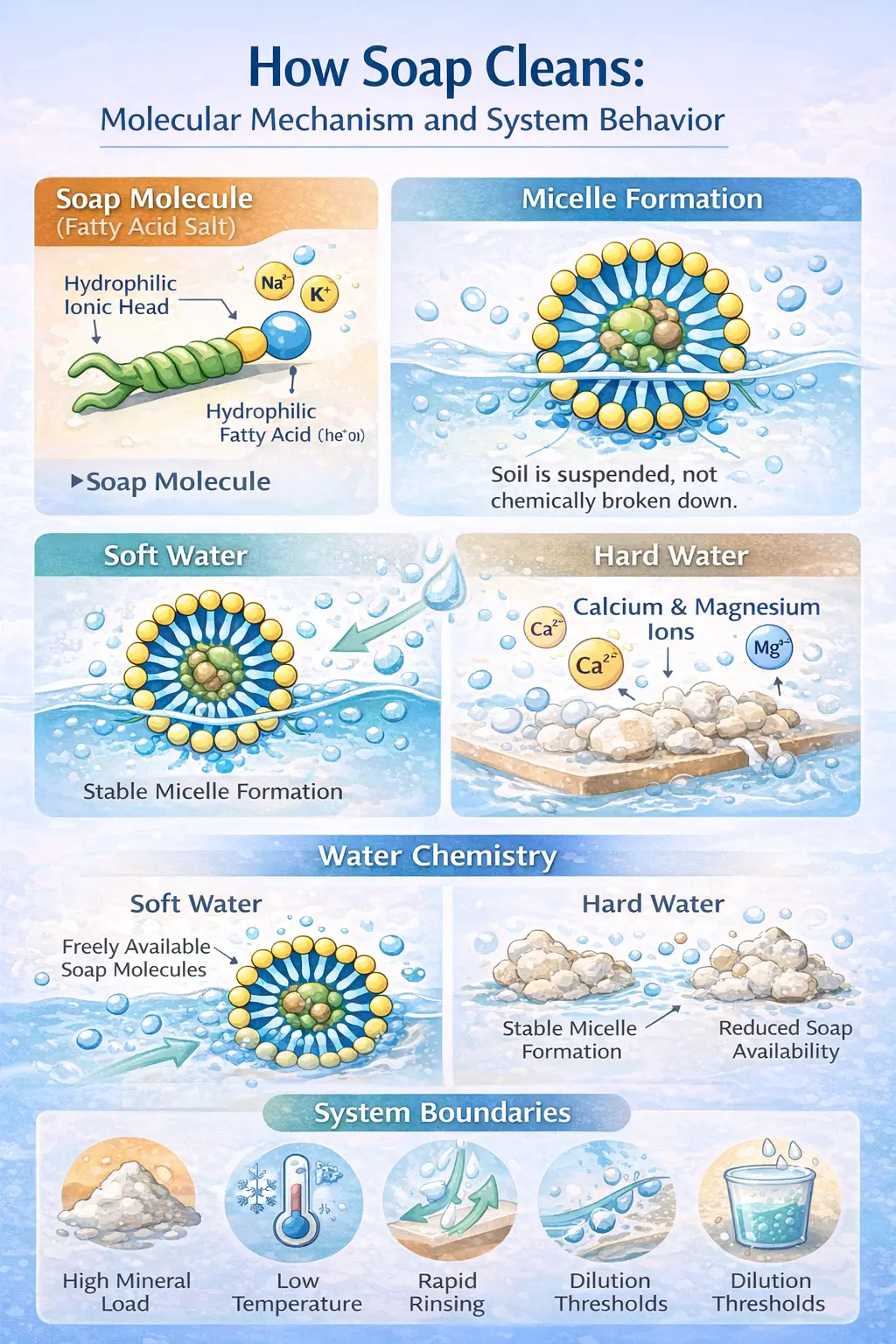
Soap molecules are amphiphilic, meaning each molecule contains two distinct regions with opposing affinities. One end of the molecule is hydrophilic (water-attracting), while the other is hydrophobic (water-repelling).
The hydrophilic portion is typically the charged carboxylate group, while the hydrophobic portion is a long hydrocarbon chain derived from fatty acids. This structure causes soap molecules to organize themselves spontaneously when introduced into water.
Rather than remaining evenly dispersed as individual molecules, soap aggregates into organized clusters once a threshold concentration is reached. These clusters are known as micelles and represent the functional cleaning units within a soap system.
Historically, this behavior was observed long before it was formally described. Traditional soapmakers noticed that oils could be removed from surfaces only when sufficient soap and water were present together, even without mechanical scrubbing.
How Micelle Formation Enables Dirt Removal
Micelles form when soap molecules arrange themselves so that their hydrophobic tails point inward, away from water, while their hydrophilic heads face outward toward the surrounding liquid.
This structure allows oily soils, grease, and particulate-bound lipids to become physically encapsulated within the micelle interior. The soil is not chemically destroyed or neutralized; it is isolated from the surface and suspended in water, a distinction that underlies the difference between cleansing action and antimicrobial effects discussed in Soap Cleansing vs Antimicrobial Action.
This distinction matters because soap does not dissolve dirt in the same way salt dissolves in water. Instead, soap changes how dirt interacts with water, making removal possible during rinsing.
A frequent misconception is that more foam means better cleaning. Foam formation
and micelle formation are related but not identical processes. Visible lather
does not directly indicate micelle efficiency or soil capture.
For plant-derived surfactant comparison, see our Himalayan Soap Nuts analysis.
How Water Chemistry Influences Soap Cleaning
Soap does not act independently of water. Its effectiveness depends heavily on the chemical environment in which it is used. One of the most influential variables is water hardness, particularly the presence of calcium and magnesium ions.
In soft water, soap molecules remain freely available to form micelles. In hard water, however, divalent minerals interact with fatty acid salts to form insoluble compounds. This interaction reduces the number of active soap molecules available for soil capture.
This behavior explains why soap may feel less slippery, produce less lather, or leave visible residue in some regions. These outcomes are not formulation failures but predictable system responses to water chemistry.
| Water Condition | Soap Molecular Availability | Visible System Effect |
|---|---|---|
| Soft Water | High availability of fatty acid salts | Easy lathering, smooth rinsing |
| Moderately Hard Water | Partial mineral binding | Reduced lather, increased soap usage |
| Hard Water | Significant mineral interaction | Residue formation, dull surface feel |
Because this interaction is structural rather than procedural, changes in
scrubbing intensity or application time do not eliminate it. The system behaves
according to chemical availability, not user effort.
For deeper analysis of mineral interaction, see our Understanding Soap pH guide.
Why Rinsing Is Central To Soap Performance
Soap cleaning is incomplete until rinsing occurs. Micelles suspend soils in water, but removal from the surface happens only when those micelles are carried away by flowing water.
If rinsing water is insufficient, interrupted, or mineral-rich, suspended soils and soap-mineral complexes may redeposit onto surfaces. This redeposition is often misinterpreted as incomplete cleaning rather than a system limitation.
Soap systems therefore depend on a balance between soil capture and removal. Capturing soil without effective removal does not improve cleanliness and may increase residue perception.
This dynamic helps explain why soap can feel effective during washing but leave surfaces feeling coated or squeaky afterward. The sensation reflects interaction outcomes rather than cleanliness itself.
The Role Of Temperature And Dilution
Temperature affects soap behavior indirectly by influencing molecular mobility and solubility. Warmer water generally increases soap dispersion and micelle formation, while colder water can slow these processes.
Dilution also alters system behavior. Below a certain concentration, soap molecules may not form micelles efficiently. Above that point, additional soap does not proportionally increase cleaning performance.
This non-linear response is why increasing soap quantity does not always improve results. Soap systems exhibit threshold behavior rather than continuous scaling.
These effects vary by fatty acid composition and counterion type, which explains why different soaps respond differently to similar use conditions.
Structural Limits Of Soap-Based Cleaning Systems
Soap is effective within a specific operating window. Outside that window, its performance declines in predictable ways. These limits are inherent to fatty acid salt chemistry rather than signs of poor formulation.
Soap does not function well in highly acidic environments, mineral-rich water, or situations where rapid rinsing is not possible. These constraints have driven the development of alternative cleansing systems, particularly in liquid and low-residue applications, a transition examined in the Soap vs Syndet Cleansers Guide.
Understanding these boundaries helps explain why soap remains widely used in some contexts while being replaced or modified in others. System selection is often about trade-offs rather than superiority.
This also clarifies why comparing soap directly to other cleanser types without considering system logic often leads to misleading conclusions.
Summary of Findings
- Soap Cleans Structurally: Cleaning occurs through micelle formation and soil suspension, not abrasion or chemical destruction.
- Water Chemistry Matters: Mineral content strongly influences soap availability and residue behavior.
- Rinsing Completes Cleaning: Soil removal depends on effective water flow, not just soap presence.
- Limits Are Predictable: Soap performance declines outside its optimal chemical environment.
References
- Rosen, M. J., & Kunjappu, J. T. (2012). Surfactants and Interfacial Phenomena. Wiley. DOI Link
- Myers, D. (2006). Surfactant Science and Technology. Wiley-Interscience. DOI Link
- Hiemenz, P. C., & Rajagopalan, R. (1997). Principles of Colloid and Surface Chemistry. CRC Press.
- OECD. Biodegradability and Surfactant Testing Guidance. OECD Documentation