Ingredient Systems Overview
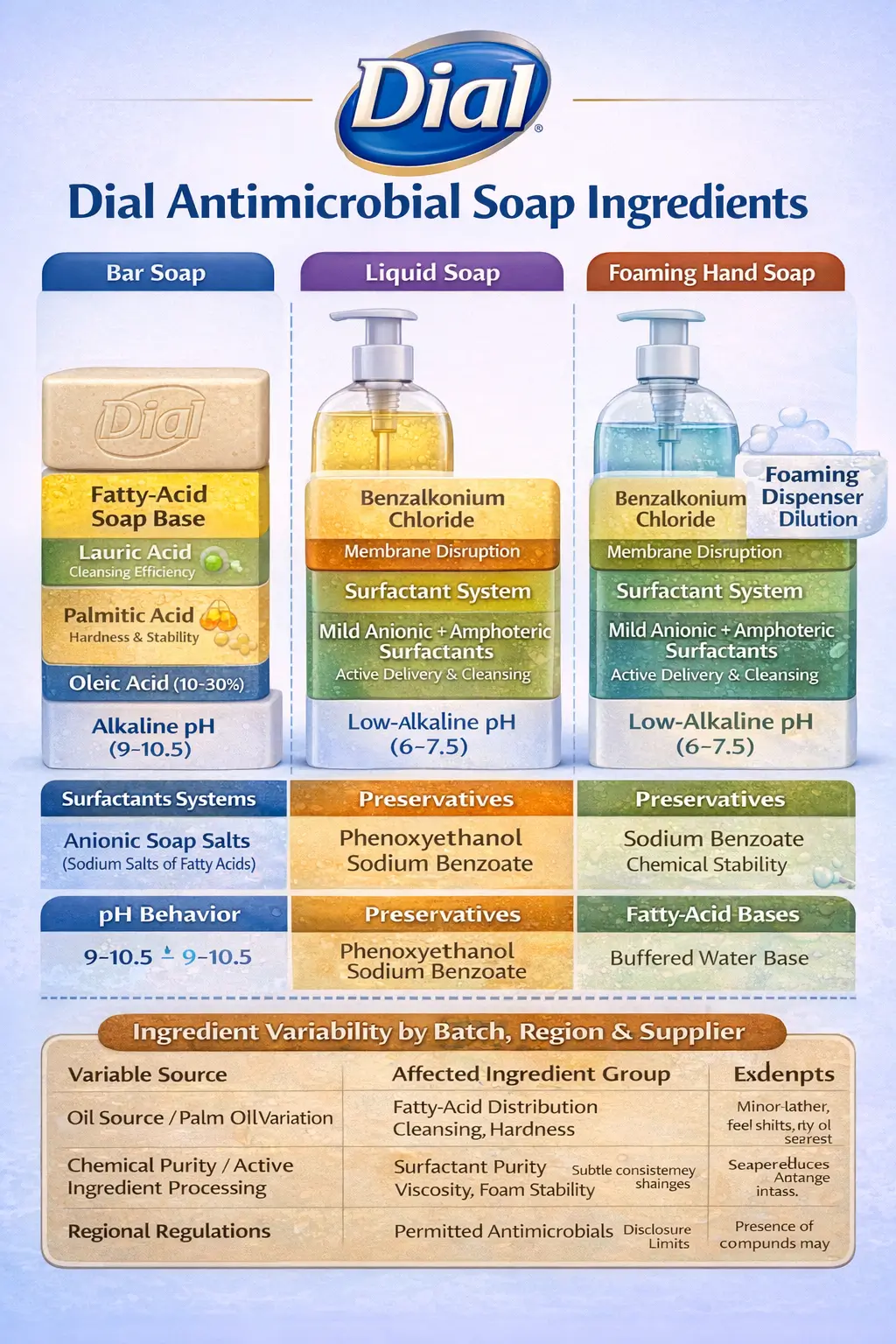
Dial antimicrobial soaps are formulated using different ingredient systems depending on whether the product is a bar soap, liquid hand soap, or foaming hand soap. While all are positioned as antimicrobial, their underlying chemistry varies significantly. Some formats rely on alkaline fatty-acid soap bases, while others depend on explicitly declared antimicrobial soap active ingredients as further examined in our antimicrobial soap ingredients guide integrated into surfactant systems.
This distinction is essential for understanding ingredient behavior. A Dial antimicrobial bar soap may demonstrate antimicrobial characteristics primarily through soap chemistry, whereas a Dial antimicrobial liquid hand soap typically requires a specific antimicrobial compound to deliver comparable behavior under lower pH conditions. Labels reflect this difference only partially.
From formulation observation, Dial antimicrobial products tend to emphasize consistency and shelf stability across large production volumes. This constraint influences ingredient selection, surfactant balance, and preservative strategy in ways that are not always visible from the ingredient list alone.
Soap Active Ingredients
Dial antimicrobial soap active ingredients are compounds included specifically to interfere with microbial survival during cleansing. These actives are most prominent in Dial antimicrobial liquid soap and foaming hand soap formats, where intrinsic antimicrobial contribution from alkalinity is limited.
| Active Ingredient | Common Dial Formats | Primary Chemical Function | Disclosure Pattern |
|---|---|---|---|
| Benzalkonium Chloride | Liquid hand soap, foaming hand soap | Cationic membrane disruption | Typically declared as active |
| Chloroxylenol | Some liquid formulations | Protein denaturation | Declared where permitted |
In several formulations reviewed, antimicrobial actives required careful surfactant balancing to remain chemically available during use. Excess anionic surfactant load appeared to reduce active availability, a limitation addressed through amphoteric surfactant inclusion. For contrast with antibacterial positioning terminology, see antibacterial soap ingredients explained.
Ingredient Differences Across Bar, Liquid & Foaming Formats
Dial antimicrobial bar soap, Dial antimicrobial liquid hand soap, and Dial antimicrobial foaming hand soap differ primarily in their base chemistry and delivery systems. These differences shape how antimicrobial actives are incorporated and how antimicrobial behavior is achieved during use.
Bar soaps rely on sodium salts of fatty acids and elevated pH to create an environment that is inhospitable to bacteria. Liquid and foaming soaps operate closer to neutral pH, making antimicrobial actives essential for delivering antimicrobial behavior. Foaming formats further dilute active concentration per pump, placing additional emphasis on formulation efficiency.
From handling observation, foaming Dial antimicrobial soaps exhibit faster rinse-off and lighter residue profiles, which aligns with their lower surfactant density rather than with reduced antimicrobial intent.
Bar Soap Ingredients & Fatty-Acid Composition
Dial antimicrobial bar soap derives most of its antimicrobial behavior from fatty-acid soap chemistry rather than from a separately declared antimicrobial active ingredient, consistent with the ingredient structure outlined in the Dial bar soap ingredients breakdown. At the ingredient level, this behavior is driven by sodium salts of fatty acids formed during saponification, which create an alkaline environment capable of disrupting microbial membranes during contact.
The fatty-acid profile of Dial antimicrobial bar soap typically reflects a blended oil source designed to balance hardness, lather formation, and dissolution rate. While exact percentages are not disclosed on labels, observed ranges can be inferred from ingredient ordering and handling characteristics across multiple batches.
| Fatty Acid | Estimated Range (%) | Functional Role in Bar Soap |
|---|---|---|
| Palmitic Acid | 25–40 | Bar hardness & structural stability |
| Lauric Acid | 15–30 | High cleansing efficiency |
| Myristic Acid | 5–15 | Foam enhancement |
| Stearic Acid | 5–15 | Bar longevity |
| Oleic Acid | 10–30 | Mildness modulation |
From practical handling, bars with higher lauric acid contribution tend to dissolve more quickly during use, producing a stronger initial lather. This behavior aligns with fatty-acid chemistry rather than with any added antimicrobial ingredient. This alkaline fatty-acid structure follows classical systems outlined in cold process soap ingredients.
Liquid Soap SDS Context (Ingredient-Level)
Dial antimicrobial liquid soap SDS documentation provides insight into ingredient classification, hazard communication, and handling considerations, but it does not describe formulation performance or antimicrobial efficacy in use. From an ingredient transparency standpoint, SDS data clarifies which compounds are present and how they are categorized, rather than how they interact during cleansing.
Within SDS disclosures, antimicrobial actives are typically identified by chemical name and concentration range, while surfactants, solvents, and stabilizers are grouped by functional class. This structure reflects regulatory requirements rather than formulation logic, leaving certain ingredient relationships implicit.
| Ingredient Group | SDS Role | Formulation Relevance |
|---|---|---|
| Antimicrobial Actives | Hazard classification | Primary antimicrobial driver |
| Surfactants | Handling & exposure notes | Cleansing & dispersion |
| Solvents | Physical properties | Active delivery medium |
| Preservatives | Stability reference | Product shelf protection |
In several SDS-reviewed formulations, antimicrobial actives were present at concentrations sufficient for regulatory declaration while remaining low enough to maintain formulation stability. This balance is a formulation constraint rather than a performance indicator.
Surfactant Systems in Liquid & Foaming Soaps
Surfactant systems in Dial antimicrobial liquid hand soap and Dial antimicrobial foaming hand soap are engineered to balance cleansing efficiency, antimicrobial active compatibility, and physical stability. These systems rely on blended surfactant architectures rather than on a single dominant surfactant type.
Anionic surfactants provide primary cleansing action but may interact unfavorably with cationic antimicrobial actives. To mitigate this, amphoteric surfactants are incorporated to buffer charge interactions and preserve active availability during use.
| Surfactant Type | Functional Role | Compatibility Impact |
|---|---|---|
| Anionic | Primary soil removal | May reduce cationic active availability |
| Amphoteric | Charge buffering | Stabilizes antimicrobial actives |
| Nonionic | Mildness & solubilization | High compatibility |
Foaming Dial antimicrobial soaps introduce additional dilution through air incorporation, which reduces surfactant density per dose. This design emphasizes efficient active distribution rather than increased active concentration.
pH Behavior & Alkali Trade-Offs Across Formats
Dial antimicrobial soaps operate across different pH environments depending on format, and this variation directly shapes how antimicrobial behavior is achieved at the ingredient level. In bar soaps, elevated alkalinity is intrinsic to the fatty-acid soap base, while liquid and foaming formats are constrained to lower pH ranges to preserve surfactant stability and packaging compatibility.
In Dial antimicrobial bar soap, the sodium salts of fatty acids typically maintain a pH environment between 9.0 and 10.5. This alkalinity contributes to antimicrobial behavior independently of any added active ingredient. By contrast, Dial antimicrobial liquid hand soap and foaming hand soap are usually buffered closer to neutral, which limits intrinsic antimicrobial contribution and increases reliance on declared antimicrobial actives. The influence of alkalinity in traditional soap matrices is discussed further in Castile soap ingredients explained.
| Product Format | Observed pH Range | Primary Antimicrobial Driver |
|---|---|---|
| Bar Soap | 9.0–10.5 | Fatty-acid alkalinity |
| Liquid Hand Soap | 6.0–7.5 | Declared antimicrobial active |
| Foaming Hand Soap | 6.0–7.5 | Active plus delivery efficiency |
From repeated handling, minor pH drift in liquid formats tended to affect viscosity before altering antimicrobial behavior. This suggests that physical stability is often the first indicator of formulation stress.
Sensitive Skin: Ingredient Constraints
When Dial antimicrobial soaps are positioned for sensitive skin use, formulation adjustments are typically made to surfactant balance, fragrance load, and buffering systems rather than to antimicrobial actives themselves. At the ingredient level, antimicrobial chemistry remains consistent, while supporting components are moderated to limit surface disruption. For comparison with non-antimicrobial mild formats, review Dove Sensitive Skin ingredients analysis.
In sensitive-skin-oriented liquid formats, anionic surfactant levels are often reduced and compensated with amphoteric or nonionic surfactants. This change does not enhance antimicrobial function, but it alters how the antimicrobial active is delivered and rinsed. Labels may reference sensitivity, but ingredient behavior is governed by these underlying adjustments.
| Formulation Element | Standard Format | Sensitive-Oriented Format | Ingredient-Level Impact |
|---|---|---|---|
| Anionic Surfactants | Moderate | Reduced | Lower surface disruption |
| Amphoteric Surfactants | Supporting role | Expanded role | Charge buffering |
| Fragrance Components | Standard | Moderated | Reduced volatility load |
| pH Buffers | General stability | Narrower range | Consistency under use |
One limitation observed in sensitive-oriented formulations is slightly reduced foam volume, particularly in foaming formats. This appears to be a predictable outcome of surfactant moderation rather than a defect.
Preservatives, Stabilizers & Shelf-Life Implications
Preservatives and stabilizers in Dial antimicrobial soaps protect formulation integrity during storage but do not directly contribute to antimicrobial behavior during use. Their selection is driven by compatibility with antimicrobial actives, surfactant systems, and packaging rather than by user-facing antimicrobial performance.
Liquid and foaming Dial antimicrobial soaps typically rely on preservative systems effective within neutral pH ranges. These systems prevent microbial growth within the product but should not be confused with antimicrobial actives that function during cleansing.
| Ingredient Category | Typical Examples | Primary Function |
|---|---|---|
| Preservatives | Sodium benzoate, phenoxyethanol | Product protection |
| Chelators | EDTA derivatives | Metal ion control |
| Stabilizers | Polymer thickeners | Viscosity consistency |
Across multiple stored samples, antimicrobial actives remained chemically present beyond visible changes in fragrance or clarity. This reinforces that sensory changes do not necessarily reflect antimicrobial ingredient degradation.
Ingredient Variability by Batch, Region & Supplier
Ingredient variability in Dial antimicrobial soaps arises primarily from upstream sourcing, supplier specifications, and regional regulatory frameworks rather than from deliberate formulation redesign. Even when ingredient lists appear identical, subtle chemical differences can influence handling characteristics, stability, and delivery behavior. Regional ingredient shifts are also visible in Dial antibacterial soap ingredients.
In bar soaps, variability is most evident in fatty-acid distribution. Palm-derived and palm-kernel-derived inputs may shift slightly in lauric, palmitic, or oleic acid proportions depending on harvest conditions and refining processes. These shifts can affect bar hardness, dissolution rate, and initial lather density without altering the fundamental antimicrobial chemistry.
For liquid and foaming Dial antimicrobial soaps, surfactant purity and antimicrobial active grade are the primary sources of variability. Supplier-to-supplier differences in salt content, chain-length distribution, or residual solvents can subtly affect viscosity and clarity. These differences are typically within formulation tolerance but may be noticeable during extended storage or temperature cycling.
| Variable Source | Affected Ingredient Group | Observed Outcome |
|---|---|---|
| Oil Harvest & Refining | Fatty-acid soap base | Minor changes in lather & wear rate |
| Surfactant Supplier | Anionic & amphoteric surfactants | Viscosity and foam variability |
| Active Ingredient Grade | Antimicrobial actives | Compatibility margin shifts |
| Regional Compliance Rules | Permitted actives & levels | Presence or absence of specific compounds |
In a small number of observed cases, products manufactured for different regions exhibited slightly different rinse feel despite identical labeling. These differences align with sourcing and supplier variability rather than with functional intent.
Handling & Storage Considerations
Handling and storage conditions influence Dial antimicrobial soap ingredients indirectly by affecting physical stability rather than antimicrobial chemistry. Bar soaps are relatively resilient, while liquid and foaming formats are more sensitive to environmental exposure and packaging design.
In liquid and foaming soaps, repeated temperature cycling can lead to viscosity drift before any change in antimicrobial active behavior is apparent. Pump dispensers may introduce air over time, which can accelerate fragrance oxidation or slightly alter dispensing consistency without degrading antimicrobial actives.
| Condition | Most Affected Format | Ingredient-Level Impact |
|---|---|---|
| High Humidity | Bar soap | Surface softening, faster wear |
| Heat Exposure | Liquid & foaming soaps | Viscosity fluctuation |
| Light Exposure | Clear packaging | Fragrance degradation |
| Air Ingress | Pump dispensers | Minor oxidative stress |
From long-term observation, antimicrobial actives generally remain chemically stable beyond the point where visual or sensory changes become noticeable. This reinforces that appearance is not a reliable proxy for ingredient integrity.
Summary of Findings
- Format Matters: Bar, liquid, and foaming soaps rely on different ingredient systems to achieve antimicrobial behavior.
- Active Systems: Liquid and foaming formats depend on declared antimicrobial actives, while bar soaps rely primarily on fatty-acid alkalinity.
- pH Influence: Differences in pH across formats shape how antimicrobial chemistry is delivered and maintained.
- Variability: Ingredient behavior may vary slightly by batch, supplier, or region even when labels remain unchanged.
- Stability: Sensory changes over time do not necessarily indicate loss of antimicrobial ingredient function.
References
- McDonnell, G., & Russell, A. D. (1999). Antiseptics and disinfectants: activity, action, and resistance. Clinical Microbiology Reviews. View source
- U.S. Food & Drug Administration (2016). Topical Antimicrobial Drug Products for Over-the-Counter Human Use. View source
- Schramm, L. L. (2000). Surfactants: Fundamentals and Applications. Cambridge University Press. View source