Quick Facts
| Property | Description |
|---|---|
| Ingredient Type | Soap base component |
| Chemical Class | Sodium salt of palm kernel fatty acids |
| Functional Role | Anionic surfactant contributing to cleansing and lather generation |
| Ionic Class | Anionic in aqueous solution |
| Typical Use Context | Traditional bar soap formulations and transparent soap systems |
| Fatty Acid Composition | Primarily lauric and myristic acid fractions derived from palm kernel oil |
| Formulation Environment | Alkaline soap matrix formed through saponification |
Ingredient Interaction Logic
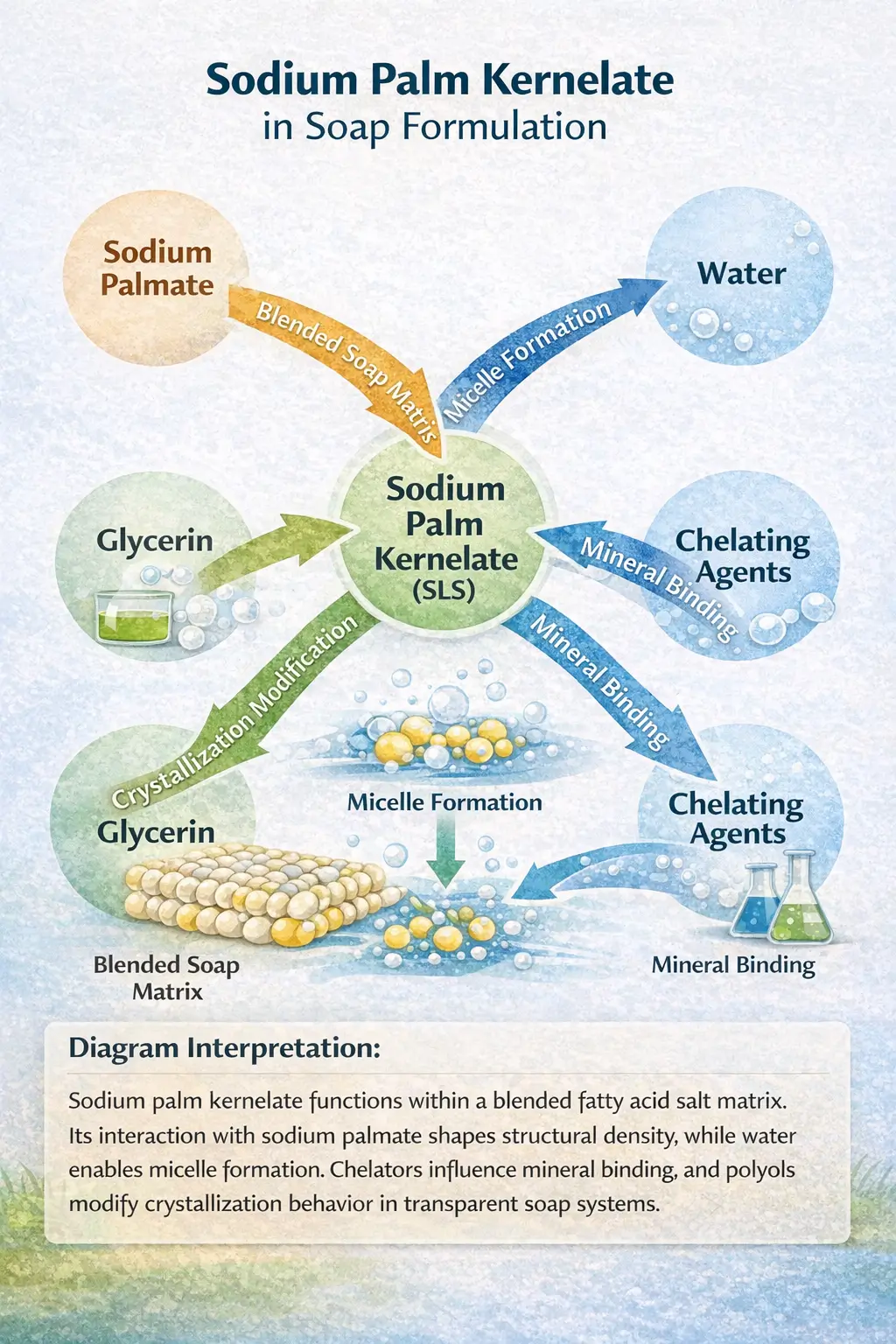
The behavior of sodium palm kernelate inside a soap formulation depends on its interaction with other components of the soap matrix. One of the primary interactions occurs with longer chain fatty acid salts such as sodium palmitate or sodium tallowate. These ingredients form the structural backbone of many soap bars, providing density and slower dissolution. Sodium palm kernelate modifies this matrix by increasing lather responsiveness and solubility.
Water also plays a central role in the interaction network. When a soap bar becomes wet, the outer surface hydrates and forms a thin gel layer composed of partially dissolved fatty acid salts. Sodium palm kernelate participates in micelle formation within this hydrated layer, enabling oils and particulate soils to disperse into the washing solution.
Chelating agents such as tetrasodium EDTA or etidronic acid influence this system indirectly. These molecules bind calcium and magnesium ions present in hard water. Without chelation, these metal ions can react with fatty acid salts to produce less soluble compounds that reduce lather clarity and create surface residues.
Polyols including glycerin modify crystallization behavior in transparent soap systems. By interfering with the formation of large crystalline domains they allow the soap matrix to remain optically clear while maintaining its surfactant functionality. In these systems sodium palm kernelate continues to participate in micelle formation even though the surrounding structure has been modified by solvent interactions.
Why This Ingredient Appears On Labels
Sodium palm kernelate commonly appears on cosmetic ingredient lists because it forms part of the structural base of many traditional soap bars. When oils containing triglycerides are reacted with alkaline substances during the saponification process, the fatty acids are converted into their corresponding sodium salts. Palm kernel oil produces a mixture of medium chain fatty acid salts, which are collectively labeled as sodium palm kernelate.
In finished soap products this ingredient contributes to cleansing behavior and lather formation. Its presence on the label therefore reflects the underlying chemistry of the soap base rather than an added functional additive. When palm kernel derived fatty acids are used as part of the oil blend in soap production, the resulting sodium salts must be declared according to the International Nomenclature of Cosmetic Ingredients system.
Chemical Identity and Classification
Sodium palm kernelate is the sodium salt of fatty acids obtained from palm kernel oil. Palm kernel oil contains a mixture of triglycerides dominated by medium chain saturated fatty acids, particularly lauric acid and myristic acid. During the saponification process these triglycerides undergo alkaline hydrolysis, converting the fatty acids into their corresponding sodium salts.
The resulting material is not a single defined molecule. Instead it represents a mixture of several fatty acid sodium salts whose proportions reflect the fatty acid distribution present in palm kernel oil. Lauric acid typically forms the largest fraction, followed by myristic acid with smaller contributions from caprylic, capric and palmitic acids.
From a formulation chemistry perspective sodium palm kernelate belongs to the family of anionic surfactants. When dissolved in water the carboxylate head group carries a negative charge while the hydrophobic hydrocarbon chain interacts with oils and other nonpolar materials. This amphiphilic structure enables the formation of micelles, which are essential to the cleansing function of soap systems.
Unlike sulfate or sulfonate surfactants used in many synthetic detergents, sodium palm kernelate derives directly from fatty acid chemistry. Its surfactant behavior therefore arises from carboxylate ion formation rather than synthetic sulfonate functional groups.
Functional Role in Soap Systems
Within traditional soap bars sodium palm kernelate functions as part of the primary surfactant matrix responsible for cleansing activity and foam formation. Its fatty acid composition influences how quickly lather develops and how the foam structure behaves during washing.
Medium chain fatty acid salts typically produce faster foam generation compared with longer chain salts such as Sodium Palmitate. This results in rapid bubble formation when the soap surface first contacts water. The bubbles produced by palm kernel derived salts tend to be larger and less dense, contributing to the perception of immediate lather.
The ingredient also contributes to cleansing efficiency because micelles formed by medium chain fatty acid salts disperse readily in water. These micelles encapsulate oily soil particles and suspend them in the washing solution until they are rinsed away.
Formulators rarely rely on sodium palm kernelate alone. Instead it is typically combined with longer chain fatty acid salts to balance several properties simultaneously including foam density, bar hardness and dissolution rate. The final performance of the soap depends on this balance rather than the presence of a single ingredient.
In transparent soap formulations sodium palm kernelate can interact with polyol solvents such as glycerin. These solvents modify crystallization behavior within the soap matrix, allowing light transmission through the bar while maintaining the surfactant structure responsible for cleansing.
Phase Behavior
Inside a finished soap bar sodium palm kernelate exists as part of a semi crystalline fatty acid salt matrix. The internal structure of this matrix is influenced by fatty acid chain length distribution, cooling conditions during manufacturing and the presence of solvent modifiers such as glycerin. Medium chain fatty acid salts derived from palm kernel oil tend to produce less densely packed crystalline domains than longer chain salts.
When the soap surface comes into contact with water the outermost layer hydrates and transitions into a gel like phase. Within this hydrated layer the fatty acid salts disperse into solution and begin forming micellar structures. These micelles capture oily soil and suspend it in the wash water until it is rinsed away.
Temperature and water composition influence this phase behavior. Higher temperatures increase solubility and accelerate micelle formation, while dissolved calcium and magnesium ions in hard water can react with fatty acid salts to produce less soluble compounds. These interactions do not change the underlying chemical identity of sodium palm kernelate but they can influence lather clarity and surface residue formation during washing.
Comparison With Related Ingredients
Sodium palm kernelate is often used alongside other fatty acid salts in soap formulations. One of the most closely related ingredients is sodium palmitate, which is derived from palm oil rather than palm kernel oil. Although both ingredients are sodium salts of fatty acids, their fatty acid chain length distribution produces different formulation behavior.
| Feature | Sodium Palm Kernelate | Sodium Palmitate |
|---|---|---|
| Source Oil | Palm kernel oil | Palm oil fruit |
| Dominant Fatty Acids | Lauric acid, Myristic acid | Palmitic acid, Stearic acid |
| Average Chain Length | Medium chain | Long chain |
| Lather Behavior | Rapid foam generation with larger bubbles | Denser and more stable foam structure |
| Contribution to Bar Hardness | Moderate structural contribution | High structural contribution |
| Dissolution Rate | Typically faster in water | Typically slower in water |
Formulators often combine these ingredients because their properties complement each other. Sodium palm kernelate increases foam responsiveness while sodium palmitate contributes structural firmness and slower wear. The final characteristics of the soap bar depend on the ratio between these fatty acid salts rather than on either ingredient alone.
Regulatory Context
Sodium palm kernelate is recognized within the International Nomenclature of Cosmetic Ingredients system as the standard name for sodium salts derived from palm kernel oil fatty acids. Cosmetic ingredient lists must declare this name when palm kernel oil has been converted into its sodium salt through saponification during soap production.
Within the European Union cosmetic products containing this ingredient fall under Regulation (EC) No 1223/2009 governing cosmetic product safety and labeling requirements. The regulation does not classify sodium palm kernelate as a preservative, colorant or fragrance allergen. Instead it is treated as part of the structural base of traditional soap formulations.
Ingredient declarations on cosmetic labels follow descending order of concentration at the time of formulation. Because sodium palm kernelate may form a substantial portion of the fatty acid base in certain soap systems it often appears near the top of the ingredient list when palm kernel derived oils are used in the saponification process.
Common Misunderstanding
One frequent misunderstanding is that sodium palm kernelate represents a synthetic detergent ingredient. The similarity in naming to certain detergent surfactants sometimes leads readers to assume it belongs to the same chemical category as sulfate or sulfonate surfactants.
In reality sodium palm kernelate is a traditional soap salt produced through the saponification of triglyceride oils. The surfactant properties arise from fatty acid carboxylate chemistry rather than from synthetic sulfonate or sulfate functional groups. Distinguishing between fatty acid soap salts and synthetic detergent surfactants requires attention to chemical classification rather than ingredient naming patterns alone.
Structural Limitations
Like other sodium salts of fatty acids, sodium palm kernelate functions within the alkaline environment characteristic of traditional soap systems. This pH environment results from the chemistry of saponification and influences how the ingredient behaves within the formulation matrix.
Another limitation arises in the presence of dissolved calcium and magnesium ions. These ions can react with fatty acid salts to form less soluble compounds that influence lather clarity and surface residue formation in hard water conditions. For this reason formulators often include chelating agents to moderate mineral interactions within the washing solution.
The fatty acid chain distribution also influences bar wear rate. Medium chain fatty acid salts typically dissolve more readily than longer chain salts, which means formulations containing larger proportions of palm kernel derived salts may require balancing with longer chain components to maintain structural durability during use.
Formulation References Using This Ingredient
Summary of Findings
Sodium palm kernelate is an anionic surfactant formed through the saponification of palm kernel oil fatty acids. The ingredient represents a mixture of sodium salts derived primarily from medium chain fatty acids such as lauric and myristic acid. Within soap formulations it contributes to cleansing activity, foam formation and interaction within the fatty acid salt matrix.
- Chemical Classification: Sodium salt of palm kernel derived fatty acids belonging to the anionic surfactant class.
- Functional Role: Contributes to foam generation and cleansing behavior within traditional soap systems.
- Formulation Interaction: Works alongside longer chain fatty acid salts, water phases and chelating agents to produce balanced soap performance.
- Phase Behavior: Participates in semi crystalline soap matrices that hydrate into micellar cleansing systems when exposed to water.
- System Boundaries: Performance characteristics depend on formulation ratios, water mineral content and surrounding matrix components.