Definition
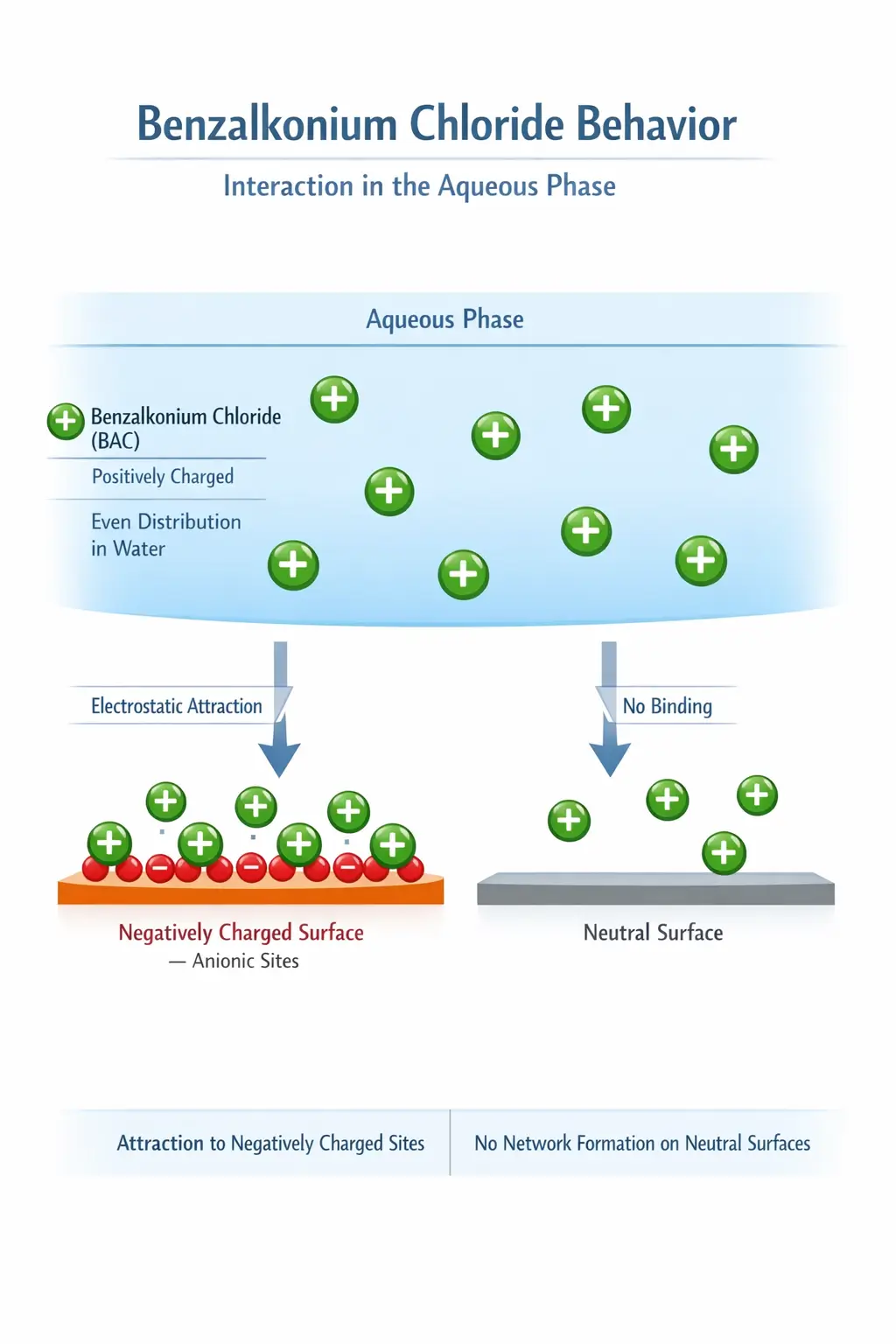
Benzalkonium chloride is a quaternary ammonium compound classified as a cationic surfactant used in cosmetic, cleaning, and formulation systems. It functions primarily as a surface-active and antimicrobial system component, interacting with microbial membranes and negatively charged surfaces rather than acting as a primary cleansing agent.
It belongs to a group of quaternary ammonium salts characterized by a permanently charged nitrogen center and hydrophobic alkyl chains, allowing it to remain active in aqueous environments such as creams, solutions, and cleaning products.
In formulation systems, this results in controlled surface interaction, preservation support, and subtle changes in how a product behaves during application and after rinsing.
Within cleansing systems, its role differs from traditional soap molecules. While soap salts drive emulsification and dirt removal, benzalkonium chloride modifies system behavior through cationic interactions, influencing microbial control, surface deposition, and formulation stability.
Functional Role Overview
Benzalkonium chloride functions as a cationic surfactant and antimicrobial system component used in cosmetics, creams, and cleaning products. It primarily interacts with surfaces and microbial structures rather than acting as a primary cleansing agent.
Quick Facts
| Property | Description |
|---|---|
| Ingredient Type | Cationic surfactant, antimicrobial agent |
| Chemical Class | Quaternary ammonium compound |
| Functional Role | Preservation support, surface activity, conditioning interaction |
| Ionic Class | Cationic |
| Typical Use Context | Cosmetics, creams, cleaning products, detergent systems, specialized soap formulations |
| Solubility | Water soluble |
Why This Ingredient Appears on Labels
Benzalkonium chloride appears on ingredient labels because it performs multiple formulation roles within a single system. In cosmetic products, creams, and solutions, it is typically included to support preservation systems and maintain microbial stability in water-based environments. In cleaning products and detergent systems, it contributes to surface activity and interaction with contaminants at the interface level.
Its presence on a label does not indicate a single-purpose function. Instead, benzalkonium chloride in cosmetics, creams, and cleaning products reflects a formulation decision where antimicrobial control, surface interaction, and compatibility with other ingredients must be balanced. In some systems, particularly aqueous solutions, it may also act as a stabilizing component that helps maintain formulation integrity over time.
For consumers reading labels, this means the ingredient is part of the system architecture rather than a standalone active. Its behavior depends heavily on concentration, formulation type, and interaction with other components.
Chemical Identity And Classification
Benzalkonium chloride is not a single compound but a mixture of alkylbenzyl dimethyl ammonium chlorides with varying alkyl chain lengths. The general structure includes a quaternary ammonium center with a permanent positive charge, paired with a chloride counterion. This ionic structure defines its classification as a cationic surfactant.
The INCI name is Benzalkonium Chloride. It belongs to the quaternary ammonium compound family, commonly referred to as quats. These compounds are characterized by their ability to adsorb onto negatively charged surfaces due to electrostatic attraction.
From a formulation perspective, its cationic nature distinguishes it from anionic soap molecules. Traditional soap systems rely on negatively charged fatty acid salts, whereas benzalkonium chloride introduces a positively charged component into the system. This difference becomes critical when considering compatibility and interaction behavior.
The alkyl chain length distribution within benzalkonium chloride influences its performance characteristics. Shorter chains tend to increase solubility, while longer chains enhance surface interaction and membrane affinity. This variability explains why benzalkonium chloride solution performance can differ depending on formulation grade and composition.
In observable terms, this chemical structure allows the ingredient to attach to surfaces and remain associated with them, which can influence how a formulation feels, spreads, or deposits on substrates.
Functional Role In Soap Systems
In soap systems, benzalkonium chloride does not behave as a primary cleansing agent. Instead, it modifies the system by introducing cationic functionality into an otherwise anionic environment. This distinction is important because it shifts the role from bulk cleansing to surface-level interaction and microbial control.
When incorporated into soap or hybrid cleansing bars, benzalkonium chloride can influence how the formulation interacts with surfaces after rinsing. Unlike soap molecules that are easily washed away, cationic compounds have a tendency to adsorb onto negatively charged substrates. This behavior can alter surface feel and residual characteristics.
In liquid soap systems, its contribution is more evident in preservation support and stability of aqueous phases. In such systems, benzalkonium chloride in soap acts as a functional additive rather than a structural component of the cleansing base.
In creams and emulsions, particularly those combining zinc oxide and benzalkonium chloride, the ingredient operates within the water phase, supporting microbial control while interacting with dispersed particles. This is why benzalkonium chloride and zinc oxide cream formulations often rely on controlled dispersion and phase balance to maintain consistency.
In detergent and cleaning products, the role shifts toward surface activity at interfaces such as hard surfaces, fabrics, or equipment. Here, benzalkonium chloride in detergent systems contributes to interaction with contaminants and surfaces rather than foam generation.
From a system perspective, the presence of benzalkonium chloride can subtly change how a formulation behaves during application and after rinsing, influencing residue characteristics and interaction with surfaces.
Ingredient Interaction Logic
Benzalkonium chloride operates within a formulation through electrostatic interactions, which means its behavior is highly dependent on the charge properties of other ingredients. This creates both opportunities and constraints in formulation design.
In systems containing anionic surfactants such as soap salts, direct interaction can lead to reduced effectiveness or formation of insoluble complexes. This is one of the primary reasons benzalkonium chloride is rarely used in high concentrations in traditional soap bars. Instead, it is more commonly found in systems where cationic compatibility is preserved.
In aqueous systems, benzalkonium chloride interacts with the water phase and distributes evenly due to its solubility. When humectants such as glycerin are present, the ingredient remains in the continuous phase, contributing to stability without significantly altering viscosity.
In emulsions, such as creams and lotions, it resides primarily in the water phase and interacts indirectly with oil droplets and dispersed solids. In zinc oxide-containing creams, benzalkonium chloride interacts with the surrounding medium rather than the zinc oxide particles themselves, helping maintain microbial control in the aqueous environment.
fragrance components and nonionic surfactants generally show better compatibility, as they do not introduce strong charge-based interactions. Chelating agents may influence system stability indirectly by modifying ionic conditions, which can affect how benzalkonium chloride distributes within the formulation.
In practical terms, these interaction dynamics determine whether the ingredient remains effective, becomes partially deactivated, or alters the overall system behavior.
Phase Behavior And Physical Characteristics
Benzalkonium chloride is highly water soluble and exists primarily within the aqueous phase of a formulation. Its cationic nature allows it to remain dispersed as individual ions rather than forming large aggregates under typical formulation conditions. This behavior supports uniform distribution in solutions, creams, and cleaning systems.
In aqueous solutions, benzalkonium chloride forms micelle-like structures at sufficient concentrations, although its primary role is not bulk surfactant structuring like traditional detergents. Its solubility enables consistent performance in benzalkonium chloride solution systems where clarity and stability are required.
Temperature stability is generally maintained within standard formulation ranges, although extreme heat or incompatible pH environments can influence its structural integrity. In emulsions, it remains in the water phase and does not migrate into oil domains, which helps maintain predictable phase separation behavior.
In observable terms, this phase behavior contributes to clear solutions, stable emulsions, and consistent distribution across the applied surface, without forming visible residues or crystalline deposits under normal conditions.
Comparison With Related Ingredients
Benzalkonium chloride is often compared with other cationic or antimicrobial agents used in similar formulation contexts. A common comparison is with cetrimonium chloride, another quaternary ammonium compound used in cosmetic systems.
| Feature | Benzalkonium Chloride | Cetrimonium Chloride |
|---|---|---|
| Chemical Class | Quaternary ammonium compound mixture | Single-chain quaternary ammonium compound |
| Primary Role | Antimicrobial support, surface interaction | Conditioning, antistatic effect |
| System Use | Cleaning products, creams, solutions | Hair conditioners, cosmetic emulsions |
| Charge Behavior | Cationic | Cationic |
| Interaction with Anionic Systems | Limited compatibility | Limited compatibility |
This comparison highlights that while both ingredients share a similar ionic classification, their functional emphasis differs. Benzalkonium chloride is more frequently used where antimicrobial control and surface interaction are required, whereas cetrimonium chloride is more associated with conditioning effects.
Regulatory Context
Benzalkonium chloride is listed under the INCI system as Benzalkonium Chloride and is recognized within global cosmetic regulatory frameworks. In the European Union, it appears in the CosIng database with defined usage categories and concentration limits depending on product type.
Its inclusion in cosmetic and cleaning formulations is governed by concentration thresholds and application context. Different product categories such as leave-on products, rinse-off systems, and cleaning formulations may have distinct regulatory considerations.
Label declaration follows standard INCI conventions, where benzalkonium chloride is listed according to its concentration relative to other ingredients. Its presence iningredient lists of cosmetics, creams, and cleaning products reflects compliance with disclosure requirements rather than a claim of function hierarchy.
Formulators must consider compatibility, concentration limits, and intended use conditions when incorporating benzalkonium chloride into products intended for regulated markets.
Common Misunderstanding
A common misunderstanding is that benzalkonium chloride functions in the same way as traditional soap or detergent surfactants. This assumption arises because it is often grouped with cleansing ingredients in product descriptions.
In reality, benzalkonium chloride does not replace the role of primary surfactants responsible for emulsifying oils and removing dirt. Instead, it operates at the interface level, interacting with surfaces and microbial structures. Its contribution is complementary rather than substitutive.
Understanding this distinction helps clarify why benzalkonium chloride is used alongside other surfactants rather than as a standalone cleansing base in most formulations.
Structural Limitations
One of the primary limitations of benzalkonium chloride is its incompatibility with strongly anionic systems. When combined with anionic surfactants such as soap salts, electrostatic interactions can reduce its effectiveness or lead to precipitation. This restricts its use in traditional high-anionic formulations.
Another limitation relates to formulation balance. Because benzalkonium chloride operates within the aqueous phase, its performance depends on maintaining appropriate ionic conditions and pH ranges. Deviations can alter its distribution and interaction behavior.
In systems containing high levels of organic matter or complex mixtures, its functional efficiency may be influenced by competing interactions at the surface level. This requires careful formulation design to ensure consistent performance.
These structural constraints define the boundaries within which benzalkonium chloride can be effectively used across soap, cosmetic, cream, and cleaning product systems.
Formulation References Using This Ingredient
Summary of Findings
- Classification: Benzalkonium chloride is a quaternary ammonium compound functioning as a cationic surfactant and antimicrobial system component.
- Functional Role: It supports preservation, surface interaction, and system stability rather than acting as a primary cleansing agent.
- Interaction Logic: Its behavior is driven by electrostatic interactions, with strong dependence on compatibility with other formulation ingredients.
- System Behavior: It remains in the aqueous phase, distributes uniformly, and interacts with surfaces rather than forming structural networks.
- Limitations: Compatibility constraints with anionic systems and dependence on formulation conditions define its effective usage boundaries.