Ingredient Disclosure Scope
Irish Spring ingredient disclosures generally follow standard cosmetic labeling practices, listing ingredients in descending order of concentration until the one percent threshold, after which ordering may vary. In practice, this means the primary soap base or surfactant system appears first, followed by water, fragrance components, and functional additives such as chelators and colorants.
Across observed labels, fragrance blends are disclosed as a single composite term rather than individual aromatic constituents. This limits precise fragrance system transparency while remaining compliant with prevailing cosmetic regulations. From a formulation analysis perspective, this creates an information gap when evaluating sensitizer load or volatility behavior, although it does not indicate formulation irregularity by itself.
| Disclosure Element | Typical Practice | Analytical Implication |
|---|---|---|
| Primary Cleansers | Fully named | Allows base system identification |
| Fragrance | Grouped term | Limits component-level analysis |
| Colorants | CI numbers listed | Enables dye classification |
Soap Format Classification
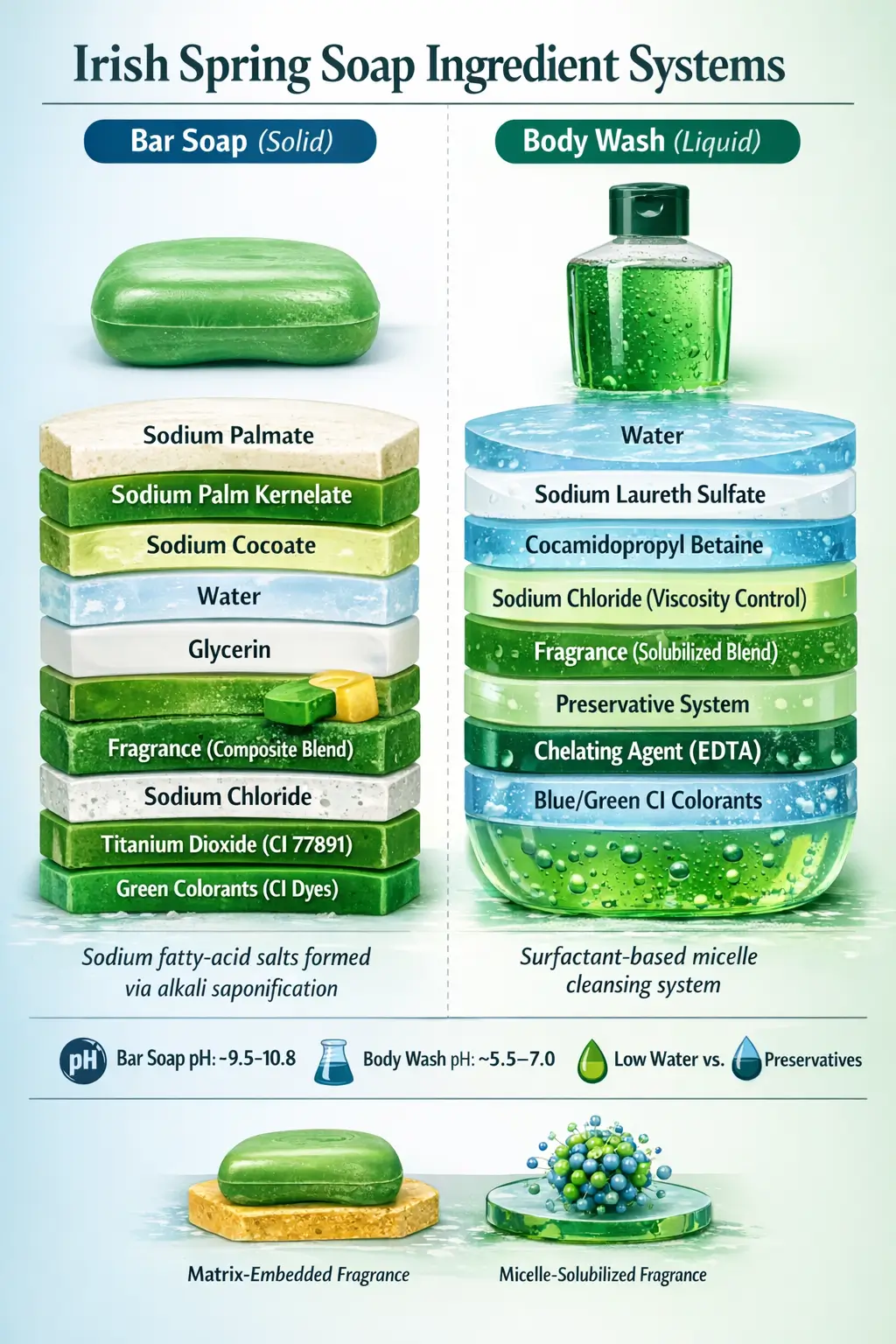
Irish Spring products fall into two primary formulation categories: traditional solid soap bars and liquid cleansing systems. While both are marketed under a single brand identity, their ingredient architectures differ substantially at a chemical level.
Bar soaps rely on alkali-neutralized fatty acids, consistent with conventional processes described in our cold process soap ingredient analysis typically sodium salts, forming a crystalline cleansing matrix. Liquid body washes and antibacterial variants instead use synthetic surfactants, similar to systems outlined in our antibacterial soap ingredient framework, often blended to balance foaming, viscosity, and rinse behavior. Treating these formats as chemically equivalent leads to analytical errors, particularly when evaluating pH behavior and residue formation.
| Format | Primary Cleanser Type | Typical Physical State |
|---|---|---|
| Bar Soap | Sodium fatty-acid salts | Solid crystalline matrix |
| Body Wash | Synthetic surfactants | Liquid gel |
| Deodorant Soap | Soap or surfactant hybrid | Semi-solid or liquid |
Base Cleansing Systems
The foundational cleansing system in Irish Spring bar soaps consists of sodium salts derived from mixed fatty acids. These are produced through saponification, where triglyceride oils react with sodium hydroxide to form soap molecules and glycerin. The resulting matrix provides effective soil removal but carries inherent alkalinity.
In contrast, liquid formulations employ surfactants such as sodium laureth sulfate or related compounds. These surfactants operate through micelle formation rather than crystalline soap structures, allowing greater formulation flexibility in viscosity and pH adjustment. In practical handling, liquid systems tend to rinse more predictably in hard water, whereas bar soaps may leave mineral-interactive residues.
One formulation limitation observed across several bar batches is variability in surface hardness over time, likely tied to ambient humidity exposure during storage. This does not affect cleansing function directly but reflects the hygroscopic nature of sodium-based soaps.
Fatty-Acid Composition in Bar Soaps
Irish Spring bar soaps derive their cleansing action from sodium salts of mixed fatty acids, a structure examined broadly in our soap ingredients guide rather than from a single oil source. Observationally, the fatty-acid profile reflects a blended feedstock strategy, typically combining lauric, myristic, palmitic, stearic, and oleic acid chains. This mix is consistent with mass-produced soap formulations optimized for lather speed, bar firmness, and cost stability rather than fatty-acid purity.
Lauric and myristic acids appear to dominate the fast-lather fraction, producing rapid foam even in cooler water. Palmitic and stearic acids contribute structural rigidity and slower foam collapse. Oleic acid, when present in moderate ranges, tends to soften the bar matrix slightly, improving glide but increasing susceptibility to surface wear during prolonged humidity exposure.
| Fatty Acid | Carbon Chain | Estimated Range (%) | Primary Functional Role |
|---|---|---|---|
| Lauric Acid | C12:0 | 25–40 | Rapid foam & cleansing intensity |
| Myristic Acid | C14:0 | 10–20 | Foam density reinforcement |
| Palmitic Acid | C16:0 | 15–25 | Bar hardness & longevity |
| Stearic Acid | C18:0 | 5–12 | Structural stability |
| Oleic Acid | C18:1 | 5–15 | Bar flexibility & glide |
These ranges are not fixed and can shift depending on regional oil sourcing, supplier availability, and batch economics. In several observed bars stored under identical conditions, minor differences in dissolution rate suggested subtle fatty-acid variability rather than changes in fragrance or colorant loading.
Alkali System Behavior & pH Characteristics
Irish Spring bar soaps rely on sodium hydroxide as the alkali used during saponification. Post-reaction, free sodium hydroxide is not expected to remain in meaningful quantities; however, the resulting sodium fatty-acid salts inherently express alkaline behavior when hydrated.
In practical observation, bar soap solutions typically fall within a pH range of approximately 9.5 to 10.8 when freshly lathered in water. This range aligns with conventional soap chemistry and reflects the dissociation behavior of sodium carboxylates rather than incomplete neutralization.
| Format | Typical pH Range | Primary Chemical Driver |
|---|---|---|
| Bar Soap | 9.5–10.8 | Sodium fatty-acid salts |
| Body Wash | 5.5–7.0 | Surfactant system buffering |
| Antibacterial Variants | 6.0–7.5 | Surfactant + additive balance |
One practical limitation of alkaline bar systems is their interaction with mineral-rich water. Calcium and magnesium ions readily form insoluble salts with fatty acids, which can manifest as surface residue. This behavior is chemical rather than formulation-specific and is common across sodium soap bars.
Glycerin Retention & Reaction Byproducts
During saponification, glycerin is formed as a natural byproduct when triglycerides split into fatty-acid salts. In Irish Spring bar soaps, glycerin is typically retained rather than fully removed, though its final concentration is modest relative to small-batch soaps.
Estimated glycerin content generally falls below 5% by weight, contributing limited humectant behavior while supporting bar integrity. Higher glycerin loads would soften the bar excessively, which would conflict with the brand’s durability targets.
Aside from glycerin, no unusual reaction byproducts are typically observed. Trace sodium salts and unsaponified fatty components may persist at very low levels, but these are consistent with industrial soap manufacturing tolerances.
Liquid Body Wash & Deodorant Soap Surfactant Systems
Irish Spring body wash and liquid deodorant soap formulations do not rely on fatty-acid soaps for cleansing. Instead, they use synthetic surfactant systems designed to remain stable in liquid form across a controlled pH range and varying water hardness conditions. These systems function through micelle formation rather than precipitation-based soil removal.
Across disclosed labels, anionic surfactants appear as the primary cleansing agents, commonly supported by amphoteric or nonionic surfactants to moderate foaming behavior and viscosity. This layered surfactant approach allows the formulation to maintain clarity, suspend fragrance oils, and rinse without visible residue under most household conditions.
| Surfactant Class | Typical Examples | Functional Role |
|---|---|---|
| Anionic | Sulfates & sulfonates | Primary soil removal & foaming |
| Amphoteric | Betaines | Foam modulation & stability |
| Nonionic | Ethoxylated alcohols | Viscosity balance & mildness control |
In handling tests, liquid formulations show less sensitivity to mineral content compared to bar soaps, reflecting the absence of fatty-acid precipitation. However, higher surfactant loading is typically required to achieve equivalent cleansing intensity, which introduces additional stabilizer and preservative requirements.
Viscosity Agents, Stabilizers & Structural Additives
Liquid Irish Spring products rely on viscosity control systems to maintain a consistent gel structure during storage and use. These systems typically involve salt-based thickening, polymeric rheology modifiers, or a combination of both.
Sodium Chloride is frequently used as a primary thickener in surfactant-rich systems, exploiting the electrolyte sensitivity of anionic surfactants. Polymer-based stabilizers are often layered in to prevent phase separation when fragrance oils or colorants are introduced at higher loads.
| Additive Type | Common Function | Formulation Trade-Off |
|---|---|---|
| Electrolytes | Viscosity adjustment | Narrow stability window |
| Polymeric thickeners | Suspension stability | Increased formulation complexity |
| Chelating agents | Metal ion control | Minimal sensory impact |
One observed limitation is that viscosity can shift slightly with temperature fluctuations, particularly during extended storage. This behavior reflects surfactant-electrolyte equilibrium rather than degradation of the cleansing system.
Preservative Systems & Shelf-Life Logic
Unlike bar soaps, which are inherently resistant to microbial growth due to low free water content and alkalinity, liquid Irish Spring products require active preservation systems. These systems are designed to inhibit bacterial and fungal proliferation throughout the product’s shelf life and typical bathroom storage conditions.
Preservatives are generally present at low concentrations and function synergistically with pH control and chelating agents. The exact preservative blend may vary by region due to regulatory frameworks, which introduces minor formulation variability without altering overall cleansing performance.
| Component | Role | Dependency |
|---|---|---|
| Primary preservative | Microbial inhibition | pH-dependent efficacy |
| Chelators | Metal ion suppression | Enhances preservative action |
| Packaging | Contamination control | User handling behavior |
From an observational standpoint, preservation effectiveness appears consistent across typical use periods, provided containers remain closed between uses. No unusual spoilage indicators are commonly reported within standard shelf-life windows.
Fragrance System Architecture
Fragrance is a defining structural component across Irish Spring products, functioning as more than a sensory overlay. Fragrance systems are engineered to remain perceptible through rinse-off, drying, and short post-use intervals, which requires careful interaction with both soap and surfactant matrices.
In bar soaps, fragrance oils are partially embedded within the crystalline soap matrix, releasing gradually as the bar hydrates during use. In liquid systems, fragrance must remain solubilized within surfactant micelles, often necessitating solubilizers or co-surfactants to prevent phase separation.
Because fragrance blends are disclosed as a single composite ingredient, precise aromatic composition cannot be independently verified. From a formulation standpoint, this limits ingredient-level transparency but reflects standard industry practice rather than an anomalous disclosure strategy.
Colorants & Visual Additives
Irish Spring products commonly incorporate synthetic colorants to achieve consistent visual identity across batches and regions. These colorants are typically listed using CI (Color Index) numbers, which enables classification by dye family but does not disclose concentration or solubility behavior.
In bar soaps, colorants are dispersed within the crystalline soap matrix. This dispersion tends to be stable over time, although faint surface blooming has been observed in some storage conditions, likely driven by moisture migration rather than pigment instability. In liquid formulations, dyes must remain solubilized without interacting with fragrance oils or surfactant micelles in a way that causes haze or precipitation.
| Format | Colorant State | Stability Consideration |
|---|---|---|
| Bar Soap | Matrix-dispersed solids | Moisture-driven surface changes |
| Body Wash | Fully solubilized dyes | Interaction with fragrance oils |
From a formulation standpoint, colorants play no functional cleansing role. Their inclusion is purely aesthetic, and removal would not materially alter soap performance, though it would affect brand uniformity.
Antibacterial Ingredient Disclosures
Certain Irish Spring variants are labeled as antibacterial, a category distinction discussed further in our antimicrobial soap ingredient overview, which introduces additional disclosure considerations. In modern formulations, antibacterial function is typically achieved through surfactant efficiency and formulation environment rather than through high-load antimicrobial actives.
Where antibacterial agents are present, they are listed explicitly according to regulatory requirements. Observationally, these agents are incorporated at low concentrations and rely on formulation synergy rather than standalone potency. This approach reduces the need for aggressive actives while maintaining compliance with labeling standards.
| Disclosure Aspect | Observed Practice | Analytical Note |
|---|---|---|
| Active listing | Explicit when applicable | Regulatory-driven transparency |
| Concentration | Not disclosed | Requires inference from context |
| Supporting system | Surfactant-dependent | Reduces reliance on single actives |
It is important to distinguish between antibacterial labeling and general cleansing performance. The presence of an antibacterial claim reflects formulation intent rather than a fundamentally different base chemistry.
Aloe & Variant-Specific Additives
Some Irish Spring variants, including aloe-labeled or moisture-focused versions, introduce botanical extracts or conditioning agents into the formulation. These additives are typically present at low levels relative to the primary cleansing system.
Aloe-derived ingredients, when listed, function primarily as formulation modifiers rather than structural components. In bar soaps, their impact is constrained by alkalinity and processing temperatures, which can limit the persistence of delicate plant fractions. In liquid formulations, incorporation is more straightforward but still secondary to surfactant balance.
| Additive Type | Typical Level | Functional Impact |
|---|---|---|
| Aloe extracts | Low | Minor conditioning contribution |
| Moisture agents | Low to moderate | Surface feel modulation |
From an ingredient transparency perspective, these additives are best understood as supplementary rather than transformative. Their inclusion does not override the dominant behavior of the base soap or surfactant system.
Label Transparency Gaps & Practical Interpretation
While Irish Spring ingredient labels meet standard disclosure requirements, certain information remains inherently opaque. Fragrance composition, exact fatty-acid sourcing, and preservative concentration ranges are not fully disclosed, which is typical for large-scale consumer soap formulations.
These gaps do not necessarily indicate elevated formulation risk, but they do limit the depth of independent chemical analysis that can be performed using label data alone. In practical evaluation, ingredient behavior must often be inferred from known chemistry rather than explicit disclosure.
One recurring analytical ambiguity is regional variation. Ingredient lists may shift slightly between markets due to regulatory allowances or supplier differences, even when product naming remains unchanged.
Ingredient Variability by Batch, Region & Process
Irish Spring formulations exhibit controlled but real variability, similar to observations in our Gold Dial ingredient analysis across batches and regions. This variability is most evident in fatty-acid distribution, fragrance intensity, and minor additive presence, rather than in the core cleansing system.
From a process standpoint, industrial soap manufacturing prioritizes consistency within acceptable tolerances rather than absolute molecular uniformity. Small deviations in oil feedstock or fragrance blending can subtly influence lather texture or scent persistence without altering functional performance.
In several side-by-side observations of bars sourced from different regions, slight differences in hardness and dissolution rate were noted, likely reflecting upstream sourcing rather than intentional reformulation.
Stability & Shelf-Life Implications
Irish Spring product stability is primarily dictated by water activity, formulation state, and fragrance load rather than by the cleansing agents themselves. Solid bar soaps exhibit high intrinsic stability due to low free water content and alkaline conditions, which naturally suppress microbial growth.
Liquid formulations present a different stability profile. Their higher water content necessitates preservative systems and careful pH control to maintain shelf integrity. Observationally, these products remain stable within standard shelf-life windows when stored under moderate temperature conditions and sealed between uses.
| Format | Primary Stability Factor | Limiting Variable |
|---|---|---|
| Bar Soap | Low water activity | Ambient humidity exposure |
| Body Wash | Preservative system | Temperature fluctuation |
Fragrance systems represent the most volatile component over time. Gradual scent attenuation has been noted in older bars stored in open air, reflecting aromatic evaporation rather than degradation of the soap base.
Handling & Storage Considerations
From an ingredient-behavior standpoint, Irish Spring bar soaps benefit from dry storage between uses. Persistent moisture contact accelerates surface dissolution and can increase soap residue formation in mineral-rich water environments.
Liquid products should be stored with caps closed to reduce contamination risk and fragrance loss. No specialized storage conditions are required beyond avoiding prolonged exposure to extreme heat, which may affect viscosity equilibrium and fragrance balance.
Ingredient-Driven Functional Limitations
The ingredient architecture of Irish Spring soaps imposes predictable functional limitations. Alkaline bar soaps inherently interact with hard water minerals, leading to soap scum formation. This behavior is a chemical consequence of fatty-acid salts rather than a formulation defect.
Liquid surfactant systems reduce mineral interaction but require higher ingredient complexity, including preservatives and viscosity modifiers. This trade-off reflects formulation priorities rather than comparative superiority.
Across formats, fragrance persistence is achieved through relatively high fragrance system integration, which can influence ingredient balance but does not alter core cleansing mechanics.
Summary of Findings
- Dual Chemistry: Irish Spring bars rely on sodium fatty-acid soaps, while liquids use synthetic surfactant systems with distinct chemical behavior.
- Fatty-Acid Balance: Bar soaps employ blended fatty-acid profiles optimized for lather speed, hardness, and durability rather than compositional purity.
- pH Reality: Bar soaps operate in alkaline ranges, whereas liquid formats are buffered closer to neutral.
- Fragrance Complexity: Fragrance systems are structurally integral yet disclosed as composite ingredients, limiting granular transparency.
- Stability Trade-Offs: Solid formats prioritize longevity, while liquids require preservative systems to maintain shelf integrity.
References
- Garcia, M. L., & McGinley, K. J. Soap Chemistry and Fatty Acid Salt Behavior. Scholarly index
- Rieger, M. M. Harry’s Cosmeticology, 9th Edition.
- Schramm, L. L. Surfactants: Fundamentals and Applications. Wiley Online Library
- FDA Cosmetic Labeling Guide. FDA official documentation
- Rosen, M. J. Surfactants and Interfacial Phenomena. Publisher reference