What Antibacterial Means In Product Claims
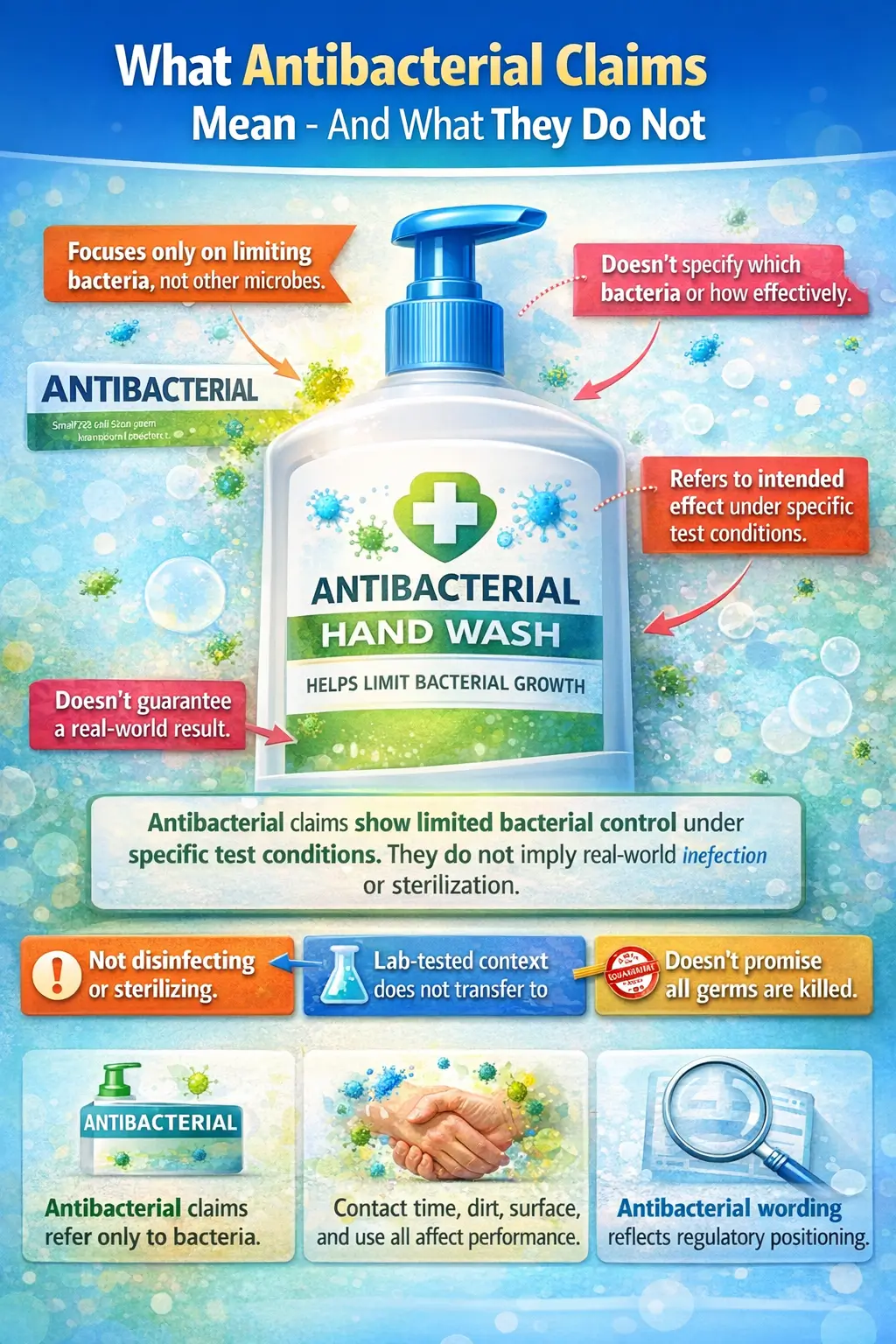
In labeling terms, antibacterial refers to an intended effect against bacteria, not a comprehensive action against all microorganisms. The term does not inherently specify which bacteria are targeted, how reduction is measured, or under what conditions the effect was observed, all of which depend on the specific antibacterial systems used, as illustrated by formulations such as Safeguard soap ingredients.
This lack of specificity is often surprising to consumers, who may assume the word functions as a broad descriptor. In practice, it operates more like a technical category, indicating a narrow type of activity rather than a general performance standard.
Because the claim is qualitative rather than quantitative, it requires context to interpret correctly. Without that context, it is easy to read more certainty into the term than it is designed to carry.
Why Antibacterial Does Not Describe A User Outcome
One of the most persistent misunderstandings is the assumption that an antibacterial claim predicts a specific real-world result. The claim, however, is tied to formulation intent or testing context, not to everyday consumer experience.
Variables such as contact time, dilution, surface type, and usage habits all shape what happens outside controlled conditions, which is why context-specific cases like antibacterial soap for foot odor can behave differently in practice. The claim does not account for these factors, even though they strongly influence perception.
This gap explains why two products with similar claims can demonstrate noticeably different behavior during routine use, without either claim being inaccurate.
How Antibacterial Claims Are Framed Under EU Rules
Within the European Union, antibacterial claims intersect with both cosmetic and biocidal regulatory frameworks. Which rules apply depends on how the product is positioned and what effect is being claimed.
In cosmetic contexts, antibacterial language is typically constrained to avoid medical or therapeutic implication. In other product categories, additional substantiation requirements may apply.
For consumers, this means the presence of the word antibacterial reflects regulatory positioning as much as formulation design. The label communicates compliance, not a hierarchy of effectiveness.
Why Antibacterial Is Not The Same As Disinfecting
Antibacterial claims are often read as shorthand for broader microbial control. This is understandable, but inaccurate. Disinfecting and sterilizing imply defined levels of microbial reduction across specified organisms. Antibacterial does not.
The distinction is not semantic. It reflects different regulatory categories, testing expectations, and intended use cases. Antibacterial claims generally signal limited action against bacteria, without extending to viruses, spores, or fungi, a distinction explored further in soap cleansing vs antimicrobial action.
When this distinction is overlooked, consumers may expect outcomes that the claim was never designed to communicate. The misunderstanding lies in interpretation, not necessarily in labeling.
How Testing Context Shapes Claim Meaning
Antibacterial claims are typically supported by testing performed under specific conditions. These conditions may involve controlled contact times, defined surfaces, or laboratory environments that differ from everyday use.
The claim does not travel with those conditions. On packaging, the word antibacterial appears without the surrounding context that gave it meaning during evaluation. This compression of information is one reason interpretation varies so widely.
In practice, this means the claim communicates capability within limits, not a prediction of real-world performance across all scenarios.
This compression of testing context is not unique to antibacterial systems. Preservation strategies operate under similar interpretive limits, as explained in Why Preservatives Exist in Formulations.
What Antibacterial Claims Do Not Cover
There are several areas that antibacterial claims do not address, even though consumers often assume they do. These include duration of effect, residual activity, and interaction with organic matter.
The claim also does not imply superiority over products without the label. Products may differ in formulation strategy while achieving similar practical outcomes, even when only one uses antibacterial language.
Recognizing what the claim does not attempt to explain helps prevent over-reading its importance on the shelf.
How Antibacterial Claims Appear In European Retail Settings
In European supermarkets and pharmacies, antibacterial claims often appear as brief front-of-pack statements, sometimes paired with icons or short qualifiers. Space constraints limit how much explanatory detail can accompany the term.
On refill packs or multi-language packaging, the claim may be reduced further, leaving even less room for context. This does not change the underlying meaning, but it does increase the likelihood of assumption-based interpretation.
These retail realities explain why antibacterial claims feel more assertive than they are. The packaging format amplifies the word while compressing its explanation.
Interpretive overreach is not limited to antibacterial terminology. Similar assumption-driven confusion appears in origin-based labeling, as discussed in Natural vs Synthetic Ingredients Explained.
Where Interpretation Reaches Its Limits
Antibacterial claims cannot fully explain how a product will be perceived in use, particularly across different environments or user expectations. Variables such as cleaning habits, water quality, and surface type remain outside the scope of the label.
This unresolved boundary is not a flaw in the system. It reflects the fact that consumer labeling balances disclosure with practicality. Some uncertainty is unavoidable.
Understanding this limit helps reframe antibacterial as a narrow descriptor rather than a promise.
Summary of Findings
- Antibacterial describes intent, not outcome: The term signals limited bacterial activity under defined conditions.
- The claim is not comprehensive: It does not imply disinfecting, sterilizing, or broad microbial control.
- Testing context matters: The meaning of the claim depends on conditions that are not visible on packaging.
- Retail presentation compresses context: Packaging amplifies the term while limiting explanation.
- Interpretation has boundaries: The label cannot predict real-world experience across all uses.
References
- European Commission. Cosmetic Products Regulation (EC) No 1223/2009.
- European Commission. Guidance on cosmetic claims and consumer interpretation.
- European Chemicals Agency. Biocidal Products Regulation overview.
- ISO. Standard terminology relating to antimicrobial activity.