Definition
Sodium Laureth Sulfate is an anionic surfactant belonging to the ethoxylated sulfate surfactant family, primarily used to enable cleansing and foam formation in water-based systems such as shampoos, liquid soaps, and detergents.
It is structurally derived from fatty alcohols that have undergone ethoxylation followed by sulfation, resulting in a molecule that combines a hydrophobic tail with a hydrophilic sulfate group.
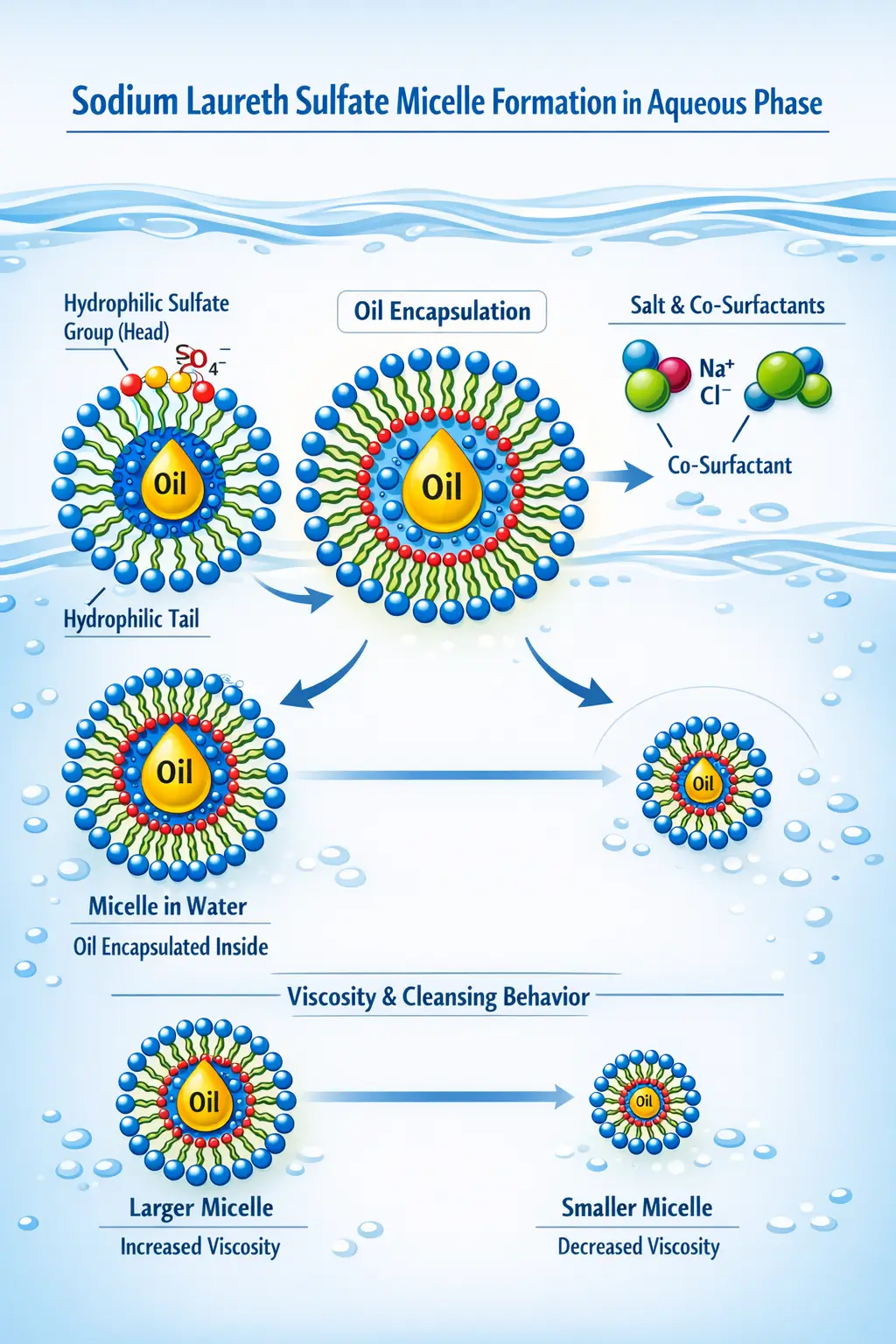
Within cleansing systems, it functions by reducing surface tension and forming micellar structures that allow oils, dirt, and particulate matter to disperse into the water phase.
In observable terms, this translates into fluid products that generate consistent lather and rinse without leaving heavy residue, particularly in liquid formulations.
Quick Facts
| Property | Description |
|---|---|
| Ingredient Type | Primary Surfactant |
| Chemical Class | Ethoxylated Alcohol Sulfate |
| Functional Role | Cleansing, foaming, emulsification |
| Ionic Class | Anionic |
| INCI Name | Sodium Laureth Sulfate |
| CAS Number | 9004-82-4 |
| Solubility | Highly water-soluble |
| Micelle Behavior | Forms spherical and elongated micelles that encapsulate oils and hydrophobic residues |
| Surface Activity | Reduces surface tension, enabling oil detachment and dispersion in water |
| Foam Profile | High foam generation with stable foam structure |
| Viscosity Response | Viscosity increases with salt addition due to micelle growth and structuring |
| Electrolyte Sensitivity | Performance and thickness vary with salt concentration and water composition |
| Compatibility | Compatible with amphoteric and nonionic surfactants; incompatible with cationic surfactants |
| Typical Use Context | Liquid cleansing systems including shampoo, body wash, facial cleanser and detergent |
| Formulation Role | Primary cleansing base often combined with co-surfactants for performance balancing |
Why This Ingredient Appears on Labels
Sodium Laureth Sulfate is commonly listed on product labels because it serves as the primary cleansing engine in many formulations, particularly in systems designed to remove oils and particulate residues through water rinsing.
It appears across multiple product categories including Sodium Laureth Sulfate in shampoo, liquid cleansers, and formulations categorized as Sodium Laureth Sulfate in body wash, where controlled foam generation and dispersion of hydrophobic materials are required.
In more complex systems such as conditioners or multi-phase cleansers, its presence may be adjusted or combined with other surfactants to balance viscosity and interaction with conditioning agents.
From a formulation perspective, its inclusion signals that the product relies on micellar cleansing rather than soap-based alkalinity, which changes how the system behaves in water, especially in terms of foam profile and rinse characteristics.
Chemical Identity and Classification
Sodium Laureth Sulfate is identified under the INCI system as an ethoxylated derivative of lauryl alcohol sulfate. The molecule consists of a fatty alcohol backbone linked to repeating ethylene oxide units and terminated with a sulfate group.
This places it within the broader category of anionic surfactants, specifically the subgroup known as alcohol ether sulfates. The presence of ethoxy groups differentiates it structurally from non-ethoxylated sulfates, modifying both solubility and interaction behavior in aqueous systems.
The hydrophobic portion typically originates from lauryl or similar chain-length fatty alcohols, while the hydrophilic sulfate head group provides strong water affinity and ionic charge.
In formulation terms, this dual structure allows the molecule to orient at interfaces, forming micelles that encapsulate non-polar substances and enable their removal during rinsing.
Functional Role in Soap Systems
Within cleansing systems, Sodium Laureth Sulfate acts as a primary surfactant responsible for reducing surface tension and initiating the formation of micelles.
In liquid cleansing formats, including systems described as Sodium Laureth Sulfate in soap or syndet-based cleansers, it replaces traditional soap salts by operating effectively across a wider pH range and maintaining clarity in aqueous formulations.
Its contribution to lather is characterized by relatively dense, stable foam compared to nonionic systems. The ethoxylation moderates the aggressiveness of interaction at interfaces, which influences how the foam forms and collapses during rinsing.
In structured systems such as Sodium Laureth Sulfate in conditioner, its role is typically secondary or reduced, as excessive anionic presence can interfere with conditioning polymers and cationic agents.
At the system level, its behavior translates into products that produce consistent foam under agitation, maintain liquid clarity, and support efficient removal of oils without forming insoluble residues.
Ingredient Interaction Logic
The behavior of Sodium Laureth Sulfate is strongly influenced by its interaction with surrounding formulation components rather than acting in isolation.
In aqueous systems, it associates with water molecules to form micellar aggregates. These aggregates expand or contract depending on electrolyte concentration, particularly in the presence of salts such as sodium chloride, which can increase viscosity through micelle structuring.
When combined with amphoteric surfactants, the system often shows altered foam texture and reduced interfacial tension variability, leading to more controlled cleansing behavior.
Interactions with humectants such as glycerin influence water activity and viscosity, indirectly modifying how micelles distribute within the formulation.
In systems where fragrance components are present, it contributes to solubilization by incorporating hydrophobic fragrance molecules into micellar cores, maintaining visual clarity.
In detergent-type systems, including contexts aligned with sodium laureth sulfate in detergent, builders and chelating agents modify ionic strength, which directly impacts micelle size and cleaning efficiency in hard water conditions.
From an observable standpoint, these interactions determine whether a product appears thick or fluid, whether foam feels dense or airy, and how cleanly the system rinses without residue.
Phase Behavior and System Structure
Sodium Laureth Sulfate is highly soluble in water and forms structured liquid phases depending on concentration and electrolyte balance.
At low concentrations, it exists primarily as dispersed monomers. As concentration increases beyond the critical micelle concentration, it transitions into micellar systems capable of solubilizing oils and hydrophobic compounds.
Further structural organization can occur in the presence of salts or co-surfactants, leading to elongated or entangled micelles that increase viscosity and create gel-like textures.
Thermal stability is generally sufficient for standard formulation conditions, although viscosity and micelle structure may shift with temperature changes due to altered hydration dynamics.
In practical terms, this phase behavior explains why formulations using this surfactant can range from thin liquids to structured gels depending on composition rather than changing the core ingredient.
Comparison With Related Surfactants
Sodium Laureth Sulfate is often evaluated alongside structurally related surfactants to understand differences in formulation behavior, especially in systems where foam profile, solubility, and interaction with other ingredients are critical.
| Feature | Sodium Laureth Sulfate | Sodium Lauryl Sulfate | Sodium Lauroyl Sarcosinate |
|---|---|---|---|
| Chemical Type | Ethoxylated sulfate | Non-ethoxylated sulfate | Amino acid-derived surfactant |
| Water Solubility | High, improved by ethoxylation | High but less flexible | Moderate to high |
| Foam Structure | Dense and stable | High volume, less stable | Softer, less dense |
| System Compatibility | Compatible with wide surfactant blends | More restrictive interactions | Often used in mild systems |
| Typical Use Context | Liquid cleansers and shampoos | Strong cleansing systems | Mild cleansing formulations |
In comparisons such as sodium laureth sulfate vs sodium lauryl sulfate, the key distinction lies in the presence of ethoxy groups, which influence solubility and system flexibility rather than fundamentally changing the surfactant mechanism.
When evaluated against amino acid surfactants, including contexts aligned with sodium laureth sulfate vs sodium lauroyl sarcosinate, the difference becomes more apparent in foam structure and interaction with conditioning systems.
Regulatory Context
Sodium Laureth Sulfate is listed under the INCI naming system and is permitted for use in cosmetic formulations within established regulatory frameworks such as the European Union Cosmetics Regulation (EC) No 1223/2009.
It is not classified as a restricted ingredient under standard cosmetic annexes when used in accordance with formulation practices. Instead, it is regulated through general product safety requirements and labeling transparency.
From a declaration standpoint, it must appear in ingredient lists using its INCI name, allowing consistent identification across products including those categorized as sodium laureth sulfate in cosmetics and cleansing systems.
Manufacturing considerations, such as residual processing byproducts, fall under broader regulatory expectations for purity and quality rather than ingredient-specific prohibition.
Common Misunderstanding
A frequent misconception is that Sodium Laureth Sulfate is simply another name for similar sulfate surfactants, leading to confusion in comparisons such as sodium laureth sulfate vs sodium lauryl ether sulfate.
In practice, these names often refer to closely related or overlapping classifications rather than entirely distinct functional ingredients. The term "laureth" itself indicates ethoxylation, which is the defining structural feature.
Another misunderstanding arises when comparing soap-based systems with surfactant-based systems. Soap relies on fatty acid salts and operates differently in water, particularly in the presence of minerals, whereas this surfactant maintains solubility and functionality across a wider range of conditions.
From a formulation perspective, the distinction is not about naming variation but about how molecular structure influences system behavior, especially in terms of solubility and interaction with electrolytes.
Structural Limitations
Despite its versatility, Sodium Laureth Sulfate presents certain formulation constraints that must be managed at the system level.
Its performance is sensitive to electrolyte concentration. While controlled salt addition can enhance viscosity, excessive ionic strength may destabilize micellar structures or reduce foam efficiency.
It also exhibits compatibility limitations with strongly cationic systems, where electrostatic interactions can lead to precipitation or reduced functionality.
In formulations requiring very low residue or minimal surfactant interaction with conditioning layers, alternative or blended systems may be used to adjust overall behavior.
In practical terms, these limitations appear as changes in thickness, reduced foam stability, or incompatibility with certain ingredient combinations rather than failure of the ingredient itself.
Formulation References Using This Ingredient
- Media Kit & Press
- Consumer Rights & Fair Use
- How To Read Cosmetic Ingredient Lists (INCI Guide)
- Cold Process Soap vs Hot Process Soap
- Method Laundry Detergent Explained
- Irish Spring Soap Ingredients Analysis
- Nivea Ingredients Analysis Analysis
- Method Gel Hand Soap – Formulation, Refills, Scents, and Antibacterial Classification
- Method Hand Soap – Ingredient Architecture, Surfactant Systems, and Refill Formats
- Williams Sonoma Hand Soap Explained
- Dawn Dish Soap Ingredients Analysis
Summary of Findings
- Classification: Anionic ethoxylated sulfate surfactant derived from fatty alcohols.
- Functional Role: Enables cleansing through micelle formation, supports foam generation, and maintains solubility in aqueous systems.
- Interaction Logic: Behavior is shaped by water, salts, co-surfactants, and formulation additives that influence micelle structure.
- System Behavior: Produces stable foam, clear liquid systems, and efficient rinsing depending on formulation design.
- Limitations: Sensitive to electrolyte balance and incompatible with certain strongly cationic environments.