Definition And System Role
Linalool is a terpene alcohol classified as a fragrance component used in cleansing formulations to contribute floral and mildly sweet scent characteristics.
It belongs to the monoterpenoid family and is commonly present in plant-derived essential oils, where it acts as a volatile aromatic compound.
Within soap and detergent systems, its role is primarily sensory, influencing fragrance perception rather than cleansing efficiency or structural behavior.
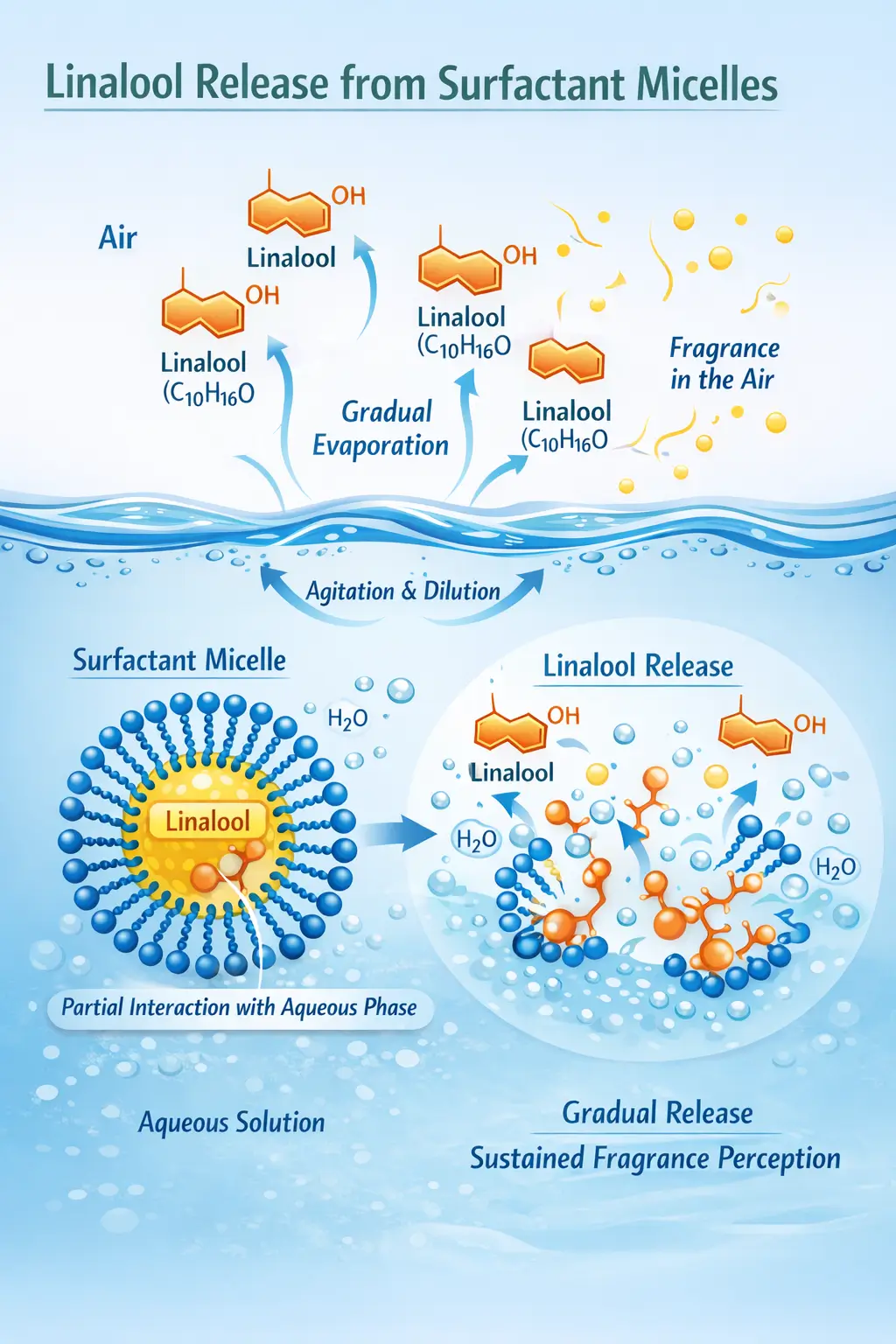
In practical formulation terms, it is dispersed within surfactant systems and released during use through evaporation, contributing to the perceived fragrance profile of the product.
This page is part of the CleanFormulation Ingredient Library, a research project analyzing ingredient behavior within real formulation systems rather than isolated descriptions.
Quick Facts
| Property | Description |
|---|---|
| Molecular Formula | C₁₀H₁₈O |
| Molecular Weight | 154.25 g/mol |
| Boiling Point | ~198–200°C (controls evaporation profile during use) |
| Flash Point | ~78–80°C (relevant for processing and storage stability) |
| LogP (Octanol-Water Partition) | ~2.8–3.0 (indicates moderate hydrophobic character) |
| Vapor Pressure | ~0.16 mmHg at 25°C (moderate volatility behavior) |
| Water Solubility | ~1.5 g/L at 25°C (limited, requires dispersion system) |
| Polarity Index | Low to moderate due to hydroxyl (-OH) group |
| Functional Group | Allylic alcohol (–OH group influences interaction behavior) |
| Refractive Index | ~1.460–1.465 (used in quality and purity checks) |
| Density | ~0.86 g/cm³ at 25°C |
| pH Contribution | Neutral (does not significantly alter formulation pH) |
| Oxidation Sensitivity | Oxidizes in presence of air and light forming peroxides |
| Typical Usage Level | ~0.05% – 1.5% depending on fragrance system design |
| Fragrance Note Position | Middle note (bridges top and base notes) |
| Evaporation Rate | Moderate (slower than limonene, faster than heavy aromatics) |
| Micelle Interaction | Partitions into micellar core with partial interface interaction |
| Thermal Stability | Degrades gradually above ~150°C under prolonged exposure |
| Photostability | Light-sensitive, requires controlled exposure in transparent systems |
| Compatibility With Systems | Compatible with surfactant blends, emulsions, and solvent-assisted systems |
Why This Ingredient Appears On Labels
Linalool appears on product labels because it is part of the fragrance system, either added directly or present within essential oil blends.
In many formulations, it is not introduced as a standalone material but exists within composite fragrance mixtures that contribute to overall scent character.
Regulatory frameworks require disclosure of specific fragrance components when present above defined thresholds, particularly in European cosmetic labeling systems.
From a formulation perspective, its presence indicates the inclusion of volatile aromatic compounds that influence scent perception rather than cleansing or structural performance.
Chemical Identity And Classification
Linalool is a monoterpene alcohol with the molecular formula C10H18O, belonging to the terpene-derived fragrance compound family commonly used in cosmetic and cleansing formulations.
It exists as two stereoisomers, which differ slightly in scent profile but share similar physical and chemical behavior in formulation systems.
Unlike hydrocarbon terpenes, the presence of a hydroxyl group gives it mild polarity, allowing slightly better interaction with aqueous systems compared to fully non-polar fragrance molecules.
Despite this, it remains largely hydrophobic and depends on surfactant systems for effective dispersion within water-based formulations.
This classification explains why it behaves differently from purely hydrocarbon fragrance compounds in terms of solubility, volatility, and system interaction.
Functional Role In Soap And Cleansing Systems
Linalool functions as a fragrance component that contributes to the middle-note structure of a formulation, influencing how scent develops and persists during use.
In contrast to highly volatile top-note compounds, it evaporates more gradually, providing continuity in fragrance perception after the initial application phase.
Within cleansing systems, its role is not related to surfactant performance, foam formation, or structural stability. Instead, it operates within the sensory layer of the formulation.
In liquid cleansers, it is dispersed within micellar systems, while in solid soap matrices, it is retained within the structure and released progressively upon contact with water.
- Fragrance continuity: extends scent perception beyond initial application
- Moderate volatility: slower evaporation compared to hydrocarbon terpenes
- Blending role: integrates with other fragrance components to create balanced profiles
From an observable standpoint, formulations containing it tend to maintain a more consistent scent during use rather than showing a rapid fade.
Ingredient Interaction Logic
Linalool interacts with formulation systems primarily through physical incorporation into surfactant structures rather than through reactive chemistry.
Within aqueous systems, it is solubilized inside micelles formed by anionic surfactants and amphoteric surfactants, allowing uniform dispersion despite low inherent water solubility.
The slight polarity introduced by its hydroxyl group allows somewhat more stable integration compared to fully non-polar fragrance hydrocarbons, but it still relies on formulation support.
Key interaction relationships include:
- Surfactants: enable dispersion and transport through micellar encapsulation
- Fragrance blends: works with other volatile and semi-volatile compounds to shape scent profile
- Solvent systems: assist in initial dissolution before incorporation
- Stabilizers: help maintain uniform distribution in liquid systems
Without proper surfactant or solvent support, phase separation may occur, leading to uneven fragrance distribution or visible instability.
This interaction logic determines whether the product maintains consistent scent perception or develops variability over time.
Phase Behavior And Physical Characteristics
Linalool exhibits low water solubility but slightly improved dispersion behavior compared to hydrocarbon terpenes due to its alcohol functional group.
It exists primarily in the oil phase of formulations and is incorporated into surfactant micelles or emulsified systems for stability.
Key phase characteristics include:
- Limited water solubility: requires surfactant-mediated dispersion
- Moderate volatility: slower evaporation than limonene-type compounds
- Partial polarity: allows slightly improved interaction with aqueous environments
- Temperature sensitivity: evaporation rate increases with heat and agitation
In liquid systems, it partitions between micellar structures and the surrounding phase, gradually releasing into the air during use.
In solid soap systems, release depends on surface dissolution and mechanical action, leading to a more controlled fragrance profile.
From a user-observable perspective, this results in a scent that persists slightly longer during washing compared to sharper, more volatile fragrance components.
Comparison With Related Fragrance Components
| Feature | Linalool | Limonene | Citral |
|---|---|---|---|
| Chemical Class | Terpene alcohol | Monoterpene hydrocarbon | Aldehyde mixture |
| Scent Profile | Floral, soft, slightly sweet | Citrus, sharp, fresh | Lemon, intense citrus |
| Volatility | Moderate | High | High |
| Water Interaction | Low solubility, slight polarity | Very low solubility, non-polar | Low solubility |
| Fragrance Role | Middle-note stabilizing component | Top-note volatile component | Top-note enhancer |
| Persistence | Moderate | Short-lived | Short-lived |
| Formulation Dependence | Requires surfactant dispersion | Requires surfactant dispersion | Requires surfactant dispersion |
| Stability | Moderate (oxidation sensitive) | Moderate (oxidation sensitive) | Lower stability |
Structural Limitations And Formulation Constraints
Linalool is sensitive to oxidation when exposed to air, light, and elevated temperatures. Over time, this can alter its scent profile and affect formulation consistency.
Although less volatile than hydrocarbon terpenes, it still does not provide long-lasting fragrance on its own and requires combination with other components for persistence.
Its low water solubility creates formulation challenges, requiring effective dispersion through surfactant or solvent systems to maintain uniform distribution.
In liquid systems, maintaining stability may depend on the presence of stabilizers, which help prevent separation and maintain consistent performance.
These constraints highlight that linalool functions best as part of a balanced fragrance system rather than as an isolated component.
Common Misunderstandings
- “It contributes to cleaning”
Linalool does not participate in cleansing mechanisms. Cleaning performance is determined by surfactants. - “It improves foam quality”
Foam behavior is controlled by surfactant structure and formulation design, not fragrance components. - “It acts as a stabilizer”
Although used alongside stabilizing systems, linalool itself does not provide structural stability. - “It remains after rinsing”
Due to its volatility, most of it evaporates during and after use, leaving limited residual presence.
Formulation References Using This Ingredient
Summary of Findings
- Classification: Linalool is a terpene alcohol used as a fragrance component in cleansing formulations.
- Primary Function: Provides floral scent characteristics and contributes to fragrance continuity.
- System Behavior: Requires surfactant systems for dispersion due to low water solubility.
- Interaction Logic: Exists within micellar structures and is gradually released during use.
- Limitations: Oxidation sensitivity and moderate volatility limit long-term persistence.
- Formulation Role: Sensory component rather than structural or cleansing contributor.