Alcohol Definition and Role in Formulation Systems
Alcohol refers to a group of organic compounds containing a hydroxyl functional group, widely used in cleansing formulations as solvents, carriers, and system modifiers.
In formulation systems, alcohol is not a single ingredient but a class that includes molecules such as ethanol, isopropanol, and fatty alcohols, each behaving differently depending on structure and chain length.
The role of alcohol in cleaning products is often linked to rapid evaporation and solvent action, while in structured systems like soap or shampoo, it influences texture, clarity, and ingredient distribution.
Rather than acting as a primary cleanser, alcohol modifies how other components interact, particularly between oil, water, and surfactant phases.
Interpretation: The presence of alcohol can make a formulation feel lighter and dry faster, but this effect is tied to evaporation rather than cleansing performance.
Quick Technical Overview
| Property | Description |
|---|---|
| Ingredient Type | Solvent and system modifier |
| Chemical Class | Alcohol functional group compounds |
| Functional Role | Solubilization, evaporation control, texture modification |
| Ionic Class | Non-ionic |
| Typical Use Context | Cosmetics, soaps, shampoos, deodorants, cleaning liquids |
Why Alcohol Appears on Ingredient Labels
Alcohol appears on ingredient lists because it functions as a solvent and system modifier, primarily influencing how different components remain dissolved, distributed, and stable within the formulation.
In cosmetic systems such as shampoos, it helps dissolve fragrance materials and maintain a clear, uniform phase. This prevents separation of less water-compatible components over time.
In deodorant formats, alcohol contributes to rapid spreading and evaporation, which affects how the formulation distributes across the surface and how quickly it transitions after application.
In cleaning liquids, it supports fast surface wetting and controlled evaporation, allowing the formulation to spread efficiently without prolonged residue.
Its presence on the label therefore reflects its role in maintaining formulation structure and phase behavior, rather than acting as a primary cleansing component.
Chemical Identity and Classification
The defining feature of alcohol compounds is the presence of a hydroxyl group attached to a carbon chain. This structural feature determines polarity and interaction behavior.
Short-chain alcohols such as ethanol are highly volatile and water-compatible, while long-chain fatty alcohols behave more like structural agents within emulsions.
The relationship between alcohol phenol and ether compounds lies in their functional groups, with alcohols distinguished by their hydroxyl functionality, influencing hydrogen bonding and solubility.
In formulation systems, this structural variation allows alcohols to operate across different roles, from solvent systems to structural modifiers.
Functional Role in Soap and Cleansing Systems
Alcohol in soap does not act as the primary cleansing component. That function remains with surfactants and soap salts, while alcohol modifies how the system behaves during processing and use.
In transparent or semi-transparent soap systems, alcohol contributes to clarity and structural uniformity by influencing how crystalline soap phases are formed and maintained.
In liquid cleansing systems, alcohol supports rapid spreading and surface wetting, enabling more uniform contact between the formulation and the application surface.
In shampoos and similar systems, alcohol ingredients in shampoo often assist in dissolving fragrances and actives, ensuring that these components remain evenly distributed.
Interpretation: Alcohol does not make a formulation clean better, but it changes how evenly and quickly the formulation spreads, dries, and maintains consistency.
Ingredient Interaction Logic in Formulations
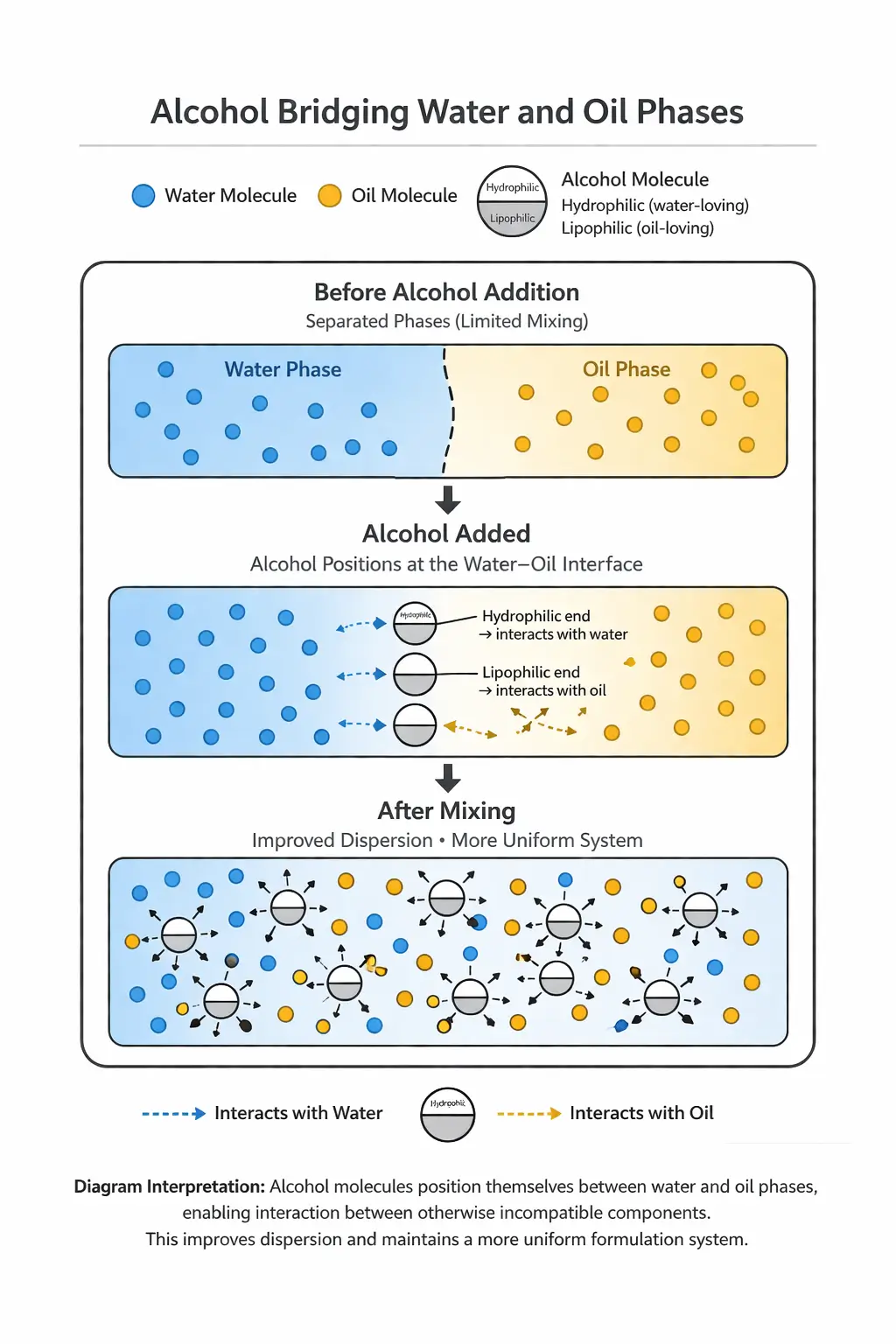
Alcohol functions as a bridge between components with different polarity characteristics. This makes it particularly important in systems where oil and water coexist.
In aqueous systems, alcohol improves the distribution of hydrophobic ingredients such as fragrance oils. This is especially relevant in formulations where fragrance clarity is required.
Interaction with water is central to its behavior. The alcohol in water reaction is not a chemical reaction in the traditional sense, but a physical interaction involving hydrogen bonding and molecular mixing.
This interaction allows alcohol to remain miscible with water while still interacting with less polar components, effectively acting as a mediator between phases.
- With water phase: Forms hydrogen-bonded mixtures enabling uniform distribution
- With surfactants: Modifies micelle environment and solubility conditions
- With fragrance: Enhances dispersion and reduces separation
- With humectants: Influences moisture retention dynamics
In systems like deodorants, alcohol in deodorant supports quick evaporation, which influences how the formulation behaves immediately after application.
Interpretation: Alcohol acts less like an active ingredient and more like a system organizer, helping incompatible components coexist within a stable formulation.
Phase Behavior and Solubility Characteristics
The solubility behavior of alcohol depends on its molecular structure. Short-chain alcohols are highly soluble in water, while long-chain variants exhibit reduced solubility and more structural behavior.
In liquid systems, alcohol contributes to phase uniformity by reducing interfacial tension between oil and water components. This allows for clearer and more stable solutions.
Evaporation is another defining characteristic. Volatile alcohols leave the system after application, which alters the formulation state during use.
This behavior is particularly relevant in cleaning liquids and deodorant systems, where rapid evaporation changes the surface condition shortly after application.
Comparison With Related Solvent Systems
Alcohols are often compared with other solvent systems used in cleansing and cosmetic formulations. While their roles overlap, their behavior within formulations differs significantly.
| Feature | Short-Chain Alcohols | Glycols | Fatty Alcohols |
|---|---|---|---|
| Chemical Nature | Small polar molecules | Diols with strong hydrogen bonding | Long-chain alcohols |
| Volatility | High | Low | Very low |
| Primary Role | Solvent and evaporation agent | Humectant and solvent | Structure and thickening |
| Water Interaction | Highly miscible | Highly miscible | Limited solubility |
| System Behavior | Rapid drying, dispersion support | Moisture retention, stabilization | Viscosity and texture control |
Interpretation: Alcohol behaves as a dynamic, fast-moving component within formulations, while glycols and fatty alcohols contribute more to structure and moisture retention.
Regulatory Context and Labeling Framework
Alcohol is listed in ingredient declarations using its specific INCI name, such as Alcohol Denat., Ethanol, or other structural variants depending on formulation type.
Within European cosmetic regulation frameworks, alcohol is not treated as a single category but as a group of substances evaluated individually based on structure and intended use.
Label placement reflects formulation concentration and function but does not indicate how it behaves within the system during use.
Different alcohol types may fall under different regulatory classifications depending on volatility, intended use, and formulation context.
Common Misunderstanding Around Alcohol in Formulations
A frequent misunderstanding is that all alcohols behave the same way within cosmetic and cleaning systems.
In reality, short-chain alcohols, glycols, and fatty alcohols differ significantly in structure and function. Grouping them together leads to incorrect assumptions about formulation behavior.
Another misconception is that alcohol contributes directly to cleansing. While it can assist in dissolving certain substances, it does not replace surfactants in removing oils and debris.
Interpretation: The term alcohol covers multiple distinct ingredient types, and understanding their structural differences is essential for interpreting formulation behavior correctly.
Structural and Formulation Limitations
Despite its versatility, alcohol introduces certain formulation constraints that must be managed carefully.
- Volatility: Rapid evaporation can alter system behavior after application
- Solubility boundaries: Not all components dissolve equally well even in alcohol systems
- System balance sensitivity: Excess levels can destabilize emulsions or affect viscosity
- Interaction dependence: Performance depends heavily on surrounding formulation components
These limitations highlight that alcohol functions best when integrated into a balanced formulation rather than used as a standalone system driver.
Interpretation: Alcohol simplifies formulation in some areas, but it also introduces dynamic changes that must be controlled through system design.
Product Formulation References Using This Ingredient
- Williams Sonoma Spiced Chestnut – Fragrance Structure
- Hibiclens Surgical Soap
- Charlie’s Soap Ingredients Analysis
- Nurture Soap Mica
- Williams Sonoma Soap & Lotion Sets
- Method Laundry Detergent Soap
- ECOS Soap Ingredients Analysis
- Sodium Lauryl Sulfate (SLS) Analysis
- Hibiclens (Chlorhexidine) Antiseptic Cleanser
- Method Hand Soap
Summary of Findings
- Classification: Alcohol represents a class of hydroxyl-containing organic compounds used as solvents and system modifiers
- Functional Role: Supports solubility, evaporation, and distribution rather than primary cleansing
- System Behavior: Influences drying time, clarity, and phase interaction in formulations
- Interaction Logic: Bridges polar and non-polar components within mixed systems
- Limitations: Volatility and system sensitivity require controlled formulation design