Phenolic refers to a class of aromatic compounds characterized by a hydroxyl group attached to a benzene ring, commonly used in cleansing and cosmetic formulations as antimicrobial-active components that influence microbial interaction within the system.
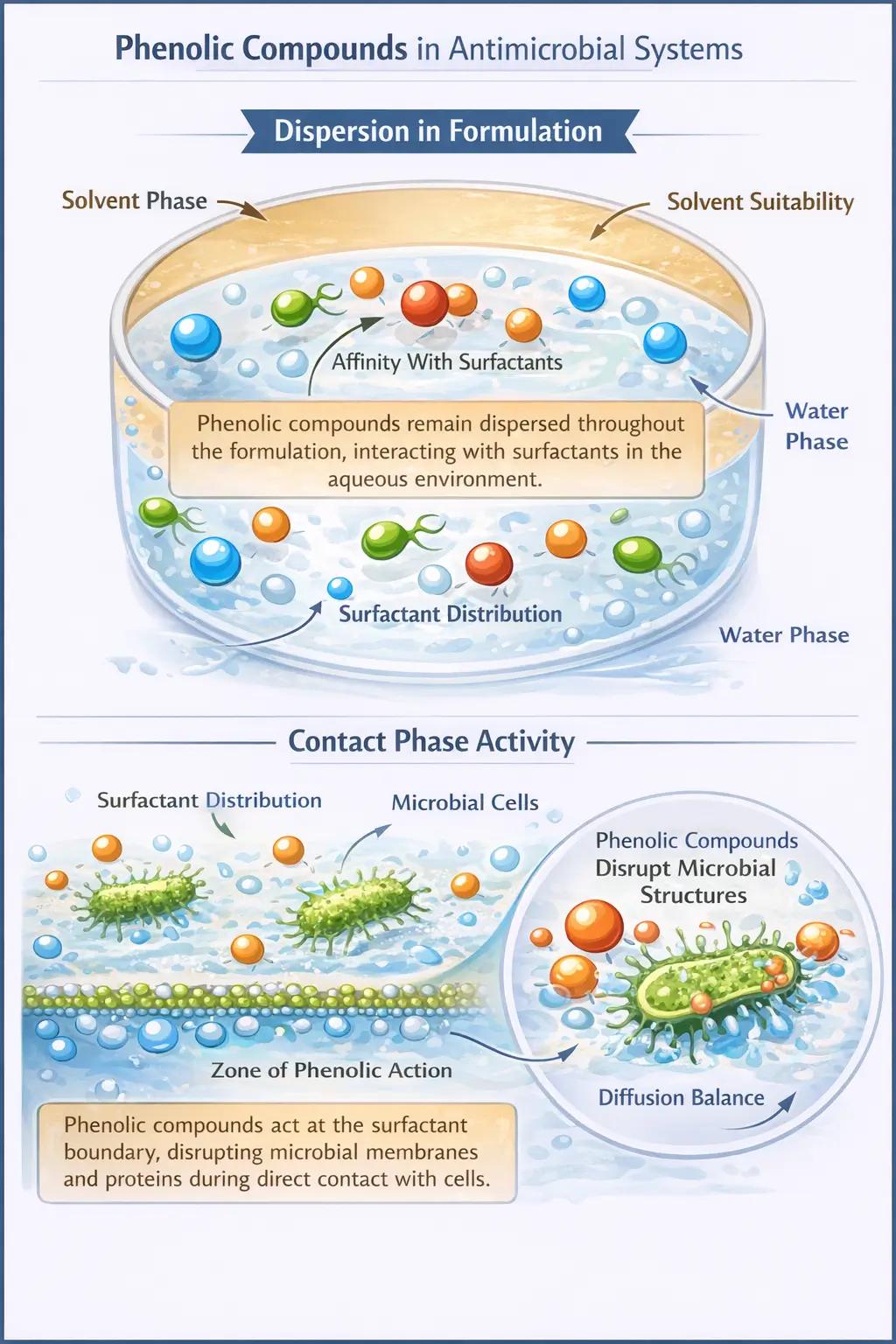
In soap and detergent systems, phenolic ingredients do not contribute to primary cleansing through surfactant action. Instead, they function within the formulation as active components that interact with microbial structures during the contact phase.
The classification of phenolic is based on its structural framework rather than a single molecule, meaning it represents a group of related compounds such as phenol, cresols, and other substituted derivatives.
Within formulation environments, these compounds are typically incorporated into systems designed for controlled interaction during washing, rather than structural or lather-forming roles.
Quick Facts
| Property | Description |
|---|---|
| Ingredient Type | Antimicrobial-active compound class |
| Chemical Class | Aromatic hydroxyl compounds |
| Functional Role | Microbial interaction, residue-phase activity |
| Ionic Class | Non-ionic |
| Typical Use Context | Antimicrobial cleansing systems, disinfectant formulations, hygiene-focused products |
Why This Ingredient Appears on Labels
Phenolic ingredients appear on product labels when a formulation includes components designed to interact with microorganisms during use. Their presence typically indicates that the formulation includes an active system beyond basic surfactant-driven cleansing.
These compounds are often included in formulations where the design requires interaction during the washing phase, particularly in systems positioned for hygiene or surface cleaning applications.
From a label interpretation perspective, the presence of phenolic suggests a formulation that integrates both cleansing and active interaction mechanisms, rather than relying solely on physical removal of soil.
Chemical Identity And Classification
Phenolic is not a single INCI ingredient name but a structural classification describing compounds that contain a hydroxyl group directly attached to an aromatic ring. Individual ingredients within this group are declared using their specific INCI names depending on the exact molecule used.
This class includes substances such as phenol, cresols, and substituted phenolic derivatives, each with variations in substitution pattern that influence solubility and interaction behavior within formulations.
From a molecular perspective, the aromatic ring provides structural stability, while the hydroxyl group enables limited interaction with aqueous environments. This dual nature allows phenolic compounds to interact with both lipid-like and aqueous phases to a certain extent.
Phenolic compounds are generally considered non-ionic, meaning their behavior in formulations is governed by molecular interactions rather than electrical charge.
In formulation practice, these materials are typically introduced in controlled concentrations as part of an active system rather than as bulk structural ingredients.
Functional Role In Soap Systems
Within soap and detergent systems, phenolic ingredients contribute through interaction mechanisms rather than surfactant-driven cleansing. Their role is associated with how the formulation interacts with microbial structures during the contact phase.
They are typically integrated into systems where cleansing and active interaction are combined. While surfactants remove soil and oils through micellar action, phenolic compounds operate alongside this process without directly contributing to lather formation or emulsification.
In bar soap systems, they do not contribute to hardness or structural integrity. In liquid systems, they do not significantly affect viscosity or foaming characteristics.
Their presence may influence how the formulation behaves during application, particularly in systems designed for targeted surface interaction.
Interpretation Layer: Products containing phenolic components may behave similarly to regular cleansing systems in terms of foam and spread, but their formulation intent extends beyond visible cleansing to interaction during the contact phase.
Ingredient Interaction Logic
Phenolic compounds operate within the formulation by interacting with other components rather than acting independently. Their behavior is influenced by the surrounding solvent system, surfactant environment, and overall formulation architecture.
In aqueous systems, their limited solubility requires compatibility adjustments, often through the use of solvents or surfactant systems that allow uniform distribution.
When combined with surfactant systems, phenolic ingredients do not become part of micelles but remain dispersed within the solution, enabling interaction during the washing process.
They may also interact with fragrance systems and other hydrophobic components, affecting how these materials distribute within the formulation.
Compatibility with the solvent phase plays a central role in determining how effectively phenolic compounds remain available during product use.
Phase Behavior And Physical Characteristics
Phenolic compounds typically exhibit limited water solubility, depending on their specific structure and substitution pattern. This characteristic requires formulation strategies that maintain uniform dispersion within aqueous systems.
They may exist in dissolved or partially solubilized states, depending on the presence of co-solvents or surfactants that modify the solvent environment.
In structured formulations, phenolic compounds do not form crystalline networks or structural matrices. Instead, they remain part of the dispersed phase, interacting dynamically during use.
Their stability is influenced by factors such as pH, temperature, and exposure to oxidizing conditions, which can alter their behavior within the formulation over time.
In multi-phase systems, their distribution depends on how effectively the formulation bridges aqueous and non-aqueous components.
Comparison With Related Ingredients
Phenolic materials are often discussed alongside other antimicrobial-active systems used in cleansing formulations. While they share functional intent, their interaction mechanisms and formulation behavior differ.
| Feature | Phenolic | Alcohol Systems |
|---|---|---|
| Chemical Structure | Aromatic ring with hydroxyl group | Short-chain aliphatic alcohols |
| Primary Role | Interaction with microbial structures | Solvent and evaporation support |
| Water Compatibility | Limited, requires formulation adjustment | Fully miscible with water |
| Formulation Position | Active component within system | Part of solvent phase |
| Behavior During Use | Acts during contact phase | Evaporates or redistributes |
This comparison highlights how different chemical classes contribute distinct roles within cleansing systems, even when they appear in similar product categories.
Regulatory Context
Phenolic ingredients are declared on product labels using their specific INCI names rather than the general class term. This ensures clarity in ingredient identification across regulatory systems.
Under European cosmetic regulation frameworks, ingredient disclosure follows standardized naming conventions and concentration-based listing order. These principles are explained in how to read ingredient list.
Depending on formulation positioning and claims, products containing phenolic compounds may fall under different regulatory categories, which are defined by intended use rather than chemical classification alone.
This distinction is part of broader regulatory interpretation covered in cosmetic vs drug classification.
Common Misunderstanding
A common misunderstanding is that phenolic ingredients replace surfactants in cleansing formulations.
In practice, surfactants remain responsible for removing dirt and oils, while phenolic components operate alongside them without contributing to lather or emulsification.
Another misconception is that all phenolic compounds behave identically. Structural variations between compounds can lead to different solubility and interaction characteristics within formulations.
Structural Limitations In Formulation
Phenolic compounds introduce formulation constraints that must be managed carefully.
Limited water solubility requires the use of compatible solvent systems or surfactant structures to maintain uniform distribution within the formulation.
Their stability can be affected by environmental factors such as pH and oxidation, which may influence long-term formulation consistency.
They do not contribute to structural properties such as viscosity or bar integrity, meaning additional formulation components are required to build product structure.
Interpretation Layer: While they add functional activity during use, they rely on the surrounding formulation system for stability, distribution, and overall performance balance.
Formulation References Using This Ingredient
Summary of Findings
- Classification: Phenolic refers to a class of aromatic compounds characterized by a hydroxyl group attached to a benzene ring.
- Functional Role: These compounds function as active components that interact with microbial structures during the cleansing process.
- Interaction Logic: Their behavior depends on compatibility with solvent and surfactant systems, which control distribution and availability.
- System Behavior: They remain dispersed within formulations and act during the contact phase rather than contributing to cleansing structure.
- Limitations: Limited solubility and sensitivity to formulation conditions require careful system design.