Definition
Amine Oxides are a class of amphoteric surfactants commonly used in cleansing systems, where they function as foam stabilizers, viscosity modifiers, and secondary surfactants supporting primary cleaning agents.
They are typically derived from tertiary amines that are oxidized to form a polar head group capable of interacting with both water and oil phases.
Within formulation systems, they do not usually act as the main cleansing agent but instead modify how other surfactants behave, especially in blended systems used in detergents, shampoos, and liquid cleansers.
This page is part of the CleanFormulation Ingredient Library, a research-based system analyzing how ingredients behave within real formulations rather than evaluating them in isolation.
Quick Facts
| Property | Description |
|---|---|
| Ingredient Type | Surfactant (secondary / co-surfactant) |
| Chemical Class | Amine oxide compounds |
| Functional Role | Foam stabilization, viscosity support, mild cleansing enhancement |
| Ionic Class | Amphoteric behavior depending on pH |
| Typical Use Context | Shampoo systems, liquid cleansers, detergent formulation system |
Why This Ingredient Appears on Labels
Amine Oxides appear on ingredient lists because they support the structural and performance balance of multi-surfactant systems. They are rarely the primary cleansing agent but are included to adjust how the system behaves during use.
In practical formulation, they help stabilize foam, improve consistency, and reduce harsh interaction patterns that may occur when only strong primary surfactants are used.
For consumers reading labels, their presence reflects a layered formulation approach rather than a single-ingredient cleaning mechanism. This becomes clearer when interpreting ingredient lists using guides such as how to read ingredient list.
They are commonly found in blended systems such as dishwashing liquid surfactant blend, where multiple surfactants interact to balance grease removal, foam behavior, and rinsing performance.
Chemical Identity and Classification
Amine Oxides are derived from tertiary amines that undergo oxidation, resulting in a molecule with a nitrogen atom bonded to an oxygen atom. This structure creates a polar head capable of interacting with water while maintaining compatibility with hydrophobic chains.
Their classification as amphoteric surfactants comes from their ability to behave differently depending on pH conditions. In neutral or alkaline environments, they function similarly to nonionic surfactants, while under acidic conditions they can exhibit cationic-like behavior.
Common examples include lauryldimethylamine oxide and cocamidopropylamine oxide, both widely used across cleansing systems categorized under cosmetic formulation systems.
From a formulation perspective, their identity is less about standalone performance and more about how they integrate into a broader surfactant architecture.
Functional Role in Soap Systems
Amine Oxides function primarily as secondary surfactants that modify how a cleansing system behaves rather than defining its core cleaning ability. Their contribution becomes most visible when combined with stronger primary surfactants such as anionic agents.
One of their most consistent roles is foam stabilization. While primary surfactants generate foam quickly, that foam can collapse rapidly or become unstable under dilution. Amine Oxides help maintain foam structure over time, especially in water-rich systems.
They also contribute to viscosity development. In liquid cleansers, especially those formulated as liquid and gel hand wash, their presence allows the formulation to achieve a thicker and more controlled flow without relying entirely on external thickeners.
In cleansing systems, they moderate interaction intensity between surfactants and surface soils. This does not reduce cleansing capability but alters how aggressively the system interacts with oils and residues.
From an observable standpoint, their inclusion often results in foam that feels denser and more stable during use, along with a smoother texture when the product is dispensed or spread.
Ingredient Interaction Logic
Amine Oxides rarely function independently. Their formulation relevance emerges through interaction with other components within a surfactant system.
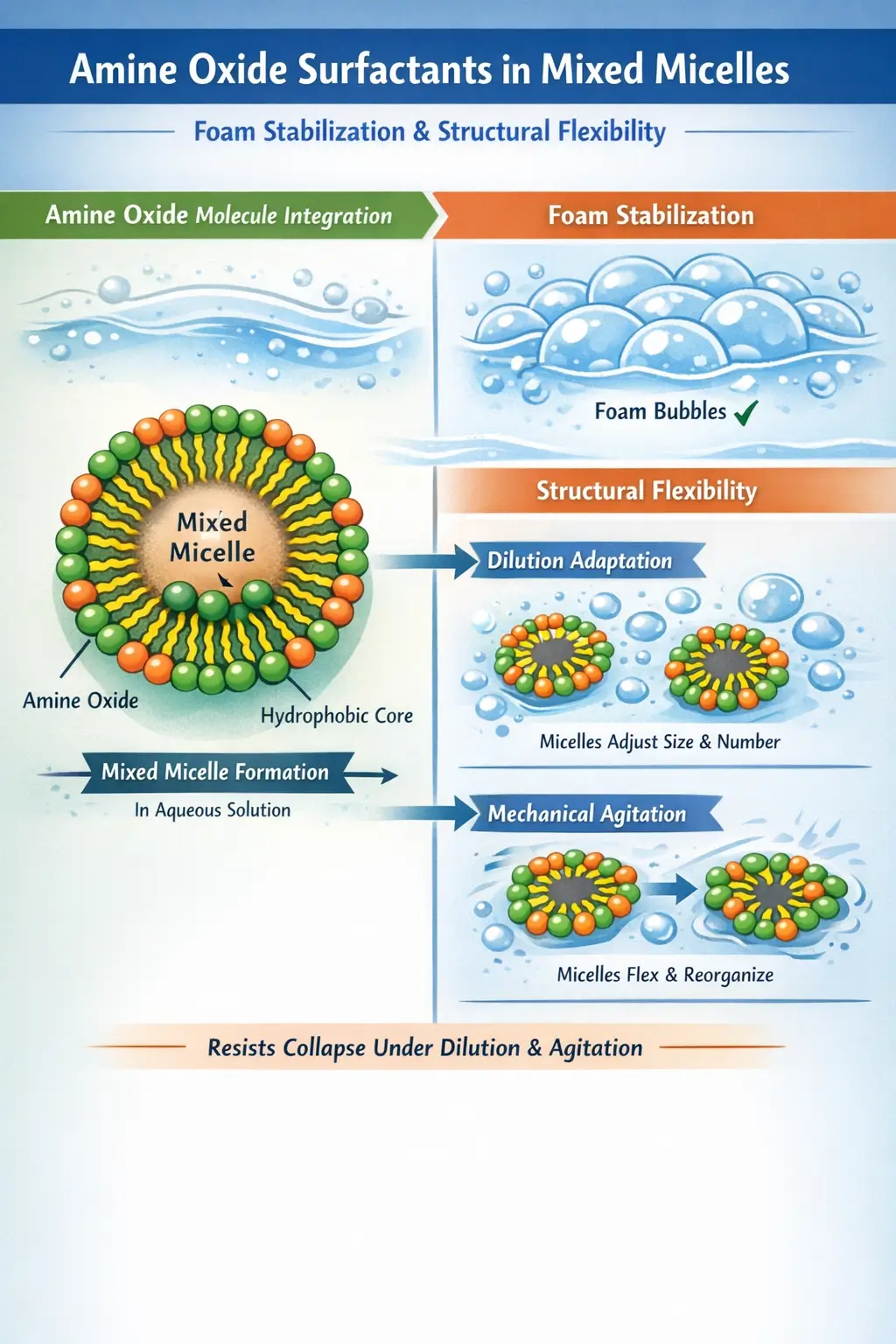
When combined with anionic surfactants, they form mixed micelle structures. This interaction changes how surfactant molecules organize in water, often leading to improved foam stability and more consistent cleaning behavior under dilution.
They also interact with water structure itself. Their polar head group participates in hydrogen bonding, which influences how the aqueous phase organizes around surfactant assemblies.
In systems containing fragrance components, their role extends into solubilization support. Fragrance materials, which are typically hydrophobic, require stabilization within the formulation. This interaction overlaps with broader concepts explained in fragrance function in cosmetic formulation, where surfactant systems help disperse aromatic compounds.
Amine Oxides also show compatibility with nonionic surfactants and certain amphoteric agents, creating flexible formulation systems that can adapt across different product formats such as shampoos, body cleansers, and surface cleaners.
At a system level, these interactions translate into more balanced formulations where foam, texture, and cleaning action remain consistent even when usage conditions change, such as dilution or agitation.
Phase Behavior
Amine Oxides are highly soluble in water and typically exist within the aqueous phase of a formulation. However, their behavior is closely tied to micelle formation rather than simple dissolution.
At sufficient concentration, they participate in micellar structures where hydrophobic tails align inward and polar heads interact with water. These structures are dynamic and respond to concentration, temperature, and the presence of other surfactants.
Unlike soap-based crystalline systems, they do not form rigid structural phases. Instead, they remain part of flexible colloidal systems that can shift between different micelle shapes such as spherical or elongated forms.
In formulations like dish soap surfactant system, this flexibility allows the product to maintain performance across varying dilution levels during washing.
pH also influences their behavior. Under acidic conditions, they can become more positively charged, altering how they interact with other surfactants and potentially changing viscosity and foam characteristics.
This dynamic phase behavior explains why formulations containing Amine Oxides often maintain stability and usability across a wide range of conditions rather than behaving as fixed or rigid systems.
Comparison With Related Ingredients
| Feature | Amine Oxides | Anionic Surfactants (e.g. SLS) |
|---|---|---|
| Primary Role | Secondary surfactant, system modifier | Main cleansing agent |
| Foam Behavior | Stabilizes and densifies foam | Rapid foam generation |
| Cleansing Contribution | Supportive, indirect | Direct removal of oils and soils |
| System Function | Enhances balance and consistency | Defines core cleaning mechanism |
| Interaction Pattern | Forms mixed micelles with other surfactants | Forms primary micelle structures |
Primary surfactants such as sodium lauryl sulfate surfactant define the main cleansing mechanism, while Amine Oxides adjust how that mechanism behaves during real use conditions.
Regulatory Context
Amine Oxides are regulated within cosmetic and cleaning product frameworks as functional surfactants rather than active agents. Their classification depends on product category, such as whether the formulation is considered a cosmetic cleanser or a household cleaning product.
Under EU cosmetic regulations, they are listed using their INCI names and must follow ingredient disclosure rules based on concentration order. This labeling structure is part of broader systems explained in soap labeling and related regulatory frameworks.
The distinction between cosmetic and non-cosmetic classification can influence how these ingredients are presented on labels, which connects to the broader topic of cosmetic vs drug classification.
From a formulation standpoint, regulatory context does not change how Amine Oxides behave chemically, but it does affect how their presence is communicated to users through labeling systems.
Common Misunderstanding
A frequent misconception is that Amine Oxides act as primary cleaning agents because they are listed among surfactants on ingredient labels.
In reality, they function as supporting components within a multi-surfactant system. Their role is not to replace primary surfactants but to adjust system behavior, including foam structure and formulation stability.
This misunderstanding often arises when ingredient lists are interpreted without context. Resources such as ingredient list interpretation guide help clarify how different components contribute differently within the same formulation.
Recognizing this distinction helps explain why formulations rarely rely on a single surfactant and instead use combinations to achieve balanced performance.
Structural Limitations
Amine Oxides have functional constraints that limit their use as standalone surfactants. Their cleansing strength is generally lower compared to primary anionic surfactants, which means they cannot independently deliver strong soil removal in most applications.
Their performance is also dependent on system composition. Without compatible co-surfactants, their ability to stabilize foam or influence viscosity is significantly reduced.
pH sensitivity introduces another limitation. Because their ionic behavior shifts depending on pH, formulation conditions must be controlled to maintain consistent performance.
Additionally, while they improve foam stability, excessive reliance on them can lead to overly dense or persistent foam that may not rinse efficiently in certain systems.
These limitations reinforce their role as system modifiers rather than primary functional drivers within cleansing formulations.
Formulation References Using This Ingredient
Summary of Findings
- Classification: Amine Oxides are amphoteric surfactants derived from oxidized tertiary amines.
- Functional Role: They act as secondary surfactants that stabilize foam, influence viscosity, and support system balance.
- Interaction Logic: Their performance depends on interaction with other surfactants, forming mixed micelle systems.
- Phase Behavior: They exist within flexible micellar structures rather than rigid phases, adapting to dilution and pH.
- System Boundaries: They cannot function effectively as primary cleansing agents and require integration into multi-component formulations.