Black Soap Ingredients & Benefits: A detailed, evidence-oriented examination of the raw and commercial formulations grouped under "black soap" (West African black soap, Dudu-Osun style bars, Moroccan black soap / savon noir, and modern shea-enriched variants). This resource explains what these soaps are made of, how they are produced (saponification chemistry), ingredient INCI interpretations, functional tables, composition ranges, pH and skin impact notes, environmental considerations, and common misconceptions - all written from a chemical ingredient researcher perspective.
Typical Ingredients
| Ingredient / Component | Primary Functional Role | Status After Processing |
|---|---|---|
| Elaeis Guineensis (Palm) Oil | Triglyceride lipid source providing palmitic and oleic fatty acids that influence soap hardness and cleansing behavior. | Undergoes saponification with alkali to form sodium or potassium palmate-type soap salts and glycerol. |
| Palm Kernel Oil | Lipid source rich in lauric and myristic fatty acids that enhance lather and cleansing strength. | Converted through saponification into laurate and myristate soap salts that remain as the primary cleansing surfactants. |
| Butyrospermum Parkii (Shea) Butter | Plant butter contributing oleic and stearic fatty acids that influence creaminess and conditioning properties. | Saponifies with alkali to produce potassium or sodium stearate/oleate soap salts along with naturally generated glycerol. |
| Olea Europaea (Olive) Fruit Oil | High-oleic triglyceride oil commonly used in Moroccan black soap pastes to provide mild cleansing and emollient character. | Converted during saponification into oleate-rich soap salts that remain dissolved or dispersed in the finished soap matrix. |
| Plantain Peel Ash (Plant Ash Lye) | Traditional alkali source containing potassium carbonate and related alkaline salts used to initiate saponification. | Dissolves to produce alkaline solution that reacts with triglycerides, forming potassium fatty-acid salts in the finished soap. |
| Cocoa Pod Ash | Mineral ash providing alkaline potassium salts and contributing to the dark color of traditional black soap. | Provides alkali during saponification and may leave trace mineral residues within the cured soap matrix. |
| Potassium Hydroxide | Standardized alkali used in modern formulations to control the saponification of plant oils. | Reacted during soapmaking to produce potassium fatty-acid salts and glycerol; minimal free alkali remains after completion. |
| Sodium Hydroxide | Alternative mineral alkali used in commercial black soap bars to produce firmer sodium soap structures. | Fully reacts with triglycerides during saponification to produce sodium fatty-acid salts that form the solid soap matrix. |
| Activated Charcoal | Carbon-based additive used as a colorant and mild particulate adsorbent. | Remains physically dispersed within the soap structure without chemical transformation. |
| Honey (Mel) | Natural sugar-rich ingredient contributing humectancy and minor conditioning properties. | Remains dispersed in small quantities and may contribute hygroscopic behavior within the finished soap. |
| Glycerin | Humectant produced naturally during saponification of triglyceride oils. | Remains dissolved within the soap matrix, contributing moisture retention and mildness. |
| Fragrance / Essential Oils | Aromatic additives such as lavender or citrus oils providing scent and sensory character. | Remain dispersed within the finished soap and may gradually volatilize during storage. |
| Water (Aqua) | Processing solvent used to dissolve alkali and facilitate the saponification reaction. | Partially evaporates during curing; remaining water contributes to the final moisture content of the soap. |
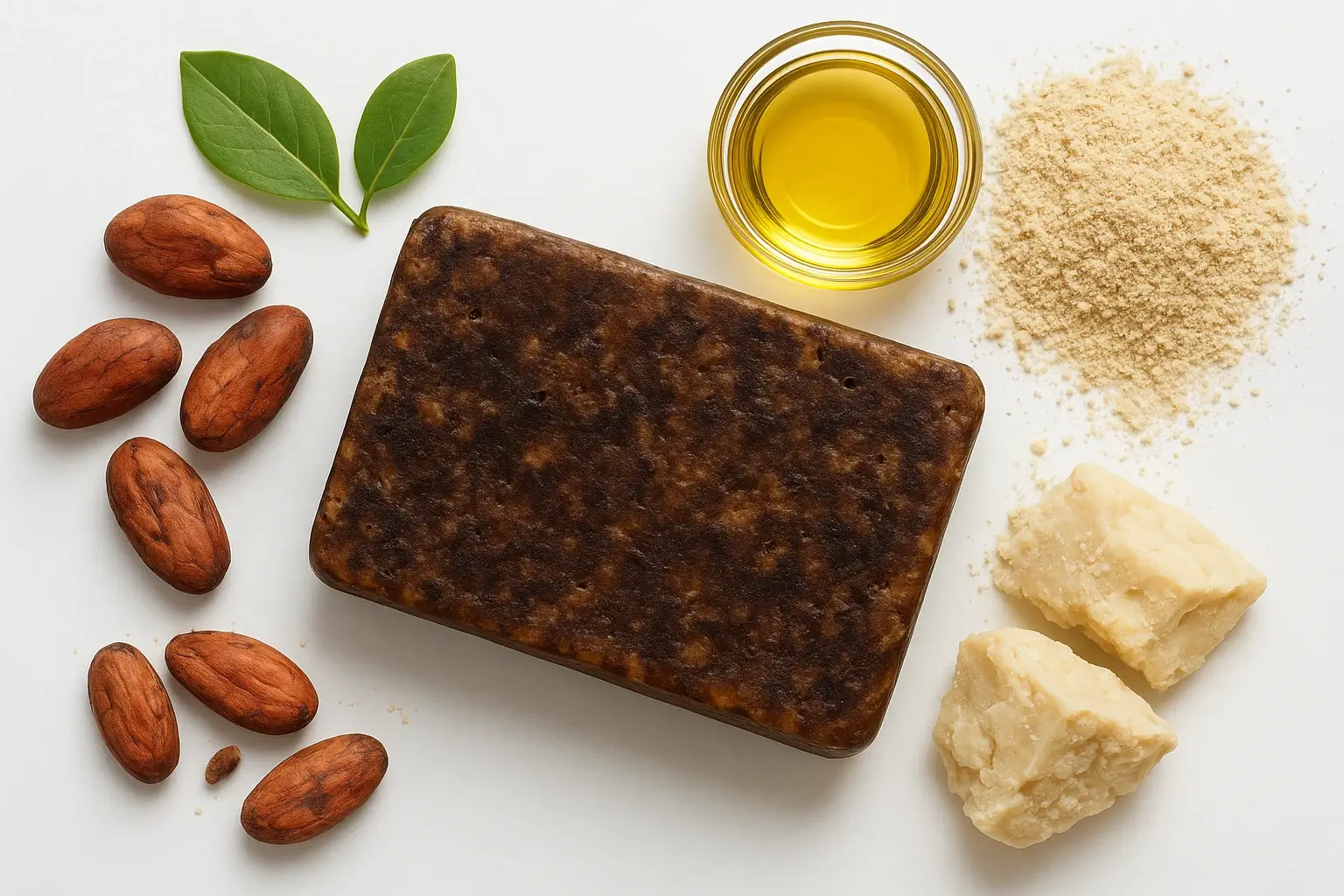
In Simple Terms
"Black soap" is a broad designation for a group of dark-colored cleansing bars or pastes traditionally made from plant fats and alkaline ash extracts (or, in Moroccan variants, olive oil and black-olive-based pastes). The common thread is saponified lipids combined with alkaline agents derived from plant ash or mineral alkali, producing a brown-to-black product with cleansing and mild exfoliating properties depending on the raw ingredients and processing.
Origin & Brief History
Black soap traces historical roots to multiple regions with distinct traditions:
- West Africa: Traditional "African black soap" (commonly associated with regions of Ghana and Nigeria) was produced by indigenous makers using locally available oils (palm kernel, palm oil, cocoa pod fat, shea) combined with alkaline extracts from burnt plantain skins, cacao pod husks, or other plant material. The resulting product is often called "Alata Samina" (Yoruba) or simply black soap.
- Nigeria (Dudu-Osun tradition): Dudu-Osun is a popular branded-style black soap, inspired by traditional formulations and often including additional botanicals like lime rind, honey, or fragrance, similar to the formulation patterns examined in the Alaffia black soap analysis.
- North Africa (Savon Noir / Moroccan Black Soap): In Morocco, black soap (savon noir or savon beldi) is a paste primarily based on olive oil and black olives processed into a dark, viscous cleansing paste used for hammam exfoliation.
These traditions evolved independently but overlap in the use of locally sourced oils and alkaline agents to produce saponified cleansing products.
How It Is Made (Chemistry + Saponification)
At its core, black soap production relies on saponification: the base chemical reaction where triglyceride oils react with an alkali to form glycerol and soap (the sodium or potassium salts of fatty acids). For a structured explanation of traditional alkali reactions, see our cold process soap ingredient analysis.
Key Chemical Steps
- Selection of Lipids: Oils and butters (palm, palm kernel, shea, cocoa, olive) provide triglycerides with varying fatty-acid profiles (lauric, myristic, palmitic, oleic, stearic, etc.).
- Preparation of Alkali: Traditional formulations often use plant ash lye (aqueous extract of burnt plantain peels, cocoa shells, or wood ash), which contains potassium carbonate and related alkaline salts. Commercial adaptations may use sodium hydroxide (NaOH) or potassium hydroxide (KOH) to control saponification more precisely.
- Saponification Reaction: Triglyceride + Alkali → Soap (fatty-acid salt) + Glycerol. The stoichiometry and reaction conditions determine whether the final bar contains residual free oils or is a "hard" fully saponified soap.
- Additives & Processing: Botanical extracts, clays, activated charcoal, honey, essential oils, or powdered herbs may be incorporated. Heat, mechanical stirring, and curing time affect microstructure, moisture content, and mildness.
Chemical Notes
Using plant-ash lye (potash) tends to produce softer, more potassium-rich soaps (potassium salts are more soluble), while NaOH produces firmer sodium salts. Traditional black soap may therefore be softer and more paste-like depending on alkali source. The presence of unreacted ash particulates, charred plant residue, or mineral salts also contributes to the characteristic dark color and texture.
Forms / Types
"Black soap" is an umbrella term that covers a range of formats:
- Raw West African Black Soap (Bar or Chunk): Often handmade, variable texture, contains plant ash particulates and unrefined oils.
- Commercial Dudu-Osun Style Bars: Branded formulations inspired by traditional recipes; may include standardized shea content, fragrances, and botanical extracts.
- Moroccan Black Soap / Savon Noir: A viscous, olive-based paste used primarily as a body cleanser and exfoliant in the hammam ritual.
- Refined Sheabutter-Enriched Black Soaps: Modern variants that deliberately add shea butter for emolliency and consistency.
Ingredient Transparency & Full INCI Interpretation
This section outlines typical ingredient lists across the major black soap variants and explains INCI nomenclature where appropriate. Note: traditional handmade soaps may list local common names rather than INCI; the table bridges both systems.
Representative INCI-Style Lists
The following lists represent common ingredients; exact formulations vary by maker and brand.
| Common Ingredient | Typical INCI Label | Role |
|---|---|---|
| Plantain Peel Ash Lye | Potassium Carbonate / Potassium Hydroxide (variable) | Alkali for saponification (traditional) |
| Palm Oil | Elaeis Guineensis (Palm Oil) | Triglyceride source; contributes palmitic/stearic acids (hardness) |
| Palm Kernel Oil | Palm Kernel Oil | High lauric/myristic content; increases lather and cleansing |
| Shea Butter | Butyrospermum Parkii (Shea) Butter | Emollient; contributes oleic/stearic fatty acids |
| Cocoa Pod Ash | Potassium Compounds, Mineral Residue | Provides alkaline salts and colorant |
| Olive Oil | Olea Europaea (Olive) Fruit Oil | Primary lipid in Moroccan black soap; yields oleate-rich soaps |
| Activated Charcoal | Charcoal Powder | Adsorbent and colorant; mild exfoliant in small amounts |
| Essential Oils / Fragrance | Lavandula Angustifolia (Lavender) Oil / Parfum | Scent; may contribute minor functional attributes |
| Honey | Mel | Humectant and humectancy support (trace) |
When reviewing commercial product labels (e.g., shea-enriched bars), you will typically see standardized INCI declarations. For raw artisanal black soap, local names may appear, and INCI mapping requires translation to the botanical/chemical names above.
Key Characteristics + pH Notes (Non-Medical)
Color and Texture: Characteristic dark brown to black color results from carbonized plant residues, oxidized polyphenols from oils, and mineral salts from ash. Texture ranges from crumbly bar to soft paste depending on alkali and curing. Alkalinity and skin interaction are discussed more broadly in our soap ingredients master guide.
Foaming Profile: The foam and lather depend on fatty-acid composition. Palm kernel oil increases quick, bubbly lather (lauric/myristic acids), while olive and shea provide creamier, lower-volume lather (oleic/palmitic acids).
Typical pH: Saponified soaps are typically alkaline. Fully saponified sodium soaps often have a pH in the range of about 9–11. Traditional black soaps made with potash and unrefined methods can vary more widely, sometimes slightly lower if excess free fatty acids or glycerin remain. Moroccan savon noir (potassium-rich paste) may be formulated for bath use and can be milder to touch; however, expect pH values generally in the alkaline range rather than neutral.
Solubility and Residue: Potassium salts are more soluble, producing softer, more paste-like products, while sodium salts yield harder bars.
Fatty-Acid / Chemical Composition Tables
Because black soap recipes vary, the following tables present representative fatty-acid ranges for common lipid choices used in black soap. These ranges are typical for the raw oils and influence cleansing, lather, and mildness. Fatty-acid behavior differences are examined further in our Aleppo soap ingredient analysis.
Fatty-Acid Ranges of Common Lipids
| Lipid | Lauric | Myristic | Palmitic | Stearic | Oleic | Linoleic |
|---|---|---|---|---|---|---|
| Palm Kernel Oil | ~45–55% | ~14–20% | ~8–12% | ~2–5% | ~10–18% | trace–3% |
| Palm Oil | trace | ~1–3% | ~40–45% | ~4–10% | ~35–45% | ~8–10% |
| Shea Butter | trace | ~1–3% | ~25–45% | ~3–10% | ~40–60% | ~5–10% |
| Olive Oil | trace | trace | ~7–20% | ~1–3% | ~55–83% | ~3–21% |
Interpretation: High lauric/myristic content (palm kernel) yields faster cleaning and bubbly foam. High oleic content (olive, shea) yields conditioning, creamier lather and a gentler feel. The final product’s behavior is determined by the blended fatty-acid profile after saponification. Palm-derived formulation differences are also examined in our Kirk’s soap ingredient analysis.
Ingredient-Function Tables
| Ingredient Class | Examples | Primary Function |
|---|---|---|
| Triglyceride Oils | Palm, Palm Kernel, Shea, Olive | Provide fatty acids for saponification; similar to lipid sources such as animal fats, these materials determine hardness, lather, and conditioning behavior. |
| Alkali Source | Plant Ash (potash), NaOH, KOH | Enable saponification; the nature of alkali controls bar hardness and solubility, consistent with the plant-derived classifications outlined in vegan soap ingredients. |
| Botanical Additives | Plantain Peel, Cocoa Pod Powder, Clays, Charcoal | Colorant, mild mechanical exfoliation, mineral content, subtle pH modification. |
| Humectants | Glycerin (natural byproduct), Honey | Attract and retain moisture on the skin. |
| Fragrance / Essential Oil | Lavender Oil, Citrus Peel Oil | Sensory; minimal functional effect on saponification. |
Ingredient Ranges, Ratios & Percentages (Estimated)
Exact recipes are variable. The ranges below present typical proportions used across representative black soap formulations (handmade and commercial approximations):
| Component | Typical Range (% by Weight) | Notes |
|---|---|---|
| Palm Oil | 20–50% | Hardness / lather contribution; higher in bar-type recipes. |
| Palm Kernel Oil | 10–30% | Boosts lather and cleansing; used variably. |
| Shea Butter | 5–20% | Conditioning and creaminess; common in shea-rich variants. |
| Olive Oil (Moroccan paste) | 60–90% (paste formulas) | Dominant lipid in savon noir; yields a soft paste rather than hard bar. |
| Plant Ash / Alkali | Variable; enough to saponify oils (stoichiometric) | Traditional potash quantities produce potassium salts; modern recipes convert to equivalent NaOH/KOH calculations. |
| Botanical Additives | 1–10% | Herbs, powdered husks, activated charcoal - used sparingly for effect. |
| Water | 10–30% | Processing solvent; lower in cured bars. |
Important: The alkali quantity is calculated to saponify the triglycerides. Process variations determine residual free oils and glycerin content.
Comparison Tables (Technical Differences)
| Attribute | West African Black Soap | Dudu-Style Commercial Bars | Moroccan Savon Noir |
|---|---|---|---|
| Primary Alkali | Plant Ash (potash) | NaOH or standardized KOH equivalents | Potassium salts from olive processing or added alkali |
| Dominant Lipid | Palm / Palm Kernel / Shea blend | Shea-enriched blends | Olive oil (oleic-rich) |
| Texture | Bar / Chunk (crumbly to firm) | Consistent bar | Viscous paste |
| Usage | Face & body cleanser, general use | Retail personal care | Hammam body paste and exfoliant |
For a detergent-based contrast, see our Dawn dish soap ingredient review.
Manufacturing Transparency
Traditional small-scale producers often use locally sourced oils and ash without standardized INCI declarations. Commercial manufacturers list INCI and may provide safety, allergen, and origin statements. For consumers seeking transparency:
- Read INCI labels for botanical and oil declarations (e.g., Butyrospermum Parkii for shea).
- Look for "saponified oils" vs. raw oil listings - "saponified" indicates a finished soap product rather than raw triglyceride addition.
- Check for declared preservatives or added glycerin in commercial bars, which can affect mildness.
Where possible, manufacturers should disclose whether alkali was derived from plant ash (potassium compounds) or standardized NaOH/KOH to help users understand product behavior (hardness/solubility differences).
Practical Understanding Guidance
How to interpret the chemistry when choosing and using black soap:
- Expect variation: Handmade black soap from village producers can differ markedly batch-to-batch; commercial bars usually offer consistent INCI lists.
- Patch test new formulations: Because botanical additives and preservative choices vary, test small skin areas if you have sensitive skin.
- Use as intended: Moroccan savon noir is formulated as a paste for wet exfoliation; it behaves differently from bar soaps.
- Storage: Soft or paste-like black soaps benefit from dry, ventilated storage to avoid excess softening or microbial growth in very moist conditions.
- For hands: Soaps with higher lauric content clean quickly but may dry skin more; bars with higher oleic content are comparatively conditioning.
Environmental Notes
Traditional black soap production can be locally sustainable when it relies on locally sourced shea, palm, and agricultural residues; however, environmental impacts depend on the upstream sourcing:
- Palm Oil Concerns: Large-scale palm cultivation has recognized environmental issues where not managed sustainably. Choosing products that disclose sustainable sourcing can mitigate this risk.
- Biodegradability: Saponified fatty-acid salts are typically biodegradable. Plant ash derived alkali and botanical residues generally pose low environmental persistence compared to synthetic polymers.
- Local Economies: Traditional soapmaking often supports local economies and smallholder producers; transparency about sourcing and fair trade practices is valuable.
Safety, Irritation Potential, and Sensitization Notes
Toxicity: Saponified soaps are not inherently toxic; however, concentration, pH, and specific botanical additives determine irritancy. Ingestion of soap in large quantities can cause gastrointestinal upset; eye contact may cause irritation. This section does not provide medical advice. Comparable irritation discussions appear in our Dove Sensitive Skin ingredient analysis.
Oil-Based Consideration: Black soaps are oil-derived (lipid feedstocks) but the final product contains fatty-acid salts (soap) and glycerin, not the original triglyceride forms. The term "oil-based" in a marketing sense indicates the presence of plant oils or butters in the recipe rather than implying oil residue after use.
Allergy and Sensitization: Botanical additives and essential oils can be sensitizers for some people. Common sensitizers include citrus peel essential oils and certain preservatives used in commercial adaptations. If you have known allergies, inspect INCI listings or consult a qualified professional.
Skin Friendliness: The conditioning quality correlates with fatty-acid profile (higher oleic content is generally more conditioning). Glycerin content (natural byproduct of saponification) enhances mildness. However, alkaline pH means some users prefer to follow cleansing with moisturizers.
Myths Vs Reality
- Myth: All black soaps are identical.
Reality: There is wide variability - from olive-paste savon noir to palm/potash bars; chemistry dictates differences in usage and feel. - Myth: Black soap is always harsh.
Reality: Formulation matters. Some black soaps are softened with high-oleic oils and naturally occurring glycerin, making them relatively gentle. - Myth: Raw plant ash is "dirty" and unsafe.
Reality: Properly prepared ash lye is an alkaline solution that, when processed and cured, yields saponified products; cleanliness depends on manufacturing practices.
Short Q&A
Q: What distinguishes Moroccan black soap from West African black soap?
A: Moroccan savon noir is typically an olive-oil derived viscous paste used in hammam rituals, while West African black soap is usually a bar made from palm/palm kernel/sheabutter blends and plant ash lye.
Q: Is shea-rich black soap better for dry skin?
A: Shea increases oleic content and emolliency; black soaps enriched with shea tend to feel more conditioning than lauric-heavy formulations, but user response varies.
Q: Are raw black soap ingredients natural?
A: Traditional ingredients are plant-based; modern commercial preparations may include refined oils, standardized alkali, and approved additives for stability, a distinction that contrasts with mineral- and extract-positioned products discussed in the Himalayan healing soap guide.
Summary
Black soap is a diverse family of saponified, plant-based cleaning products. Scientific understanding of their behavior relies on the fatty-acid profile of the lipids used and the nature of the alkali. Traditional recipes (plant ash potash + local oils) yield characterful soaps with variable texture and composition. Commercialized and branded variants standardize ingredients and list INCI names, improving transparency. When assessed from a chemistry viewpoint, black soap variants range from high-lather, quick-cleansing bars to olive-oil based pastes designed for hammam exfoliation. Environmental and safety considerations depend on sourcing, processing, and added botanicals rather than the term "black soap" alone.
References
-
Gunstone, F. D. (2011).
The Lipid Handbook (3rd ed.). CRC Press.
CRC Press Publisher Page -
INCI Dictionary & Cosmetic Ingredient Nomenclature.
EU CosIng Database -
OECD Chemicals Safety & Risk Assessment Portal.
OECD Official Portal -
HERA Project – Household Cleaning Product Risk Assessment.
HERA Project Documentation