Palm Kernel Oil Definition and Role in Cleansing Systems
Palm Kernel Oil is a vegetable triglyceride oil derived from the kernel of the oil palm fruit and functions primarily as a cleansing and lather-generating precursor in soap and surfactant systems. It is chemically distinct from palm oil, despite originating from the same plant.
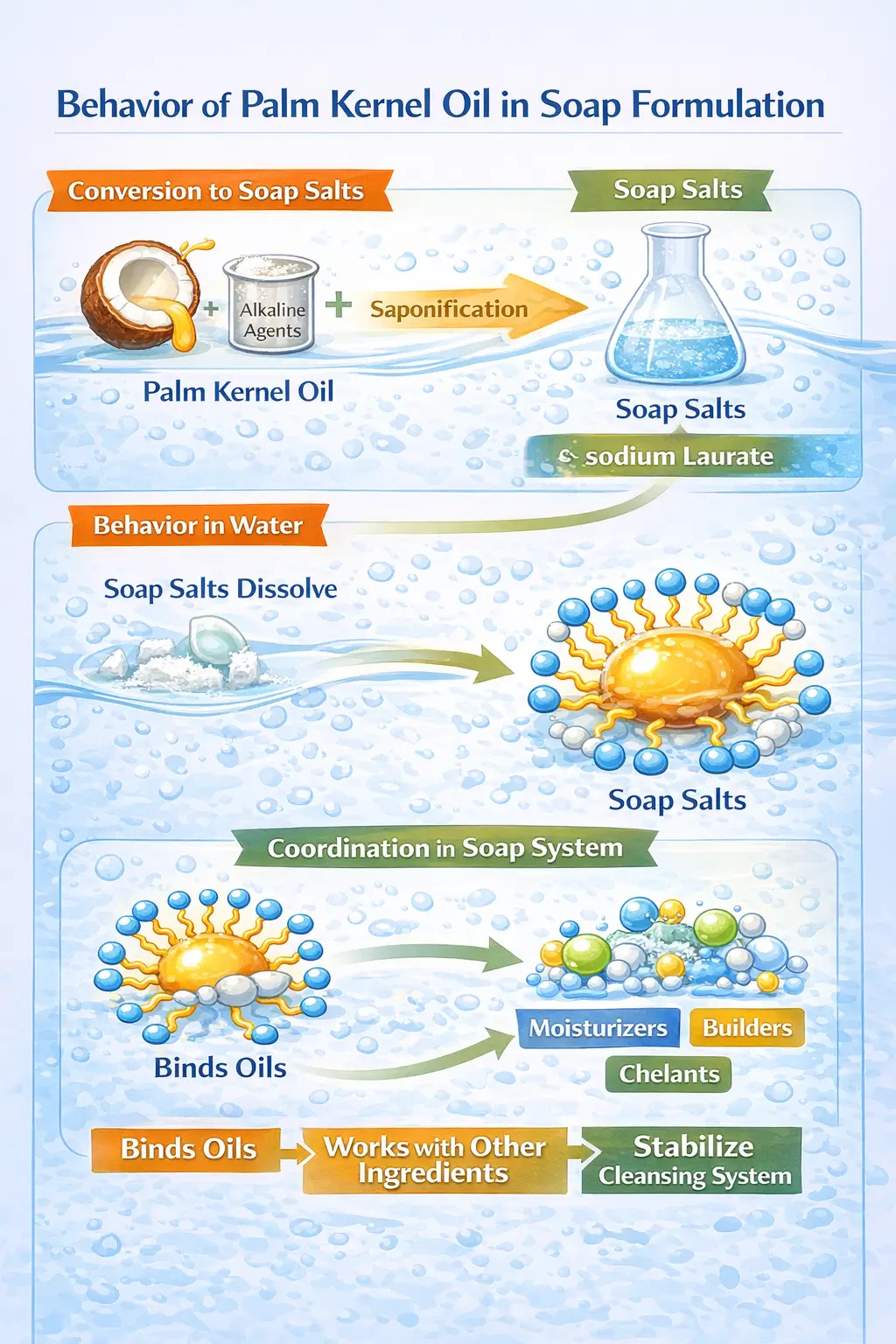
Within formulation systems, it is not a surfactant itself but serves as a raw material that is converted into soap salts or surfactant intermediates through chemical processing.
Its fatty acid profile is dominated by shorter-chain saturated components, which influence how the resulting system behaves during washing.
In observable terms, formulations containing derivatives of this oil tend to produce faster foam, stronger initial cleansing and quicker solubility compared to oils with longer-chain fatty acid profiles.
This page is part of the CleanFormulation Ingredient Library, a research-based system documenting how ingredients behave within real soap, detergent and cosmetic formulations.
Quick Formulation Facts
| Property | Description |
|---|---|
| Ingredient Type | Vegetable oil |
| Chemical Class | Triglyceride (fatty acid ester) |
| Primary Function | Cleansing precursor, foam generation |
| Ionic Character | Non-ionic (before conversion) |
| Typical Use Context | Soap making, surfactant production, cleansing systems |
| Fatty Acid Profile | High in lauric and myristic acids (medium-chain saturated fatty acids) |
| Saponification Role | Reacts with alkali to form sodium or potassium fatty acid salts (soap base) |
| Cleansing Strength | High due to strong solubilization of oils and soils |
| Foam Behavior | Produces quick, high, and stable lather |
| Solubility Contribution | Improves soap solubility and faster dissolution in water |
| Hardness Contribution | Moderate bar hardness, often balanced with longer-chain fats |
| Interaction with Water Hardness | Forms insoluble salts with calcium and magnesium, contributing to soap scum |
| Chain Length Characteristics | Dominated by C12–C14 fatty acids influencing rapid cleansing action |
| Role in Syndet Systems | Serves as feedstock for fatty alcohol and surfactant production |
| Processing Behavior | Melts easily and integrates uniformly during formulation |
| Oxidative Stability | Relatively stable due to saturated fatty acid composition |
| Residue Behavior | May leave residue in hard water without chelating agents |
| Skin Interaction Profile | Strong cleansing can reduce skin lipids if used in high proportion |
| Compatibility | Compatible with other oils to balance hardness, lather, and mildness |
| Formulation Position | Core structural lipid in traditional soap systems |
Why Palm Kernel Oil Appears on Ingredient Labels
Palm Kernel Oil appears on ingredient lists because it acts as a foundational raw material in many cleansing formulations. It may be present either in its original triglyceride form or as part of a converted system such as soap salts or surfactant derivatives.
In bar soap formulations, it contributes to the fatty acid composition that determines cleansing strength and lather behavior. In liquid systems, it is more commonly used indirectly through processed derivatives that function within surfactant systems.
Its presence on labels reflects formulation design choices related to performance, rather than a direct indication of how the ingredient behaves in isolation.
Chemical Identity and Classification
Palm Kernel Oil is a triglyceride composed of glycerol esterified with a mixture of fatty acids. It belongs to the broader class of vegetable oils used as structural precursors in soap and cleansing formulations.
Its INCI representation typically reflects either the oil itself or its derived fatty acid components depending on formulation context. Unlike finished cleansing agents, the oil remains chemically non-surface-active until it undergoes conversion.
During processes such as reaction with alkaline agents, the triglyceride structure is broken into fatty acid salts and glycerol, forming the basis of traditional soap systems.
This transformation defines its role as a precursor rather than an active cleansing ingredient in its original state.
Fatty Acid Composition and Structural Behavior
The behavior of Palm Kernel Oil in formulations is largely determined by its fatty acid composition, which is dominated by shorter-chain saturated components.
| Fatty Acid | Approximate Role in Formulation |
|---|---|
| Lauric Acid | High cleansing ability, rapid foam generation |
| Myristic Acid | Supports lather stability and hardness |
| Palmitic Acid | Contributes to structural firmness |
| Oleic Acid | Provides mild conditioning properties |
This composition distinguishes it from palm oil, which contains a higher proportion of longer-chain fatty acids and behaves differently in cleansing systems.
In observable terms, formulations derived from Palm Kernel Oil tend to generate quicker foam and exhibit stronger initial cleansing compared to oils with higher oleic or stearic content.
Functional Role in Soap and Cleansing Systems
Palm Kernel Oil contributes to cleansing formulations through its conversion into fatty acid salts or surfactant intermediates, influencing multiple aspects of system performance.
Cleansing Behavior
Fatty acids derived from this oil produce soap salts that are highly effective at removing oils and particulate soils due to their relatively short carbon chain length.
This property enhances the overall efficiency of soap systems, particularly in situations requiring strong removal of greasy residues.
Lather Formation
One of its defining contributions is rapid foam generation. The resulting soap structures tend to produce abundant lather quickly upon contact with water.
This behavior is often balanced with other oils to control excessive cleansing intensity and maintain formulation stability.
Solubility and Rinse Behavior
Shorter-chain fatty acid salts derived from Palm Kernel Oil dissolve more readily in water compared to longer-chain equivalents.
This influences how quickly the formulation activates during washing and how easily it rinses from surfaces.
Role in Detergent Systems
Beyond traditional soap, the oil serves as a raw material for the production of surfactant systems, including both anionic and nonionic types used in liquid cleansers and detergents.
In these systems, it contributes indirectly to cleansing performance through its transformed chemical derivatives.
Ingredient Interaction Logic
Palm Kernel Oil functions within a network of interacting formulation components, where its effectiveness depends on conversion and integration into the system.
Interaction with Alkali
The reaction with sodium hydroxide or similar alkaline agents converts the oil into soap salts, establishing its primary role in cleansing formulations.
This interaction determines the final chemical form that participates in cleaning.
Interaction with Water Phase
Water enables dissolution of the resulting soap salts, allowing them to interact with oils and surfaces during washing.
The rate of dissolution influences foam formation and cleansing efficiency.
Interaction with Other Oils
Palm Kernel Oil is often combined with other oils such as palm oil to balance cleansing strength, hardness and conditioning properties.
This blending creates a more controlled formulation system with predictable performance characteristics.
Interaction with Additives
Additives such as fragrance systems are incorporated alongside the oil-derived matrix, influencing sensory perception without altering the underlying cleansing mechanism.
Interaction with Mineral Ions
Like other soap-based systems, derivatives of Palm Kernel Oil interact with minerals present in water, which can influence residue formation and overall system behavior.
Phase Behavior and Physical Characteristics
Palm Kernel Oil exists as a semi-solid fat at ambient conditions due to its high proportion of saturated fatty acids.
This physical state influences how it is handled during formulation, particularly in processes involving melting, mixing and reaction with alkaline components.
Melting and Solidification
The oil transitions between solid and liquid states over a relatively narrow temperature range, enabling controlled processing during soap manufacturing.
This behavior contributes to the structural properties of the final product, including hardness and stability.
Solubility Characteristics
As a triglyceride, Palm Kernel Oil is not water-soluble in its original form. Solubility is achieved only after conversion into soap salts or surfactant derivatives.
This distinction is critical in understanding its role within cleansing systems.
Storage Stability
Under controlled conditions, the oil remains stable over time. However, its physical consistency may vary with temperature, influencing handling and formulation processes.
Comparison With Palm Oil
Palm Kernel Oil and palm oil originate from the same plant but differ significantly in composition and functional behavior within formulations.
| Feature | Palm Kernel Oil | Palm Oil |
|---|---|---|
| Source | Kernel (seed) | Fruit pulp |
| Dominant Fatty Acids | Lauric, myristic | Palmitic, oleic |
| Cleansing Strength | Higher | Moderate |
| Foam Behavior | Quick, abundant lather | Creamy, stable lather |
| Primary Role | Cleansing and foam generation | Structure and conditioning |
This comparison highlights how the two oils are often combined to create balanced soap formulations with both structural integrity and effective cleansing.
Regulatory Context
Palm Kernel Oil is regulated as a raw material ingredient within cosmetic and detergent frameworks. Its use is evaluated within the context of the final formulation rather than as an isolated substance.
In labeling systems, it may appear either under its oil name or as part of derived ingredient nomenclature depending on the extent of processing.
Ingredient labeling conventions are explained in the ingredient list interpretation guide, where listed components reflect formulation composition rather than direct functional hierarchy.
Common Misunderstanding
A common misconception is that Palm Kernel Oil itself acts as a cleansing agent in its original form.
In reality, cleansing occurs only after the oil has been converted into soap salts or surfactant derivatives. The oil itself is not surface-active.
Another misunderstanding is that it is interchangeable with palm oil. While both originate from the same plant, their composition and functional roles differ significantly.
Formulation Considerations and Limitations
- Requires conversion: does not function as a cleansing agent without chemical transformation.
- High cleansing intensity: may require balancing with other oils to avoid overly aggressive system behavior.
- Temperature sensitivity: physical consistency varies with temperature, affecting processing.
- System dependency: performance depends on integration with other formulation components.
These considerations highlight the importance of combining Palm Kernel Oil with other ingredients to achieve balanced formulation performance.
Formulation References Using This Ingredient
Summary of Findings
- Classification: Palm Kernel Oil is a vegetable triglyceride oil.
- Functional Role: It serves as a precursor to soap and surfactant systems.
- Key Behavior: Derived components provide strong cleansing and rapid foam generation.
- System Interaction: Requires conversion and integration with other ingredients.
- Comparison: Distinct from palm oil in both composition and formulation role.