Ethanol is a low molecular weight alcohol classified as a volatile organic solvent, commonly used in cleansing and cosmetic formulations to modify solubility, evaporation behavior, and ingredient distribution within the system.
In soap and detergent systems, it does not act as a primary cleansing agent. Instead, it functions as a formulation support component that influences how other ingredients dissolve, disperse, and interact.
This ingredient is frequently encountered in ethanol soap structures and liquid cleansing systems where transparency, fragrance delivery, or quick-drying characteristics are required.
The role of ethanol alcohol becomes more visible in formulations where water alone cannot efficiently solubilize aromatic or hydrophobic components.
Quick Facts
| Property | Description |
|---|---|
| Ingredient Type | Solvent |
| Chemical Class | Alcohol (short-chain aliphatic alcohol) |
| Functional Role | Solubilizer, volatility modifier, carrier fluid |
| Ionic Class | Non-ionic |
| Typical Use Context | Perfume systems, transparent soaps, liquid cleansers, surface cleaning formulations |
Why This Ingredient Appears on Labels
Ethanol appears on ingredient labels because it performs multiple formulation-support roles rather than acting as a standalone active component.
In systems such as ethanol for perfume, it serves as a carrier phase that allows aromatic compounds to remain evenly distributed while enabling controlled evaporation after application.
Within ethanol for cleaning formulations, it contributes to rapid drying behavior and helps dissolve residues that are not fully water soluble.
In cosmetic structures like ethanol shampoo, creams, and lotions, its presence often reflects a formulation decision related to texture, spreadability, or ingredient compatibility rather than primary cleansing function.
From a label interpretation perspective, ethanol typically indicates a formulation designed to manage solubility constraints or evaporation dynamics rather than to provide cleansing on its own.
Chemical Identity And Classification
Ethanol is identified in ingredient labeling systems under the INCI name Alcohol. It belongs to the group of short-chain aliphatic alcohols, characterized by a two-carbon structure with a hydroxyl functional group.
Within broader formulation contexts, it is often discussed alongside Alcohol (Ethanol / Isopropanol), although these substances differ in volatility, odor profile, and interaction with formulation matrices.
From a molecular perspective, ethanol is a small, polar organic compound. This dual polarity allows it to interact with both water and certain non-polar substances, making it functionally useful as a bridge between otherwise incompatible ingredients.
It is classified as non-ionic, meaning it does not carry a charge in solution and does not directly participate in surfactant charge interactions. Instead, its influence is indirect, modifying how other components behave within the system.
In terms of origin, ethanol used in formulations may be derived from fermentation processes or synthetic routes, but its functional behavior remains consistent regardless of source.
Functional Role In Soap Systems
Ethanol does not contribute to cleansing through surfactant activity. Instead, its role is defined by how it modifies the physical and structural properties of the formulation.
In ethanol for soap making, it is often used to adjust clarity and transparency. By altering how soap molecules organize, it reduces crystalline structure formation, enabling transparent or semi-transparent bar systems.
In liquid cleansing products such as ethanol detergent formats or body wash systems, it improves the solubility of fragrance compounds and certain additives that would otherwise separate or form cloudy phases.
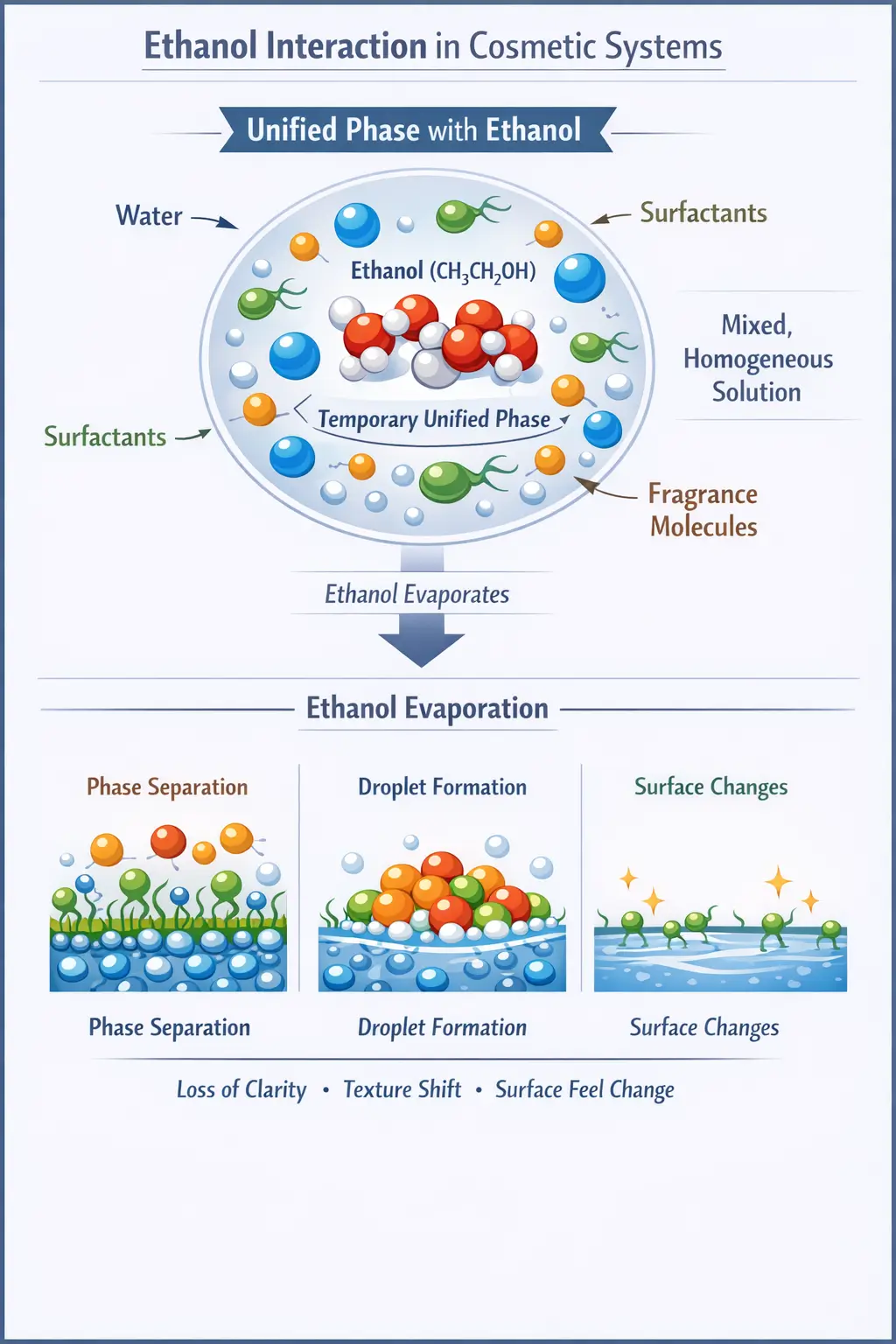
Its volatility also introduces a dynamic behavior. After application, ethanol evaporates faster than water, which can change how the remaining formulation feels on the surface.
Interpretation Layer: In practical terms, formulations containing ethanol may appear clearer, spread more easily, and dry faster compared to systems without it.
Ingredient Interaction Logic
Ethanol functions as a mediator between different formulation components rather than acting independently.
In soap-based systems, it interacts with fatty acid salts by modifying the solvent environment. This can reduce aggregation of soap molecules, which is particularly relevant in transparent soap structures.
Within water phases, ethanol reduces overall polarity, allowing partial solubilization of hydrophobic materials such as fragrance oils or certain emollients.
It also influences interactions with humectants like glycerin. In combined systems, ethanol can shift how water is retained or released, affecting texture and drying behavior.
In formulations containing aromatic blends, its role becomes especially important. It enables uniform dispersion of fragrance components, linking to broader concepts explained in fragrance function in cosmetic formulation.
In more complex systems such as creams or ethanol lotion structures, it interacts with emulsifiers by temporarily altering phase balance, which can influence spreadability during application.
Phase Behavior And Physical Characteristics
Ethanol is completely miscible with water, meaning it can form a single homogeneous phase across all proportions. This property is central to its role as a formulation solvent.
Its low boiling point introduces high volatility compared to water. As a result, it transitions rapidly from liquid to vapor under ambient conditions.
In soap and detergent systems, ethanol can disrupt structured phases such as crystalline soap matrices or highly ordered surfactant assemblies. This disruption is what enables clarity in transparent systems.
Temperature also influences its behavior. At higher temperatures, volatility increases further, accelerating evaporation and altering the balance between liquid and vapor phases.
In multi-phase systems, ethanol acts as a transitional medium rather than a stable structural component. It supports temporary solubilization but does not remain as a long-term stabilizing phase.
Comparison With Related Ingredients
Ethanol is often compared with other short-chain alcohols used in cleansing and cosmetic systems. The most common comparison is with isopropanol, which shares solvent functionality but differs in behavior and application context.
| Feature | Ethanol | Isopropanol |
|---|---|---|
| Chemical Structure | 2-carbon alcohol | 3-carbon alcohol |
| Volatility | High | High but slightly slower than ethanol |
| Odor Profile | Relatively mild | More pronounced and sharper |
| Typical Use Context | Perfume carriers, cosmetic solvents | Surface cleaning, industrial solvent use |
| Formulation Role | Solubilizer and evaporation modifier | Degreasing and rapid surface cleaning |
This distinction explains why ethanol is more frequently used in cosmetic systems, while isopropanol is more common in heavy-duty cleaning contexts.
Regulatory Context
Ethanol is listed under the INCI name Alcohol and is widely permitted in cosmetic and cleansing formulations under major regulatory frameworks.
Within the European Union, it is regulated under the broader framework of cosmetic ingredient disclosure, where it must be listed according to concentration order iningredient lists. This aligns with principles explained in how to read ingredient list.
Its classification typically falls within cosmetic product definitions rather than drug or biocidal categories, unless specific functional claims alter the regulatory status. This distinction is explored further in cosmetic vs drug classification.
In labeling practice, ethanol may appear simply as “Alcohol,” which can create ambiguity for readers unfamiliar with INCI naming conventions.
Regulatory treatment focuses on disclosure and classification rather than functional restriction in standard rinse-off or leave-on cosmetic systems.
Common Misunderstanding
A common misunderstanding is that ethanol functions as a primary cleansing agent in soaps or detergents.
In reality, cleansing performance in these systems is driven by surfactants or soap salts, not by ethanol itself. Ethanol supports the system by improving solubility and modifying physical behavior.
Another source of confusion arises from label terminology. Because ethanol is listed simply as “Alcohol,” it is often interpreted without context, even though multiple alcohol types exist with different roles in formulations.
This misunderstanding is partly addressed in broader discussions about ingredient naming conventions in why ingredients sound chemical.
Structural Limitations In Formulation
Despite its versatility, ethanol introduces several formulation constraints that must be managed carefully.
Its high volatility means it does not remain in the system for long after application. This limits its role to temporary support rather than long-term structural contribution.
It can also disrupt certain structured systems. In formulations that rely on stable emulsions or thickened phases, excessive ethanol can reduce viscosity or destabilize the system.
In soap matrices, its ability to interfere with crystallization is useful for transparency but may reduce structural rigidity if not balanced correctly.
Additionally, ethanol has limited compatibility with highly hydrophobic systems unless supported by additional solubilizers or emulsifiers.
Interpretation Layer: In practical formulation terms, ethanol improves clarity and spreadability but requires balance to avoid weakening structure or stability.
Summary of Findings
- Classification: Ethanol is a non-ionic, short-chain alcohol functioning primarily as a solvent within formulations.
- Functional Role: It supports solubility, enhances clarity, and modifies evaporation behavior rather than contributing to cleansing directly.
- Interaction Logic: It bridges water and hydrophobic components, enabling uniform distribution of otherwise incompatible ingredients.
- System Behavior: Its volatility introduces dynamic changes after application, influencing drying and surface feel.
- Limitations: High volatility and structural disruption effects require controlled use within balanced formulation systems.
Formulation References Using This Ingredient
- Williams Sonoma Winter Forest
- Method Foaming Hand Soap
- Soap Cleansing vs Antimicrobial Action
- Method Laundry Products Explained
- Method Laundry Detergent Explained
- Nivea Ingredients Analysis Analysis
- Dawn Dish Soap Ingredients Analysis
- Antibacterial Soap Ingredients Analysis
- Antimicrobial Soap Ingredients Analysis
- Alcohol In Cosmetics, Soap And Cleaning Products