Isopropanol(Isopropyl Alcohol) is a short-chain alcohol classified as a volatile organic solvent, used in cleansing and cosmetic formulations to assist solubility, remove residues, and modify evaporation behavior within liquid systems.
In soap and detergent formulations, it does not function as a primary cleansing agent. Instead, it supports the system by altering how oils, residues, and additives dissolve and disperse within the solvent phase.
The relevance of isopropanol structure lies in its three-carbon arrangement, which gives it stronger interaction with hydrophobic materials compared to smaller alcohols, influencing its degreasing behavior.
Within formulation systems, isopropanol is often associated with rapid drying characteristics and is commonly used where quick evaporation and residue removal are required.
Quick Facts
| Property | Description |
|---|---|
| Ingredient Type | Solvent |
| Chemical Class | Alcohol (secondary alcohol) |
| Functional Role | Solvent, degreasing agent, evaporation modifier |
| Ionic Class | Non-ionic |
| Typical Use Context | Surface cleaning systems, cosmetic formulations, residue removal applications |
Why This Ingredient Appears on Labels
Isopropanol appears on ingredient labels because it supports formulation performance rather than acting as a primary cleansing component.
In many systems, it is included to dissolve substances that are not fully compatible with water, particularly oily residues or certain additives that require a different solvent environment.
Its presence may also reflect formulation decisions related to evaporation behavior. Because it evaporates faster than water, it can influence how quickly a product dries after application.
From a label interpretation perspective, isopropanol typically indicates a formulation designed for efficient solubility management or residue removal rather than direct cleansing action.
Chemical Identity And Classification
Isopropanol is identified in ingredient labeling systems under the INCI name Isopropyl Alcohol. It belongs to the class of short-chain aliphatic alcohols and is categorized specifically as a secondary alcohol due to the position of its hydroxyl group.
The isopropanol structure consists of a three-carbon chain where the hydroxyl group is attached to the central carbon. This structural arrangement influences how the molecule interacts with both water and non-polar substances.
It exhibits amphiphilic behavior to a limited extent, meaning it can interact with both polar and moderately non-polar materials. However, it does not form micelles or act as a surfactant.
Isopropanol is classified as non-ionic, and its role in formulations is governed by physical interactions rather than electrostatic charge behavior.
In formulation contexts, it is typically produced synthetically, though its origin does not significantly alter its functional performance within cleansing systems.
Functional Role In Soap Systems
Isopropanol contributes to formulation behavior primarily through its solvent and degreasing capabilities. It does not provide cleansing through surfactant mechanisms but enhances how cleansing systems interact with oily or hydrophobic materials.
In soap and detergent formulations, it can assist in breaking down residues that are not easily removed by water alone. This makes it useful in systems designed for surface cleaning or removal of persistent films.
It also influences drying characteristics. Due to its relatively high volatility, isopropanol evaporates quickly after application, which can reduce the amount of residual liquid left on a surface.
In certain formulations, it may be used to adjust the balance between water and non-water compatible ingredients, helping maintain uniform distribution of components.
Interpretation Layer: In practical terms, formulations containing isopropanol may feel lighter during application, spread quickly, and leave less residual moisture after use.
Ingredient Interaction Logic
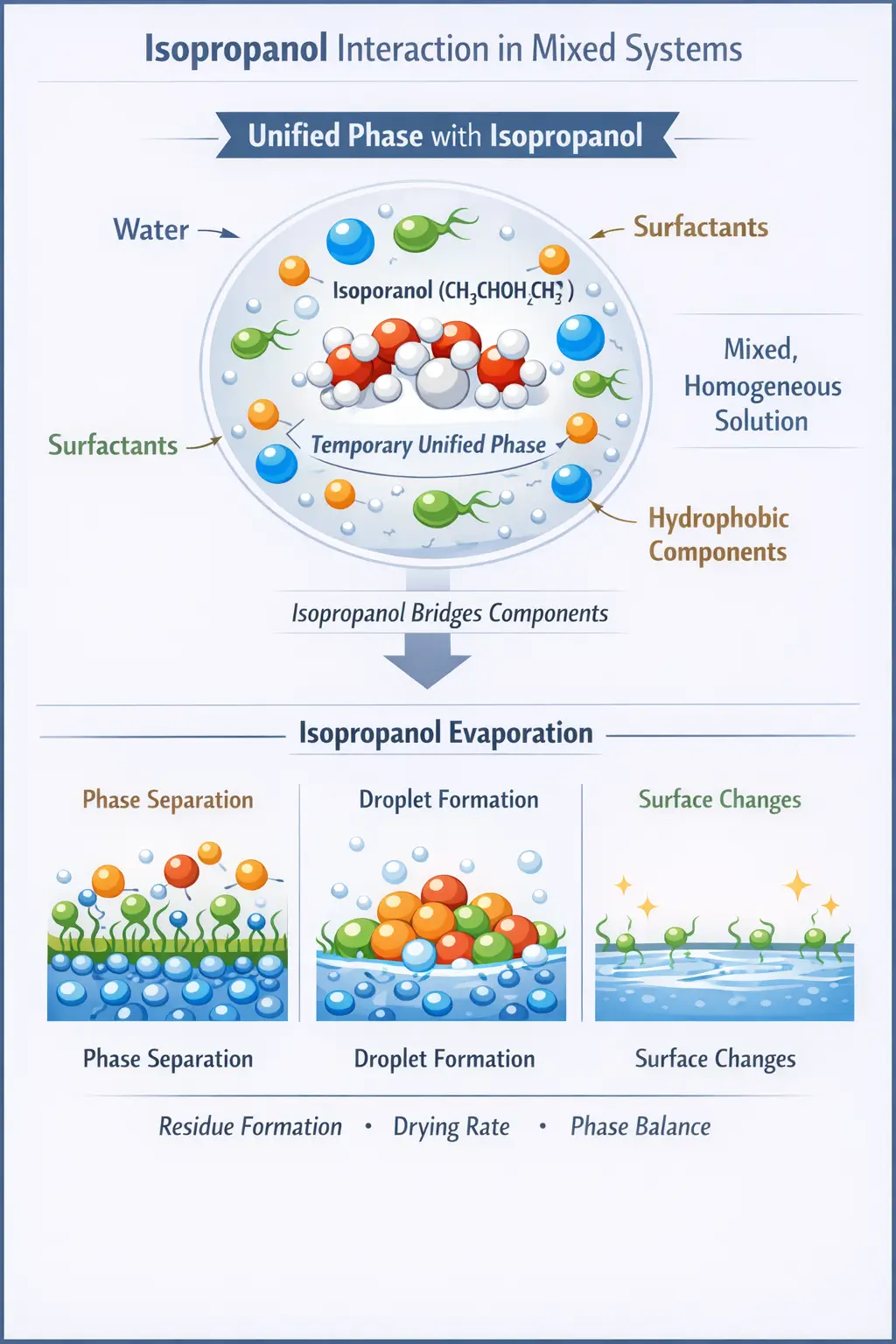
Isopropanol acts as an intermediary within formulation systems, influencing how different components interact rather than functioning independently.
In water-based systems, it reduces the overall polarity of the solvent phase. This allows partial solubilization of materials that would otherwise separate, such as oils or certain fragrance components
When combined with surfactants, it does not directly participate in micelle formation but can influence how surfactant systems behave by modifying the surrounding solvent environment.
It interacts with humectants such as glycerin by affecting how water is retained or released, which can alter perceived drying characteristics after application.
In formulations containing aromatic compounds, it facilitates dispersion by enabling more uniform distribution of hydrophobic molecules throughout the liquid phase.
Phase Behavior And Physical Characteristics
Isopropanol is fully miscible with water, forming a homogeneous phase across a wide range of concentrations. This property allows it to integrate seamlessly into aqueous formulation systems.
Its boiling point is higher than ethanol but still low enough to support rapid evaporation under ambient conditions. This balance contributes to controlled drying behavior in formulations.
In structured systems, isopropanol can disrupt organized molecular arrangements such as crystalline soap structures or highly ordered surfactant assemblies.
This disruption can influence clarity, viscosity, and overall stability depending on concentration and formulation design.
In multi-phase systems, isopropanol functions as a transitional solvent, temporarily enabling compatibility between components that would otherwise separate.
Comparison With Related Ingredients
Isopropanol is closely related to other short-chain alcohols used in formulation systems, particularly ethanol. While both function as solvents, their structural differences influence how they behave within cleansing systems.
| Feature | Isopropanol | Ethanol |
|---|---|---|
| Carbon Structure | Three-carbon secondary alcohol | Two-carbon primary alcohol |
| Solvent Strength For Oils | Higher affinity for hydrophobic materials | Moderate affinity |
| Evaporation Behavior | Fast, slightly slower than ethanol | Very rapid evaporation |
| Typical Use Context | Degreasing and residue removal systems | Fragrance carriers, cosmetic solvents |
| Formulation Role | Residue breakdown and solvent adjustment | Solubilization and evaporation support |
This comparison highlights how small structural differences lead to distinct formulation roles, even within the same chemical class.
Regulatory Context
Isopropanol is listed under the INCI name Isopropyl Alcohol and is widely recognized in cosmetic ingredient databases.
In the European Union, it is regulated under general cosmetic framework rules, where it must be declared iningredient lists according to concentration hierarchy. This aligns with principles described in how to read ingredient list.
Its classification remains within cosmetic ingredient categories unless the formulation is positioned under a different regulatory classification, which depends on intended product claims. This distinction is discussed in cosmetic vs drug classification.
Labeling typically uses the INCI name rather than common naming variations, which helps standardize disclosure across international markets.
Common Misunderstanding
A frequent misunderstanding is that isopropanol functions as a primary cleansing agent within soap or detergent formulations.
In practice, cleansing is driven by surfactants or soap salts. Isopropanol supports the process by modifying how residues dissolve and how the solvent phase behaves.
Another misconception is that all alcohols behave identically in formulations. Differences in molecular structure lead to distinct roles, even among closely related compounds.
Structural Limitations In Formulation
Isopropanol introduces certain constraints that must be managed during formulation design.
Its volatility means it does not remain in the system after application, limiting its role to temporary support rather than long-term structural contribution.
It can disrupt structured systems such as emulsions or thickened liquids if used beyond balanced levels, potentially reducing viscosity or stability.
Its compatibility with highly hydrophobic systems is limited without additional solubilizers, requiring careful formulation balance.
Interpretation Layer: While it improves residue removal and drying behavior, excessive use can weaken formulation structure or alter consistency.
Product Formulation References Using This Ingredient
Summary of Findings
- Classification: Isopropanol is a non-ionic, short-chain secondary alcohol functioning primarily as a solvent.
- Functional Role: It enhances solubility, assists residue removal, and modifies evaporation behavior rather than providing cleansing directly.
- Interaction Logic: It bridges water and moderately hydrophobic materials, influencing dispersion and solvent balance.
- System Behavior: Its volatility contributes to rapid drying and reduced residual moisture after application.
- Limitations: High volatility and structural disruption effects require controlled use to maintain formulation stability.