Chloroxylenol Definition and Role in Cleansing Systems
Chloroxylenol is a chlorinated phenolic compound classified as a non-ionic antimicrobial agent used in cleansing systems primarily for microbial control rather than surface-active cleaning.
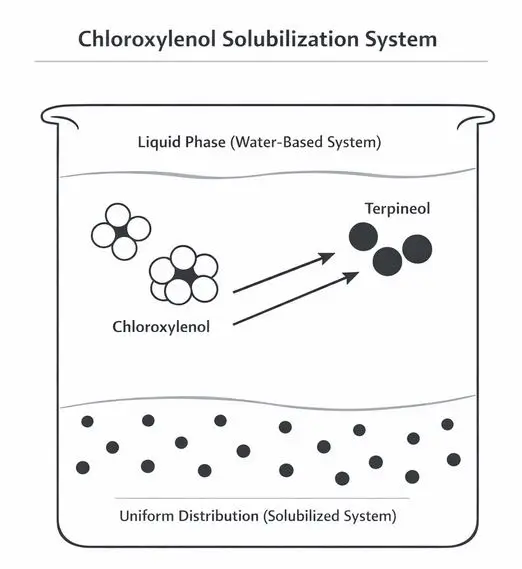
In formulation systems, it is typically introduced in liquid solutions, often stabilized or solubilized using solvents and co-components such as terpineol, which helps distribute it evenly within aqueous or semi-aqueous bases.
Unlike surfactants, chloroxylenol does not contribute significantly to lather or emulsification. Its function is instead tied to membrane interaction and microbial disruption, operating alongside cleansing agents rather than replacing them.
Within soap and liquid cleansing products, its role is therefore supportive, influencing system preservation, surface contact behavior, and formulation stability under use conditions.
Quick Technical Overview
| Property | Description |
|---|---|
| Ingredient Type | Antimicrobial additive |
| Chemical Class | Chlorinated phenolic compound |
| Functional Role | Microbial control agent in cleansing systems |
| Ionic Class | Non-ionic |
| Typical Use Context | Liquid antiseptic solutions, soap systems, and cleaning liquids |
Why Chloroxylenol Appears on Ingredient Labels
Chloroxylenol appears in ingredient lists because it performs a specific functional role related to microbial interaction within the product system. It is not responsible for cleaning itself, but rather complements the cleansing base.
In liquid formulations, particularly those described as chloroxylenol solution or chloroxylenol liquid, it is incorporated to maintain performance consistency during storage and use. Its presence ensures that the formulation maintains controlled interaction with microorganisms during application.
When used in products such as chloroxylenol dish soap or skin cleansing liquids, it is part of a broader system that includes surfactants, solvents, and stabilizers. Each component contributes differently, and chloroxylenol operates within that network rather than acting independently.
Chemical Identity and Structural Classification
The INCI name Chloroxylenol refers to a substituted phenolic compound where chlorine and methyl groups are attached to an aromatic ring structure. This structural arrangement defines its interaction profile within formulation systems.
The chloroxylenol structure is characterized by a hydrophobic aromatic ring combined with a functional hydroxyl group. This dual nature allows limited compatibility with both organic and aqueous environments, particularly when supported by solubilizing agents.
Unlike ionic surfactants, chloroxylenol does not carry a charge. This non-ionic behavior influences how it distributes in formulations, especially in systems containing charged components such as anionic surfactants.
Its typical origin is synthetic, with controlled manufacturing ensuring consistent purity and predictable behavior across batches.
Functional Role in Soap and Cleansing Systems
Within cleansing systems, chloroxylenol does not act as a primary cleaning agent. Instead, it operates alongside surfactants, contributing to the overall functional profile of the formulation.
In soap systems, particularly those described as chloroxylenol in soap, its presence is associated with controlled interaction at the surface level. It does not influence lather formation directly, nor does it significantly modify foam structure.
In liquid systems, such as chloroxylenol liquid formulations, its role becomes more dependent on uniform distribution. Proper dispersion ensures consistent contact across the application surface.
From a system perspective, this means that while surfactants handle oil removal and emulsification, chloroxylenol contributes to surface-level microbial interaction, functioning as a complementary component.
Interpretation: In practical terms, its presence does not make a soap “stronger” in cleansing, but it changes how the formulation behaves during contact with surfaces, particularly in liquid applications.
Ingredient Interaction Logic in Formulations
Chloroxylenol rarely functions in isolation. Its behavior is strongly influenced by surrounding formulation components, particularly solvents and surfactant systems.
One of the most important associations is with terpineol. In many traditional and modern systems, the combination of chloroxylenol and terpineol is used to improve solubility and distribution within liquid formulations.
Terpineol acts as a co-solvent and carrier, helping chloroxylenol integrate into aqueous systems where it would otherwise have limited dispersion. This interaction is especially relevant in chloroxylenol solution formats.
In systems containing anionic surfactants, chloroxylenol remains largely compatible due to its non-ionic nature. However, its distribution can still be affected by the presence of high surfactant concentrations or phase separation tendencies.
Other interactions include:
- With water phase: Requires solubilization support for uniform distribution
- With solvents: Enhanced dispersion and stability
- With fragrance systems: Can coexist but may influence overall system polarity
- With surfactants: Works alongside but does not replace cleansing action
Interpretation: The effectiveness of chloroxylenol in a formulation depends less on its presence alone and more on how well the surrounding system enables its distribution.
Phase Behavior and Solubility Characteristics
Chloroxylenol exhibits limited direct solubility in water, which is why it is commonly formulated in chloroxylenol liquid systems using solubilizers or co-solvents.
In the absence of proper formulation support, it may remain unevenly distributed, leading to phase inconsistency. This is particularly relevant in transparent or low-viscosity liquid systems.
When combined with components such as terpineol or alcohol-based carriers, chloroxylenol can be maintained in a more stable dispersed state. This enables its use in clear liquid solutions without visible separation.
Temperature and pH conditions also influence behavior. While relatively stable within typical formulation ranges, extreme conditions can alter its distribution within the system.
Interpretation: From a formulation standpoint, chloroxylenol is not inherently water-compatible. Its usability depends on how effectively the system maintains it in a dispersed or solubilized state.
Comparison With Related Antimicrobial Ingredients
Chloroxylenol is often compared with other antimicrobial agents used in cleansing systems. While functional overlap exists, their formulation behavior and compatibility differ.
| Feature | Chloroxylenol | Benzalkonium Chloride |
|---|---|---|
| Chemical Class | Chlorinated phenolic compound | Quaternary ammonium compound |
| Ionic Nature | Non-ionic | Cationic |
| Solubility Behavior | Requires co-solvents | Highly water-soluble |
| Compatibility | Broad compatibility | Limited with anionic systems |
| Typical System Role | Supplementary antimicrobial | Surface-active antimicrobial |
Interpretation: Chloroxylenol integrates more flexibly into mixed systems due to its non-ionic nature, while benzalkonium chloride shows stronger surface interaction but more formulation constraints.
Regulatory Context and Labeling Framework
Chloroxylenol is recognized under cosmetic and antiseptic product frameworks and is listed using its INCI name Chloroxylenol in ingredient declarations.
Within regulatory systems such as the European Union cosmetic framework, it is classified as a preservative-type or antimicrobial substance, with defined concentration and use conditions depending on product category.
Its inclusion on labels reflects its functional role within the formulation rather than any standalone property. Label positioning does not indicate performance intensity, but rather presence within the formulation system.
In different markets, its classification may vary slightly depending on whether the product is positioned as cosmetic, hygienic, or disinfecting, but the naming convention remains consistent.
Common Misunderstanding Around Chloroxylenol
A common misconception is that chloroxylenol replaces the need for surfactants in cleansing systems.
In reality, it does not perform oil removal or emulsification. These functions are handled by surfactants. Chloroxylenol operates independently of that mechanism and does not contribute to dirt removal in a conventional sense.
This misunderstanding often arises because it is associated with cleansing products, but its role is separate from the physical cleaning process.
Interpretation: The presence of chloroxylenol does not change how well a product removes oils or debris. It modifies system behavior in a different way that is not directly visible during washing.
Structural and Formulation Limitations
Chloroxylenol presents several formulation constraints that must be managed during product development.
- Limited water solubility: Requires co-solvents such as terpineol or alcohol systems
- Distribution sensitivity: Uneven dispersion can affect formulation consistency
- Dependence on system design: Performance relies on proper formulation structure
- Phase stability considerations: May separate in poorly balanced liquid systems
These limitations do not prevent its use, but they require careful system design to ensure stable and consistent performance.
Interpretation: From a formulation perspective, chloroxylenol is not difficult to use, but it cannot be added without considering how the surrounding system supports it.
Formulation References Using This Ingredient
Summary of Findings
- Classification: Chloroxylenol is a non-ionic chlorinated phenolic compound used as an antimicrobial additive
- Functional Role: It complements surfactants by contributing to microbial interaction rather than cleansing
- System Behavior: Its effectiveness depends on proper solubilization, often supported by terpineol or similar solvents
- Interaction Logic: Works within a network of surfactants, solvents, and stabilizers rather than independently
- Limitations: Requires formulation support due to limited water solubility and distribution sensitivity