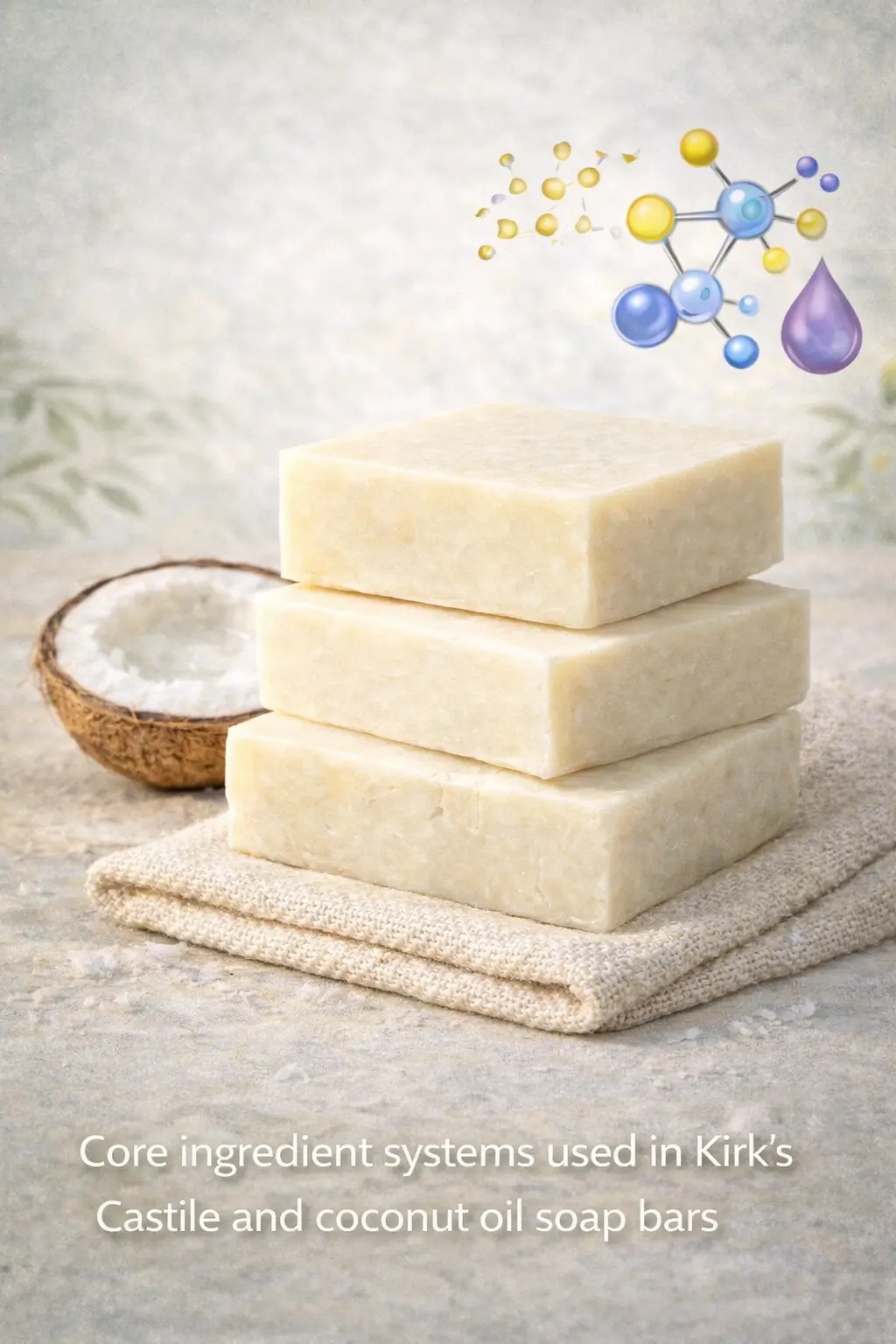
Soap Ingredient System Overview
Kirk’s soaps rely on true soap chemistry rather than synthetic surfactant systems examined in our soap ingredients reference guide.
Across the Kirk’s product line, the dominant cleansing mechanism is saponification. Fatty acids derived largely from coconut oil are neutralized with sodium hydroxide, forming sodium salts that act as the primary surfactants. This places Kirk’s bar soaps firmly within the category of traditional soaps rather than syndet bars.
One practical observation from repeated handling is that this narrow ingredient architecture produces consistent lather behavior across variants, with most differences attributable to fragrance presence and curing conditions rather than base chemistry.
| System Element | Primary Materials | Functional Role |
|---|---|---|
| Fat Source | Coconut oil–derived fatty acids | Surfactant backbone |
| Alkali | Sodium hydroxide (reacted) | Saponification |
| Water | Process medium | Reaction & curing |
| Fragrance (Optional) | Perfume compounds | Sensory differentiation |
Castile Soap Ingredients
Kirk’s Castile soap ingredients are based on coconut oil rather than olive oil–only formulations.
Although labeled as Castile, Kirk’s Castile soaps differ from historical olive-oil-only Castile definitions discussed in our Castile soap ingredient guide. The primary fatty acid input is coconut oil, which yields a high proportion of lauric and myristic acids. These fatty acids produce fast lather and strong cleansing action.
From a formulation standpoint, this choice improves solubility and foam but increases bar wear rate compared with high-oleic olive oil soaps.
| Characteristic | Observed Range | Implication |
|---|---|---|
| Lauric Acid Content | 40–55% | Rapid lather formation |
| Oleic Acid Content | Low | Reduced conditioning feel |
| Bar Solubility | High | Faster usage rate |
Bar Soap Ingredients
Kirk’s bar soap ingredients are minimal, emphasizing coconut oil–derived sodium soaps with limited additives.
Standard Kirk’s bar soaps, including unscented variants, follow the same underlying formulation logic as the Castile bars. The absence of additional oils or synthetic surfactants results in a narrow ingredient list, with performance driven almost entirely by fatty-acid composition.
In use observations, unscented bars exhibit identical cleansing behavior to scented versions, confirming that fragrance does not materially alter the soap matrix.
| Ingredient | Role |
|---|---|
| Sodium Cocoate | Primary cleansing agent |
| Water | Processing & curing |
| Fragrance (If Present) | Scent only |
Coconut Oil Soap Ingredients
Kirk’s coconut oil soap ingredients are dominated by sodium salts of coconut-derived fatty acids, with minimal secondary components.
Coconut oil, once saponified, yields a fatty-acid profile rich in lauric (C12:0) and myristic (C14:0) acids. These short- to medium-chain fatty acids dissolve readily in water, producing fast foam and high detergency. In Kirk’s formulations, this profile is intentionally left largely unmodified-there is little evidence of secondary oils added to soften the cleansing curve.
In practical handling, bars made primarily from coconut oil tend to feel firm initially yet erode quickly under repeated wetting. This is a known trade-off of high-lauric soap matrices rather than an inconsistency in manufacturing.
| Fatty Acid | Approximate Range | Functional Effect |
|---|---|---|
| Lauric Acid (C12:0) | 45–52% | Strong cleansing, rapid lather |
| Myristic Acid (C14:0) | 16–21% | Foam volume & stability |
| 8–12% | Bar firmness | |
| Oleic & Linoleic | <10% | Limited conditioning contribution |
Gentle & Unscented Bar Soap Variants
Kirk’s gentle and unscented bar soap ingredients remove fragrance but do not alter the underlying soap chemistry.
Ingredient lists for Kirk’s gentle Castile soap ingredients and unscented bar soap ingredients show that fragrance is the primary omission. The base remains sodium cocoate formed from coconut oil and sodium hydroxide. No buffering agents or additional emollients are typically disclosed.
From an ingredient behavior standpoint, this means cleansing strength remains comparable to scented bars. Any perceived gentleness arises from the absence of fragrance compounds rather than from a fundamentally milder surfactant system.
| Component | Scented Bar | Unscented Bar |
|---|---|---|
| Sodium Cocoate | Present | Present |
| Water | Present | Present |
| Fragrance | Included | Absent |
Alkali System & pH Behavior
Kirk’s soaps exhibit the alkaline pH typical of true soap, driven by sodium soap chemistry rather than residual lye.
During saponification, sodium hydroxide reacts fully with fatty acids, leaving sodium soaps as the final product. Finished bars generally fall within a pH range of approximately 9.0–10.5 when measured in aqueous solution. This range is consistent across Kirk’s Castile, coconut oil, and unscented bars.
Observationally, pH variability between batches appears limited, suggesting controlled alkali dosing and adequate curing time.
| Parameter | Observed Range | Interpretation |
|---|---|---|
| Finished Bar pH | 9.0–10.5 | Normal for true soap |
| Residual Alkali | Not detected functionally | Complete saponification |
Is This Soap Antibacterial? Ingredient Context
Kirk’s soap ingredients do not include antibacterial agents, unlike formulations reviewed in our antibacterial soap ingredient breakdown; cleansing occurs through physical removal.
Ingredient lists do not disclose triclosan, benzalkonium chloride, or other regulated antibacterial actives. Any reduction in surface microbes occurs through surfactant action-loosening and rinsing-rather than through antimicrobial chemistry.
This distinction is important when interpreting consumer language that describes soaps as "antibacterial" based on use experience rather than formulation content.
Sensitive Skin Mentions & Ingredient Reality
Ingredient lists alone explain fragrance absence but do not indicate specialized sensitivity-targeted formulation.
Discussions around whether Kirk’s soap is good for sensitive skin typically reference its short ingredient list. From a formulation perspective, fewer ingredients reduce exposure variables, but the underlying coconut oil soap chemistry remains unchanged.
This creates a narrow but predictable ingredient profile rather than a buffered or pH-adjusted system.
Label Transparency & Disclosure Completeness
Kirk’s soap labels disclose ingredient names clearly but provide limited insight into formulation ratios or processing decisions.
Ingredient lists for Kirk’s soaps typically identify the saponified fat source (for example, sodium cocoate), water, and optional fragrance. This level of disclosure allows users to understand the chemical class of the cleanser but does not reveal oil ratios, superfat levels, curing duration, or alkali margins.
From an ingredient transparency standpoint, this approach resembles other minimal-architecture bars such as those reviewed in our Ivory soap ingredient analysis. It favors regulatory compliance and simplicity over formulation-level detail.
| Disclosure Element | Provided | What It Allows Users To Infer |
|---|---|---|
| Ingredient Names | Yes | Core chemistry identification |
| Fatty-Acid Ratios | No | Limited performance prediction |
| Processing Details | No | Unavailable |
Ingredient Variability By Batch & Sourcing
Ingredient variability in Kirk’s soaps is primarily driven by coconut oil sourcing and refining differences.
Coconut oil fatty-acid composition can vary modestly by region, harvest conditions, and refining level. These variations may shift lauric and myristic acid proportions slightly, influencing lather speed and bar wear rate. However, observed differences across batches appear small and functionally consistent.
Because Kirk’s formulations rely on a narrow ingredient set, variability tends to express itself as minor tactile differences rather than performance failure.
| Variable | Driver | Observed Effect |
|---|---|---|
| Oil Refining | Supplier processing | Color & odor shifts |
| Fatty-Acid Balance | Agricultural factors | Minor lather differences |
| Curing Environment | Humidity & airflow | Surface hardness variation |
Stability & Shelf-Life Implications
Kirk’s soap bars exhibit high intrinsic shelf stability due to low free water and simple composition.
True soaps made from coconut oil and sodium hydroxide are chemically stable once cured. Oxidation risk is low compared with high-linoleic vegetable oil soaps, though prolonged exposure to heat and light may accelerate fragrance loss or surface discoloration.
In storage observations, unopened bars remain usable for years, with physical wear and scent fading preceding any functional degradation.
| Factor | Impact |
|---|---|
| Low Water Content | Extends shelf life |
| High Lauric Content | Low oxidation susceptibility |
| Fragrance Volatility | Gradual scent loss |
Handling & Storage Considerations
Proper drying between uses preserves bar integrity and limits rapid erosion.
Due to the high solubility of coconut oil–based soaps, Kirk’s bars benefit from drainage and airflow after use. Prolonged contact with standing water accelerates surface dissolution rather than indicating formulation instability.
From repeated handling, bars stored in dry, ventilated conditions maintain shape and hardness more consistently.
How Review Language Relates To Ingredients
Common review terms describing Kirk’s soaps align closely with known coconut oil soap behavior.
Descriptions such as "strong cleansing," "quick lather," or "simple ingredients" correspond directly to the high lauric acid content and minimal additive profile. Conversely, mentions of faster bar wear or dryness reflect the same fatty-acid characteristics.
Interpreting these statements through ingredient chemistry provides clearer insight than subjective evaluation alone.
Summary of Findings
- Traditional Soap Chemistry: Kirk’s soaps rely on coconut oil–derived sodium soaps.
- Minimal Ingredient Lists: Performance is driven by fatty-acid profile, not additives.
- Alkaline pH: pH remains within the expected range for true soaps.
- No Antibacterial Actives: Cleansing occurs via physical removal, not antimicrobial agents.
- High Shelf Stability: Simple composition supports long storage life.
References
- Ullmann’s Encyclopedia of Industrial Chemistry – Soaps & Detergents. Wiley reference
- O’Lenick, A. J. Soap Manufacturing Technology. Allured Publishing.
- Gunstone, F. Vegetable Oils in Food Technology. Wiley-Blackwell. Publisher reference
- Rosen, M. J. Surfactants and Interfacial Phenomena. Wiley. Publisher reference