Opening Definition
Aldehydes are a class of organic carbonyl compounds characterized by a terminal functional group that influences volatility and scent behavior. In cleansing and cosmetic systems, they are primarily used as fragrance components rather than active cleansing agents.
Within soap and detergent formulations, these compounds contribute to the overall sensory profile by shaping how a product smells during use and after rinsing. Their presence does not alter cleansing chemistry directly.
They are often part of complex aromatic blends where their volatility allows them to act as top or middle notes, influencing how fragrance evolves over time.
This page is part of the CleanFormulation Ingredient Library, a research-based system focused on explaining how ingredients behave within real formulations rather than in isolation.
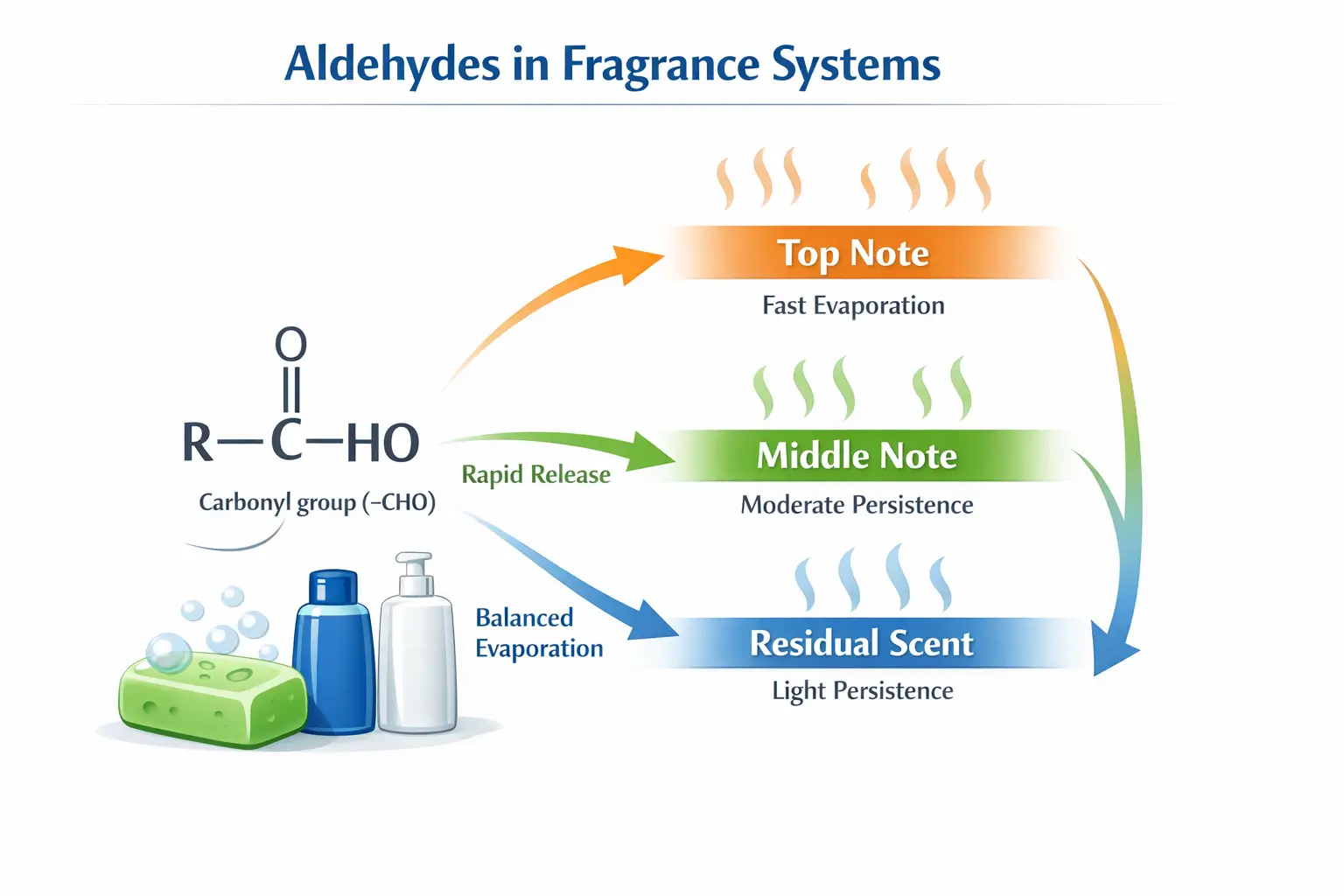
Illustration showing the general structure of aldehydes (R–CHO) and their role in fragrance behavior within soap and cosmetic formulations. Their low molecular weight and terminal carbonyl group contribute to volatility, allowing them to act as top or middle notes that influence how scent develops during application and after rinsing.
Quick Facts
| Property | Description |
|---|---|
| General Structure | R–CHO (terminal carbonyl group bonded to hydrogen) |
| Common Chain Range | C6–C12 most used in fragrance systems |
| Molecular Weight Range | ~100–200 g/mol for typical cosmetic aldehydes |
| Volatility Profile | High; rapid evaporation contributes to top-note impact |
| Boiling Point Range | ~150°C – 250°C depending on chain length |
| Odor Threshold | Very low; detectable at ppm to ppb levels |
| Typical Usage Rate | 0.01% – 0.5% in finished formulations |
| Solubility Behavior | Low water solubility; readily soluble in alcohols and oils |
| Polarity | Moderately polar due to carbonyl group |
| Reactivity | Reactive toward oxidation and nucleophilic addition reactions |
| Oxidation Pathway | R–CHO + [O] → R–COOH (conversion to corresponding acid) |
| Stability Concerns | Prone to air oxidation and light-induced degradation |
| pH Sensitivity | Relatively stable in neutral systems; reactivity increases in extreme pH |
| Fixation Behavior | Often combined with fixatives to slow evaporation rate |
| Impact on Fragrance Profile | Provides fresh, waxy, citrus, or soapy notes depending on structure |
| Interaction with Surfactants | Can be solubilized using nonionic or amphoteric surfactant systems |
| Flash Point | Typically 60°C – 120°C (varies with structure) |
| Storage Conditions | Store in airtight containers, away from light and oxygen exposure |
| Regulatory Consideration | Some aldehydes are restricted or monitored due to sensitization potential |
| Formulation Note | Used in trace amounts; overdosing easily leads to harsh or overpowering scent profiles |
Why This Ingredient Appears on Labels
Aldehydes appear on ingredient labels because they are part of the broader fragrance system used to define the sensory identity of a product. Instead of acting as cleaning agents, they contribute to how a formulation is perceived during application and rinsing.
In many cases, they are included as part of aromatic blends rather than as isolated ingredients. Their role is to modify scent structure, enhance brightness, or create specific olfactory effects within the formulation.
The way these compounds behave is closely tied to volatility. Some evaporate quickly, creating an immediate scent impression, while others persist longer and influence how the product smells after use.
For users trying to interpret ingredient labels, understanding how fragrance components are listed can be helpful. See how to read ingredient list for a broader explanation of label structure and disclosure.
In observable terms, their inclusion affects how a soap or cleanser smells when first applied and how long that scent remains after rinsing, without changing the underlying cleansing mechanism.
Chemical Identity and Classification
Aldehydes are defined by the presence of a terminal carbonyl group, where a carbon atom is double bonded to oxygen and single bonded to hydrogen. This structural feature places them within the broader family of organic carbonyl compounds.
In formulation contexts, they are not treated as a single ingredient but as a group of related molecules with varying chain lengths and structures. These differences influence volatility, odor character, and interaction with surrounding components.
Most aldehydes used in cleansing and cosmetic systems are non-ionic and lipophilic, meaning they are more compatible with the oil or fragrance phase rather than the aqueous phase.
They may be derived from natural sources such as plant extracts or synthesized through controlled chemical processes. Regardless of origin, their functional behavior in formulations remains tied to their molecular structure.
From a formulation standpoint, this means they distribute within aromatic blends rather than forming independent functional phases.
Functional Role in Soap Systems
The role of aldehydes in soap systems is primarily sensory. They contribute to fragrance profiles without participating in the chemical process of cleansing.
Unlike surfactants such as sodium lauryl sulfate, aldehydes do not reduce surface tension or remove oils. Their influence is limited to how the formulation is perceived during and after use.
They are often used to create brightness or sharpness in fragrance composition, especially in the initial phase of application. This is due to their relatively high volatility compared to heavier aromatic compounds.
In bar soap systems, they can influence how scent is released when the soap is wetted and agitated. In liquid systems, they contribute to the immediate scent experience during dispensing and use.
This results in a noticeable difference in how a product smells at first contact compared to how it smells after rinsing, even though the cleansing mechanism remains unchanged.
Ingredient Interaction Logic
Aldehydes primarily interact within the fragrance phase, but their behavior is influenced by the surrounding formulation environment.
In systems containing surfactants, their distribution depends on how fragrance materials are incorporated into micellar structures. While they do not form micelles themselves, they may be carried within surfactant assemblies that help disperse aromatic compounds in water-based systems.
This interaction is indirectly linked to surfactant behavior, as explained in soap ingredient guide, where micelle formation determines how non-water-soluble components are stabilized.
They may also interact with solvents and carriers that control fragrance dispersion. These supporting ingredients influence how evenly aldehydes are distributed and how quickly they evaporate during use.
In formulations containing humectants such as glycerin, the evaporation rate of volatile compounds can be slightly moderated due to changes in the surrounding environment, although this effect is indirect.
Overall, aldehydes do not act independently but as part of a broader aromatic system where their performance depends on how the formulation supports fragrance stability and release.
Phase Behavior and Volatility
Aldehydes are typically located within the oil or fragrance phase of a formulation. They are not inherently water soluble and require dispersion mechanisms to remain evenly distributed in aqueous systems.
Their defining characteristic is volatility. Lower molecular weight aldehydes tend to evaporate quickly, contributing to the initial scent impression, while heavier ones persist longer and influence the residual fragrance.
They do not form crystalline structures or stable aqueous solutions on their own. Instead, they rely on formulation systems such as emulsions or surfactant-based dispersions to remain integrated.
Thermally, they can be sensitive to prolonged exposure to heat or reactive environments, which may alter their odor characteristics over time.
From a formulation perspective, this behavior explains why fragrance intensity can change during storage or after repeated use, even when the base formulation remains stable.
Comparison With Related Ingredients
Aldehydes are often used alongside other fragrance-related compounds such as alcohols and esters. While all contribute to scent, their behavior within formulations differs based on structure and volatility.
| Feature | Aldehydes | Esters |
|---|---|---|
| Chemical Class | Carbonyl compounds with terminal functional group | Organic compounds formed from acids and alcohols |
| Volatility | Often high, especially low molecular weight types | Moderate, more stable scent profile |
| Scent Role | Sharp, bright or fresh top notes | Smooth, fruity or rounded notes |
| Formulation Role | Initial scent impact and diffusion | Body and persistence of fragrance |
| Phase Behavior | Oil or fragrance phase | Oil or fragrance phase |
In practical terms, aldehydes shape the first impression of a product’s scent, while esters contribute to how that scent evolves and persists over time.
Regulatory Context
Aldehydes are declared on ingredient labels either individually or as part of fragrance compositions, depending on concentration and regulatory disclosure requirements.
Within cosmetic labeling systems, fragrance components may be grouped under general terms or listed separately when required by regulatory frameworks. This depends on how ingredients are classified within the product.
For a broader explanation of how products and ingredients are categorized, see cosmetic vs drug classification and how soap is regulated.
Labeling practices may also vary across regions, as outlined in global labeling differences explained, which affects how fragrance-related components appear in ingredient disclosures.
These compounds do not determine product classification but are part of the overall formulation composition declared under standard labeling rules.
Common Misunderstanding
A common misunderstanding is that aldehydes influence how well a product cleans or performs during washing. In reality, they do not contribute to soil removal or surface interaction.
Their presence is often associated with noticeable scent changes, which can create the impression of improved performance. However, this effect is sensory rather than functional in terms of cleansing chemistry.
This distinction becomes clearer when comparing them to active cleansing agents, as explained in soap cleansing vs antimicrobial action, where the mechanism of cleaning is separate from fragrance perception.
Structural Limitations
Aldehydes are inherently volatile, which limits their persistence in formulations over time. This can result in gradual changes in fragrance profile during storage or repeated exposure to air.
They may also be sensitive to reactive environments, particularly in the presence of oxidizing conditions or incompatible formulation components, which can alter their odor characteristics.
Because they are not water soluble, they rely on surfactants or emulsification systems for proper dispersion. Without this support, uniform distribution within aqueous formulations can be difficult to maintain.
These limitations define their role as part of a broader fragrance system rather than as standalone functional ingredients.
Formulation References Using This Ingredient
Summary of Findings
- Classification: Aldehydes are organic carbonyl compounds used as fragrance components in cleansing and cosmetic formulations.
- Primary Role: They contribute to scent profile, particularly in the initial phase of fragrance perception.
- System Behavior: Their volatility influences how fragrance evolves during and after use without affecting cleansing performance.
- Interaction Logic: They operate within fragrance systems and depend on surfactants or carriers for dispersion.
- Limitations: Volatility, sensitivity to environmental conditions, and lack of water solubility define their functional boundaries.