Definition
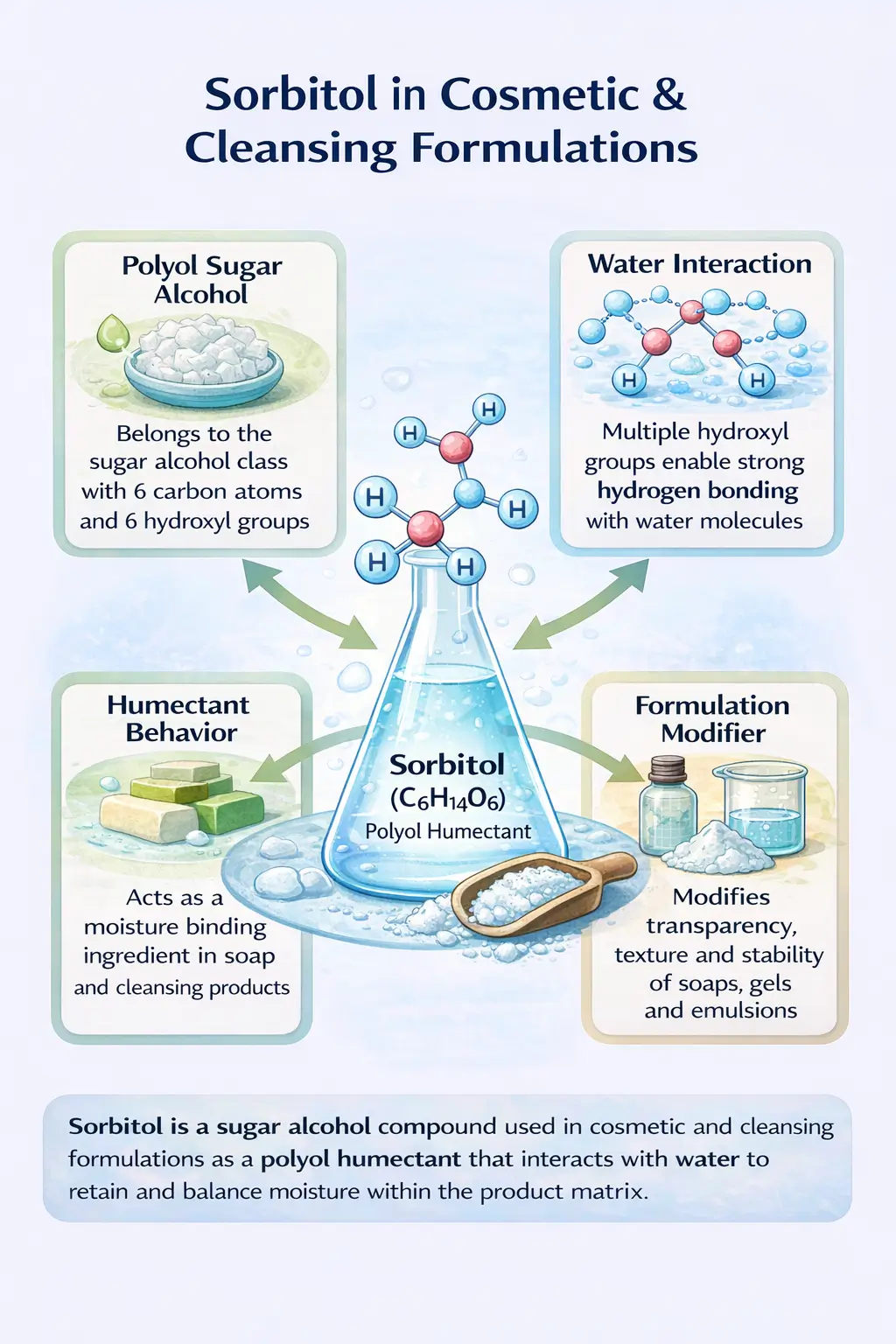
Sorbitol is a polyol compound widely used in cosmetic and cleansing formulations as a moisture interacting ingredient. Chemically it belongs to the family of sugar alcohols and contains multiple hydroxyl groups that allow strong interaction with water molecules. Because of this structure sorbitol behaves as a humectant that participates in hydration balance within cosmetic formulations.
Within soap systems and cleansing products, sorbitol functions primarily as a formulation modifier rather than a cleansing surfactant. Soap salts perform the cleansing role, while sorbitol interacts with the water phase and contributes to moisture distribution inside the formulation matrix. These interactions influence properties such as transparency, texture and stability in certain soap formats.
In some formulations sorbitol appears as part of sorbitol solution ingredients used during manufacturing. These aqueous solutions provide a controlled way to introduce the polyol into soap bases, liquid cleansers or cosmetic emulsions. The resulting system allows sorbitol to participate in the hydration environment surrounding surfactants and other formulation components.
This page belongs to the CleanFormulation Ingredient Library, a research project focused on analyzing how ingredients behave inside real formulations rather than evaluating cosmetic marketing claims.
Quick Facts
| Property | Description |
|---|---|
| Ingredient Type | Humectant and formulation modifier |
| Chemical Class | Polyol sugar alcohol |
| Chemical Formula | C6H14O6 |
| Functional Role | Moisture interacting compound within aqueous formulations |
| Ionic Class | Non ionic molecule |
| Typical Use Context | Bar soaps, liquid cleansers, cosmetic formulations and sorbitol solution ingredients |
| Physical State | Crystalline solid or viscous aqueous solution |
Why This Ingredient Appears on Cosmetic Labels
Consumers often encounter sorbitol on cosmetic ingredient labels because it is commonly used as a formulation component that interacts with moisture inside the product system. Ingredient lists follow the International Nomenclature of Cosmetic Ingredients system, which identifies sorbitol by its standardized INCI name.
In many cosmetic formulations sorbitol appears as part of the solvent and hydration environment surrounding surfactants, emulsifiers and other ingredients. The compound readily dissolves in water and contributes to moisture distribution within the product matrix.
Sorbitol may also appear in formulations because it is incorporated through sorbitol solution ingredients used during manufacturing. These solutions allow formulators to introduce controlled amounts of the polyol into the water phase of the formulation.
The presence of sorbitol in an ingredient list therefore reflects its role as a structural and hydration related component within the formulation environment rather than as a cleansing active ingredient.
Chemical Identity and Classification
Sorbitol is a sugar alcohol belonging to the polyol family of organic compounds. The molecule contains six carbon atoms and six hydroxyl groups, which explains its strong interaction with water. Its chemical formula is C6H14O6. Because of the high number of hydroxyl groups, sorbitol exhibits strong polarity and dissolves readily in aqueous environments.
Within cosmetic and cleansing formulations sorbitol behaves as a non ionic compound. Unlike surfactants or soap salts, it does not possess charged functional groups that interact directly with oils or soil during washing. Instead its role is associated with hydration behavior and solvent phase interactions.
The compound may be derived from the hydrogenation of glucose obtained from plant based carbohydrate sources. In formulation contexts, sorbitol frequently appears either as a crystalline material or as a pre prepared aqueous solution. These sorbitol solution ingredients allow controlled integration of the polyol into the water phase of cosmetic and cleansing products.
Because sorbitol belongs to the same chemical family as other polyols such as glycerin or xylitol, its functional behavior in formulations often relates to moisture interaction and solvent modification rather than surfactant activity.
Functional Role in Soap Systems
In bar and liquid soap formulations sorbitol primarily functions as a moisture interacting component that modifies the hydration state of the formulation matrix. The cleansing action itself is carried out by soap salts or surfactants, while sorbitol participates in the surrounding solvent environment.
When incorporated into certain soap bases, sorbitol can influence how moisture is retained within the product structure. These interactions affect properties such as flexibility of the soap bar, transparency of some soap bases and the behavior of the product under different humidity conditions.
Sorbitol may also contribute to structural characteristics in certain transparent or semi transparent soap compositions. In these systems polyols interfere with the typical crystallization pattern of soap salts. This disruption allows light to pass through the structure rather than scattering at crystalline boundaries.
In liquid cleansers sorbitol interacts with the water phase and may influence viscosity and solvent balance. The compound does not contribute directly to lather generation, but the hydration environment it creates can influence how surfactants behave during washing.
Ingredient Interaction Logic
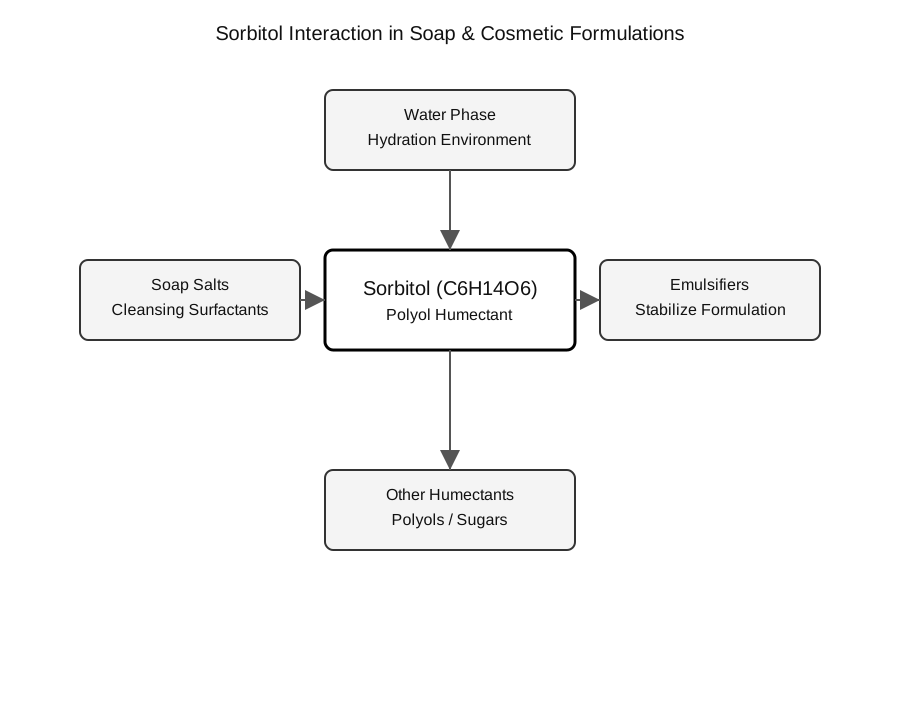
The functional behavior of sorbitol in cleansing formulations arises primarily from its interaction with the water phase. Multiple hydroxyl groups on the molecule allow it to establish hydrogen bonding networks with surrounding water molecules. These interactions influence moisture distribution and hydration balance within the formulation.
Soap salts such as Sodium palmate or sodium cocoate operate as the active cleansing agents in traditional soaps. Sorbitol does not interact with oils or soil particles in the same way. Instead it modifies the environment surrounding these surfactants by affecting the solvent properties of the aqueous phase.
In systems containing multiple humectants, sorbitol may interact with other polyols such as glycerin. These cooperative interactions contribute to moisture retention and influence how the product responds to environmental humidity during storage.
Chelating agents present in some cleansing formulations also operate within the same aqueous environment. While sorbitol does not bind mineral ions directly in the way chelators do, the hydration structure created by polyols may influence how minerals and surfactants interact within the formulation.
Phase Behavior in Cleansing Formulations
Sorbitol exhibits strong solubility in water because of the multiple hydroxyl groups present in its molecular structure. When introduced into an aqueous formulation the compound dissolves readily and becomes part of the continuous solvent phase. This behavior explains why sorbitol solution ingredients are frequently used during manufacturing rather than introducing the crystalline material directly.
In solid soap systems sorbitol may influence how the internal soap matrix interacts with retained moisture. Polyols can disrupt the typical crystallization pattern of fatty acid soap salts, which may alter optical properties and physical texture in certain soap formats. Transparent soap bases often rely on polyol mixtures that include sorbitol in combination with other compounds.
Temperature can influence the solubility and mobility of sorbitol within aqueous systems. Higher temperatures generally increase molecular movement and solubility, while lower temperatures may allow partial crystallization if the concentration exceeds solubility limits. Formulators therefore consider water balance and polyol concentration when designing stable cleansing formulations.
Regulatory Context
In cosmetic ingredient declarations sorbitol appears under its recognized International Nomenclature of Cosmetic Ingredients name sorbitol. Ingredient lists in cosmetic products are required to use standardized INCI terminology so that formulations can be interpreted consistently across regulatory jurisdictions.
Within the European Union cosmetic ingredient labeling is governed by Regulation (EC) No 1223 2009 on cosmetic products. The regulation requires that ingredients be listed in descending order of concentration when present above defined thresholds. Polyols such as sorbitol therefore appear in the ingredient declaration according to their proportion within the final formulation.
Ingredient databases such as the European Commission CosIng database classify sorbitol primarily as a humectant and solvent related ingredient within cosmetic products. This classification reflects its functional role within formulations rather than any marketing description applied to finished products.
Common Misunderstanding
A common misunderstanding arises from the assumption that sorbitol functions as an active cleansing ingredient in soap or cosmetic formulations. In practice the compound does not operate as a surfactant and does not directly participate in the removal of oils or soil during washing.
Instead sorbitol interacts with the water phase of the formulation and contributes to moisture distribution and structural behavior within the product system. Cleansing activity is provided by soap salts or synthetic surfactants present in the formulation.
Another misunderstanding relates to the interpretation of ingredient names. Some consumers encountering sorbitol cosmetic ingredient listings assume the compound represents a fragrance or active additive. In formulation contexts its role is generally structural and hydration related rather than sensory or cleansing oriented.
Structural Limitations
Although sorbitol functions effectively as a hydration modifying ingredient in many formulations, its use introduces certain formulation boundaries. One limitation arises from its high solubility in water. Because sorbitol interacts strongly with moisture, excessive concentrations may alter viscosity or create overly soft textures in some soap systems.
Another limitation involves crystallization behavior at high concentrations or under certain temperature conditions. Polyol rich formulations must be designed carefully to prevent unwanted crystallization that could affect visual clarity or texture in transparent soap bases.
In addition, sorbitol does not provide surfactant activity or emulsification capability. Formulators therefore rely on separate ingredients to perform cleansing or emulsifying functions while sorbitol remains part of the hydration environment surrounding those active components.
Product Formulation References Using This Ingredient
Summary of Findings
Sorbitol is a polyol compound belonging to the sugar alcohol family and appears in cosmetic ingredient lists under the INCI name sorbitol. Within cleansing and cosmetic formulations the ingredient functions primarily as a moisture interacting component that modifies hydration behavior within the water phase.
- Chemical Classification: Sorbitol is a polyol sugar alcohol with the chemical formula C6H14O6.
- Functional Role: The compound operates as a humectant and hydration modifying ingredient rather than a cleansing surfactant.
- Interaction Logic: Sorbitol interacts strongly with water molecules and influences the hydration environment surrounding surfactants and other ingredients.
- Phase Behavior: The ingredient dissolves readily in aqueous systems and may influence crystallization patterns within certain soap bases.
- Formulation Boundaries: Concentration balance, temperature stability and moisture interaction must be considered when incorporating sorbitol into cosmetic formulations.