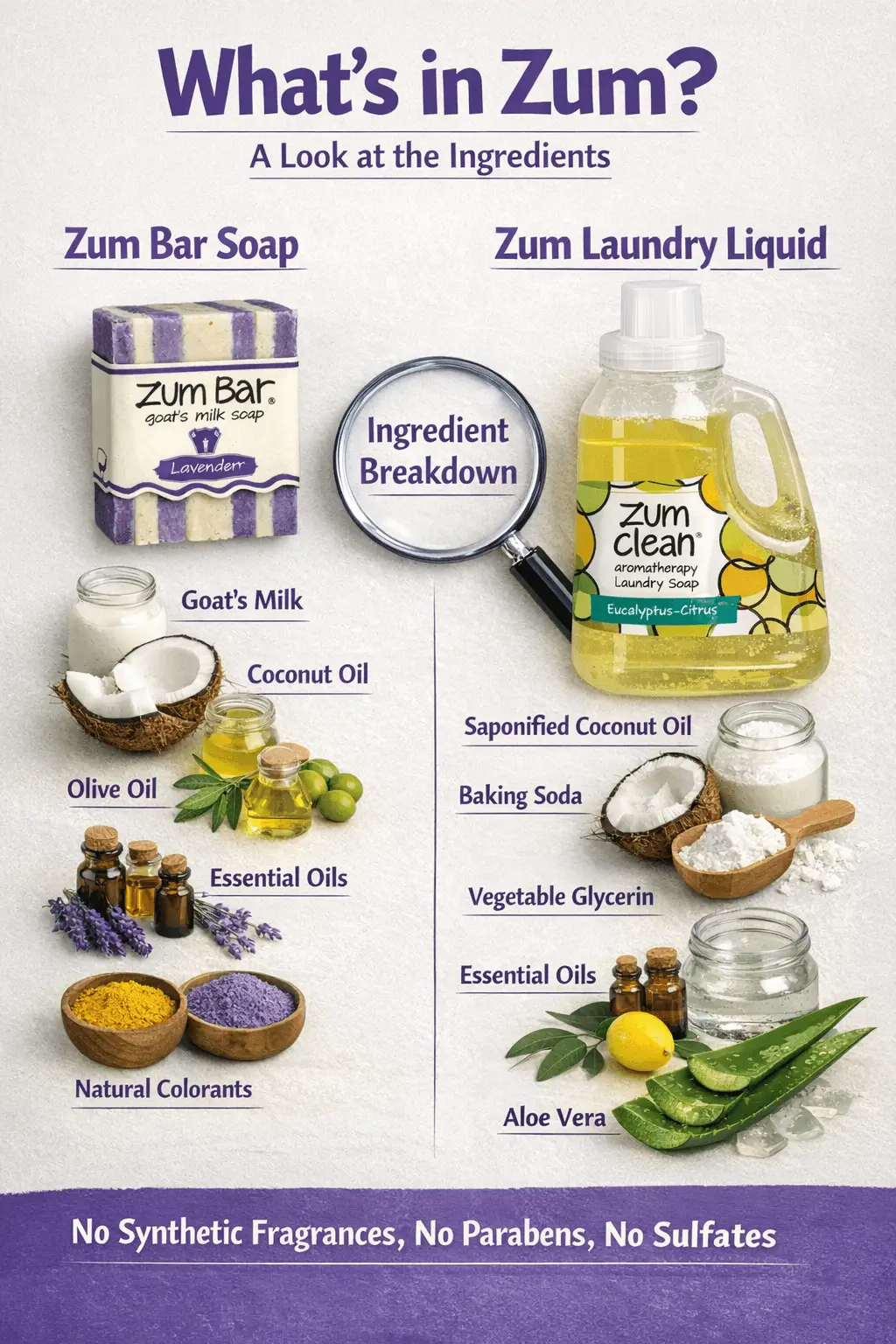
Ingredient Scope Covered In This Guide
This article examines ingredient disclosures and formulation behavior across multiple Zum product categories, including zum hand soap ingredients, zum bar goat's milk soap ingredients, zum clean laundry soap ingredients, zum laundry soap sea salt ingredients, and zum hand and body lotion ingredients.
Each category is evaluated strictly through an ingredient-function lens. Cleansing chemistry, emulsion structure, alkalinity, fatty-acid balance, and stability considerations are discussed where relevant. Performance claims, marketing language, and comparative rankings are intentionally excluded.
Where ingredient lists omit concentrations, processing detail, or functional context, those gaps are identified explicitly. Observed variability related to batch production, storage conditions, or formulation simplicity is discussed as part of ingredient behavior rather than treated as a defect.
Underlying Formulation Philosophy Observed
Across available labels and real-world handling characteristics, Zum formulations align more closely with traditional soapmaking logic discussed in the cold process soap ingredient analysis than with modern detergent engineering. Cleansing action is primarily generated through saponified fatty acids formed via oil–alkali reactions, with fragrance systems layered on top rather than integrated into complex surfactant matrices.
This approach results in ingredient lists that are relatively short and conceptually transparent, but it also introduces trade-offs. Soap-forward systems are inherently sensitive to oil ratios, fragrance load, curing time, and environmental conditions. Variations in bar hardness, liquid viscosity, and surface appearance can occur without indicating contamination or formulation failure.
In several observed products, sensory priorities appear to outweigh uniformity. Aroma intensity and tactile feel are emphasized, while strict batch-to-batch standardization is less dominant. This reflects a formulation philosophy that favors traditional chemistry and sensory experience over engineered consistency.
Bar Soap Ingredient System: Base Oils & Goat’s Milk Structure
Zum bar soaps are built on a traditional true-soap foundation similar to formulations explained in Castile soap ingredient systems created through the saponification of plant-derived oils with a sodium-based alkali. Goat’s milk, when present, functions as a secondary formulation modifier rather than a primary cleansing agent.
In zum bar goat's milk soap ingredients, the core cleaning action is produced by fatty-acid salts formed during the oil–alkali reaction. These salts are responsible for soil removal, emulsification of oils, and rinse-off behavior. Goat’s milk enters the formulation after the cleansing system is established, contributing sugars, proteins, and minor lipid fractions that subtly alter bar characteristics.
Observationally, goat’s milk inclusion affects bar color development during curing, surface feel during early use, and lather creaminess. It does not increase cleansing strength and does not alter the fundamental alkalinity of the soap once saponification is complete.
| Ingredient Group | Primary Function | Formulation Impact |
|---|---|---|
| Saponified Plant Oils | Primary cleansing mechanism | Controls lather type, cleansing strength, and bar longevity |
| Sodium-Based Alkali | Enables saponification | Determines final pH and soap completeness |
| Goat’s Milk | Secondary modifier | Influences texture, surface feel, and curing behavior |
| Fragrance Components | Sensory profile | Can soften bars and increase environmental sensitivity |
One practical limitation observed with milk-containing bars is increased sensitivity to heat and humidity. In warmer environments, surface sweating or softening can occur due to hygroscopic milk sugars rather than instability of the soap itself.
Fatty-Acid Composition & Cleansing Behavior
The performance characteristics of Zum bar soaps are governed more by fatty-acid balance than by ingredient names. Lather speed, bar hardness, perceived mildness, and wear rate are direct outcomes of the relative proportions of lauric, myristic, palmitic, stearic, and oleic acids produced during saponification.
Oils rich in lauric and myristic acids generate faster lather and stronger oil removal but can feel more drying when used frequently. Palmitic and stearic acids contribute structural hardness and creamier foam. Oleic acid slows lather formation but softens cleansing feel and accelerates surface wear. Fatty-acid driven cleansing behavior can also be compared with formulations analyzed in Aleppo soap ingredients.
| Fatty Acid Group | Approximate Range (%) | Functional Effect |
|---|---|---|
| Lauric + Myristic | 15–30% | Rapid lather, strong oil emulsification |
| Palmitic + Stearic | 25–40% | Bar hardness, dense and stable foam |
| Oleic | 20–40% | Milder feel, slower lather, faster wear |
In several observed bars, higher oleic content correlates with quicker edge rounding and surface erosion during daily use. This behavior reflects fatty-acid chemistry rather than formulation error and represents a conscious trade-off between mildness and durability.
Importantly, these fatty-acid dynamics remain consistent regardless of fragrance profile. Scent selection may influence bar softness and storage behavior, but it does not override the underlying fatty-acid structure.
Hand Soap Ingredients: Liquid Cleansing System Structure
Zum hand soaps differ fundamentally from bar soaps because liquid formulations must remain stable in water, resist phase separation, and maintain usable viscosity over time. The ingredient system therefore prioritizes solubility and dispersion in addition to cleansing chemistry.
Based on available ingredient disclosures and observed behavior, zum hand soap ingredients appear to rely on soap-based or hybrid cleansing systems comparable to commercial structures discussed in Dove soap ingredient analysis rather than dense synthetic surfactant stacks. Cleansing action is produced by dissolved fatty-acid salts or mild surfactants that remain suspended in the aqueous phase.
This approach simplifies ingredient lists but introduces practical trade-offs. Soap-forward liquid systems are more sensitive to temperature, fragrance load, and water mineral content than fully engineered detergent formulas. Variations in thickness and clarity are therefore expected rather than exceptional.
| Ingredient Group | Primary Role | Observed Behavior |
|---|---|---|
| Soap or Mild Surfactants | Cleansing and emulsification | Moderate foam with effective soil removal |
| Water | Carrier and dilution medium | Controls flow, rinse behavior, and dispersion |
| Fragrance Oils | Aroma profile | Can reduce clarity and soften viscosity |
| Stabilizers or Thickeners | Texture control | Limit separation and maintain pour consistency |
One practical observation with liquid soap systems of this type is seasonal viscosity shift. In cooler conditions, thickening can increase noticeably, while warmer environments may lead to thinning. This reflects the physical behavior of soap micelles rather than degradation or spoilage.
pH Behavior Across Soap Formats
Zum soap products generally operate within an alkaline pH range consistent with true soap chemistry. This alkalinity is an inherent outcome of fatty-acid salts and cannot be substantially reduced without converting the formulation to a detergent-based system.
While pH is often discussed in isolation, its practical impact depends on formulation context. Contact time, dilution, fatty-acid profile, and rinse behavior influence user experience more strongly than small numeric differences within typical soap pH ranges.
| Product Format | Typical pH Range | Stability Notes |
|---|---|---|
| Bar Soap | 9.0 – 10.5 | Stable once fully cured |
| Liquid Hand Soap | 9.0 – 10.0 | Sensitive to dilution and fragrance load |
| Laundry Soap | 9.5 – 11.0 | Higher alkalinity supports soil removal |
Importantly, alkaline pH alone does not determine irritation potential or cleansing strength. In many cases, formulation balance and usage patterns exert greater influence than pH values within these ranges.
Zum Laundry Soap Ingredients: Cleansing Chemistry & Formulation Logic
Zum laundry soaps rely on high-alkalinity, soap-based cleansing systems designed to remove oils and particulate soil through emulsification rather than enzymatic or optical enhancement. Ingredient lists emphasize fatty-acid salts, alkaline builders, and fragrance rather than complex detergent architectures.
In zum clean laundry soap ingredients, the absence of enzymes, optical brighteners, and polymeric boosters shifts cleaning performance toward mechanical factors such as water temperature, agitation, dosage, and rinse volume. From an ingredient perspective, soil removal is driven primarily by fatty-acid chain interaction with oils and suspended dirt. Soap-based laundry chemistry differences are explored further in Arm & Hammer laundry soap ingredients.
This formulation strategy favors ingredient transparency and simplicity but introduces predictable limitations. Soap-based laundry systems are less effective against protein-based stains and can interact unfavorably with hard water minerals if not adequately diluted.
| Ingredient Group | Primary Role | Fabric Interaction Notes |
|---|---|---|
| Fatty-Acid Salts | Soil emulsification | Highly effective on oils and greases |
| Alkaline Builders | pH elevation | Improves grease removal, may stiffen fibers if overused |
| Water | Solvent and carrier | Controls dilution and rinse efficiency |
| Fragrance Components | Aroma only | No contribution to cleaning chemistry |
A commonly observed limitation with soap-based laundry products is reduced effectiveness in hard water conditions discussed in laundry-focused systems such as Fels-Naptha soap ingredient analysis. Calcium and magnesium ions can bind to fatty-acid salts, forming insoluble residues that reduce available cleaning agents unless water softness or dosage is adjusted.
Sea Salt Inclusion: Ingredient Purpose & Trade-Offs
Sea salt in zum laundry soap sea salt ingredients functions primarily as a mineral modifier rather than an active cleanser. Its presence alters solution ionic strength and foam behavior but does not directly increase stain removal capability.
Sodium Chloride can influence how soap molecules aggregate in wash water, subtly affecting foam volume and rinsing perception. In practical use, this may create the impression of easier rinse-off without changing the underlying emulsification chemistry.
| Aspect | Observed Influence | Practical Implication |
|---|---|---|
| Foam Volume | Slight reduction | Perceived easier rinsing |
| Residue Formation | Variable | Depends strongly on water hardness |
| Cleaning Power | Neutral | No direct enhancement of stain removal |
In softer water conditions, sea salt inclusion appears largely neutral. In harder water environments, mineral interactions may increase residue risk if dosage and rinse volume are not adjusted accordingly.
Hand & Body Lotion Ingredients: Emulsion Design & Functional Roles
Zum hand and body lotions are structured as oil-in-water emulsions designed to distribute lipids evenly across the skin surface while remaining pourable and shelf-stable. Unlike soap products, lotions do not rely on alkalinity or saponification; their performance is governed by emulsion balance, preservative adequacy, and ingredient compatibility.
In zum hand and body lotion ingredients, the primary functional groups include water as the continuous phase, plant-derived oils or butters as emollients, emulsifiers to bind oil and water, and preservatives to control microbial growth. Fragrance components are layered for sensory effect but do not contribute to emulsion stability.
From an ingredient perspective, lotion performance depends less on individual oil selection and more on the emulsifier system’s ability to maintain uniform dispersion over time. Separation, thickening, or thinning are typical indicators of emulsion stress rather than contamination.
| Ingredient Group | Primary Role | Formulation Impact |
|---|---|---|
| Water | Continuous phase | Controls spreadability and absorption feel |
| Plant Oils & Butters | Emollient function | Influence richness and surface lubrication |
| Emulsifiers | Oil–water binding | Determine long-term stability and texture |
| Preservatives | Microbial control | Protect water phase from contamination |
| Fragrance Components | Sensory profile | May slightly affect viscosity over time |
One practical observation with lotion formats of this type is sensitivity to temperature cycling. Repeated exposure to heat followed by cooling can stress emulsifier systems, occasionally resulting in mild separation or texture change without rendering the product unsafe or unusable.
Preservation, Shelf Stability & Storage Behavior
Lotion stability depends on preservative coverage, packaging exposure, and storage conditions rather than ingredient origin. Water-containing formulations require active preservation regardless of how minimal or plant-focused the ingredient list appears.
In simplified formulations, preservative systems are often calibrated tightly to the expected shelf life and packaging type. This can result in adequate stability under normal use while leaving less margin for prolonged heat exposure, repeated contamination, or extended storage after opening.
Observationally, lotions stored in warm environments or subjected to frequent cap exposure may thicken, thin, or shift slightly in texture over time. These changes typically reflect emulsion stress rather than microbial activity when preservative systems are intact.
Ingredient Label Transparency Across Zum Product Categories
Zum ingredient labels generally communicate core ingredient identity clearly but provide limited quantitative or process-level detail. Labels prioritize naming raw materials over explaining functional ratios, processing order, or formulation intent.
Across zum hand soap ingredients, zum bar goat's milk soap ingredients, zum clean laundry soap ingredients, and zum hand and body lotion ingredients, ingredient lists tend to disclose major components while omitting concentration ranges, fatty-acid distributions, and emulsifier system logic. This level of disclosure is typical for consumer products but leaves important formulation behavior implicit rather than explicit.
From an ingredient analysis perspective, transparency is strongest at the identity level and weakest at the functional-detail level. Users can identify what categories of ingredients are present, but not how those ingredients are balanced or optimized within the formula. Disclosure variation can also be observed in commercial ingredient labeling analyzed in Safeguard soap ingredient analysis.
| Product Category | Identity Disclosure | Functional Detail | Observed Gaps |
|---|---|---|---|
| Bar Soap | High | Low | Oil ratios, curing method, superfat level |
| Hand Soap | Moderate | Low | Surfactant balance, viscosity control method |
| Laundry Soap | Moderate | Low | Alkalinity buffering, water hardness tolerance |
| Hand & Body Lotion | Moderate | Low | Emulsifier system strength, preservative margin |
It is important to distinguish between limited transparency and misleading labeling. The absence of technical detail does not imply formulation risk; it simply reflects standard cosmetic and household product disclosure norms that favor brevity over chemical explanation.
Ingredient Variability, Batch Differences & Natural Inputs
Ingredient variability in Zum products is largely driven by the use of natural inputs and soap-based systems rather than inconsistent manufacturing practices. Variations in color, hardness, viscosity, or scent intensity are expected outcomes of these formulation choices.
Plant-derived oils, milk components, and fragrance materials naturally vary based on sourcing, season, and processing. In soap-forward formulations, these variations are less buffered by synthetic stabilizers, making them more visible to the end user.
Observationally, batch-to-batch differences are most noticeable in bar soaps and liquid hand soaps, where fragrance load and oil composition exert direct influence on physical properties. These differences typically remain within functional norms and do not indicate contamination or reduced safety.
Safety, Handling & Practical Use Considerations
The safe and effective use of Zum products is primarily determined by formulation type, alkalinity, and storage conditions rather than by individual ingredient names. Soap-based systems and water-containing emulsions behave predictably when used within their intended context.
For bar soaps and liquid hand soaps, alkaline pH is an inherent characteristic of true soap chemistry. This alkalinity supports cleansing efficiency but also means that prolonged contact, excessive frequency, or insufficient rinsing can increase residue perception. Normal rinse-off use mitigates this effect without requiring formulation modification.
Laundry soaps formulated around fatty-acid salts require adequate dilution and rinse volume to minimize fabric residue, particularly in hard water conditions. Overconcentration can lead to fiber stiffness or soap film formation, which reflects chemistry rather than product defect.
Lotion formats introduce different handling considerations. Because they contain water, they rely on preservative systems to remain stable during normal use. Clean dispensing, closed packaging, and avoidance of prolonged heat exposure help preserve texture and uniformity over time.
Storage Behavior & Ingredient-Driven Limitations
Ingredient-driven limitations in Zum products are most often related to environmental exposure rather than formulation inadequacy. Temperature, humidity, and water quality influence how soap-based and emulsion-based products age during use.
Bar soaps containing milk components or high fragrance loads may soften or sweat when stored in humid environments. Allowing airflow between uses and avoiding sealed containers reduces moisture retention and prolongs bar life. Environmental storage sensitivity is also discussed in traditional soap systems analyzed in black soap ingredient analysis.
Liquid soaps may thicken in cold conditions and thin in warm conditions due to the physical behavior of soap micelles. Gentle mixing typically restores uniformity without indicating spoilage or separation failure.
Lotion products are most stable when stored away from direct heat and light. Repeated temperature cycling can stress emulsifier systems, leading to minor texture changes that reflect physical rearrangement rather than microbial instability when preservative coverage remains intact.
Summary of Findings
- Soap-Forward Chemistry: Zum products rely primarily on traditional soap chemistry rather than modern synthetic detergent systems, influencing cleansing behavior, alkalinity, and variability.
- Ingredient Simplicity: Ingredient lists emphasize identifiable raw materials, but provide limited functional or quantitative formulation detail.
- Fatty-Acid Balance Matters: Cleansing strength, bar longevity, and lather behavior are driven by fatty-acid composition rather than ingredient names or fragrance type.
- Liquid Systems Trade Stability for Simplicity: Hand soaps and laundry soaps prioritize minimal formulations, resulting in expected viscosity and clarity variation with temperature and water quality.
- Lotions Depend on Emulsion Integrity: Lotion performance and shelf stability are governed by emulsifier balance and preservative coverage, not oil origin alone.
- Label Transparency Is Identity-Level: Labels disclose what ingredients are present but not how they are proportioned or optimized.
- Observed Variability Is Structural: Batch differences and texture changes reflect formulation design choices rather than quality defects.
References
- Dunn, K. M. Scientific Soapmaking. Author reference
- Broze, G. Handbook of Detergents Part A: Properties. CRC Press reference
- Rosen, M. J. Surfactants and Interfacial Phenomena. Wiley Online Library
- Brummer & Godersky. Cosmetic Emulsion Science. Scientific reference
- U.S. Food and Drug Administration. Cosmetic Labeling Guidance. FDA reference
- European Commission CosIng Database. CosIng database