What Marketing Language Is Designed To Do
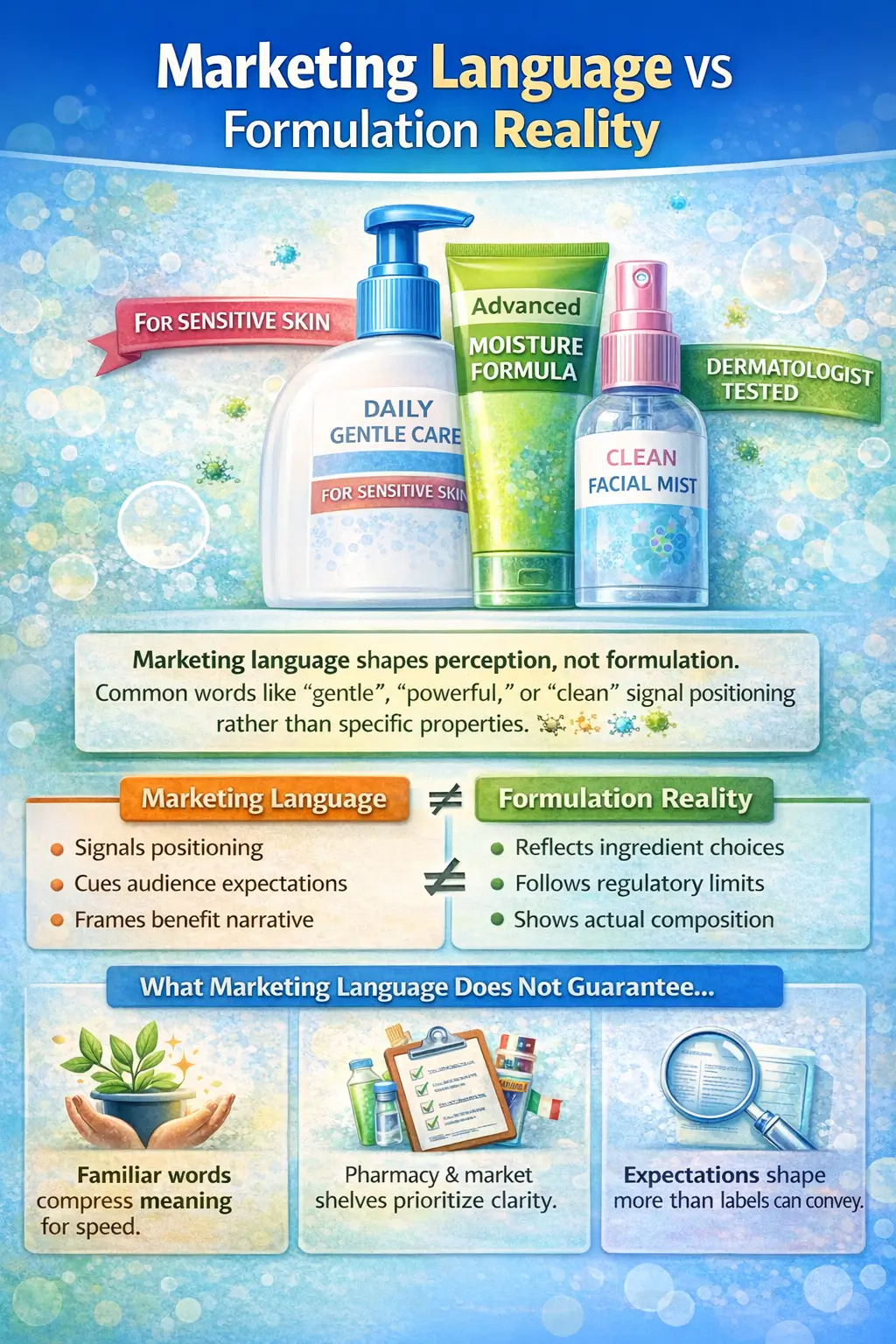
Marketing language exists to frame perception. Its purpose is to signal positioning, intended audience, and perceived benefit within seconds of visual contact. It is not intended to describe formulation structure or disclose technical decisions.
Words such as gentle or powerful are interpretive cues rather than specifications. They operate in relative, not absolute, terms and are shaped by consumer expectations as much as by formulation choices.
This is why similar products can use different language without meaningfully differing in composition. The language reflects narrative strategy, not necessarily chemical divergence.
Why Descriptive Language Rarely Maps To Ingredients
Consumers often attempt to translate marketing descriptors directly into ingredient signals. For example, a mild claim may be expected to correspond to specific surfactants or concentrations. In practice, this mapping is rarely one-to-one.
Formulation outcomes emerge from interaction, balance, and context. Two products can behave similarly while using different ingredient systems, just as similar ingredient lists can produce noticeably different experiences.
Marketing language collapses this complexity into simplified cues. The simplification is intentional, not deceptive, but it limits how precisely language can be read.
How Regulation Shapes What Marketing Can Say
Within the European Union, marketing language is not unrestricted. Article 20 of Regulation (EC) No 1223/2009 prohibits cosmetic claims that are misleading, unsupported, or imply characteristics the product does not possess. This article establishes the legal boundary between acceptable promotional language and misrepresentation.
That boundary is further clarified by Regulation (EU) No 655/2013, which sets out the “Common Criteria” for cosmetic claims. These criteria require that claims be supported by adequate and verifiable evidence, be truthful, and not exaggerate performance beyond what can be substantiated.
As a result, many common marketing terms operate within a permitted zone of interpretive flexibility. Words such as gentle, advanced, or effective are allowed provided they do not imply measurable medical or therapeutic outcomes that would require a different regulatory classification.
This framework explains why marketing language often feels broad rather than technical. The vocabulary is shaped by compliance requirements under EU claims regulation, not solely by brand preference.
Why Certain Marketing Phrases Invite Over-Interpretation
Some marketing terms consistently attract more interpretation than they can support. Words such as natural, clean, advanced, or dermatologist-tested appear frequently on European packaging, yet none of them correspond to a fixed formulation standard.
These phrases operate as positioning signals. They indicate how a product is meant to be perceived relative to others on the shelf, not how it is chemically constructed. The same term may appear on products with very different ingredient systems.
The confusion arises when consumers assume shared language implies shared formulation logic. In reality, the language often reflects audience targeting rather than ingredient strategy.
Why The Absence Of A Claim Does Not Imply Absence Of A Feature
Another frequent assumption is that if a product does not advertise a particular attribute, it must lack that characteristic entirely. This reasoning is understandable but incomplete.
Claims are selected strategically. Space constraints, regulatory caution, and brand positioning all influence what appears on packaging. Many formulation choices are never mentioned simply because they are not central to the product narrative.
As a result, silence on a label should not be read as negation. It usually reflects prioritization, not omission at the formulation level.
How Marketing Language Functions On European Shelves
In European supermarkets and pharmacies, marketing language must work quickly. Products are viewed at arm’s length, often for only a few seconds, and across multiple languages.
This environment favors short, familiar terms that compress meaning. Nuance is sacrificed for clarity and speed. The result is language that feels declarative even when it is intentionally broad.
Understanding this retail context helps explain why marketing claims can feel more definitive than the underlying formulation decisions they reference.
Where Interpretation Reaches Its Limits
Marketing language cannot fully account for individual experience. Factors such as usage habits, environment, and personal expectation shape perception in ways that no label can predict.
This is where interpretation often breaks down. Consumers may look to language for certainty that it is not designed to provide. The gap is structural rather than intentional.
Recognizing this limit allows marketing language to be read as context-setting rather than as evidence.
This disconnect is particularly visible in legacy utility soaps and mainstream personal-care brands, where ingredient disclosures for products such as Fels-Naptha soap formulations or Nivea product ingredient systems often differ from the assumptions created by long-standing marketing narratives.
Summary of Findings
- Marketing language frames perception: It signals positioning, not formulation detail.
- Words do not map directly to ingredients: Similar terms can describe very different compositions.
- Claims are selective: What appears on packaging reflects narrative choice and regulatory limits.
- Retail context compresses meaning: Shelf language prioritizes speed and clarity over nuance.
- Interpretation has limits: Labels cannot predict individual experience or outcome.
References & Primary Sources
| Source Title | Authority | Specific Relevance | Official Link |
|---|---|---|---|
| Regulation (EC) No 1223/2009 – Article 20 | European Parliament & Council | Establishes legal prohibition of misleading cosmetic claims and defines claim responsibility. | EUR-Lex (Article 20) |
| Regulation (EU) No 655/2013 | European Commission | Defines the Common Criteria for cosmetic claims including truthfulness, evidential support, fairness, and informed decision-making. | Claims Regulation |
| Technical Document on Cosmetic Claims Substantiation | European Commission | Provides interpretive guidance on evidential standards required to support cosmetic marketing claims. | European Commission – Cosmetics Guidance |
Related Regulatory Context
- Common Criteria Framework: Legal requirement that cosmetic claims be supported by adequate and verifiable evidence.
- Misleading Claims Standard: Claims must not attribute characteristics the product does not possess or imply medical classification.