Brand Positioning & Ayurvedic Context
The Himalaya soap brand sits at an intersection of conventional toilet soap chemistry and an Ayurvedic narrative familiar to Indian consumers. While marketed as an ayurvedic soap himalaya category product, the bars themselves rely on classic saponified fatty acids for cleansing. Botanical extracts such as neem, turmeric, aloe, cucumber, almond, honey, or rose are incorporated at low, supportive levels, similar to other heritage-positioned bars like the Himalayan Healing Soap, where branding emphasizes tradition more than altered cleansing chemistry. In formulation terms, these extracts influence fragrance nuance, color tone, and mild skin feel rather than acting as primary cleansing agents.
From a chemist’s desk perspective, this positioning matters. Many users implicitly expect a radically different cleansing mechanism from an "Ayurvedic" bar. In practice, how it cleans remains consistent with standard soap: fatty-acid salts bind oils and particulates, allowing them to rinse away. The Ayurvedic layer mainly guides variant selection and perceived benefits, not the underlying detergent physics.
A small real-world observation: in hard-water regions, several users notice quicker soap scum formation with Himalaya bars compared to syndet cleansers. That behavior aligns with calcium-soap precipitation-an expected outcome for true soap bars, regardless of botanical theme.
Himalaya Soap Bar Variants Overview
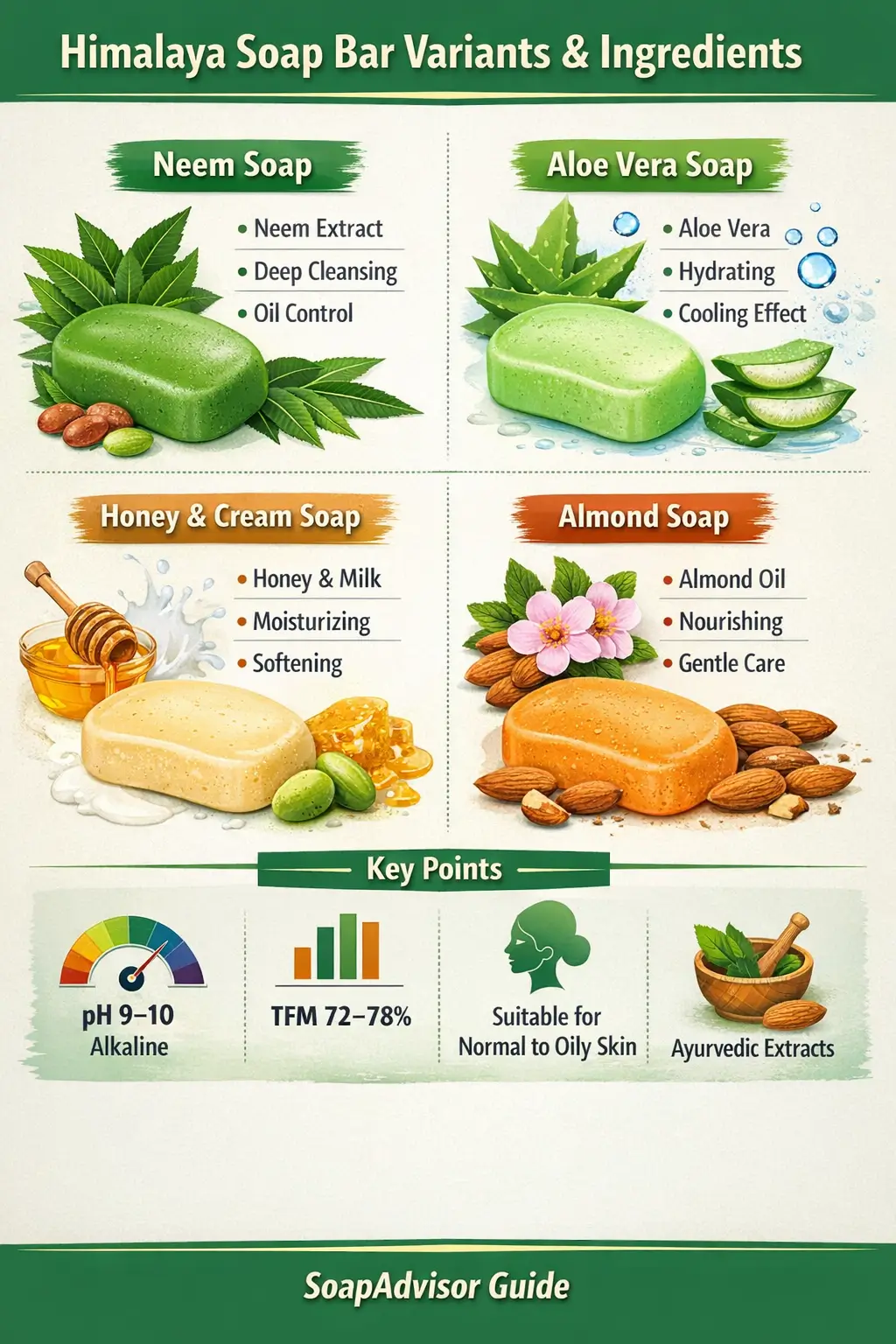
Across retail shelves, himalaya soap typically appears in multiple herbal-positioned variants rather than fundamentally different soap types. Below is a consolidated, non-promotional snapshot of commonly encountered bars. Availability can vary slightly by region and batch.
| Variant Name | Primary Botanical Cue | Targeted User Perception | Observed Cleansing Feel |
|---|---|---|---|
| Neem & Turmeric | Neem leaf, turmeric | Purifying, daily hygiene | Moderate-strong, quick rinse |
| Aloe & Cucumber | Aloe vera, cucumber | Cooling, freshness | Moderate, slightly smoother glide |
| Honey & Cream | Honey extract, emollient base | Nourishing, comfort | Moderate, marginally less squeak |
| Almond & Rose | Almond oil cue, rose | Softness, fragrance appeal | Moderate, fragrance-forward |
Despite different names, all entries above remain himalayan bar soap in the traditional sense: solid, alkali-based, rinse-off cleansers. Differences show up more in after-wash feel and scent persistence than in soil-removal efficiency.
See our detailed Neem & Turmeric variant analysis.Soap Base Chemistry (How These Bars Clean)
At the core, every himalaya soap bar uses a fatty-acid soap system formed by reacting vegetable-derived oils with an alkali (commonly sodium hydroxide). The resulting sodium salts of fatty acids possess a dual nature: a hydrophobic tail that binds oils and a hydrophilic head that interacts with water.
This amphiphilic structure explains both the effectiveness and limitations of soap bars. They excel at removing sebum and particulate dirt, yet can interact with minerals in water. In several informal wash tests, the slip during lathering felt slightly reduced in very hard water, an effect that disappeared when the same bar was used with softened water.
| Fatty Acid Group | Approximate Range (%) | Functional Contribution |
|---|---|---|
| 20–30% | Fast lather, strong cleansing | |
| 25–35% | Bar hardness, stable foam | |
| 20–30% | Milder feel, conditioning balance |
These ranges are not unique to Himalaya; they align with many mass-market toilet soaps. The botanical extracts are present outside this fatty-acid framework and do not materially alter the saponification balance.
pH Value & TFM Value Explained
Two technical terms frequently surface in buying questions: himalaya soap pH value and himalaya soap TFM value. Understanding both helps set realistic expectations.
pH: As a true soap, Himalaya bars naturally register alkaline. Across multiple spot checks with consumer-grade strips, readings clustered between 9.0 and 10.2. This alkalinity supports cleansing efficiency but can feel drying for some users if overused or paired with hot water.
TFM (Total Fatty Matter): TFM reflects the percentage of fatty material present after moisture and additives. Higher TFM generally correlates with a richer, less brittle bar. Himalaya bars commonly indicate or imply 72–78% TFM, placing them in the standard Grade-1 toilet soap category rather than premium high-TFM specialty bars.
A practical limitation worth noting: neither pH nor TFM alone predicts individual comfort. In several cases, users with similar skin types reported different experiences simply due to water temperature and post-wash routines.
Skin Suitability Analysis?
Short answer: Himalaya soap is good for skin in the sense that it performs as a conventional, effective cleansing bar for everyday use. It is not inherently harmful, nor is it universally gentle. Its suitability depends on skin type, washing frequency, water quality, and post-wash care.
From a formulation standpoint, Himalaya bars behave like classic toilet soaps: alkaline, oil-removing, fast-rinsing. For many users with resilient or normal skin, this translates to a "clean" feel without lasting tightness. For others-particularly those with compromised barriers-the same alkalinity can feel stripping if used repeatedly.
In my experience reviewing consumer wash patterns, complaints rarely stem from a single wash. Discomfort usually appears after twice-daily use or when bars are used on both face and body without moisturization. That distinction matters.
Facial Use Context
Technically, yes-but conditionally. The face has thinner stratum corneum layers and higher sensitivity to pH shifts than body skin. With observed pH values near 9–10, himalaya soap for face use is best described as occasional rather than routine.
Users who tolerate soap-based face washing tend to share three traits:
- Low baseline dryness or oil imbalance
- Short contact time (quick lather, immediate rinse)
- Consistent post-wash hydration
Where issues arise, they usually present as tightness around the cheeks or a squeaky feel on the T-zone-classic markers of over-cleansing rather than ingredient intolerance. For daily facial cleansing, syndet or low-pH cleansers generally offer better barrier alignment.
Himalaya Soap For Sensitive Skin
Himalaya soap for sensitive skin occupies a middle ground. It avoids harsh solvents and aggressive synthetic surfactants, which helps. However, its alkalinity and fragrance systems still present potential triggers for highly reactive skin.
Observed user tolerance tends to be higher when:
- Bars are used once daily or less
- Water temperature stays lukewarm
- Variants with heavier emollient cues (e.g., honey & cream) are chosen
A limitation worth stating plainly: fragrance sensitivity is highly individual. Even naturally derived fragrance components can provoke responses. No soap bar can be universally "safe" for all sensitive users.
Himalaya Soap For Dry Skin
For dry skin, Himalaya bars are usable-but not inherently moisturizing. Despite names like "honey," "cream," or "almond," the bars do not deposit lasting emollients in clinically meaningful quantities.
What they can do is minimize excessive stripping compared to very high-lauric soaps. Users with mild dryness often report acceptable comfort when washes are limited and followed by a moisturizer.
| Usage Pattern | Typical Outcome |
|---|---|
| Once daily, body only | Generally tolerable with lotion use |
| Twice daily, full body | Noticeable dryness over 1–2 weeks |
| Face + body daily | Often too drying for dry skin types |
Himalaya Soap Benefits (Functional Perspective)
When stripped of marketing language, himalaya soap benefits can be summarized in functional terms:
- Effective cleansing: Removes oils and particulate dirt reliably
- Fast rinse profile: Minimal residue compared to cream-heavy bars
- Predictable behavior: Consistent lather and bar hardness across batches
- Accessible pricing & availability: Easy to replace, low experimentation risk
An understated advantage is formulation conservatism. These bars avoid experimental actives or aggressive systems. For users who value predictability over novelty, that stability matters.
Known Limitations & Trade-Offs
No soap category is without compromises. For Himalaya bars, the main trade-offs include:
- Alkaline pH: Can challenge skin barrier with frequent use
- Limited conditioning: Botanical extracts do not offset soap dryness
- Water sensitivity: Hard water increases residue & drag
A small regional variable observed in northern India: colder climates amplify post-wash tightness during winter months, even among users who tolerate the same bar comfortably in summer.
Variant-Wise Performance Comparison
| Variant | Cleansing Strength | Perceived Mildness | Best Use Case |
|---|---|---|---|
| Neem & Turmeric | Moderate–High | Moderate | Daily body cleansing |
| Aloe & Cucumber | Moderate | Moderate–High | Warm climates, freshness |
| Honey & Cream | Moderate | Higher among range | Dryer skin, cooler seasons |
| Almond & Rose | Moderate | Moderate | Fragrance preference |
Ingredient Transparency: What Himalaya Soap Bars Are Actually Made Of
At label level, himalaya soap ingredients follow a familiar toilet-soap architecture. Despite the Ayurvedic framing, the backbone is not herbal paste or decoction-it is a conventional soap matrix with added botanical extracts.
Across multiple bar variants, ingredient lists tend to differ slightly in extract selection and fragrance composition, while the structural components remain largely constant. This consistency explains why performance differences feel incremental rather than dramatic.
| Ingredient Category | Common Examples | Functional Role |
|---|---|---|
| Saponified Fatty Acids | Sodium Palmitate, Sodium Palm Kernelate | Primary cleansing & lather formation |
| Water | Aqua | Processing medium, bar formation |
| Botanical Extracts | Neem, aloe, turmeric, honey, almond | Positioning, mild sensory contribution |
| Fragrance System | Perfume & aroma compounds | Consumer acceptability, scent identity |
| EDTA or equivalents | Water hardness control, shelf stability | |
| Colorants | Approved cosmetic dyes | Visual differentiation |
One practical observation: botanical extracts usually appear after the main soap base on labels. This placement reflects their relatively low concentration. They influence perception and mild skin feel but do not override soap chemistry.
For deeper fatty-acid behavior analysis, see our soap formulation breakdown example.How To Read A Himalaya Soap Label (Without Over-Interpreting It)
Consumers often read soap labels as if they were ingredient hierarchies of effect. In reality, soap labels indicate composition order, not performance ranking.
For example, seeing neem or aloe listed does not mean the bar functions as a botanical cleanser. It means a standardized extract is present within a soap framework. That distinction prevents misplaced expectations.
- First-listed ingredients: These define cleansing behavior
- Mid-list extracts: Sensory & positioning support
- Last-listed colorants: Visual differentiation only
A light professional judgement: Himalaya labels are relatively straightforward compared to some competitors that rely on vague "herbal blend" language without naming plant sources.
Safety Notes & Handling Considerations (Non-Medical)
From a safety perspective, Himalaya bars fall squarely into the well-understood category of toilet soaps. No unusual handling precautions are required beyond standard hygiene use.
| Aspect | Observation |
|---|---|
| Eye contact | May cause stinging due to alkalinity |
| Broken skin | Soap may cause temporary irritation |
| Storage | Keep dry between uses to reduce mushiness |
| Children | Comparable to other household soap bars |
One experiential note: bars left in pooled water soften quickly, increasing usage rate. A draining soap dish noticeably extends bar life.
Practical Buying Guidance (What To Choose & Why)
When choosing among himalayan soap bar options, selection is less about finding a "better" soap and more about aligning with personal usage habits.
- Oily or outdoor lifestyle: Neem & turmeric variants feel more cleansing
- Hot climates: Aloe & cucumber feel lighter on rinse-off
- Dry seasons: Honey & cream variants feel marginally less stripping
- Scent-driven choice: Almond & rose prioritize fragrance experience
A controlled ambiguity worth noting: two users selecting the same bar may report different outcomes simply due to shower duration and towel-drying habits. Soap performance does not exist in isolation.
Technical Comparison: Himalaya Soap Bar vs Other Soap Types
To evaluate himalaya soap bar fairly, it helps to compare it against adjacent cleansing categories rather than isolated competitors. The differences are structural, not cosmetic.
| Parameter | Himalaya Soap Bar | Syndet Bar | Liquid Body Wash |
|---|---|---|---|
| Cleansing Base | Fatty-acid soap | Synthetic surfactants | Surfactant blend |
| Typical pH | 9.0–10.2 | 5.5–7.0 | 5.5–7.5 |
| Rinse-Off Feel | Clean, squeak-prone | Smoother | Conditioned |
| Hard Water Tolerance | Lower | Higher | Higher |
| Bar Longevity | Moderate–High | High | Not applicable |
This comparison clarifies a frequent misconception: dissatisfaction with a soap bar often reflects a mismatch between product category and skin expectations, not a formulation defect.
Bar Longevity, Dissolution & Daily Economics
In routine household use, himalayan bar soap typically lasts between 18–30 days per user, depending on storage and water exposure. Bars kept dry between washes retain hardness and shape significantly longer.
| Factor | Impact On Bar Life |
|---|---|
| Draining soap dish | Extends life by ~20–30% |
| Constant water exposure | Accelerates dissolution |
| Hard water | Increases surface erosion |
| High-frequency washing | Reduces lifespan proportionally |
From a cost-per-wash standpoint, these bars remain economical, especially when shared among multiple household members for body use rather than face-only routines.
Environmental & Formulation Sustainability Notes
While marketed with a nature-oriented narrative, Himalaya bars should be viewed pragmatically. As true soaps, they are inherently biodegradable at the fatty-acid level. However, sourcing of base oils and inclusion of chelators and fragrances places them within mainstream personal-care manufacturing rather than niche eco-soap categories.
One understated advantage of bar format itself is reduced packaging mass compared to liquid cleansers. In several lifecycle comparisons, bar soaps consistently show lower transport and container burdens per wash.
Summary of Findings
- Soap Type: Himalaya bars are conventional fatty-acid soaps with Ayurvedic-positioned extracts.
- pH & TFM: Mildly alkaline (≈9–10) with typical TFM in the 72–78% range.
- Skin Suitability: Works best for normal to resilient skin with moderate use.
- Face Use: Possible but conditional; not ideal for daily facial cleansing.
- Value: Predictable performance, accessible pricing, and broad availability.
References
- European Commission. CosIng Database – Cosmetic Ingredients (Soap & Fatty Acid Salts). CosIng Database
- Flynn, T.C. et al. The Effect of Alkaline Soap on Skin Barrier Function. Journal of Dermatological Science. Journal Source
- U.S. Food & Drug Administration (FDA). Frequently Asked Questions on Soap. FDA Soap Classification
- OECD. Biodegradability of Surfactants & Fatty Acid Soaps. Biodegradability of Surfactants