Definition and System Identity
Linear Alkylbenzene Sulfonates, often abbreviated as LAS, are anionic surfactants belonging to the synthetic detergent class, widely used as primary cleansing agents in modern washing systems.
They are derived from linear alkylbenzene structures that are sulfonated to introduce a negatively charged functional group, enabling interaction with water and oily soils simultaneously.
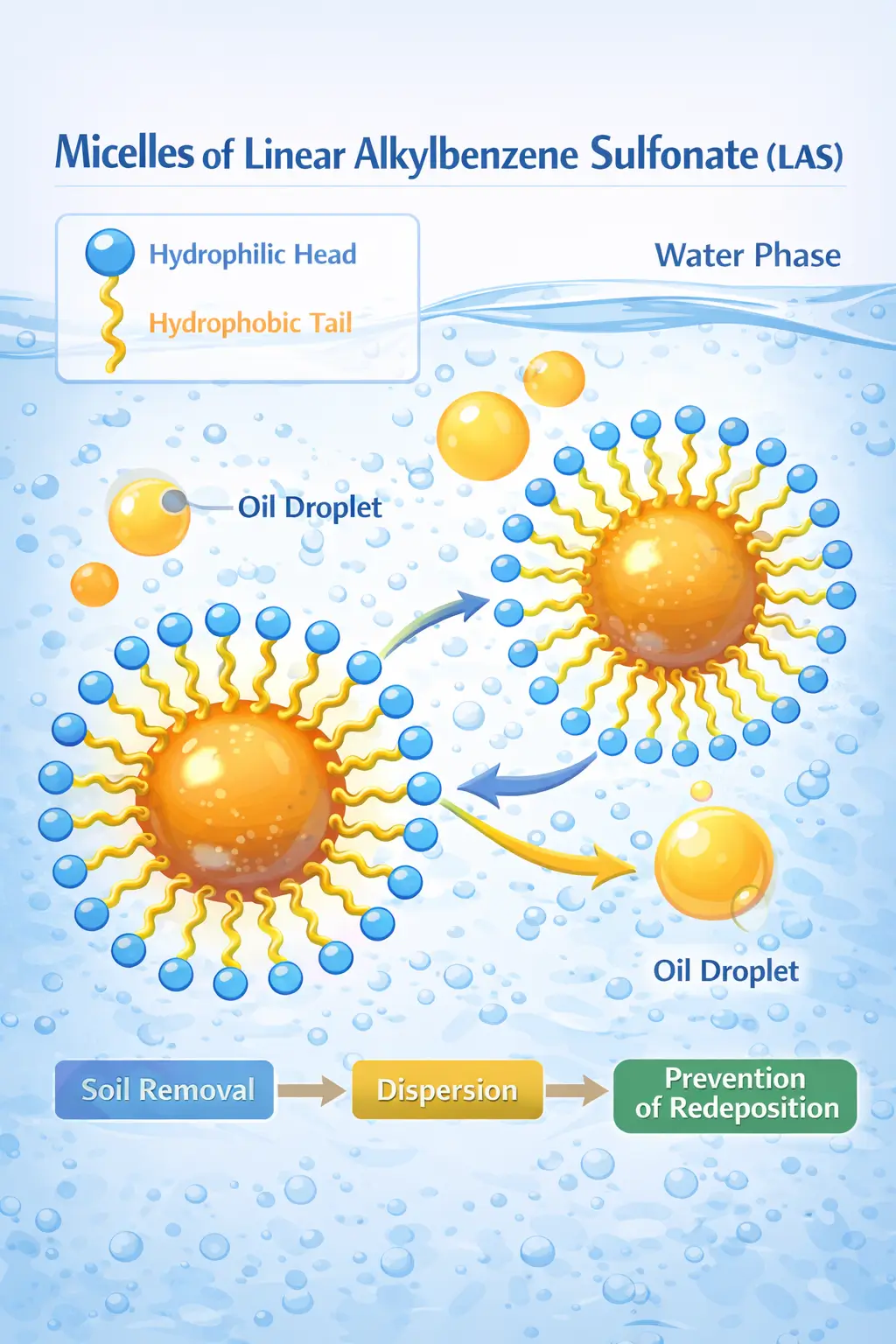
Within formulation systems, they function as the core soil-removal mechanism, forming micellar structures that detach and disperse hydrophobic contaminants during washing processes.
This page is part of the CleanFormulation Ingredient Library, a research-driven project focused on understanding how ingredients behave inside real cleansing formulations rather than evaluating them in isolation.
Quick Facts
| Property | Description |
|---|---|
| Ingredient Type | Anionic surfactant |
| Chemical Class | Alkylbenzene sulfonate salt |
| Common Abbreviation | LAS |
| Functional Role | Primary detergent surfactant for soil removal and emulsification |
| Molecular Structure | Linear alkyl chain attached to benzene ring with sulfonate group |
| Ionic Nature | Anionic (negatively charged in aqueous systems) |
| Hydrophilic Group | Sulfonate (-SO₃⁻) |
| Hydrophobic Group | Linear alkyl chain (typically C10–C14) |
| Solubility | Highly soluble in water as sodium salt |
| Foaming Behavior | High foam generation with stable foam structure |
| Cleaning Mechanism | Reduces surface tension and forms micelles to solubilize oils and soils |
| Typical Use Context | Laundry detergents, dishwashing liquids, cleaning products |
| Performance in Hard Water | Moderate tolerance; often combined with builders for improved efficiency |
| pH Behavior | Stable across alkaline detergent systems |
| Interaction with Builders | Works synergistically with builders to improve cleaning efficiency |
| Compatibility | Compatible with most anionic and nonionic surfactants |
| Phase Behavior | Forms micellar structures in aqueous systems |
| Biodegradability | Readily biodegradable under aerobic conditions |
| Formulation Forms | Powders, liquids, pastes, and concentrated surfactant blends |
| System Role | Primary active component driving detergent cleaning performance |
Why This Ingredient Appears on Labels
Linear Alkylbenzene Sulfonates appear in ingredient disclosures because they act as the primary cleaning engine in many detergent formulations, particularly those designed for fabric washing and high-load soil removal.
On labels, they are typically listed under their INCI-compliant naming structure or as sodium salts, reflecting their water-soluble form used in formulation systems. Their presence signals that the product relies on a synthetic surfactant mechanism rather than traditional soap-based chemistry.
For readers learning how ingredient lists are structured, the placement of such surfactants often aligns with their concentration and functional dominance, as explained in the ingredient list interpretation guide.
In practical terms, their inclusion correlates with strong foaming and effective soil dispersion, which becomes observable during washing as faster grease breakdown and more consistent rinse behavior compared to fatty-acid-based systems.
Chemical Identity and Classification
Linear Alkylbenzene Sulfonates are a family of synthetic surfactants characterized by a linear alkyl chain attached to a benzene ring, followed by sulfonation to introduce a strongly polar sulfonate group.
The most common commercial form is the sodium salt, typically referred to as sodium linear alkylbenzene sulfonate. This ionic form ensures water solubility and enables interaction with charged species present in aqueous cleaning systems.
From a classification perspective, they belong to the broader group of anionic surfactants, meaning the hydrophilic head carries a negative charge during use.
Structurally, the molecule combines two distinct domains:
- Hydrophobic tail: linear alkyl chain that associates with oils and grease
- Hydrophilic head: sulfonate group that remains soluble in water
This dual structure is what enables micelle formation, a key mechanism shared across surfactant systems such as sodium lauryl sulfate, although structural differences lead to distinct performance behavior.
In formulation terms, this architecture allows LAS to function effectively across a wide range of soil types, particularly hydrophobic contaminants encountered in laundry and dishwashing environments.
Functional Role in Detergent Systems
Within detergent formulations, Linear Alkylbenzene Sulfonates act as the primary driver of soil removal by reducing surface tension and enabling the detachment of oily residues from surfaces.
When introduced into water, these molecules organize into micellar structures where hydrophobic tails orient inward and hydrophilic heads face outward, creating a dynamic interface between water and non-polar substances.
This behavior translates into three observable system effects:
- Soil lifting: detachment of grease from fabric or surfaces
- Emulsification: stabilization of dispersed oil droplets
- Suspension: prevention of redeposition during rinse cycles
Compared to traditional soap systems based on fatty acid salts, such as those formed using saponification reactions, LAS maintains consistent performance in varying water conditions, particularly where mineral content would otherwise interfere with soap efficiency.
In real-world usage, this translates into more stable foam, reduced residue formation, and improved cleaning consistency across different wash environments.
Ingredient Interaction Logic
The behavior of Linear Alkylbenzene Sulfonates cannot be understood in isolation, as their performance is strongly influenced by surrounding formulation components.
Interaction with Water Phase
In aqueous systems, LAS molecules dissociate into their ionic form, allowing rapid dispersion and micelle formation. The efficiency of this process depends on concentration and ionic strength of the solution.
As concentration increases beyond the critical micelle concentration threshold, structured aggregates form, which directly impacts cleaning performance and foaming characteristics.
Interaction with Builders and Alkaline Systems
Detergent formulations often include alkaline builders such as carbonates or phosphates that enhance cleaning efficiency by modifying pH and water hardness behavior.
In this environment, LAS remains functionally stable and continues to operate without forming insoluble salts, unlike traditional soap systems which may react with calcium and magnesium ions.
This compatibility is a key reason synthetic surfactants dominate modern detergent formulation systems, where predictable performance across variable water conditions is required.
Interaction with Chelating Agents
Chelators such as phosphonates or EDTA derivatives are often introduced to bind metal ions. This indirectly supports LAS performance by preventing interference from hardness minerals.
The interaction is not direct binding with LAS, but rather environmental stabilization of the system in which it operates.
Interaction with Fragrance Systems
Fragrance compounds are typically hydrophobic and rely on surfactant micelles for dispersion. LAS contributes to this solubilization process by incorporating fragrance molecules into micellar cores.
This interaction aligns with broader fragrance system behavior, where surfactant structure influences volatility and release patterns during use.
Interaction with Co-Surfactants
LAS is often combined with amphoteric or nonionic surfactants to adjust foam profile, reduce harshness of interaction, and improve rinse behavior.
These blended systems demonstrate that formulation outcomes are rarely driven by a single ingredient, but rather by the balance between multiple surface-active agents.
Phase Behavior and Physical Characteristics
The performance of Linear Alkylbenzene Sulfonates is closely tied to their behavior in aqueous environments, particularly their ability to transition between dispersed molecular states and structured micellar systems.
At low concentrations, LAS exists primarily as individual molecules dispersed in water. As concentration increases beyond the critical micelle threshold, organized aggregates begin to form, enabling effective solubilization of hydrophobic materials.
This transition is not merely theoretical. It directly influences how a detergent behaves during use, especially in terms of foam stability, soil capture, and rinse efficiency.
Solubility and Ionic Behavior
As a sodium salt, LAS demonstrates high water solubility, allowing rapid dispersion even in cold water systems. This contributes to its widespread use in laundry formulations where temperature conditions vary significantly.
Its anionic nature also means that electrostatic interactions influence aggregation behavior, particularly in the presence of electrolytes such as salts or builders.
Foam Structure and Stability
LAS generates relatively strong and persistent foam compared to some nonionic systems. However, foam is not a direct indicator of cleaning performance, but rather a side effect of surface activity.
In practical observation, this translates into visible lather during washing, even though the actual soil removal process is occurring at the microscopic interface level.
Temperature and pH Stability
LAS remains stable across a wide pH range typically encountered in detergent systems, particularly alkaline environments. This stability allows it to function alongside builders without structural degradation.
Temperature variation has limited impact on its fundamental structure, though solubility and micelle dynamics may shift slightly with changing thermal conditions.
In applied terms, this means consistent performance across cold and warm wash cycles without significant loss of cleaning efficiency.
Comparison With Related Surfactants
To understand the role of Linear Alkylbenzene Sulfonates more clearly, it is useful to compare them with both traditional soap systems and other synthetic surfactants.
| Feature | LAS | SLS | Soap (Fatty Acid Salts) |
|---|---|---|---|
| Chemical Type | Synthetic anionic surfactant | Synthetic anionic surfactant | Natural-derived soap salt |
| Water Hardness Sensitivity | Low | Low | High |
| Foam Behavior | Strong, stable | High, fast forming | Variable, often suppressed in hard water |
| Residue Formation | Low | Low | Higher due to insoluble salts |
| Typical Use | Laundry, dishwashing | Personal care, cleaners | Bar soaps, traditional systems |
This comparison highlights why LAS remains dominant in laundry systems, while surfactants like sodium lauryl sulfate are more commonly used in personal cleansing formats.
Regulatory Context
Linear Alkylbenzene Sulfonates are regulated under general chemical and detergent frameworks rather than being treated as specialized active substances.
In the European Union, their use in cleaning products falls under detergent regulations and broader chemical safety frameworks, where biodegradability and environmental behavior are key evaluation criteria.
When used in personal cleansing systems classified under cosmetic regulation, they must comply with ingredient disclosure rules using standardized naming conventions.
Their presence on labels follows INCI naming principles, which are further explained in the ingredient list interpretation guide, where ingredient order reflects concentration hierarchy.
Importantly, regulatory frameworks evaluate ingredients based on intended use and exposure context, not merely on their chemical classification.
Common Misunderstanding
A frequent misconception is that Linear Alkylbenzene Sulfonates are simply interchangeable with traditional soap because both produce foam and remove dirt.
In reality, they belong to entirely different chemical systems. Soap is formed through the reaction of fats with alkali, while LAS is a synthetically produced surfactant designed for controlled and consistent performance.
Another related misunderstanding is the assumption that “synthetic” automatically implies a fundamentally different cleaning mechanism. In practice, both systems rely on surface activity, but differ significantly in how they interact with minerals, pH, and formulation environments.
These distinctions become clearer when comparing cleansing versus antimicrobial claims, as discussed in the cleansing mechanism explanation.
Structural and Formulation Limitations
Despite its widespread use, Linear Alkylbenzene Sulfonates are not without formulation constraints.
- Foam persistence: high foam generation can become undesirable in systems requiring low-sudsing behavior, such as high-efficiency washing machines.
- Electrolyte sensitivity: while stable in many conditions, excessive ionic strength can alter micelle structure and affect performance balance.
- Formulation dependency: performance is strongly influenced by supporting ingredients such as builders and co-surfactants, meaning LAS alone does not define system behavior.
- Surface interaction profile: strong detergency may require balancing agents in formulations intended for controlled or mild cleaning environments.
These limitations reinforce the importance of formulation design, where ingredient balance determines final system performance rather than any single component.
Formulation References Using This Ingredient
Summary of Findings
- Classification: Linear Alkylbenzene Sulfonates are synthetic anionic surfactants used as primary cleansing agents.
- Functional Role: They enable soil removal through micelle formation, emulsification, and suspension mechanisms.
- Interaction Logic: Their performance depends on water chemistry, builders, chelators, and co-surfactants.
- System Behavior: They maintain effectiveness in hard water conditions where traditional soap systems may struggle.
- Limitations: Foam control and formulation balance are key constraints influencing final product behavior.