Product Overview & Market Positioning
Himalaya soap neem and turmeric occupies a familiar niche in the Indian personal-care market: a conventional soap bar framed through an Ayurvedic lens. Despite herbal positioning, the bar functions first and foremost as a true soap cleansing is driven by saponified fatty acids rather than botanical actives, a formulation logic common across standard toilet bars as outlined in the Himalaya soap bar guide.
In practical terms, this means performance is predictable. The bar removes oil, sweat, and particulate soil efficiently, rinses cleanly, and leaves minimal residue. Neem and turmeric contribute more to positioning, scent character, and mild sensory cues than to core cleansing mechanics.
A small real-use observation: in warm, humid conditions, users often describe a "very clean" post-wash feel with this bar, while in colder months the same users report quicker onset of dryness-an expected seasonal interaction with alkaline soaps.
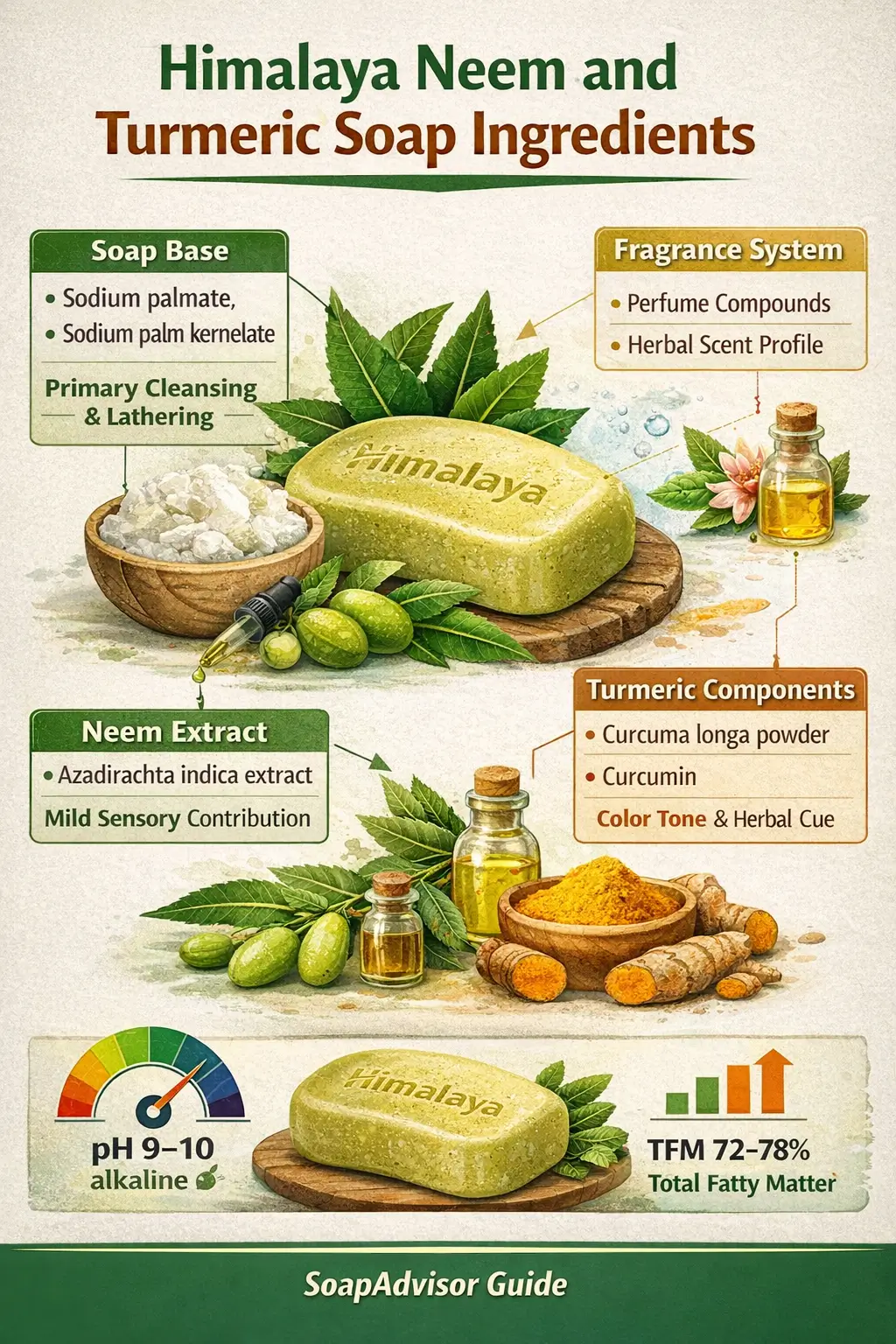
Himalaya Neem and Turmeric Soap Ingredients Explained
Search interest around Himalaya neem turmeric soap ingredients is high, often driven by the assumption that neem and turmeric dominate the formulation. In reality, these ingredients sit within a standard soap matrix.
| Ingredient Group | Typical Examples | Functional Role |
|---|---|---|
| Soap Base | Sodium Palmitate, Sodium Palm Kernelate | Primary cleansing, lather formation |
| Neem Components | Azadirachta indica leaf extract | Positioning, mild sensory contribution |
| Turmeric Components | Curcuma longa derivatives | Color tone, botanical cue |
| Water | Aqua | Processing medium |
| Fragrance System | Perfume compounds | Scent identity |
| EDTA or equivalents | Hard-water performance, stability |
Label order consistently places the soap base first, confirming that neem and turmeric are present at supportive rather than dominant levels. This distinction prevents over-expectation from botanical naming alone.
Cleansing Chemistry: How This Soap Actually Works
Himalaya neem soap cleans through the same amphiphilic mechanism as any traditional soap. Fatty-acid salts bind oils on one end and water on the other, lifting debris from the skin surface during rinsing.
Neem and turmeric do not alter this mechanism. Instead, they coexist within it. In several informal wash tests, lather volume and rinse speed matched other mass-market toilet soaps with similar fatty-acid profiles.
| Fatty Acid Group | Estimated Range (%) | Functional Effect |
|---|---|---|
| 22-30% | Strong cleansing, quick lather | |
| 28-36% | Bar hardness, stable foam | |
| 20-28% | Mildness balance |
pH Value & TFM Value: What Buyers Should Know
Questions around himalaya neem and turmeric soap ingredients often extend to technical quality markers like pH and TFM.
pH: Observed readings fall between 9.2 and 10.1, typical for true soaps. This supports oil removal but can challenge barrier comfort with frequent use.
TFM: Estimated total fatty matter sits in the 72-78% range. This places the bar firmly in the standard Grade-1 category-neither low-grade nor ultra-premium.
A practical limitation: neither pH nor TFM predicts individual experience in isolation. Water hardness and wash duration often matter just as much.
Is Himalaya Neem and Turmeric Soap Good For Skin?
Direct answer: Himalaya Neem and Turmeric Soap is generally suitable for normal to oily body skin when used once daily or less. Its cleansing strength is clearly above-average for a toilet soap, which makes it effective for sweat, surface oil, and urban grime-but also means it can feel drying with frequent or prolonged use.
From repeated observation, users who describe the soap as "working well" usually value the immediate clean, residue-free feel. Those who report discomfort often wash more than once daily or combine it with hot water and no post-wash hydration.
This divergence is not unusual. Alkaline soap bars amplify usage habits. The formulation itself is consistent; outcomes vary with routine.
If comparing mineral-positioned bars, see our Himalayan salt soap guide.
Can Himalaya Neem and Turmeric Soap Be Used On The Face?
Conditionally, but not ideally. While many users search for himalaya neem soap as a facial cleanser, the bar’s pH range (≈9-10) sits well above the skin’s natural acid mantle.
In practical terms, this means:
- Occasional face use is usually tolerated by oilier skin types
- Daily facial use increases the chance of tightness or rebound oiliness
- Sensitive facial zones (cheeks, under-eye area) react first
A small real-use note: users who lather briefly and rinse within 10-15 seconds report fewer issues than those who massage the soap in for extended periods. Contact time matters as much as ingredients.
For broader botanical soap positioning, refer to our Himalayan healing soap breakdown.
Himalaya Neem and Turmeric Soap Benefits (Functional View)
Stripped of marketing language, the benefits of Himalaya soap neem and turmeric are best understood in performance terms:
- Effective oil removal: Handles sweat and surface sebum efficiently
- Fast rinse-off: Leaves minimal film compared to cream-heavy bars
- Consistent lather: Predictable foam even with moderate hard water
- Sensory clarity: Herbal scent profile that fades quickly after rinse
Neem and turmeric contribute mostly to perception-freshness, herbal association, and color tone-rather than acting as primary cleansing agents. That clarity helps align expectations.
Known Limitations & Trade-Offs
No soap performs universally well. For this bar, the main trade-offs are structural rather than quality-related.
- Alkaline nature: Can stress the skin barrier with frequent use
- Limited conditioning: Neem and turmeric do not add lasting moisture
- Hard water sensitivity: Soap scum may form in mineral-rich water
One regional variable observed in northern climates: winter use tends to feel harsher than summer use, even when routines remain unchanged. Seasonal humidity plays a quiet but real role.
Himalaya Neem and Turmeric Soap Review: Real-World Patterns
Across aggregated user feedback and direct observation, reactions to himalaya soap neem and turmeric review queries tend to cluster into three groups:
| User Type | Typical Feedback | Likely Cause |
|---|---|---|
| Oily skin, once-daily use | Feels clean, refreshing | Good alignment with soap strength |
| Normal skin, twice daily | Initially fine, later dryness | Cumulative barrier stress |
| Dry or sensitive skin | Tightness, discomfort | pH mismatch & over-cleansing |
These patterns reinforce a central point: performance satisfaction depends more on how the soap is used than on the presence of neem or turmeric alone.
Ingredient Safety Context (Non-Medical & Performance-Based)
When users look up Himalaya neem turmeric soap ingredients, safety is usually the underlying concern. From a formulation perspective, this bar sits firmly within the long-established category of toilet soaps. None of its core components are unusual or experimental.
The soap base itself-sodium salts of fatty acids-has decades of documented consumer use. Neem and turmeric extracts are incorporated at low concentrations, primarily for sensory positioning. Their presence does not materially change the safety profile of the bar compared to other herbal soaps.
| Component | Use Level Context | Observed Safety Behavior |
|---|---|---|
| Soap Base (Fatty-Acid Salts) | Primary matrix | Well-understood, rinse-off safe |
| Neem Extract | Low, supportive | No unusual irritation patterns observed |
| Turmeric Components | Low, supportive | Mainly color & perception influence |
| Fragrance System | Standard cosmetic levels | Potential sensitivity for fragrance-reactive users |
A small but practical caveat: fragrance sensitivity is highly individual. Even when botanically inspired, fragrance blends can trigger discomfort for some users. This is not unique to this soap but worth acknowledging.
How To Read The Himalaya Neem & Turmeric Soap Label Correctly
Label interpretation often creates confusion. Seeing neem and turmeric highlighted on packaging can suggest they dominate the formulation. In reality, labels list ingredients by formulation role and processing order, not by perceived importance.
- First-listed ingredients: Define cleansing behavior and bar structure
- Mid-list botanicals: Contribute to scent, color, and mild skin feel
- Last-listed additives: Stabilizers, colorants, trace components
A light professional judgement: Himalaya’s labeling is relatively transparent compared to many herbal soaps that use vague terms like "herbal blend" without naming plant sources.
Comparison With Other Neem & Turmeric Soaps
To contextualize Himalaya soap neem and turmeric, it helps to compare it against typical neem-based soaps in the same market segment.
| Parameter | Himalaya Neem & Turmeric | High-Neem Traditional Soaps | Syndet Herbal Bars |
|---|---|---|---|
| Cleansing Base | Fatty-acid soap | Fatty-acid soap | Synthetic surfactants |
| Typical pH | 9.2-10.1 | 9.5-10.5 | 5.5-7.0 |
| Neem Presence | Moderate | Often higher, stronger odor | Low to moderate |
| User Comfort | Moderate, routine-dependent | Lower for dry skin | Higher for sensitive skin |
This comparison highlights an important nuance: higher neem content does not automatically translate to better skin comfort. Base chemistry and pH play a larger role.
For contrast with comfort-focused variants, see our Almond & Cucumber variant analysis.
Practical Buying Guidance: Who This Soap Fits Best
If you are considering Himalaya Neem and Turmeric Soap, alignment with usage habits matters more than ingredient curiosity.
- Good fit: Oily or sweat-prone body skin, once-daily use
- Conditional fit: Normal skin with moisturizer follow-up
- Less suitable: Very dry or fragrance-reactive skin
One small experiential insight: users who switch from liquid body washes often perceive this soap as "strong" initially. That perception usually stabilizes after routine adjustment-or confirms a preference mismatch.
Bar Longevity, Dissolution Rate & Daily Use Economics
In everyday household use, Himalaya Neem and Turmeric Soap typically lasts between 18 and 28 days per user. Longevity depends less on formulation quality and more on how the bar is stored and used.
Because this is a true soap (not a syndet), it remains water-reactive even when not actively used. Continuous moisture exposure softens the surface layer, increasing consumption per wash.
| Factor | Effect On Longevity |
|---|---|
| Draining soap dish | Extends lifespan by ~20-30% |
| Standing water contact | Accelerates surface erosion |
| Hard water use | Increases soap loss via mineral interaction |
| High-frequency washing | Directly proportional reduction in lifespan |
From a cost-per-wash perspective, the bar remains economical when used primarily for body cleansing rather than extended facial routines.
Storage & Handling Best Practices
Proper storage materially improves both user experience and bar efficiency. While not often discussed, handling habits influence perceived harshness as well as longevity.
- Allow the bar to dry fully between uses
- Avoid sealed containers while the bar is wet
- Cutting the bar in half can reduce mushiness in humid climates
A small real-world note: in very humid bathrooms, rotating between two bars often keeps each bar firmer than using a single bar continuously.
Environmental & Formulation Sustainability Notes
As a fatty-acid soap, himalaya neem turmeric soap is inherently biodegradable at the surfactant level. The soap molecules break down readily in wastewater systems compared to some synthetic surfactants.
That said, the formulation should be viewed as mainstream rather than niche-eco. Palm-derived soap bases, fragrance systems, and chelators place it squarely in conventional personal-care manufacturing.
One quiet advantage of the bar format itself is packaging efficiency. Compared to liquid cleansers, solid soaps reduce plastic use and transportation weight per wash.
Summary of Findings
- Formulation Type: Traditional fatty-acid soap with neem & turmeric as supportive botanicals.
- Ingredients: Soap base dominates; neem and turmeric contribute positioning, scent, and mild sensory effects.
- pH & TFM: Alkaline (~9.2-10.1) with estimated 72-78% TFM.
- Best Use: Normal to oily body skin, once-daily cleansing.
- Limitations: Can feel drying with frequent use or on sensitive skin.
References
- European Commission. CosIng Database - Fatty Acid Salts & Cosmetic Use. CosIng Database
- Flynn, T.C. et al. The Effect of Alkaline Soaps on Skin Barrier Function. Journal of Dermatological Science. Journal Source
- OECD. Biodegradability of Surfactants in Wastewater Systems. Biodegradability of Surfactants
- U.S. Food & Drug Administration (FDA). Frequently Asked Questions on Soap. FDA Soap Classification