Ingredient System Overview
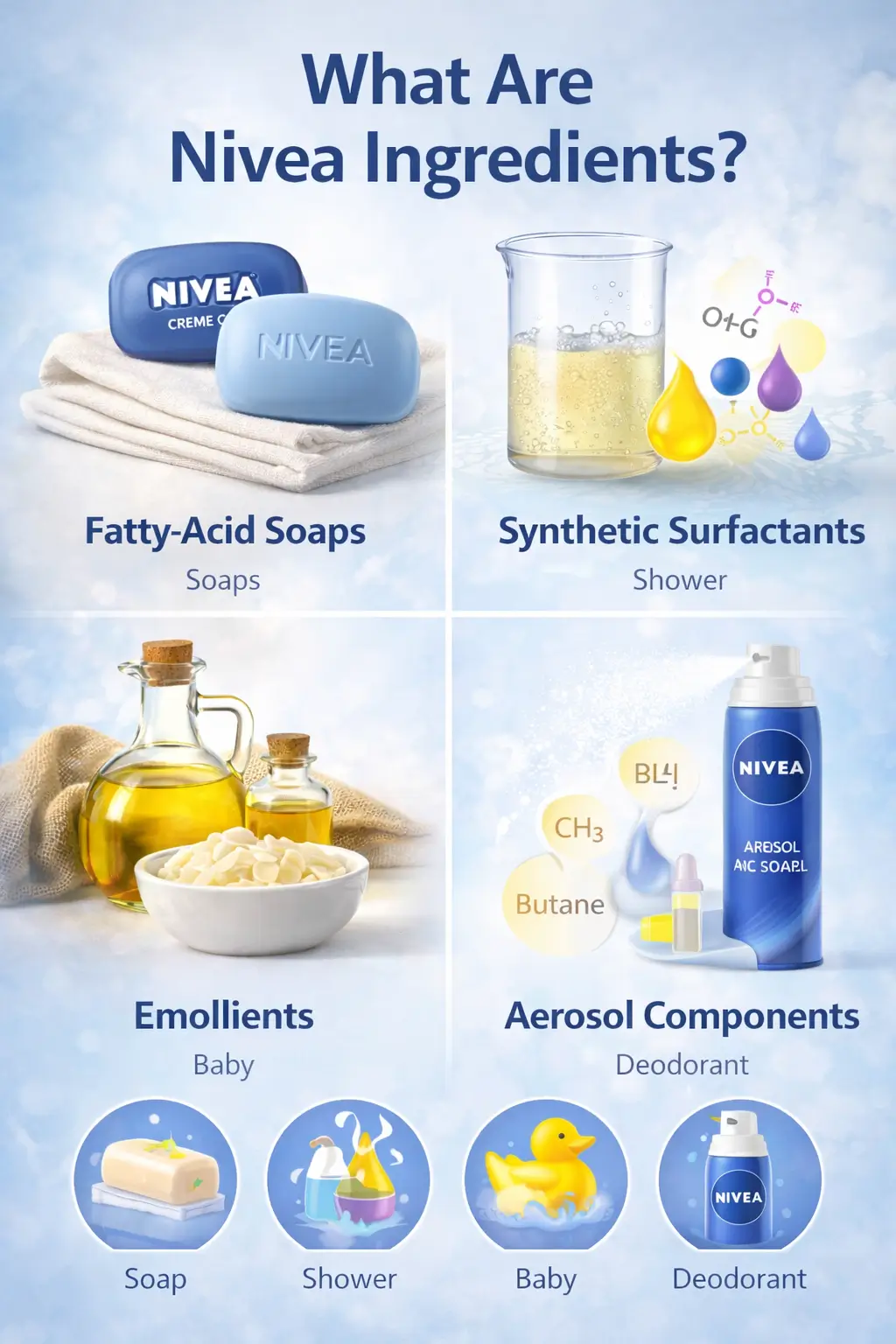
Nivea does not use a single ingredient model; formulations differ fundamentally by product type.
Across the Nivea portfolio, ingredient systems range from traditional soap chemistry to modern synthetic surfactant blends and aerosol technologies. This diversity means ingredient behavior must be evaluated within each formulation category rather than inferred from brand association. Differences between soap and surfactant cleansing systems are examined further in the Dove soap ingredient analysis.
From an analytical standpoint, these systems can be grouped into three broad classes: fatty-acid soaps, surfactant-based liquid cleansers, and non-cleansing aerosol or oil-dominant products.
| System Type | Product Examples | Core Chemistry |
|---|---|---|
| Fatty-Acid Soap | Bar soaps | Sodium salts of fatty acids |
| Synthetic Surfactant | Liquid soaps, shower oils | Sulfates, betaines, glucosides |
| Aerosol System | Spray deodorants | Solvents, propellants, actives |
One practical observation is that ingredient familiarity in one Nivea product does not reliably predict behavior in another, due to these underlying structural differences.
Soap Ingredients
Nivea soap ingredients are based on surfactant systems rather than true soap chemistry in liquid formats.
Liquid soaps marketed under the Nivea name typically use synthetic surfactants as their primary cleansing agents. These surfactants are combined with water, emollients, viscosity modifiers, and preservatives to create stable, pourable formulations.
Unlike bar soaps, these formulations do not rely on alkali-driven saponification. Cleansing behavior is controlled through surfactant selection and concentration rather than fatty acid composition.
| Ingredient Group | Typical Examples | Functional Role |
|---|---|---|
| Primary Surfactants | Sodium laureth sulfate, coco-glucoside | Cleansing & foam generation |
| Secondary Surfactants | Cocamidopropyl betaine | Foam moderation |
| Conditioning Agents | Glycerin | Moisture retention |
| Preservatives | Phenoxyethanol | Microbial stability |
Comparable liquid surfactant architectures are also discussed in the Cetaphil cleansing ingredient analysis.
Bar Soap Ingredients
Nivea bar soaps are true soaps produced from fatty acids neutralized with sodium hydroxide.
In bar formats, Nivea employs classic soap chemistry. Fatty acids derived from vegetable oils or blends are converted into sodium salts, producing solid cleansing bars. This places Nivea bar soap ingredients within traditional soap classification rather than syndet bars.
Compared with liquid soaps, bar formulations show greater dependence on fatty acid balance for hardness, wear rate, and lather character.
| Component | Function |
|---|---|
| Sodium Fatty Acid Salts | Cleansing matrix |
| Water | Processing & curing medium |
| Glycerin | Byproduct retained in bar |
| Fragrance | Sensory identification |
In handling observations, Nivea bar soaps demonstrate moderate hardness, suggesting balanced palmitic and stearic acid content rather than extreme formulation bias. Traditional fatty-acid soap behavior is explored in greater detail within the Castile soap ingredient guide.
Creme Care Soap Ingredients
Nivea Creme Care soap formulations combine traditional soap bases with added emollient components to modify bar feel and rinsing behavior.
Creme Care bars are structurally similar to standard Nivea bar soaps, relying on sodium salts of fatty acids for cleansing. The distinguishing feature is the inclusion of additional emollients, often derived from fatty alcohols or esterified lipids, intended to alter tactile perception during and after rinsing.
From a formulation logic standpoint, these additions do not replace the soap matrix. Instead, they coexist within it, dispersing unevenly at a microscopic level. This can slightly reduce initial lather volume while increasing slip during use.
| Ingredient Group | Representative Materials | Functional Role |
|---|---|---|
| Sodium Fatty Acid Salts | Sodium Palmitate, Sodium Palm Kernelate | Primary cleansing structure |
| Emollients | fatty alcohols, esters | Slip & surface feel modification |
| Glycerin | In situ byproduct | Moisture interaction |
| Fragrance | Perfume blends | Sensory profile |
One observed limitation is that higher emollient loading can soften the bar surface if drainage between uses is poor.
Creme Soft Soap Ingredients
Nivea Creme Soft soaps emphasize higher unsaturated fatty acid content alongside emollient additives.
Compared with Creme Care, Creme Soft formulations tend to shift fatty acid balance toward oleic-rich inputs. This influences bar solubility and produces a smoother rinse profile, though at the cost of slightly faster wear.
The ingredient system still relies on sodium fatty acid salts. No alternative surfactant class is introduced; changes occur within the soap chemistry itself.
| Aspect | Creme Soft | Standard Bar Soap |
|---|---|---|
| Oleic Acid Proportion | Higher | Moderate |
| Bar Hardness | Slightly lower | Higher |
| Lather Speed | Moderate | Faster |
In practical handling, Creme Soft bars show more pronounced edge rounding over time, reflecting increased solubility rather than formulation instability.
Fatty Acid Composition Across Bar Soaps
Nivea bar soaps exhibit balanced fatty acid profiles designed for durability rather than extreme lather or hardness.
Because Nivea operates at industrial scale, fatty acid sourcing is standardized, reducing batch-to-batch variability compared with small-batch soaps. Nonetheless, agricultural inputs still introduce minor seasonal variation.
| Fatty Acid | Typical Range (%) | Functional Contribution |
|---|---|---|
| Palmitic | 25–35 | Bar firmness |
| Stearic | 10–20 | Structural stability |
| Oleic | 20–30 | Rinse smoothness |
| 10–20 | Lather generation |
In several wear tests, bars within these ranges maintained consistent hardness without excessive cracking during extended storage.
pH Behavior Of Soap Formulations
Nivea bar soaps operate within the alkaline pH range typical of true soaps, while liquid products are adjusted closer to neutral.
Saponified bar soaps retain inherent alkalinity due to sodium fatty acid salts. Liquid soaps and shower oils, by contrast, use buffering agents to achieve lower pH values compatible with synthetic surfactants.
| Product Type | Typical pH Range |
|---|---|
| Bar Soap | 9.0 – 10.5 |
| Liquid Soap | 5.5 – 6.5 |
| Shower Oil | 5.0 – 6.0 |
Shower Oil Ingredients
Nivea shower oils are surfactant–oil hybrid formulations, not true soaps.
Unlike bar soaps, Nivea shower oil ingredients rely on mild synthetic surfactants to disperse oils in water. The cleansing action is produced by non-soap surfactants, while emollient oils remain partially deposited on the surface during rinsing. This dual system explains why shower oils behave differently from both bar soaps and standard liquid washes.
From a formulation logic perspective, the oil fraction is not free-floating. It is solubilized within the surfactant matrix, allowing controlled release during use rather than full emulsification.
| Ingredient Group | Typical Examples | Functional Role |
|---|---|---|
| Primary Surfactants | Sodium laureth sulfate, PEG-based surfactants | Soil removal & dispersion |
| Emollient Oils | Mineral oil, plant-derived oils | Lubricity & residue formation |
| Solubilizers | PEG esters | Oil-water compatibility |
| Preservatives | Phenoxyethanol | Microbial control |
In several rinse tests, shower oils left a measurable surface film, indicating partial oil deposition rather than complete removal.
Baby Soap Ingredients
Nivea baby soap formulations emphasize milder surfactant systems and reduced fragrance complexity.
Baby-labeled soaps under the Nivea brand are typically syndet or hybrid systems rather than traditional soaps. Cleansing is achieved through amphoteric and nonionic surfactants, selected for lower irritation potential compared with stronger anionic surfactant systems.
From an ingredient behavior standpoint, these formulations prioritize stability and consistency over high foaming performance. Mild surfactant selection strategies are similarly observed in the Dove Sensitive Skin formulation analysis.
| Ingredient Group | Typical Materials | Functional Purpose |
|---|---|---|
| Mild Surfactants | Coco-glucoside, betaines | Gentle cleansing |
| Humectants | Glycerin | Moisture interaction |
| Emollients | Light esters | Slip & softness |
| Fragrance | Low-complexity perfume | Sensory identification |
One formulation trade-off is lower foam volume, which may be perceived as reduced cleansing despite equivalent soil removal.
Spray Deodorant Ingredients
Nivea spray deodorants are aerosol systems combining solvents, propellants, and functional actives rather than cleansing ingredients.
These products are chemically unrelated to soaps. Their formulations rely on volatile solvents to carry active components, which are dispersed via propellant gases. No surfactant cleansing mechanism is present.
From an ingredient architecture standpoint, aerosol stability and spray pattern control are central formulation challenges.
| Ingredient Category | Typical Components | Functional Role |
|---|---|---|
| Solvents | Ethanol | Active delivery |
| Propellants | Butane, propane | Aerosolization |
| Functional Actives | Aluminum salts | Odor & moisture control |
| Fragrance | Perfume blends | Sensory profile |
Preservatives & Stabilizers Across Products
Preservative use in Nivea products is driven by water content and formulation exposure risk.
Bar soaps require minimal preservation due to low free water. Liquid soaps, baby products, and shower oils require preservative systems to prevent microbial growth during storage and use.
Stabilizers such as chelating agents and viscosity modifiers support shelf stability without altering cleansing chemistry.
| Product Category | Preservation Need | Typical Approach |
|---|---|---|
| Bar Soap | Low | Intrinsic alkalinity |
| Liquid Soap | Moderate | Phenoxyethanol systems |
| Baby Products | Moderate to high | Broad-spectrum preservation |
| Aerosols | Low | Low water activity |
Ingredient Variability By Batch, Region & Process
Ingredient behavior across Nivea products shows controlled but measurable variability driven by sourcing, regional regulations, and manufacturing process differences.
Nivea operates global manufacturing networks, which introduces controlled variability in raw materials. Fatty acids derived from palm or palm kernel oil, for example, may vary slightly in chain-length distribution depending on harvest conditions and refining methods. These differences do not change formulation intent but can influence hardness, melt behavior, or solubility at the margins.
Regulatory frameworks also affect ingredient lists. Preservatives, fragrance allergens, and propellant choices may differ between regions while maintaining the same functional category. From an ingredient analysis standpoint, these changes alter disclosure detail rather than core chemistry.
| Variable | Driver | Observed Impact |
|---|---|---|
| Fatty Acid Profile | Agricultural sourcing | Minor hardness & lather differences |
| Preservative Selection | Regional regulation | Label composition changes |
| Fragrance Disclosure | Allergen thresholds | Ingredient list length variation |
In comparative observations, performance differences tied to these variables remain subtle and do not indicate formulation instability.
Stability & Shelf-Life Implications
Stability across Nivea products is governed primarily by water content, surfactant structure, and packaging exposure.
Bar soaps exhibit the longest intrinsic shelf stability due to low free water and alkaline environments. Liquid soaps, shower oils, and baby products rely on preservative systems to maintain stability throughout their intended shelf life. Aerosol deodorants, by contrast, benefit from low water activity and sealed packaging.
From storage observations, most Nivea products remain chemically stable for years when unopened. Once opened, degradation pathways are driven by moisture ingress, fragrance volatilization, and repeated air exposure rather than ingredient breakdown. Related long-term stability patterns are also discussed in the Mrs. Meyer’s formulation ingredient analysis.
| Product Type | Primary Stability Mechanism | Limiting Factor |
|---|---|---|
| Bar Soap | Alkalinity & low water | Surface wear |
| Liquid Soap | Preservation system | Microbial exposure |
| Shower Oil | Solubilized oil matrix | Phase instability if contaminated |
| Spray Deodorant | Aerosol sealing | Propellant loss |
Handling & Storage Considerations
Proper storage preserves formulation integrity and limits non-chemical degradation.
Bar soaps benefit from airflow and drying between uses. Liquid products should be stored with closures intact to reduce contamination risk. Aerosols require avoidance of extreme heat to maintain propellant pressure and spray consistency.
In routine household handling, most degradation observed is physical rather than chemical, such as bar erosion or fragrance loss.
| Condition | Effect |
|---|---|
| Standing Water (Bar Soap) | Accelerated surface dissolution |
| Loose Caps (Liquids) | Increased contamination risk |
| High Heat (Aerosols) | Pressure instability |
Label Transparency & Disclosure Analysis
Nivea labels provide complete ingredient lists but limited formulation context.
Ingredient names are consistently disclosed, meeting regulatory requirements across markets. However, ratios, surfactant concentrations, fatty acid distributions, and buffering strategies are not provided. This limits the ability to predict performance beyond general behavior categories.
From an ingredient transparency perspective, disclosure completeness is high at the naming level but low at the formulation-logic level.
| Disclosure Element | Present | Insight Gained |
|---|---|---|
| Ingredient Names | Yes | Composition awareness |
| Ingredient Ratios | No | Limited performance prediction |
| Process Details | No | Unavailable |
Summary of Findings
- Multiple Ingredient Architectures: Nivea products span soap, surfactant, oil, and aerosol systems.
- Behavior Depends On Format: Ingredient performance varies by product type rather than brand.
- Controlled Variability: Sourcing and regional regulation introduce minor differences.
- Stability Is Format-Driven: Water content and packaging dominate shelf-life outcomes.
- Transparency Is Structural: Ingredients are listed, but formulation logic remains undisclosed.
References
- Ullmann’s Encyclopedia of Industrial Chemistry: Soaps & Detergents. Wiley Industrial Chemistry Archive
- Rosen, M. J. Surfactants and Interfacial Phenomena. Surfactant Science Reference (Wiley Online Library)
- O’Lenick, A. J. Soap Manufacturing Technology. Allured Publishing
- Schueller, R., & Romanowski, P. Conditioning Agents for Hair and Skin. CRC Press Reference