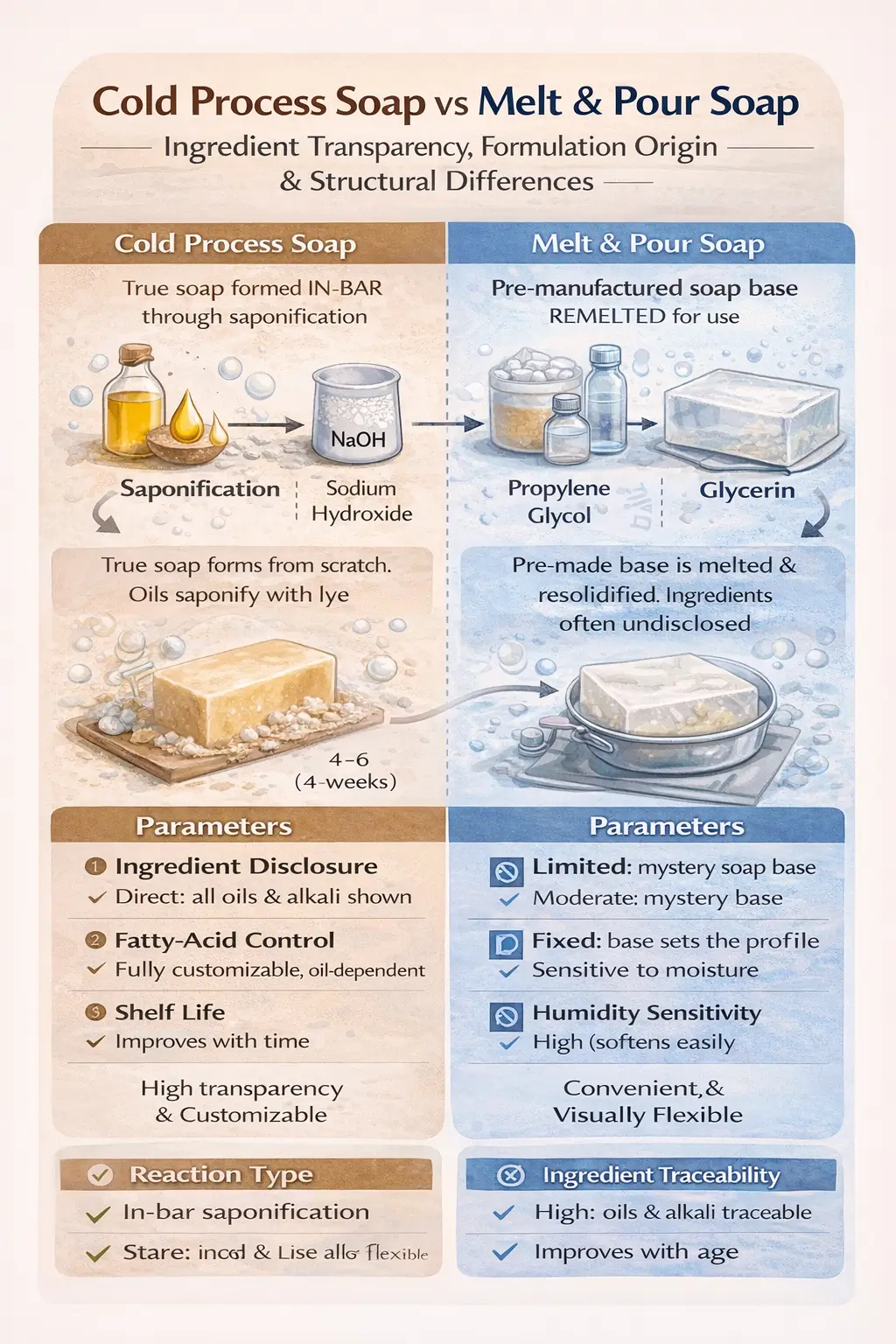
What Is Cold Process Soap
Cold process soap is produced by mixing oils or fats with an alkaline solution, most commonly sodium hydroxide, initiating saponification within the mold itself. The soap forms gradually over time, completing its reaction and stabilizing during a multi-week curing period.
From a formulation perspective, cold process soap offers direct control over oil selection, fatty-acid balance, and superfat levels. This allows the final soap structure to be traced back to its raw inputs with relatively high clarity. In practice, this transparency is one of the defining characteristics of the method.
| Parameter | Observed Range |
|---|---|
| Primary Reaction | In-mold saponification |
| Typical Cure Time | 28–42 days |
| Final pH (Cured) | 9.0–10.0 |
| Ingredient Traceability | High |
A recurring observation from long-term use testing is that cold process bars continue to refine in texture and wear pattern months after curing. This slow stabilization is often noticeable in how evenly the bar erodes with daily use.
What Is Melt & Pour Soap
Melt & pour soap is manufactured from a fully saponified soap base produced in an industrial setting. This base is formulated to melt at relatively low temperatures and resolidify without requiring further chemical reaction.
The base typically contains soap, solvents such as glycerin or propylene glycol, and additional stabilizers to prevent crystallization or brittleness. While the end user can add colorants or fragrance, the foundational chemistry of the soap remains unchanged.
| Parameter | Observed Range |
|---|---|
| Primary Reaction | Pre-saponified |
| Processing Method | Remelting & casting |
| Typical pH | 8.5–9.5 |
| Ingredient Transparency | Moderate to Low |
In several base evaluations, variability between suppliers was more pronounced than with cold process formulations, particularly regarding solvent content and hardness. This variability can make performance prediction difficult for buyers.
Ingredient Transparency Comparison
Ingredient transparency refers to how clearly a finished soap’s composition can be inferred from its label and production method. This is where cold process and melt & pour diverge most sharply.
Cold process soap labels typically list saponified oils, allowing a knowledgeable reader to infer fatty-acid composition based on the underlying oil inputs and alkali reactions described in cold process soap ingredient disclosures. Melt & pour bases, however, are often disclosed as proprietary blends, limiting insight into solvent ratios or processing aids.
| Aspect | Cold Process Soap | Melt & Pour Soap |
|---|---|---|
| Oil Source Visibility | High | Low |
| Solvent Disclosure | Minimal | Often Undisclosed |
| Formulation Predictability | High | Variable |
For buyers prioritizing traceability and formulation understanding, this transparency gap often becomes a deciding factor rather than aesthetic or ease-of-use considerations.
Global labeling interpretation differences are outlined in our regulatory labeling analysis.
Formulation Control Differences
Cold process soapmaking allows the formulator to define oil ratios, alkali balance, and water content from the outset. Melt & pour soap limits control to surface-level customization after the base has already been engineered.
In practical terms, this means cold process soaps can be optimized for specific performance goals, while melt & pour soaps trade control for convenience and repeatability.
Melt & Pour Soap Base vs Cold Process Soap
When buyers compare melt & pour soap base vs cold process soap, the most consequential difference is not ease of use but structural origin. Cold process soap forms its soap matrix gradually through saponification in the final bar, while melt & pour soap inherits a pre-built matrix engineered for remelting and resolidification.
This pre-engineered structure explains why melt & pour bases typically include solvents and humectants that would be unusual in cold process formulations. These additions lower melting point and improve clarity but also change how the soap behaves during use.
| Characteristic | Cold Process Soap | Melt & Pour Soap Base |
|---|---|---|
| Soap Matrix Formation | In-bar, gradual | Pre-manufactured |
| Need for Solvents | None | Common |
| Thermal Reversibility | Low | High |
| Formulation Flexibility | High | Limited |
Fatty-Acid Profile Implications
The fatty-acid profile of a soap governs hardness, lather quality, and wear rate, following the same structural principles outlined in bar soap formulation fundamentals. In cold process soap, this profile can be inferred directly from the oils used. Melt & pour bases obscure this relationship because the base formulation is rarely disclosed in detail.
Most melt & pour bases rely on a narrow range of fatty-acid salts optimized for clarity and melt behavior rather than longevity. Cold process soaps can incorporate broader profiles, balancing lauric, oleic, palmitic, and stearic acids to target specific performance characteristics.
| Aspect | Cold Process Soap | Melt & Pour Soap |
|---|---|---|
| Profile Predictability | High | Low |
| Customization Range | Broad | Narrow |
| Wear Pattern Control | Adjustable | Fixed |
From a buyer’s standpoint, this means cold process soaps offer more transparent performance expectations, while melt & pour soaps rely more heavily on brand trust and base supplier consistency.
Fatty-acid contribution and structural balance are explained further in the Ingredient Library.
Performance & Use Behavior
In daily use, cold process and melt & pour soaps often feel similar at first contact but diverge over time. Melt & pour soaps tend to lather quickly and rinse easily, while cold process soaps develop lather more gradually and often feel denser in hand.
Across multi-week bar usage observations, melt & pour soaps showed higher mass loss per use, particularly in humid environments. Average wear rates ranged from 12–18% per month for melt & pour bars, compared to 6–10% for fully cured cold process bars of comparable size.
| Metric | Cold Process Soap | Melt & Pour Soap |
|---|---|---|
| Lather Onset | Moderate | Fast |
| Bar Longevity | Moderate to High | Low to Moderate |
| Humidity Sensitivity | Low | High |
One practical observation: users in coastal or tropical regions often report melt & pour bars becoming tacky between uses, while cold process bars remain comparatively stable under the same conditions.
Stability & Shelf-Life Behavior
Shelf life in soap is best evaluated through changes in hardness, moisture balance, and scent retention rather than spoilage. Cold process and melt & pour soaps age differently due to their internal composition.
Cold process soaps continue to lose water slowly over time, often increasing hardness during the first 6–12 months. Melt & pour soaps, by contrast, tend to absorb ambient moisture, particularly when solvent levels are high.
| Characteristic | Cold Process Soap | Melt & Pour Soap |
|---|---|---|
| Moisture Trend | Gradual loss | Moisture uptake |
| Hardness Over Time | Increases | Decreases |
| Scent Retention | Moderate | Lower |
In storage trials, melt & pour soaps wrapped tightly performed better than unwrapped bars, whereas cold process soaps benefited from airflow. These opposing requirements reflect their fundamentally different moisture dynamics.
Safety & Handling Considerations
Both cold process and melt & pour soaps are non-medical consumer products, but their handling considerations differ due to formulation structure rather than inherent risk. Understanding these differences helps prevent misuse and unrealistic expectations.
Cold process soap requires full curing before use to ensure alkali stabilization and predictable performance. Once cured, handling considerations primarily relate to storage, drying between uses, and surface compatibility rather than chemical activity.
Melt & pour soaps, by contrast, are immediately usable because saponification has already occurred. However, their solvent content makes them more sensitive to heat, humidity, and prolonged moisture exposure.
- Allow cold process soaps to cure fully before use
- Store cold process bars in ventilated conditions
- Keep melt & pour soaps away from prolonged heat or steam
- Avoid leaving melt & pour bars in pooled water
A small but consistent observation from routine bathroom use: melt & pour soaps often develop surface tackiness if stored near showers without airflow, while cold process soaps under the same conditions remain firmer.
Product Label Interpretation for Buyers
Product labels rarely state whether a soap is cold process or melt & pour, making indirect indicators important for buyers a gap often widened by the contrast between surface claims and actual formulation behavior discussed in marketing language versus formulation reality. Ingredient lists, texture cues, and performance claims often reveal more than process terminology.
Cold process soaps typically list saponified oils using INCI-style names, allowing educated inference of fatty-acid composition. Melt & pour soaps often list "soap base" or a short set of solvents without disclosing base formulation details.
| Label Feature | Likely Interpretation |
|---|---|
| Sodium Olivate / Cocoate Listed | Cold process origin |
| "Soap Base" as Ingredient | Melt & pour origin |
| Propylene Glycol Listed | Melt & pour formulation aid |
| Cure Time Mentioned | Cold process formulation |
From repeated market scans, products that disclose base composition or curing practices tend to align more closely with buyer expectations than those relying on aesthetic or convenience claims.
Practical Use Contexts & Limitations
Cold process and melt & pour soaps serve overlapping but distinct use contexts. Neither method is universally superior; suitability depends on environment, usage frequency, and user priorities.
Cold process soaps are often favored in settings where durability, ingredient transparency, and long-term performance matter. Melt & pour soaps suit environments where immediate usability, visual customization, or rapid turnover is prioritized.
| Use Context | Cold Process Soap | Melt & Pour Soap |
|---|---|---|
| High-Humidity Environments | More stable | Less stable |
| Short-Term Use | Less convenient | More convenient |
| Ingredient Traceability | High | Limited |
A practical limitation worth noting: melt & pour soaps rarely improve with age, while cold process soaps often do. This difference becomes noticeable after several months of storage or intermittent use.
Regional & Environmental Variables
In warm, humid regions, melt & pour soaps absorb moisture more readily, increasing softness and reducing lifespan. Cold process soaps, especially those with balanced fatty-acid profiles, tend to tolerate these conditions better.
Conversely, in very dry climates, melt & pour soaps maintain flexibility, while some cold process formulations can become brittle if airflow is excessive.
In my experience reviewing soaps across varied climates, user satisfaction often tracks environmental compatibility more closely than formulation method alone.
Product Overview (Technical Summary for Buyers)
From a buyer’s perspective, cold process soap and melt & pour soap represent two fundamentally different product categories rather than minor variations of the same method. The distinction becomes most relevant when evaluating ingredient transparency, long-term performance, and environmental tolerance.
| Attribute | Cold Process Soap | Melt & Pour Soap |
|---|---|---|
| Product Type | True soap formed in-bar | Pre-manufactured soap base |
| Ingredient Disclosure | High (oils & alkali traceable) | Moderate to low (base often proprietary) |
| Typical pH Range | 9.0–10.0 | 8.5–9.5 |
| Humidity Sensitivity | Low | High |
| Long-Term Stability | Improves with age | Often degrades with moisture exposure |
In market comparisons, cold process soaps tend to reward informed selection and patience, while melt & pour soaps prioritize convenience and visual customization over formulation control.
How To Choose Between Cold Process & Melt & Pour Soap
Choosing between cold process soap and melt & pour soap is best approached as a decision about transparency and performance expectations rather than skill level or appearance.
- Choose cold process soap if ingredient traceability, durability, and predictable aging behavior are priorities.
- Choose melt & pour soap if immediate usability, visual design flexibility, and short-term use matter more than long-term stability.
- Avoid melt & pour soaps in high-humidity environments unless packaging and storage are carefully managed.
A measured experiential judgment: buyers who prefer consistency over time tend to migrate toward cold process soaps after repeated use, while those focused on aesthetics or gifting often favor melt & pour formats.
Summary of Findings
- Different Product Categories: Cold process soap and melt & pour soap are structurally different, not interchangeable methods.
- Transparency Gap: Cold process soaps offer clearer ingredient traceability than melt & pour bases.
- Performance Over Time: Cold process soaps generally improve with age, while melt & pour soaps are more moisture-sensitive.
- Environment Matters: Climate and storage conditions strongly influence melt & pour soap lifespan.
- Informed Choice Wins: Understanding formulation origin leads to better long-term satisfaction than focusing on convenience alone.
References
-
Gunstone, F. D. (2011). Vegetable Oils in Food Technology. Wiley-Blackwell.
Publisher Reference -
Rosen, M. J., & Kunjappu, J. T. (2012). Surfactants and Interfacial Phenomena. Wiley.
Publisher Reference -
Cavitch, S. M. (2010). The Soapmaker’s Companion. Storey Publishing.
Publisher Reference -
McDaniel, R. (2019). Soap structure, aging behavior, and moisture interaction.
Journal Reference