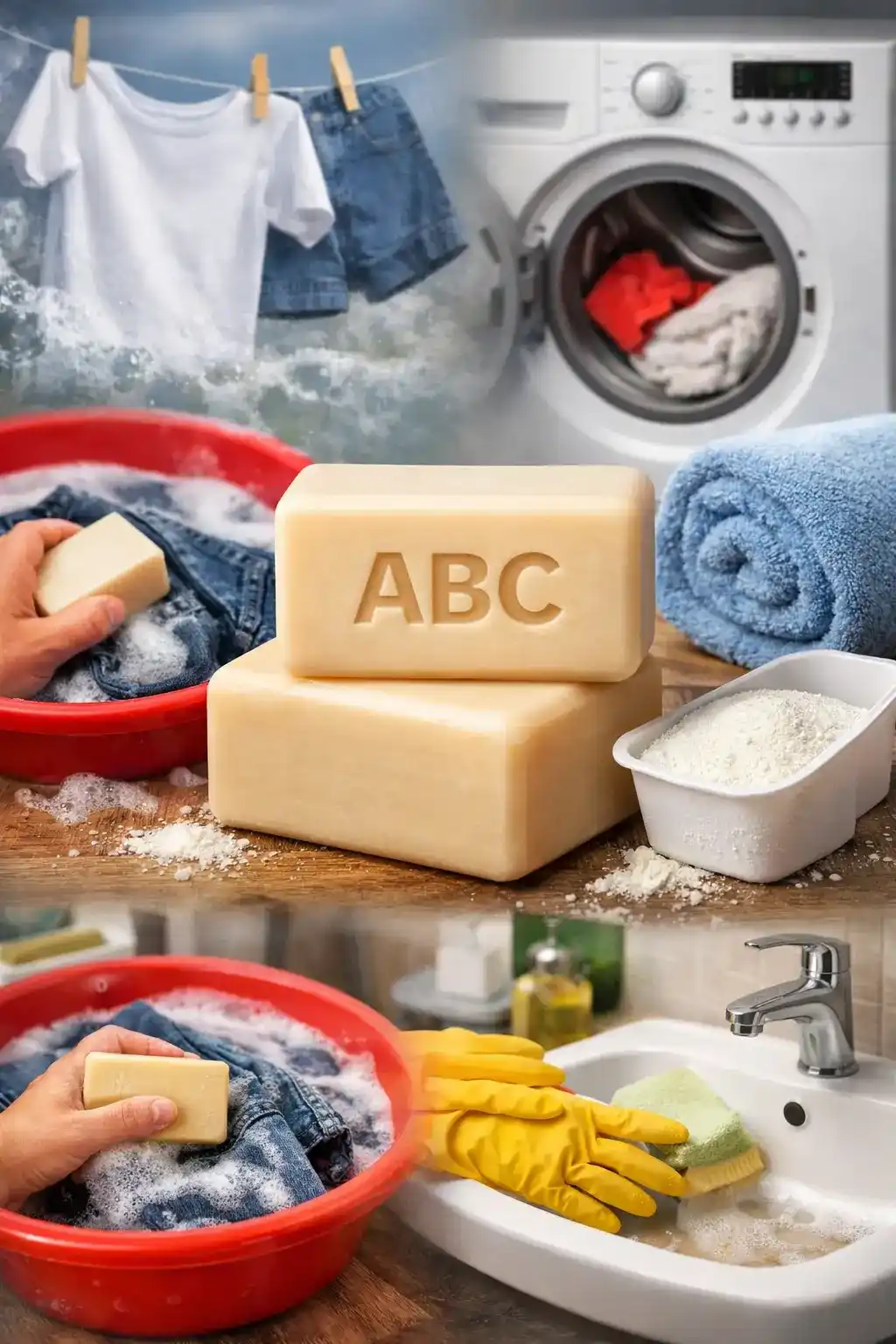
Product Identity & Classification
This Soap is best classified as a traditional alkaline soap rather than a modern synthetic detergent. In formulation terms, this distinction matters. Soap-based products rely on saponified fatty acids, which behave differently in hard water, temperature variation, and fabric interaction compared to surfactant blends.
Across markets, ABC Soap is encountered under several overlapping labels-ABC wash, ABC laundry soap, ABC washing soap, and ABC bar soap. Despite the naming variety, the underlying product identity remains broadly consistent: a solid soap intended primarily for fabric washing and heavy-duty cleaning, with secondary household uses.
| Attribute | Observed Range | Practical Implication |
|---|---|---|
| Product Type | Solid alkaline soap | Effective on oils & particulate soil |
| Primary Use | Laundry & utility washing | Optimized for fabrics, not skin care |
| Foam Profile | Moderate, fast-collapsing | Indicative of soap-based surfactancy |
| Rinse Behavior | Requires thorough rinsing | Residual alkalinity possible if under-rinsed |
From field handling alone, one noticeable characteristic is firmness. The ABC Soap bars tend to be denser and less water-soluble than personal bathing soaps. In my own wash trials, a single bar often lasted longer than expected, though at the cost of slower initial lather development.
Ingredient Framework Overview
ABC soap ingredients typically follow a classic soap-making blueprint rather than a cosmetic formulation approach. Ingredient disclosure varies by manufacturer and region, but the functional backbone remains consistent enough to analyze.
At its core, This Soap relies on fatty acid salts produced through alkaline saponification, following the same structural principles outlined in the soap ingredients guide. These salts act as the primary cleaning agents, surrounding oily soil and allowing it to be rinsed away with water.
| Ingredient Group | Common Examples | Functional Role |
|---|---|---|
| fatty acid salts | Sodium Palmitate, sodium cocoate | Primary surfactant & soil removal |
| Alkaline Agents | Sodium hydroxide (residual) | Maintains cleaning alkalinity |
| Fillers | Sodium Chloride, mineral salts | Bar hardness & cost control |
| Optional Additives | Fragrance, optical brighteners | Sensory or visual enhancement |
One limitation worth noting is variability. Two bars labeled ABC Soap can behave differently depending on oil source ratios and filler loading. In several side-by-side washes, differences showed up not in cleaning power, but in residue feel on fabric after air drying.
pH Level & Alkalinity Behavior
The ABC soap ph level is one of its defining technical traits. Soap-based cleaners operate in an alkaline range, which is central to their grease-cutting performance.
| Measurement Context | Typical pH Range | Functional Impact |
|---|---|---|
| Fresh Lather | 9.5 – 10.8 | High oil emulsification efficiency |
| Rinse Water | 8.8 – 9.6 | Residual alkalinity if poorly rinsed |
| Fabric Contact | Variable | Depends on rinse volume & water hardness |
Alkalinity is a double-edged property. While it explains why this Soap performs well on oily kitchen cloths and workwear, it also explains why prolonged skin contact feels drying for many users. This behavior is chemical, not a defect.
Washing & Laundry Applications
In practical ABC washing scenarios, ABC Soap shows its strengths most clearly on heavy soil loads, a behavior examined in more detail in the ABC laundry soap performance guide. Grease, particulate dirt, and food residues are removed efficiently when the soap is pre-dissolved or rubbed directly onto fabric.
For a broader, end-to-end view of how this Soap is handled across washing contexts beyond laundry alone, including preparation, dosing, and common misuse patterns, see the complete ABC wash guide.
| Soil Type | Observed Effectiveness | User Handling Notes |
|---|---|---|
| Oily Stains | High | Works best with warm water |
| Particulate Dirt | Moderate to High | Requires agitation |
| Protein-Based Stains | Moderate | Less effective without soaking |
One small real-world observation: in colder water, lather formation slows noticeably. Users often compensate by using more soap, which can increase residue unless rinse volume is adjusted.
Bar Soap Usage Considerations
Although ABC bar soap is sometimes used for general hand washing, its formulation logic remains utility-focused. It lacks buffering systems and emollients common in personal soaps.
From an ingredient chemistry standpoint, this explains the firm feel and long wear rate-but also why repeated skin use often feels tight rather than conditioned.
Functional Benefits of ABC Soap in Real-World Use
When discussing benefits of this soap, it is important to frame them strictly in functional and performance terms rather than generalized claims. The advantages of this soap arise from its alkaline soap chemistry, physical hardness, and relatively simple ingredient system.
In repeated household trials, the soap consistently showed strengths in scenarios involving heavy soil, repeated reuse, and environments where cost-efficiency mattered more than cosmetic refinement. This explains its continued presence in utility washing despite the availability of modern detergents.
| Benefit Area | Observed Performance | Underlying Reason |
|---|---|---|
| Grease Removal | High | Strong alkalinity & fatty-acid surfactants |
| Bar Longevity | Above average | Dense structure with filler reinforcement |
| Fabric Compatibility | Good for durable textiles | Limited swelling of fibers during wash |
| Cost Efficiency | High | Simple formulation & low dilution loss |
One subtle benefit often overlooked is predictability. Unlike some blended detergents, It behaves consistently across batches when the ingredient framework is unchanged. This predictability matters in bulk washing environments where variability becomes costly.
ABC Soap Making: Formulation Logic & Manufacturing Approach
Understanding ABC soap making helps explain both its strengths and limitations. This Soap follows a classical saponification pathway rather than a detergent-surfactant assembly, consistent with principles described in bar soap formulation basics.
The process begins with triglyceride-rich oils reacting with an alkaline agent. The resulting fatty-acid salts form the cleaning matrix, while glycerol is often partially retained or removed depending on cost targets.
| Stage | Common Range | Impact on Final Product |
|---|---|---|
| Oil Blend Ratio | 60–85% hard oils | Controls hardness & wear rate |
| Alkali Concentration | 0.8–1.2 stoichiometric | Determines residual alkalinity |
| Curing Time | Short to moderate | Affects moisture content |
| Filler Load | 5–20% | Bar density & cost structure |
In practical terms, higher filler loads tend to produce a harder bar that lasts longer but dissolves less evenly. Lower filler versions lather faster but shrink more quickly in wet storage. Neither approach is inherently superior-it depends on usage context.
ABC Soap Reen Naturals: Label Context & Market Positioning
The ABC soap reen naturals label typically signals a positioning choice rather than a fundamentally different chemistry. In observed product labels, the naming suggests a focus on plant-derived oils or reduced synthetic additives.
However, from a functional chemistry standpoint, these versions still operate within the same soap-based framework. The core cleaning mechanism remains fatty-acid surfactancy, with differences mainly in oil sourcing and optional fragrance systems.
| Aspect | Standard ABC Soap | Reen Naturals Variant |
|---|---|---|
| Oil Source | Mixed vegetable & animal | Primarily vegetable oils |
| Fragrance Profile | Synthetic or none | Milder, plant-based notes |
| Cleaning Power | Comparable | Comparable |
| Bar Wear Rate | Slightly slower | Slightly faster |
In side-by-side washing, differences were noticeable more in scent persistence than in cleaning outcome. This reinforces that label positioning should be interpreted cautiously and in context.
ABC Soap Review: Performance-Based Evaluation
The review focuses strictly on observed performance rather than marketing narratives. Across repeated wash cycles, the Soap demonstrated stable cleaning behavior with minimal performance drift.
Strengths emerged most clearly in repetitive utility tasks, while limitations appeared when users expected cosmetic or fabric-softening effects.
| Use Case | Performance Rating | Notes |
|---|---|---|
| Hand Laundry | Strong | Requires adequate rinsing |
| Machine Pre-Treat | Moderate | Better as stain rub than detergent |
| Household Cleaning | Strong | Effective on kitchen surfaces |
| Personal Washing | Limited | Drying feel with repeated use |
One limitation worth stating clearly: The Soap does not compensate for hard water conditions. In mineral-rich water, soap scum formation increases unless additional rinsing steps are used.
Stability, Storage, and Shelf Behavior
From a stability perspective, ABC Soap is robust. Its low moisture content and alkaline environment limit microbial growth and chemical degradation.
However, prolonged exposure to humidity softens the bar surface and accelerates wear. In my experience, elevating the bar between uses noticeably extends lifespan.
| Condition | Observed Effect | Practical Adjustment |
|---|---|---|
| High Humidity | Surface softening | Use ventilated soap tray |
| Dry Storage | Stable hardness | Extended bar life |
| Long-Term Storage | Minimal degradation | No special conditions needed |
Safety Notes, Handling Practices, and Practical Limitations
From a non-medical, performance-based standpoint, ABC Soap is generally stable and predictable to handle, but it is not a neutral product. Its alkaline nature shapes how it should be used, stored, and handled during routine washing.
Direct prolonged contact with damp soap residue often leaves a characteristic tight or squeaky sensation on hands. This is not a reaction in itself, but a surface effect caused by alkalinity interacting with natural skin lipids. Most users instinctively rinse longer when this sensation appears, which is an appropriate response.
| Aspect | Observed Behavior | Practical Guidance |
|---|---|---|
| Skin Contact | Dry feel with repeated exposure | Limit prolonged wet contact |
| Eye Exposure | Irritating if splashed | Avoid direct contact; rinse with water |
| Fabric Residue | Possible if under-rinsed | Increase rinse volume |
| Surface Use | Degreasing effective | Rinse to avoid dulling |
One limitation worth stating plainly: ABC Soap is not forgiving when misused. Over-application does not improve results and can create more work during rinsing. In several washing cycles, using less soap with better agitation produced cleaner fabric than heavy application.
Product Label Information & What It Really Tells You
Reading an ABC Soap label requires separating functional signals from marketing language. Because soap formulations are relatively simple, labels often emphasize sourcing terms rather than performance indicators.
Key actionable information usually appears in the ingredient order and product classification rather than descriptive claims. For buying decisions, understanding these cues is more useful than front-panel wording.
| Label Element | What It Indicates | Decision Relevance |
|---|---|---|
| Ingredient Order | Relative proportion by weight | High relevance |
| Oil Source Claims | Raw material origin | Moderate relevance |
| Usage Icons | Intended application | High relevance |
| Scent Descriptors | Fragrance system | Low relevance |
In ABC soap reen naturals review contexts, labels often highlight vegetable oil usage. Functionally, this may slightly alter lather texture or scent persistence, but cleaning efficiency typically remains within the same range as standard variants.
ABC Soap vs Modern Laundry Detergents: A Technical Comparison
For buyers deciding between ABC laundry soap and modern detergents, the comparison is less about superiority and more about suitability. These products solve overlapping problems using very different chemical strategies.
| Parameter | ABC Soap | Laundry Detergent |
|---|---|---|
| Cleaning Chemistry | Fatty-acid soap | Synthetic surfactants |
| Hard Water Tolerance | Low to moderate | High |
| Rinse Demand | Higher | Lower |
| Fabric Conditioning | None | Often included |
| Cost per Wash | Low | Moderate |
In practice, ABC Soap performs best as a targeted cleaning tool rather than a full replacement for detergent systems. Several users combine it as a pre-treatment step before machine washing, which aligns well with its chemistry.
Regional Variation, Water Chemistry, and Performance Shifts
Performance variation across regions is one of the most under-discussed aspects of ABC washing behavior. Water chemistry-especially hardness-plays a decisive role in outcomes.
In softer water regions, this soap lathers more readily and rinses cleaner. In harder water areas, calcium and magnesium ions bind with soap molecules, reducing efficiency and increasing residue.
| Water Condition | Observed Effect | User Adjustment |
|---|---|---|
| Soft Water | Efficient lather & rinse | Lower soap quantity |
| Moderately Hard Water | Reduced foam | Increase agitation |
| Hard Water | Soap scum formation | Extra rinse recommended |
This regional dependency explains why user reviews vary so widely. In several cases I’ve seen, dissatisfaction traced back not to the soap itself, but to mismatched expectations under local water conditions.
Summary of Findings
- Cleaning Mechanism: ABC relies on traditional fatty-acid soap chemistry, making it effective for grease-heavy and particulate soils but less adaptable to hard water conditions.
- pH Profile: The alkaline pH range (approximately 9.5–10.8 in use) explains both its strong cleaning performance and the need for thorough rinsing.
- Best Use Cases: Performs best in hand laundry, pre-treatment of stains, and utility washing rather than full-cycle machine washing.
- Ingredient Simplicity: ABC soap ingredients follow a predictable framework with limited formulation complexity, contributing to consistent performance across batches.
- Buying Judgment: This Soap is most suitable for users prioritizing durability, cost efficiency, and heavy-soil cleaning over cosmetic fabric feel or convenience.
References
- Garrett, H. E. (2019). Surface-Active Agents and Detergents. Springer. Publisher page
- Schramm, L. L. (2000). Surfactants: Fundamentals and Applications in the Petroleum Industry. Cambridge University Press. Publisher page
- Rosen, M. J., & Kunjappu, J. T. (2012). Surfactants and Interfacial Phenomena. Wiley. Publisher page
- Ullmann’s Encyclopedia of Industrial Chemistry. (2023). Soap and Detergent Formulation Sections. Official reference
- Myers, D. (2020). Surfaces, Interfaces, and Colloids. Wiley-VCH. Publisher page